

Sh2-122 – VdS Remote Hakos
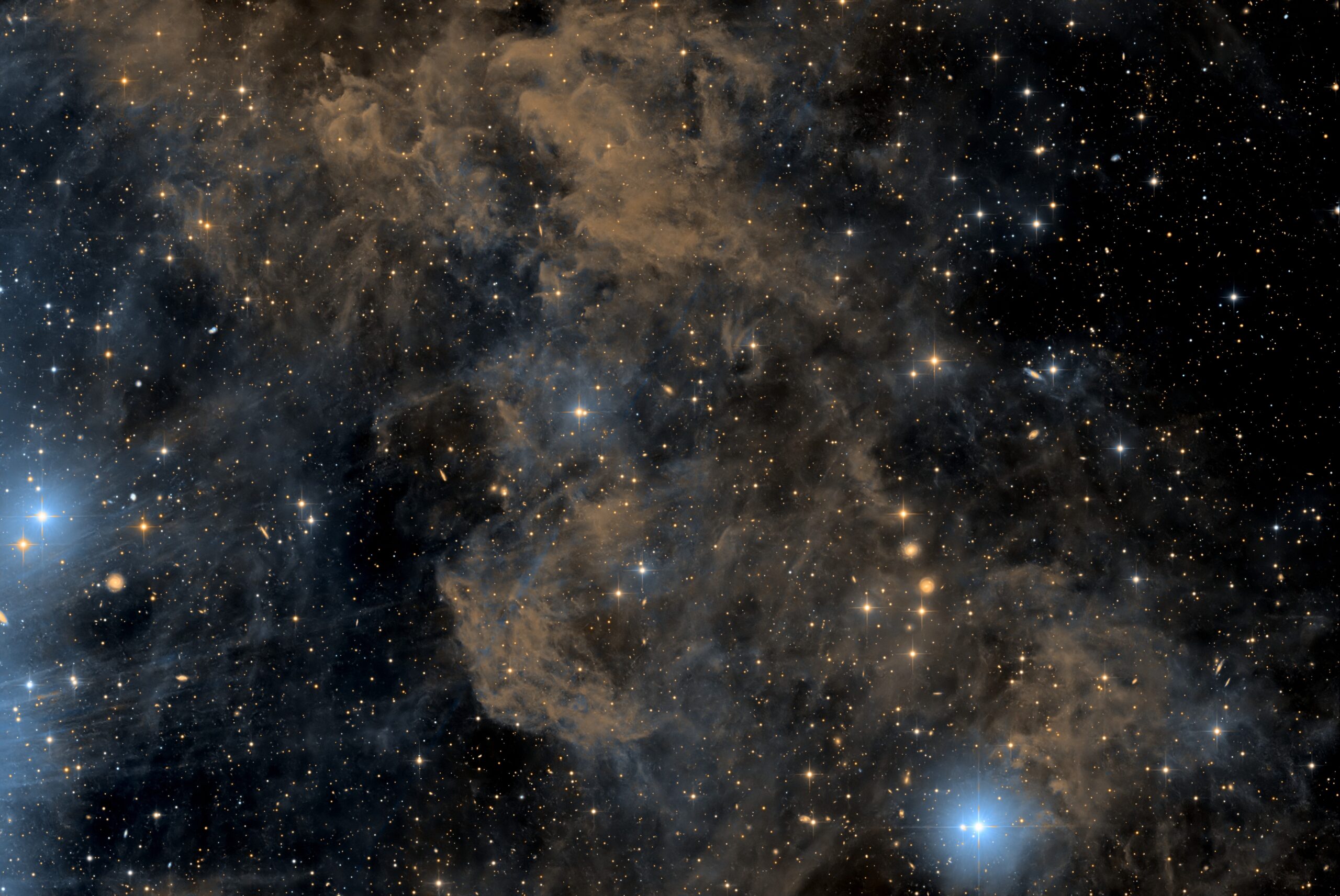
In 2025, my astrophotography companion Karsten Möller and I planned to image the emission nebula Sh2-122 using both telescopes of theVdS Remote Observatory at Hakos. Unfortunately, all of my observing sessions were canceled due to persistent bad weather, while Karsten was fortunate enough to complete his imaging runs successfully. As a result, this image is based entirely on the excellent dataset he acquired under the pristine skies of Namibia, which I later processed to reveal the delicate structures of this little-known emission nebula.
Sh2-122 is a very faint, nearby emission/reflection nebula in Pegasus, projected just east of the bright star Markab and likely associated with a local high‑latitude molecular cloud system.
Sh2-122 is an entry in the Sharpless catalog of emission nebulae, lying in the constellation Pegasus near the star Markab (α Pegasi), the southwest corner of the Great Square. It is extremely low surface brightness, so it does not show visually in typical amateur telescopes; it mainly reveals itself on long‑exposure images as a tenuous, filamentary, irregular cloud.
On the sky, Sh2‑122 sits almost on top of part of the MBM 55 dark cloud complex, one of several nearby high‑latitude molecular clouds (MBM 53, 54, 55) only a few hundred light‑years away. Estimates place Sh2‑122 roughly in the 100–175 parsec range (about 330–570 light‑years), making it surprisingly close compared with many Sharpless H II regions, which are usually several thousand light‑years away.
The physical nature of Sh2‑122 is somewhat controversial. It was catalogued as an emission nebula, but no single, obvious ionizing star has been securely identified, and its distance and excitation source remain uncertain. The nebula is probably part of a faint molecular cloud that is being weakly illuminated or ionized by one or more nearby main‑sequence stars rather than by a hot, massive O‑star as in classic bright H II regions.
Two candidate associated stars in the area are HD 218155 and HD 218499, fairly nearby white (A‑type) stars at around 120–140 parsecs and magnitudes 6–7 that may contribute to Sh2‑122’s glow. Markab itself, although visually right next to the nebula, is closer still (around 40–45 parsecs) and shows no spectral absorption features from the nebular gas along the line of sight, indicating it is only a foreground marker, not the source of the nebula’s excitation.
On deep images, Sh2‑122 appears as a delicate, filamentary, somewhat ragged patch of mist around MBM 55 and the surrounding dark structures, more reminiscent of cirrus clouds on the sky than a compact, bright H II region. Narrowband Hα can help tease out its structure, but broadband LRGB, carefully stretched, often shows the subtle wisps and their relationship to the adjacent dark filaments.
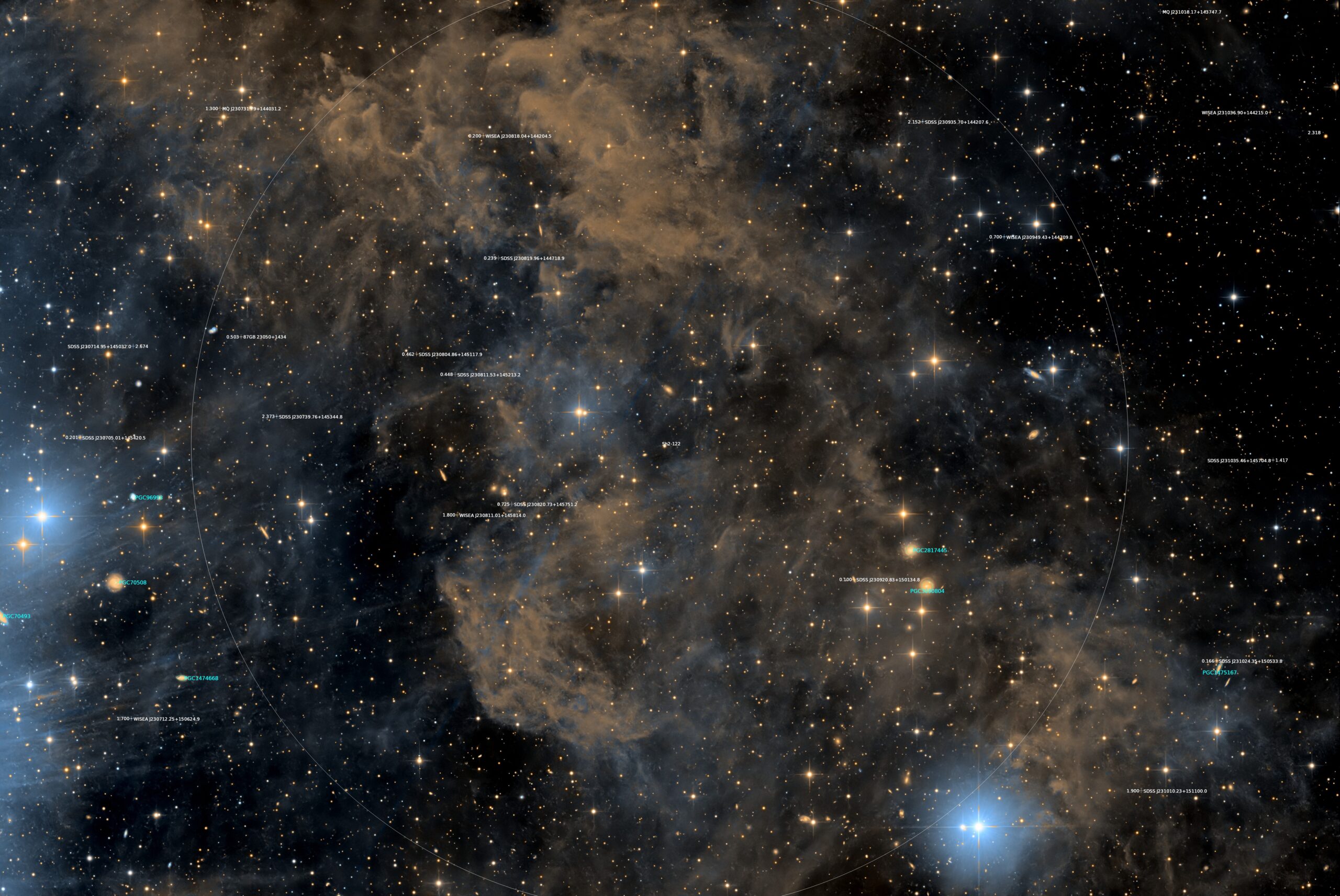
Because it is so faint and close, Sh2‑122 sits in a rich star field with many background galaxies sprinkled through the frame, which gives wide‑field images a sense of depth: nearby Galactic cirrus in the foreground, Milky Way stars at intermediate distances, and distant galaxies beyond. That mix makes it an interesting, though challenging, target for astrophotographers who enjoy hunting rare, high‑latitude nebulae and capturing “dust in front of the cosmos” rather than the more familiar bright emission complexes.
The dataset acquired at the VdS Remote Observatory under the exceptionally dark skies of Hakos beautifully captures the delicate complexity of this overlooked region. The combination of glowing ionized gas, intricate dust clouds, and the dense stellar backdrop illustrates the dynamic interplay between massive stars and the interstellar medium. Although Sh2-122 is not among the best-known nebulae in the Sharpless catalogue, it provides an outstanding example of the ongoing cycle of stellar birth and the continuous shaping of our Galaxy by the energy released from young, massive stars.
The data the calibration, registration, and final processing were performed in PixInsight.
The images were taken with the following equipment:
- Date: 2025
- Location: Hakos, Namibia
- Telescope/Lens: TS 12“ Newton-Astrograph
- Focal length [mm]: 1391
- Focal ratio: 4.56
- Mount: 10Micron GM3000
- Camera: Lacerta DeepSkyPro2600 (mono)
- Filter: LRGB
- Exposure time [min]: 375:185:135:135
- Resolution: 0.56″/px
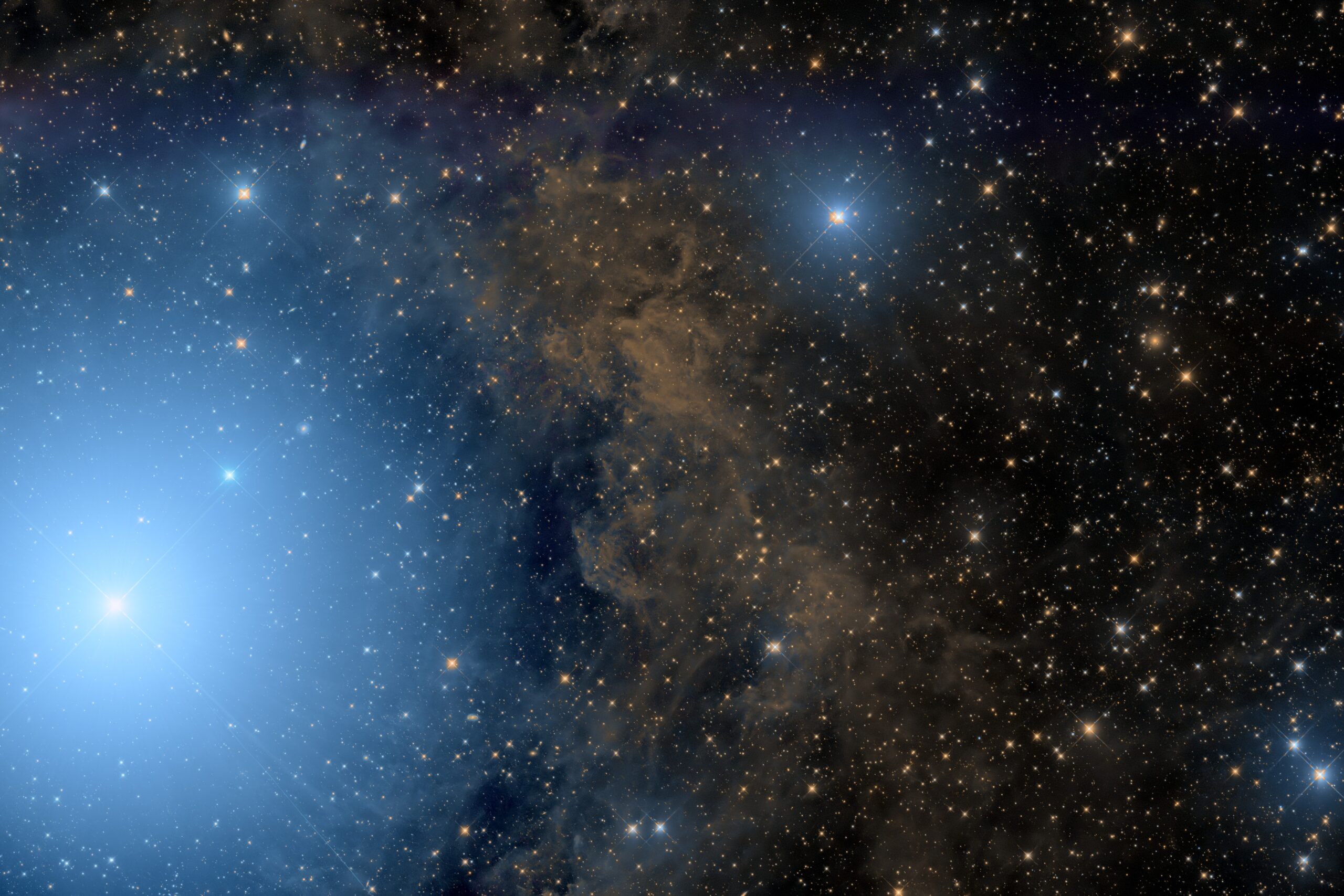

Despite lying close to the crowded plane of the Milky Way, the image contains numerous background galaxies and quasars that can be seen through gaps in the interstellar dust. These distant objects add a remarkable sense of depth, demonstrating that even observations aimed at Galactic nebulae can probe the far reaches of the Universe. The two most distant identified objects in the field are the quasars SDSS J231025.44+141426.9 with a redshift of z = 3.84 and SDSS J231049.67+140901.4 with z = 3.85. Their light has traveled for approximately 12 billion years, allowing us to observe these active galactic nuclei as they existed when the Universe was only about 1.7 billion years old, less than 15% of its current age.
The images were taken with the following equipment:
- Date: 2025
- Location: Hakos, Namibia
- Telescope/Lens: Takahashi Epsilon-160ED
- Focal length [mm]: 535
- Focal ratio: 3.3
- Mount: 10Micron GM3000
- Camera: Lacerta DeepSkyPro2600 C
- Filter: Clear
- Exposure time [min]: 340
- Resolution: 1.45″/px




Leave a reply