• Home
  • Blog
  • Astrophotography
    • Deep Sky
      • Galaxies (Galaxien)
      • Nebulae (Nebel)
      • Planetary Nebulae (Planetarische Nebel)
      • Globular Clusters (Kugelsternhaufen)
      • Open Clusters (Offene Sternhaufen)
      • Miscellaneous (Verschiedenes)
    • Solar System (Sonnensystem)
      • Comets (Kometen)
      • Moon (Mond)
      • Planets (Planeten)
      • Sun (Sonne)
  • Archiv

    • Juli 2026
    • Juni 2026
    • Mai 2026
    • April 2026
    • Februar 2026
    • Januar 2026
    • Dezember 2025
    • November 2025
    • Oktober 2025
    • September 2025
    • August 2025
    • Juli 2025
    • Juni 2025
    • Mai 2025
    • April 2025
    • März 2025
    • Januar 2025
    • Dezember 2024
    • November 2024
    • Oktober 2024
    • September 2024
    • August 2024
    • Juli 2024
    • Juni 2024
    • Mai 2024
    • April 2024
    • März 2024
    • Februar 2024
    • Januar 2024
    • November 2023
    • Oktober 2023
    • September 2023
    • August 2023
    • Juli 2023
    • Juni 2023
    • Mai 2023
    • April 2023
    • März 2023
    • Februar 2023
    • Januar 2023
    • Dezember 2022
    • November 2022
    • Oktober 2022
    • September 2022
    • August 2022
    • Juli 2022
    • Juni 2022
    • Mai 2022
    • April 2022
    • März 2022
    • Februar 2022
    • Januar 2022
    • Dezember 2021
    • November 2021
    • September 2021
    • August 2021
    • Juli 2021
    • März 2021
    • Februar 2021
    • November 2020
    • September 2020
    • August 2020
    • April 2020
    • März 2020
    • Februar 2020
    • Januar 2020
    • Dezember 2019
    • November 2019
    • Oktober 2019
    • September 2019
    • August 2019
    • Mai 2019
    • April 2019
    • März 2019
    • Dezember 2018
    • November 2018
    • Oktober 2018
    • September 2018
    • Juni 2018
    • Mai 2018
    • April 2018
    • März 2018
    • Februar 2018
    • Januar 2018
    • Oktober 2017
    • Juli 2017
    • Juni 2017
    • Januar 2017
    • Dezember 2016
    • September 2016
    • Mai 2016
    • März 2016
    • November 2015
    • Oktober 2015
    • Juli 2015
    • Mai 2015
    • März 2015
    • Februar 2015
    • September 2014
    • August 2014
    • März 2014
    • Februar 2014
    • Oktober 2013
    • September 2013
    • August 2013
    • April 2013
    • März 2013
    • November 2012
    • August 2012
    • Juli 2012
    • Mai 2012
    • März 2012
    • Januar 2012
    • November 2011
    • Oktober 2011
    • September 2011
    • August 2011
    • April 2011
    • März 2011
    • Oktober 2010
    • September 2010
    • August 2010
    • Juli 2010
    • April 2010
    • Juli 2009
    • Juli 2008
    • Januar 2008
    • Oktober 2007
    • Juli 2007
    • März 2007
    • Februar 2007
    • Juni 2006
    • Oktober 2005
    • September 2005
    • August 2005
    • Januar 2005
  • Kategorien

    • Asterism
    • Astrophotography
    • Barnard
    • Comet
    • Galaxies
    • Globular Cluster
    • IC
    • Messier
    • Moon
    • Nebula
    • NGC
    • Open cluster
    • Photography
    • Planetary Nebula
    • Travel
  • Meta

    • Anmelden
    • Eintrags-Feed
    • Kommentar-Feed
    • WordPress.org
  • Privacy Policy
  • Impressum
  • Haftungsausschluss
  • Cookie-Richtlinie
  • Datenschutzerklärung

wonderfuluniverse.de
  • Home
  • Blog
  • Astrophotography
    • Deep Sky
      • Galaxies (Galaxien)
      • Nebulae (Nebel)
      • Planetary Nebulae (Planetarische Nebel)
      • Globular Clusters (Kugelsternhaufen)
      • Open Clusters (Offene Sternhaufen)
      • Miscellaneous (Verschiedenes)
    • Solar System (Sonnensystem)
      • Comets (Kometen)
      • Moon (Mond)
      • Planets (Planeten)
      • Sun (Sonne)

Sextans A Dwarf Galaxy (UGCA 205) from remote


In 2022, I received a high-quality LRGB dataset of the Sextans A Dwarf Galaxy from Telescope Live, acquired under the pristine skies of Chile.

Sextans A is a small dwarf irregular galaxy in the outskirts of the Local Group, roughly 4 to 5 million light-years away. It is one of the nearest examples of a galaxy that is still actively forming stars, so astronomers use it to study star formation in a chemically primitive environment.

Unlike the Milky Way, Sextans A has no obvious spiral arms or central bulge. Its shape is irregular and somewhat square in wide-field images, largely because huge shells of gas and young stars dominate its appearance. The galaxy is small, only about 5,000 to 8,000 light-years across depending on how its edge is measured, and it contains far fewer stars than a large spiral galaxy. Even so, it is rich in gas, which means it still has the raw material needed for future star formation.

One of the most striking things about Sextans A is how much of its visible structure is made by young blue stars and glowing hydrogen regions. The galaxy is actively forming massive O-type stars, especially in its outskirts, and studies have identified early O stars there using spectroscopy. These hot stars emit intense ultraviolet light that ionizes nearby hydrogen, creating bright H II regions. In images, the result is a patchwork of blue stellar clusters and pink-red gas clouds.

Sextans A is chemically very poor in elements heavier than helium, often described as “metal-poor” or “chemically primitive”. That makes it especially interesting to astronomers because its interstellar gas is closer to the conditions found in the early Universe than the gas in the Milky Way is. Low metal content affects how gas cools, how stars form, and how stellar winds behave. In other words, Sextans A is a useful nearby laboratory for studying the kinds of processes that were common when galaxies were young.

A major part of Sextans A is its large reservoir of neutral hydrogen gas. Radio observations show that this gas extends beyond the visible starlight, which is common in dwarf irregular galaxies. The galaxy’s unusual shape is thought to have been influenced by feedback from massive stars: supernovae and stellar winds likely pushed gas outward, forming shells and triggering new waves of star formation. That kind of self-propagating star formation helps explain the patchy, asymmetric look of the galaxy.

Sextans A matters because it combines several difficult-to-replicate conditions in one nearby object: low metallicity, active star formation, abundant neutral gas, and a small galactic mass. It helps astronomers understand how stars form in environments unlike the Milky Way and how small galaxies evolve over time. It also helps connect local, observable systems with the kinds of primitive galaxies that were more common in the early cosmos.

Data calibration, registration and the final processing was done with PixInsight. The result was as follows:
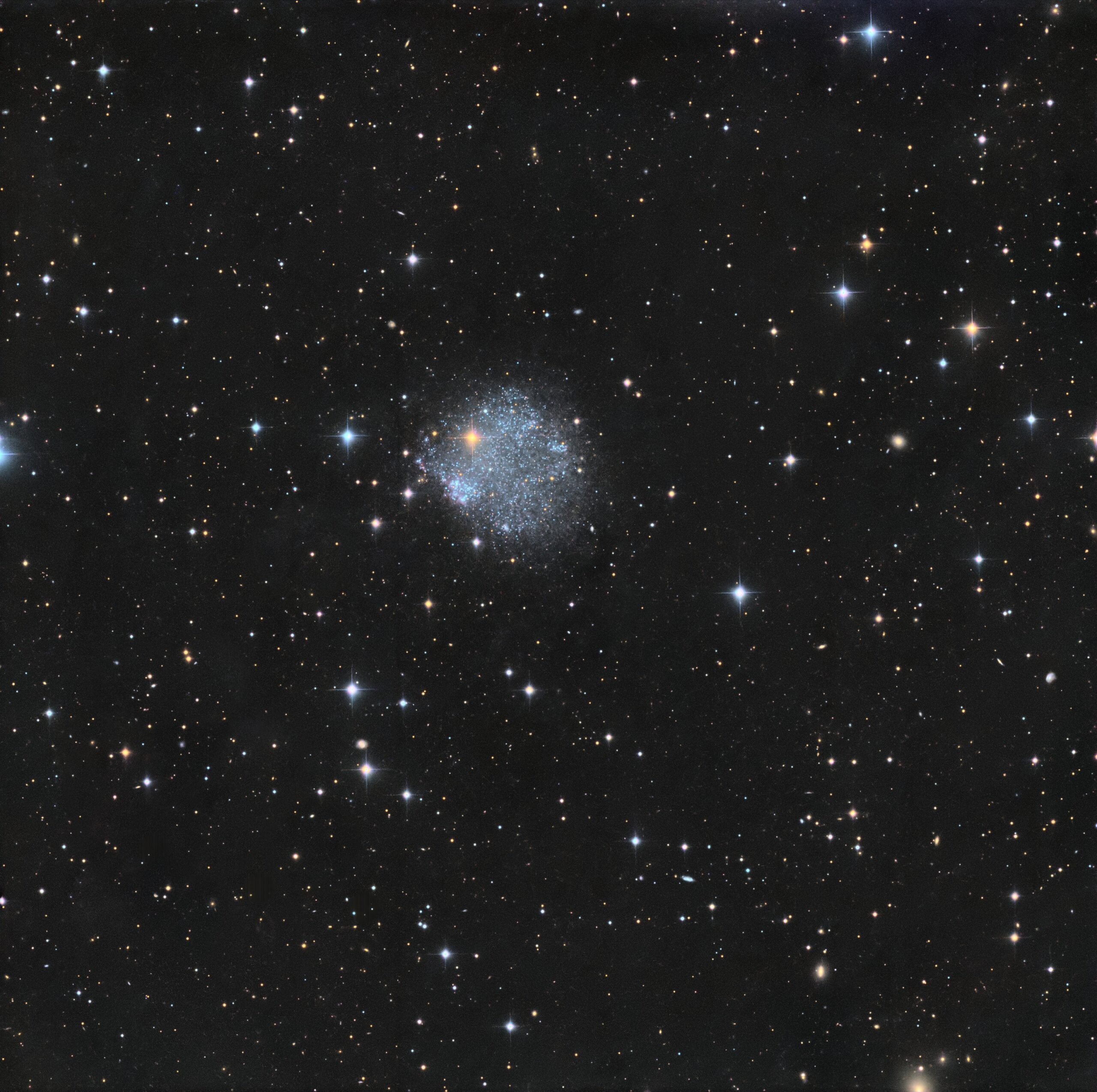
Sextans A, Telescope Live, Chile, 2022
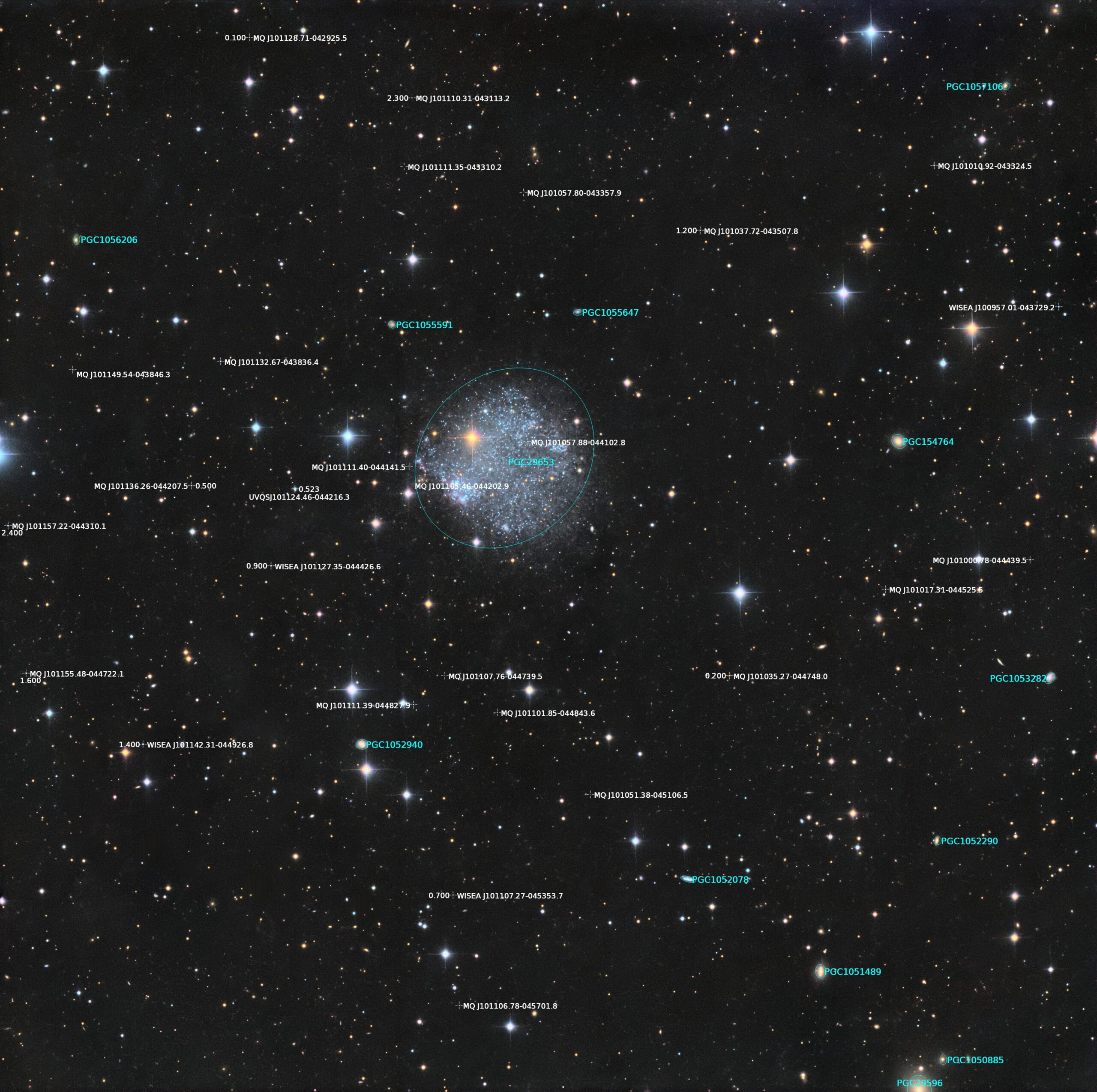
Sextans A annotated
Sextans A annotated


Here is an overview of the used equipment and the exposure times:

  • Date: 2022
  • Location: El Sauce Observatory Chile
  • Telescope/Lense: Planwace CDK24
  • Focal length [mm]: 3962
  • Focal ratio: 6.5
  • Mount: Mathis MI-1000/1250
  • Camera: FLI PL 9000
  • Filter: L:R:G:B
  • Exposure time [min]: 100:110:110:100
  • Resolution: 0.62″/px


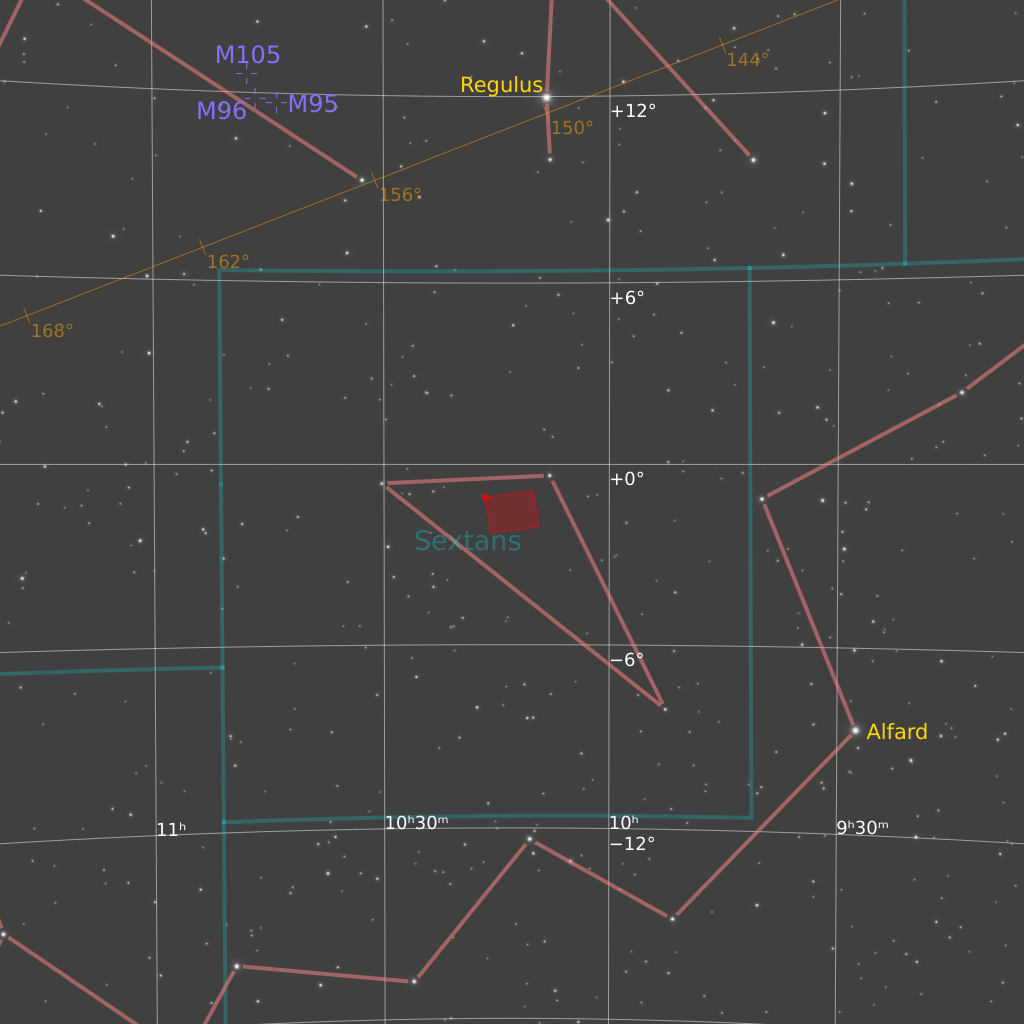
Sextans A Finder Chart

Stephan Küppers


You might also like
IC 1318
15. Juli 2026
NGC 7000 with IC 5070
24. Juni 2026
Sh2-129, Outters 4
29. Mai 2026

Leave a reply

Schreibe einen Kommentar Antwort abbrechen

Deine E-Mail-Adresse wird nicht veröffentlicht. Erforderliche Felder sind mit * markiert


© Stephan Küppers 2020-2022

Cookie-Zustimmung verwalten
Wir verwenden Cookies, um unsere Website und unseren Service zu optimieren.
Funktional Immer aktiv
Die technische Speicherung oder der Zugang ist unbedingt erforderlich für den rechtmäßigen Zweck, die Nutzung eines bestimmten Dienstes zu ermöglichen, der vom Teilnehmer oder Nutzer ausdrücklich gewünscht wird, oder für den alleinigen Zweck, die Übertragung einer Nachricht über ein elektronisches Kommunikationsnetz durchzuführen.
Vorlieben
Die technische Speicherung oder der Zugriff ist für den rechtmäßigen Zweck der Speicherung von Präferenzen erforderlich, die nicht vom Abonnenten oder Benutzer angefordert wurden.
Statistiken
Die technische Speicherung oder der Zugriff, der ausschließlich zu statistischen Zwecken erfolgt. Die technische Speicherung oder der Zugriff, der ausschließlich zu anonymen statistischen Zwecken verwendet wird. Ohne eine Vorladung, die freiwillige Zustimmung deines Internetdienstanbieters oder zusätzliche Aufzeichnungen von Dritten können die zu diesem Zweck gespeicherten oder abgerufenen Informationen allein in der Regel nicht dazu verwendet werden, dich zu identifizieren.
Marketing
Die technische Speicherung oder der Zugriff ist erforderlich, um Nutzerprofile zu erstellen, um Werbung zu versenden oder um den Nutzer auf einer Website oder über mehrere Websites hinweg zu ähnlichen Marketingzwecken zu verfolgen.
  • Optionen verwalten
  • Dienste verwalten
  • Verwalten von {vendor_count}-Lieferanten
  • Lese mehr über diese Zwecke
Einstellungen anzeigen
  • {title}
  • {title}
  • {title}