• Home
  • Blog
  • Astrophotography
    • Deep Sky
      • Galaxies (Galaxien)
      • Nebulae (Nebel)
      • Planetary Nebulae (Planetarische Nebel)
      • Globular Clusters (Kugelsternhaufen)
      • Open Clusters (Offene Sternhaufen)
      • Miscellaneous (Verschiedenes)
    • Solar System (Sonnensystem)
      • Comets (Kometen)
      • Moon (Mond)
      • Planets (Planeten)
      • Sun (Sonne)
  • Archiv

    • Juni 2026
    • Mai 2026
    • April 2026
    • Dezember 2025
    • November 2025
    • Oktober 2025
    • September 2025
    • August 2025
    • Juli 2025
    • Juni 2025
    • Mai 2025
    • April 2025
    • März 2025
    • Januar 2025
    • Dezember 2024
    • November 2024
    • Oktober 2024
    • September 2024
    • Juli 2024
    • Juni 2024
    • Mai 2024
    • April 2024
    • März 2024
    • Februar 2024
    • Januar 2024
    • November 2023
    • Oktober 2023
    • September 2023
    • August 2023
    • Juli 2023
    • Juni 2023
    • Mai 2023
    • April 2023
    • März 2023
    • Februar 2023
    • Januar 2023
    • Dezember 2022
    • November 2022
    • Oktober 2022
    • September 2022
    • August 2022
    • Juni 2022
    • Mai 2022
    • April 2022
    • März 2022
    • Februar 2022
    • Januar 2022
    • Dezember 2021
    • November 2021
    • September 2021
    • August 2021
    • Juli 2021
    • März 2021
    • Februar 2021
    • November 2020
    • September 2020
    • August 2020
    • April 2020
    • März 2020
    • Februar 2020
    • Januar 2020
    • Dezember 2019
    • November 2019
    • Oktober 2019
    • September 2019
    • August 2019
    • Mai 2019
    • April 2019
    • März 2019
    • Dezember 2018
    • November 2018
    • September 2018
    • Juni 2018
    • Mai 2018
    • April 2018
    • März 2018
    • Februar 2018
    • Januar 2018
    • Oktober 2017
    • Juli 2017
    • Juni 2017
    • Januar 2017
    • September 2016
    • Mai 2016
    • März 2016
    • November 2015
    • Oktober 2015
    • September 2015
    • Mai 2015
    • März 2015
    • Februar 2015
    • September 2014
    • März 2014
    • Februar 2014
    • Oktober 2013
    • September 2013
    • August 2013
    • April 2013
    • März 2013
    • November 2012
    • August 2012
    • Juli 2012
    • Mai 2012
    • März 2012
    • Januar 2012
    • November 2011
    • Oktober 2011
    • September 2011
    • August 2011
    • April 2011
    • März 2011
    • Oktober 2010
    • September 2010
    • August 2010
    • Juli 2010
    • April 2010
    • Juli 2009
    • Juli 2008
    • Januar 2008
    • Oktober 2007
    • Juli 2007
    • Februar 2007
    • Juni 2006
    • Oktober 2005
    • September 2005
    • August 2005
    • Januar 2005
  • Kategorien

    • Asterism
    • Astrophotography
    • Barnard
    • Comet
    • Galaxies
    • Globular Cluster
    • IC
    • Messier
    • Moon
    • Nebula
    • NGC
    • Open cluster
    • Photography
    • Planetary Nebula
    • Travel
  • Meta

    • Anmelden
    • Eintrags-Feed
    • Kommentar-Feed
    • WordPress.org
  • Privacy Policy
  • Impressum
  • Haftungsausschluss
  • Cookie-Richtlinie
  • Datenschutzerklärung

wonderfuluniverse.de
  • Home
  • Blog
  • Astrophotography
    • Deep Sky
      • Galaxies (Galaxien)
      • Nebulae (Nebel)
      • Planetary Nebulae (Planetarische Nebel)
      • Globular Clusters (Kugelsternhaufen)
      • Open Clusters (Offene Sternhaufen)
      • Miscellaneous (Verschiedenes)
    • Solar System (Sonnensystem)
      • Comets (Kometen)
      • Moon (Mond)
      • Planets (Planeten)
      • Sun (Sonne)

RCW 114 (SNR G343.0-06.0)


In 2015, during a stay at the Tivoli Astrofarm in Namibia, I imaged the large supernova remnant RCW 114 using a 105 mm telephoto lens and a CCD camera. I recorded the object in HRGB, combining deep Hα exposures with broadband RGB data to reveal the vast network of faint emission filaments. The exceptionally dark skies of the Namib Desert were essential for capturing this enormous and extremely low-surface-brightness object, which spans several degrees across the sky.

RCW 114 is located in the constellation Scorpius and is identified with the supernova remnant SNR G343.0−06.0. Unlike the bright remnants of more recent stellar explosions, RCW 114 is thought to be several hundred thousand years old. Over this long period, the expanding shock wave has slowed considerably and the remnant has become extremely diffuse, making it a challenging target for deep wide-field astrophotography.

The nebula consists of an intricate web of filamentary hydrogen emission, produced where the expanding shock front compresses and heats the surrounding interstellar medium. The deep Hα data clearly reveal these delicate filaments, while the RGB data preserve the rich foreground star field of the Milky Way. Together, they create a detailed portrait of the remnant’s enormous extent and complex structure.

For many years, astronomers debated whether RCW 114 was physically associated with the nearby WR 90. Modern observations, however, indicate that the nebula is most likely an old supernova remnant located much closer to Earth than WR 90, and that the apparent alignment is simply a chance projection along our line of sight. This makes RCW 114 an excellent example of the importance of combining imaging with spectroscopic and distance measurements to understand the true nature of celestial objects.

Deep images also reveal numerous dark dust clouds crossing the field, together with the dense stellar background of the Milky Way. The enormous angular size of RCW 114 makes it particularly well suited to imaging with a short focal length, allowing the complete remnant and its surrounding environment to be captured in a single frame.

From a scientific perspective, RCW 114 illustrates the late stages of a supernova remnant’s evolution. As the expanding shell disperses into the interstellar medium, it enriches its surroundings with heavy elements synthesized by the progenitor star and by the supernova explosion itself. These elements eventually become incorporated into future generations of stars and planetary systems, making supernova remnants an essential part of the cosmic cycle of matter.

The HRGB image obtained in 2015 beautifully captures the faint, filamentary appearance of this ancient stellar explosion. Using a 105 mm telephoto lens allowed the entire remnant to be framed against the spectacular backdrop of the southern Milky Way, while the pristine skies of Namibia revealed subtle details that would be almost impossible to detect from light-polluted locations. The result is a striking wide-field portrait of one of the largest and oldest visible supernova remnants in the southern sky.

The data calibration, registration and final processing was done with PixIsight. The result is shown below:

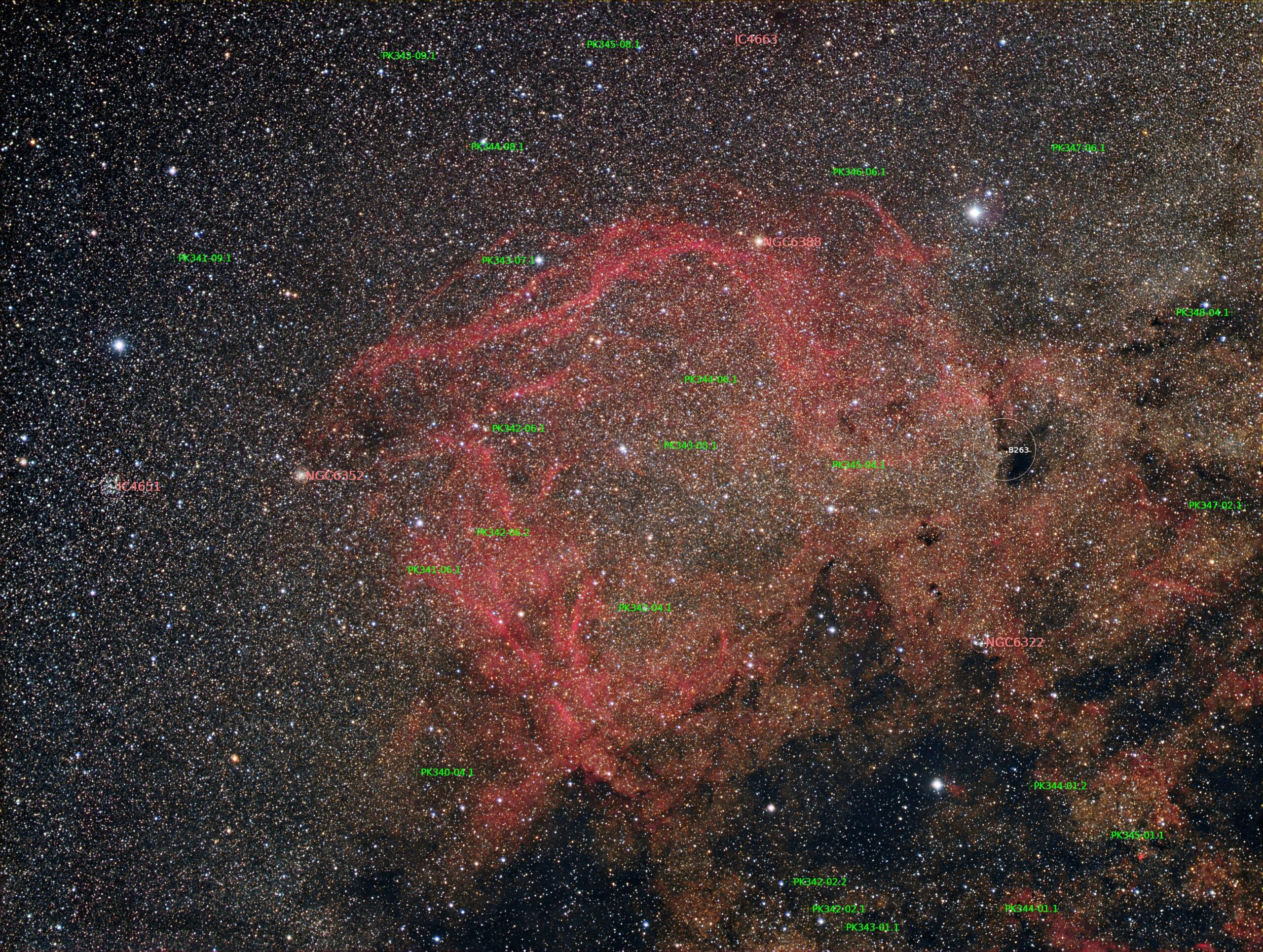
RCW 114, Tivoli, Namibia, 2015

RCW 114 annotated
RCW 114 annotated


The images were taken with the following equipment:

  • Location: Tivoli, Namibia
  • Telescope/Lens: Canon 24-105
  • Focal length [mm]: 105
  • Focal ratio: 4
  • Mount: Losmandy G11
  • Camera: Moravian FW8300
  • Filter: Hα:R:G:B
  • Exposure time [min]: 300:90:90:90
  • Resolution: 11.24″/px


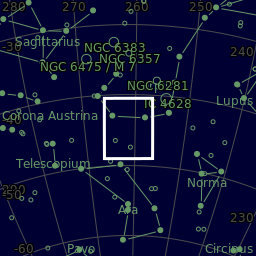
RCW 114 Finder Chart


Stephan Küppers


You might also like
NGC 7000 with IC 5070
24. Juni 2026
NGC 7023 (Iris Nebula) and LBN 468
25. Mai 2026
NGC 5907
15. Mai 2026

Leave a reply

Schreibe einen Kommentar Antwort abbrechen

Deine E-Mail-Adresse wird nicht veröffentlicht. Erforderliche Felder sind mit * markiert


© Stephan Küppers 2020-2022

Cookie-Zustimmung verwalten
Wir verwenden Cookies, um unsere Website und unseren Service zu optimieren.
Funktional Immer aktiv
Die technische Speicherung oder der Zugang ist unbedingt erforderlich für den rechtmäßigen Zweck, die Nutzung eines bestimmten Dienstes zu ermöglichen, der vom Teilnehmer oder Nutzer ausdrücklich gewünscht wird, oder für den alleinigen Zweck, die Übertragung einer Nachricht über ein elektronisches Kommunikationsnetz durchzuführen.
Vorlieben
Die technische Speicherung oder der Zugriff ist für den rechtmäßigen Zweck der Speicherung von Präferenzen erforderlich, die nicht vom Abonnenten oder Benutzer angefordert wurden.
Statistiken
Die technische Speicherung oder der Zugriff, der ausschließlich zu statistischen Zwecken erfolgt. Die technische Speicherung oder der Zugriff, der ausschließlich zu anonymen statistischen Zwecken verwendet wird. Ohne eine Vorladung, die freiwillige Zustimmung deines Internetdienstanbieters oder zusätzliche Aufzeichnungen von Dritten können die zu diesem Zweck gespeicherten oder abgerufenen Informationen allein in der Regel nicht dazu verwendet werden, dich zu identifizieren.
Marketing
Die technische Speicherung oder der Zugriff ist erforderlich, um Nutzerprofile zu erstellen, um Werbung zu versenden oder um den Nutzer auf einer Website oder über mehrere Websites hinweg zu ähnlichen Marketingzwecken zu verfolgen.
  • Optionen verwalten
  • Dienste verwalten
  • Verwalten von {vendor_count}-Lieferanten
  • Lese mehr über diese Zwecke
Einstellungen anzeigen
  • {title}
  • {title}
  • {title}