• Home
  • Blog
  • Astrophotography
    • Deep Sky
      • Galaxies (Galaxien)
      • Nebulae (Nebel)
      • Planetary Nebulae (Planetarische Nebel)
      • Globular Clusters (Kugelsternhaufen)
      • Open Clusters (Offene Sternhaufen)
      • Miscellaneous (Verschiedenes)
    • Solar System (Sonnensystem)
      • Comets (Kometen)
      • Moon (Mond)
      • Planets (Planeten)
      • Sun (Sonne)
  • Archiv

    • Juli 2026
    • Juni 2026
    • Mai 2026
    • April 2026
    • Februar 2026
    • Dezember 2025
    • November 2025
    • Oktober 2025
    • September 2025
    • August 2025
    • Juli 2025
    • Juni 2025
    • Mai 2025
    • April 2025
    • März 2025
    • Januar 2025
    • Dezember 2024
    • November 2024
    • Oktober 2024
    • September 2024
    • August 2024
    • Juli 2024
    • Juni 2024
    • Mai 2024
    • April 2024
    • März 2024
    • Februar 2024
    • Januar 2024
    • November 2023
    • Oktober 2023
    • September 2023
    • August 2023
    • Juli 2023
    • Juni 2023
    • Mai 2023
    • April 2023
    • März 2023
    • Februar 2023
    • Januar 2023
    • Dezember 2022
    • November 2022
    • Oktober 2022
    • September 2022
    • August 2022
    • Juni 2022
    • Mai 2022
    • April 2022
    • März 2022
    • Februar 2022
    • Januar 2022
    • Dezember 2021
    • November 2021
    • September 2021
    • August 2021
    • Juli 2021
    • März 2021
    • Februar 2021
    • November 2020
    • September 2020
    • August 2020
    • April 2020
    • März 2020
    • Februar 2020
    • Januar 2020
    • Dezember 2019
    • November 2019
    • Oktober 2019
    • September 2019
    • August 2019
    • Mai 2019
    • April 2019
    • März 2019
    • Dezember 2018
    • November 2018
    • Oktober 2018
    • September 2018
    • Juni 2018
    • Mai 2018
    • April 2018
    • März 2018
    • Februar 2018
    • Januar 2018
    • Oktober 2017
    • Juli 2017
    • Juni 2017
    • Januar 2017
    • Dezember 2016
    • September 2016
    • Mai 2016
    • März 2016
    • November 2015
    • Oktober 2015
    • Juli 2015
    • Mai 2015
    • März 2015
    • Februar 2015
    • September 2014
    • August 2014
    • März 2014
    • Februar 2014
    • Oktober 2013
    • September 2013
    • August 2013
    • April 2013
    • März 2013
    • November 2012
    • August 2012
    • Juli 2012
    • Mai 2012
    • März 2012
    • Januar 2012
    • November 2011
    • Oktober 2011
    • September 2011
    • August 2011
    • April 2011
    • März 2011
    • Oktober 2010
    • September 2010
    • August 2010
    • Juli 2010
    • April 2010
    • Juli 2009
    • Juli 2008
    • Januar 2008
    • Oktober 2007
    • Juli 2007
    • Februar 2007
    • Juni 2006
    • Oktober 2005
    • September 2005
    • August 2005
    • Januar 2005
  • Kategorien

    • Asterism
    • Astrophotography
    • Barnard
    • Comet
    • Galaxies
    • Globular Cluster
    • IC
    • Messier
    • Moon
    • Nebula
    • NGC
    • Open cluster
    • Photography
    • Planetary Nebula
    • Travel
  • Meta

    • Anmelden
    • Eintrags-Feed
    • Kommentar-Feed
    • WordPress.org
  • Privacy Policy
  • Impressum
  • Haftungsausschluss
  • Cookie-Richtlinie
  • Datenschutzerklärung

wonderfuluniverse.de
  • Home
  • Blog
  • Astrophotography
    • Deep Sky
      • Galaxies (Galaxien)
      • Nebulae (Nebel)
      • Planetary Nebulae (Planetarische Nebel)
      • Globular Clusters (Kugelsternhaufen)
      • Open Clusters (Offene Sternhaufen)
      • Miscellaneous (Verschiedenes)
    • Solar System (Sonnensystem)
      • Comets (Kometen)
      • Moon (Mond)
      • Planets (Planeten)
      • Sun (Sonne)

NGC 7293 (Helix Nebula)


I imaged the NGC 7293 several times over the years, documenting both my personal development in astrophotography and the rapid advances in imaging technology. My first image was captured in 2007 during a stay at the Emberger Alm using my DSLR equipment. Under the dark alpine skies, I was able to record the bright outer shell of one of the closest planetary nebulae to Earth. In 2011, during another astrophotography trip to Banon, I revisited the Helix Nebula with a newer DSLR camera, producing a significantly improved image thanks to the camera’s higher sensitivity and lower noise.

In 2015, while staying at the Tivoli Astrofarm in Namibia, I imaged the nebula using a rented observatory in Hα-O-RGB (HORGB), allowing the intricate gaseous structures to be recorded with much greater detail. Most recently, in 2023, I received a professional SHO dataset of the Helix Nebula from Telescope Live, acquired under the exceptionally dark skies of Chile. The narrowband data reveal an extraordinary wealth of fine filaments and subtle ionization structures throughout the nebula.

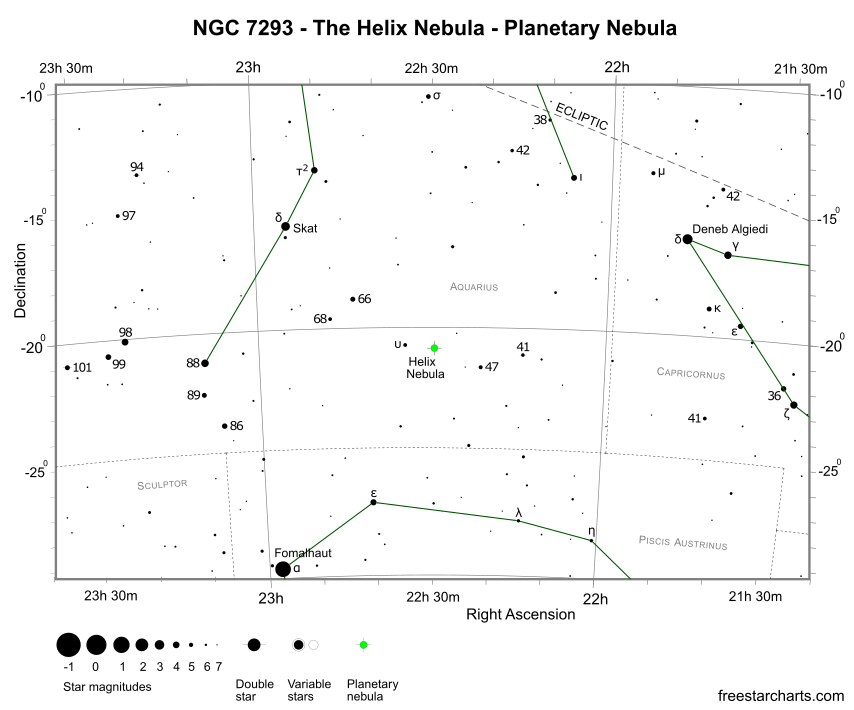
Located in the constellation Aquarius, the Helix Nebula is one of the closest planetary nebulae known, lying at a distance of only about 650 light-years. With an apparent diameter of nearly 25 arcminutes, it is also one of the largest planetary nebulae in the sky, although its low surface brightness makes it a challenging visual target.

The nebula was formed when a Sun-like star reached the end of its life approximately 10,000 years ago and expelled its outer layers into space. At its center lies a hot white dwarf, whose intense ultraviolet radiation ionizes the expanding shell of gas, producing the characteristic emission from hydrogen, oxygen, and sulfur that is beautifully highlighted in narrowband images.

One of the Helix Nebula’s most fascinating features is the presence of thousands of tiny cometary knots. These dense clumps of gas and dust each possess a bright ionized head pointing toward the central star and a long tail extending away from it. First revealed by the Hubble Space Telescope, these structures are thought to survive from the original stellar envelope and provide valuable insight into the complex processes that shape planetary nebulae.

Deep images also reveal that the Helix Nebula is far more complex than its familiar ring-like appearance suggests. It consists of multiple shells, bipolar structures, and faint outer halos produced by successive episodes of mass loss during the progenitor star’s final evolutionary stages. The apparent ring is actually the projection of a three-dimensional structure viewed from Earth at a slight angle.

The Helix Nebula is regarded as one of the finest laboratories for studying the future evolution of our own Sun. In approximately five billion years, the Sun is expected to undergo a similar transformation, shedding its outer layers before ending its life as a white dwarf surrounded by an expanding planetary nebula.

The four images acquired in 2007, 2011, 2015, and 2023 beautifully illustrate both the evolution of my astrophotography and the dramatic improvements in imaging technology. From early DSLR photographs under the dark skies of Austria and France to a sophisticated HORGB image from Namibia and finally a professional SHO dataset from Chile, each version reveals new details of one of the most iconic and scientifically important planetary nebulae in the night sky. Together they document nearly two decades of experience while showcasing the extraordinary beauty and complexity of the Helix Nebula.

For the Telescope Live data the calibration, registration and the final processing was done with PixInsight. The result was as follows:
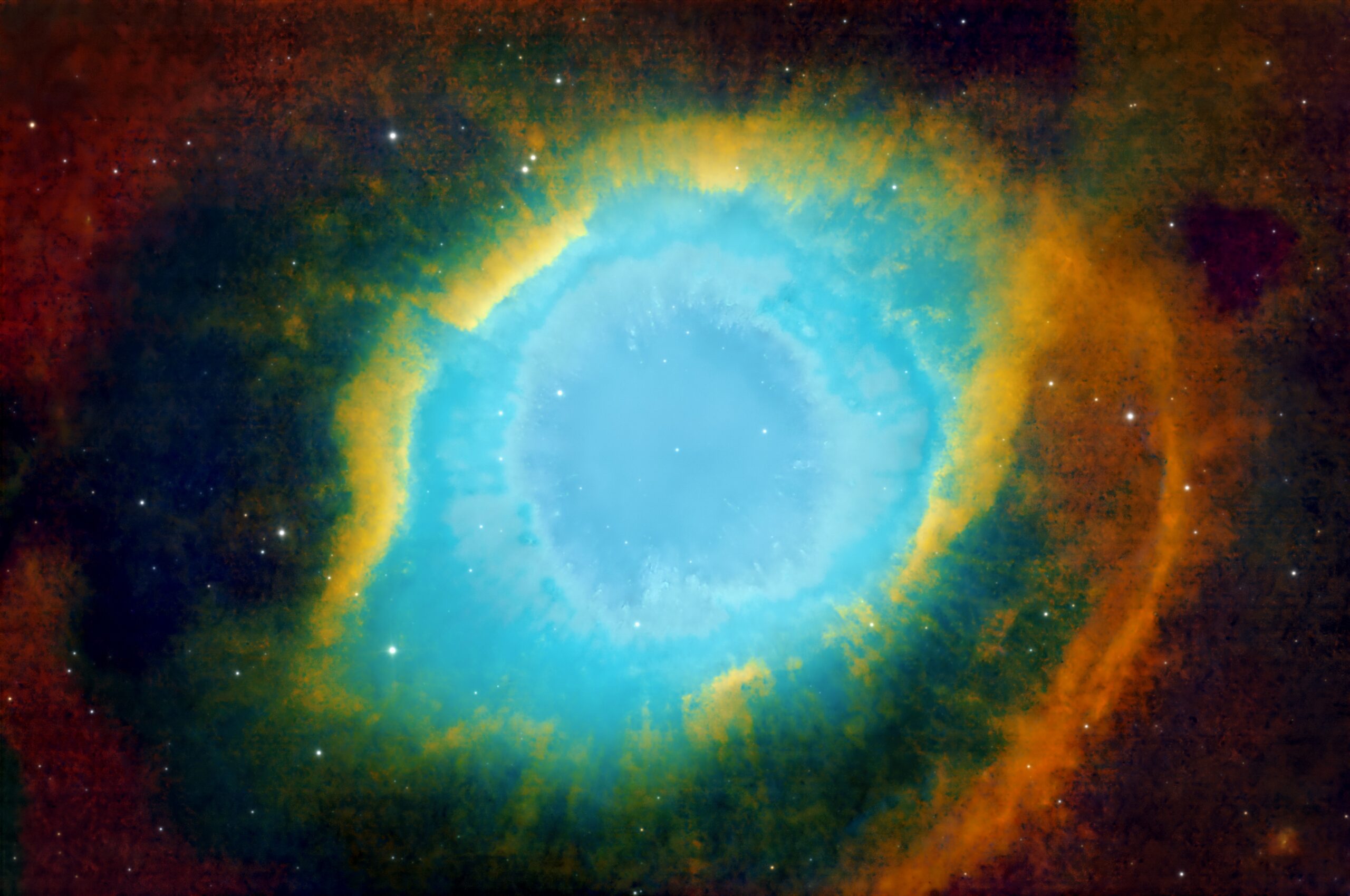
NGC 7293, Telescope Live, Chile, 2023


The images were taken with the following equipment (Telescope Live CHI-1):

  • Date: 2023
  • Location: El Sauce Observatory, Chile
  • Telescope/Lense: Planwave CDK24
  • Focal length [mm]: 3900
  • Focal ratio: 6.5
  • Mount: Mathis MI-1000/1250
  • Camera: QHY 600M Pro
  • Filter: Hα:[OIII][SII]
  • Exposure time [min]: 210:210:150
  • Resolution: 0.39″/px (bin2)


For the 2015 data the calibration, registration and the final processing was done with PixInsight. The result was as follows:
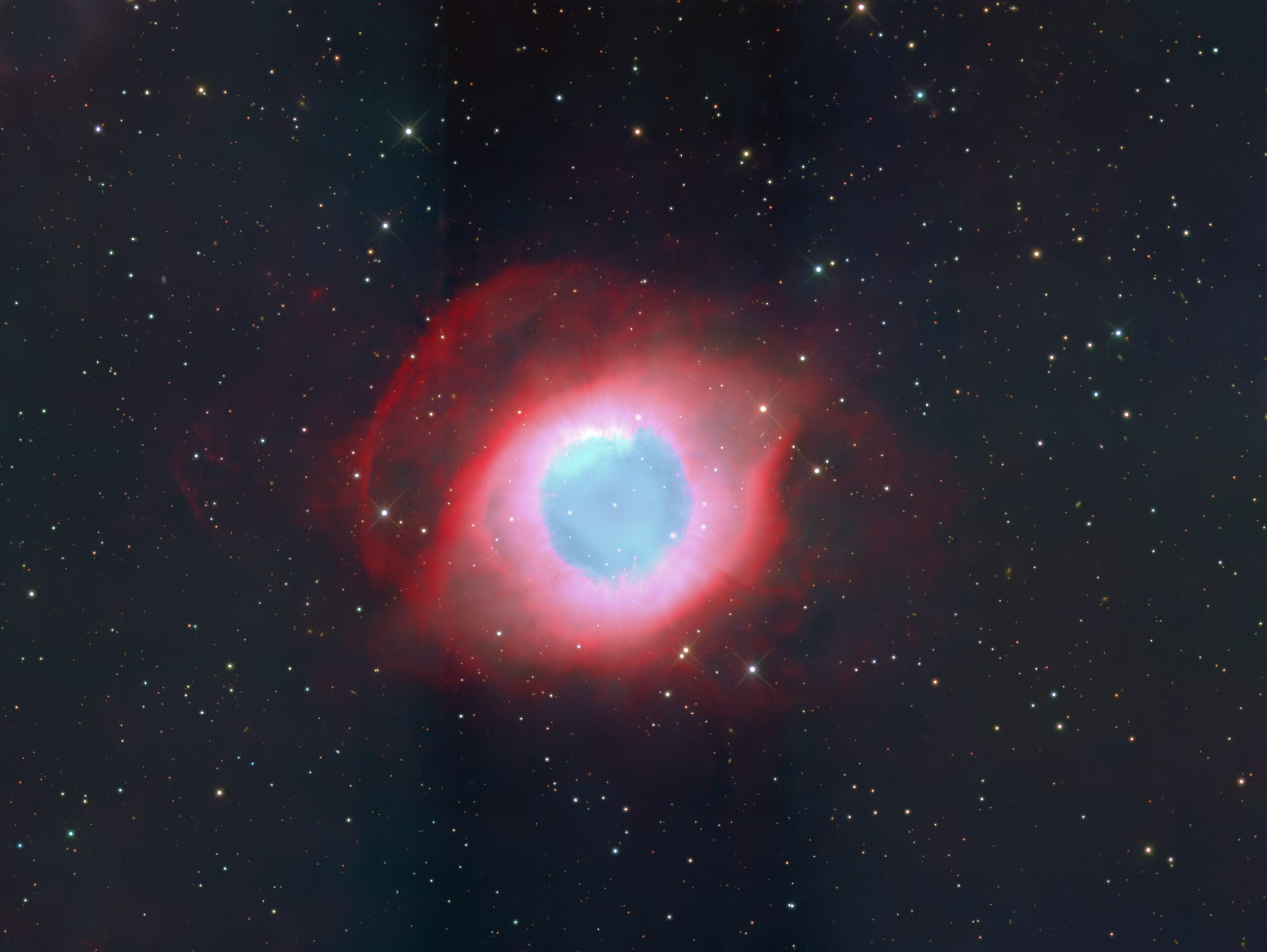
NGC 7293, Tivoli, Namibia, 2015


The images were taken with the following equipment:

  • Date: 2015
  • Location: Tivoli, Namibia
  • Telescope/Lense: 12″ ASA Astrograph
  • Focal length [mm]: 1076
  • Focal ratio: 3.6
  • Mount: ASA DDM 85
  • Camera: FLI Microline ML8300
  • Filter: R:G:B:Hα:[OIII]
  • Exposure time [min]: 40:40:40:200:90
  • Resolution: 1.04″/px


For the 2011 data the calibration and registration was done with DeepSkyStacker and the final processing was done with PixInsight. The result was as follows:
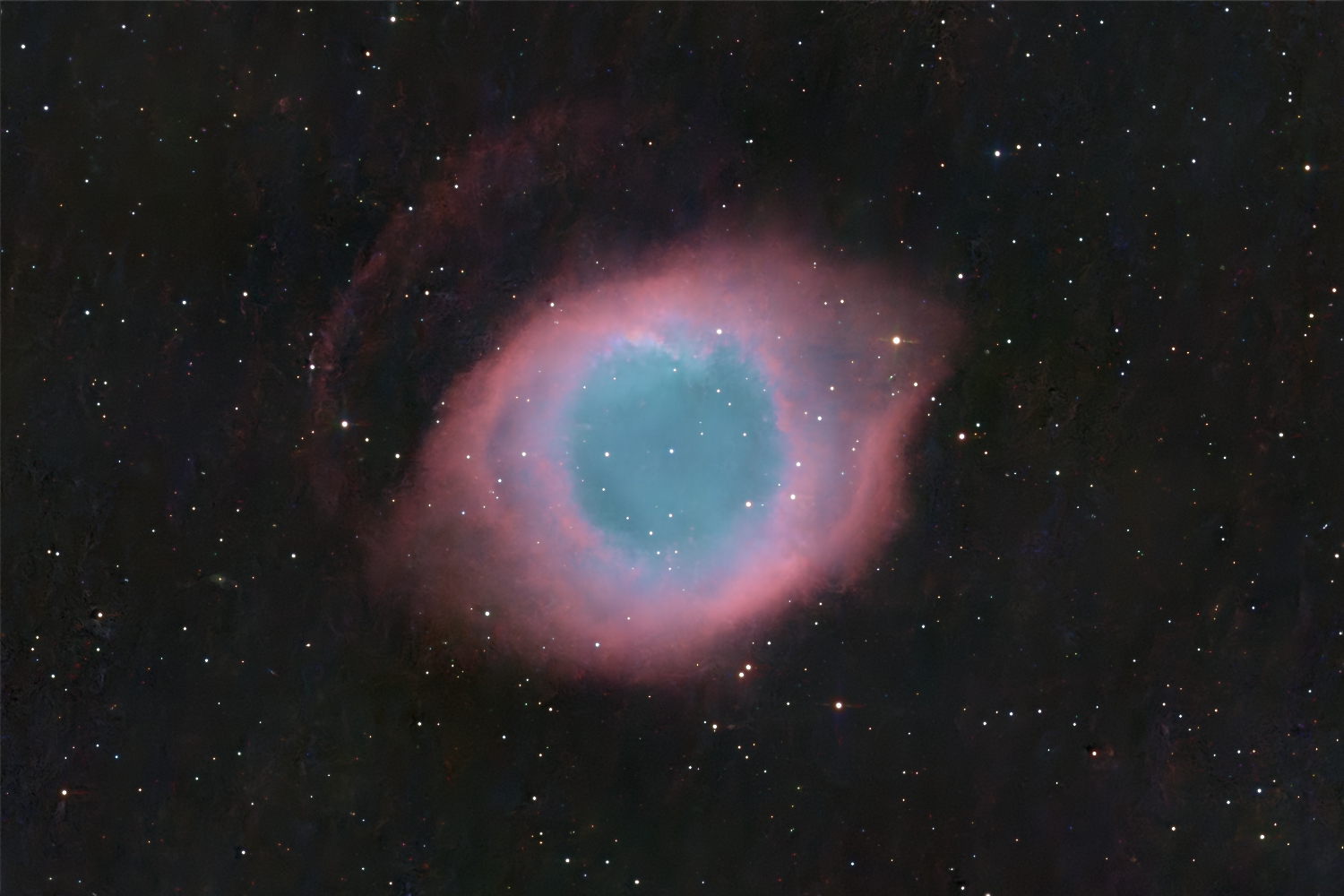
NGGC 7293, Banon, France, 2011


The images were taken with the following equipment:

  • Date: 2011
  • Location: Banon, France
  • Telescope/Lense: 10″ TS Newton
  • Focal length [mm]: 1140
  • Focal ratio: 4.5
  • Mount: Skywatcher NEQ6
  • Camera: Canon 500Da
  • Filter: OSC
  • Exposure time [min]: 158
  • Resolution: 1.7″/px (bin2)


For the 2007 data the calibration and registration was done with DeepSkyStacker and the final processing was done with PixInsight. The result was as follows:
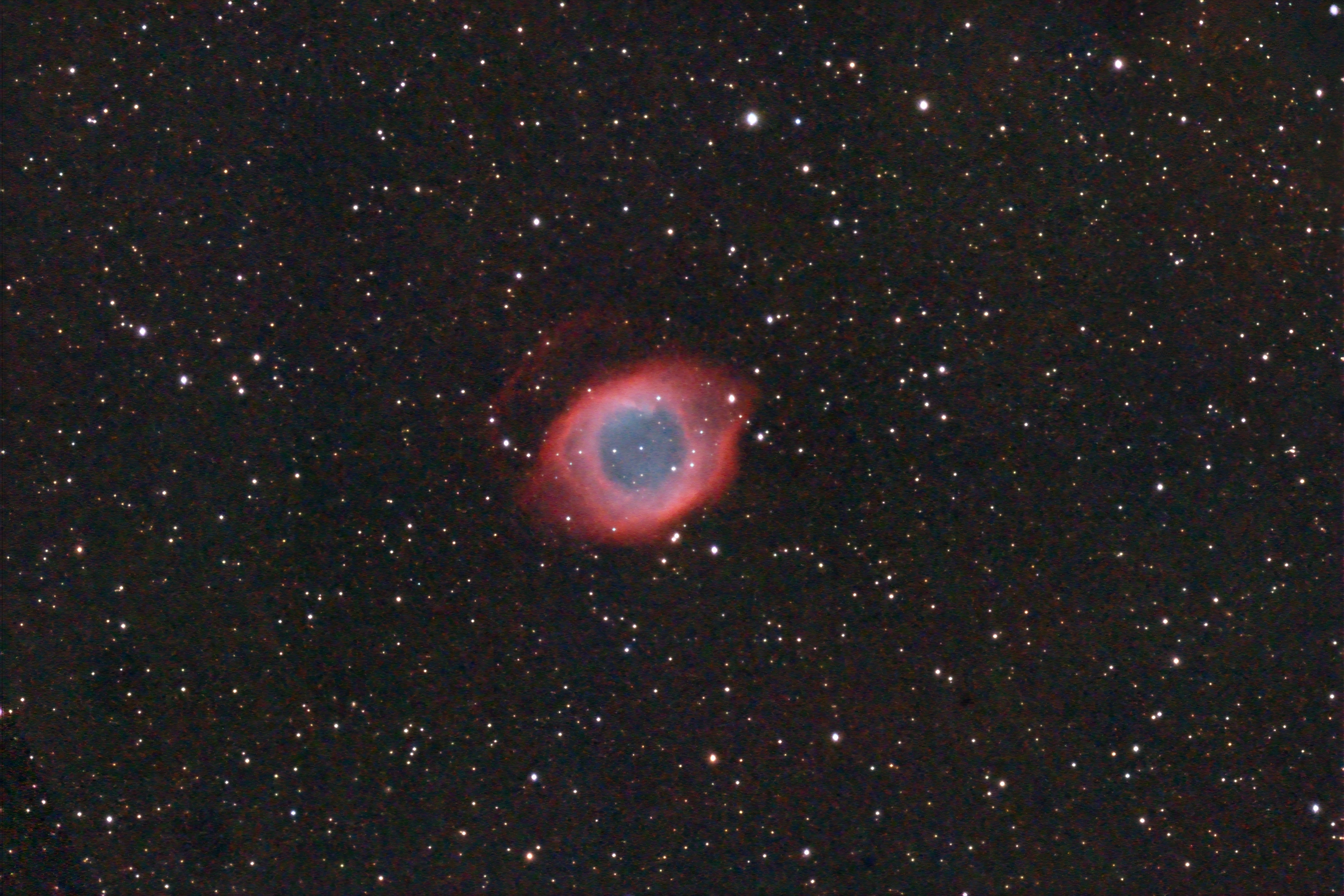
NGC 7293, Emberger Alm, Austria, 2007


The images were taken with the following equipment:

  • Date: 2007
  • Location: Emberger Alm, Austria
  • Telescope/Lense: Pentax 75
  • Focal length [mm]: 500
  • Focal ratio: 6.7
  • Mount: Vixen GP-DX
  • Camera: Canon 300Da
  • Filter: OSC
  • Exposure time [min]: 53
  • Resolution: 3.04″/px


NGC 7293 Finder Chart

Stephan Küppers


You might also like
IC 1318
15. Juli 2026
NGC 7000 with IC 5070
24. Juni 2026
Sh2-129, Outters 4
29. Mai 2026

Leave a reply

Schreibe einen Kommentar Antwort abbrechen

Deine E-Mail-Adresse wird nicht veröffentlicht. Erforderliche Felder sind mit * markiert


© Stephan Küppers 2020-2022

Cookie-Zustimmung verwalten
Wir verwenden Cookies, um unsere Website und unseren Service zu optimieren.
Funktional Immer aktiv
Die technische Speicherung oder der Zugang ist unbedingt erforderlich für den rechtmäßigen Zweck, die Nutzung eines bestimmten Dienstes zu ermöglichen, der vom Teilnehmer oder Nutzer ausdrücklich gewünscht wird, oder für den alleinigen Zweck, die Übertragung einer Nachricht über ein elektronisches Kommunikationsnetz durchzuführen.
Vorlieben
Die technische Speicherung oder der Zugriff ist für den rechtmäßigen Zweck der Speicherung von Präferenzen erforderlich, die nicht vom Abonnenten oder Benutzer angefordert wurden.
Statistiken
Die technische Speicherung oder der Zugriff, der ausschließlich zu statistischen Zwecken erfolgt. Die technische Speicherung oder der Zugriff, der ausschließlich zu anonymen statistischen Zwecken verwendet wird. Ohne eine Vorladung, die freiwillige Zustimmung deines Internetdienstanbieters oder zusätzliche Aufzeichnungen von Dritten können die zu diesem Zweck gespeicherten oder abgerufenen Informationen allein in der Regel nicht dazu verwendet werden, dich zu identifizieren.
Marketing
Die technische Speicherung oder der Zugriff ist erforderlich, um Nutzerprofile zu erstellen, um Werbung zu versenden oder um den Nutzer auf einer Website oder über mehrere Websites hinweg zu ähnlichen Marketingzwecken zu verfolgen.
  • Optionen verwalten
  • Dienste verwalten
  • Verwalten von {vendor_count}-Lieferanten
  • Lese mehr über diese Zwecke
Einstellungen anzeigen
  • {title}
  • {title}
  • {title}