

NGC 7008 from my backyard and „Sterntaucher“ observatory
I imaged the planetary nebula NGC 7008 three times over the years, documenting both my personal development in astrophotography and the steady advancement of my imaging equipment. My first image was captured in 2010 using my DSLR equipment, producing a pleasing image of this small but fascinating planetary nebula. In 2013, I revisited the object with a CCD camera, acquiring a high-resolution LRGB dataset that revealed considerably more of the nebula’s intricate internal structure. Most recently, in 2023, I imaged NGC 7008 using my dual-rig setup, combining high-resolution Luminance, Hα, and [O III] data. This latest image provided the highest level of detail, highlighting both the complex shell structure and the subtle differences between the various emission regions.
NGC 7008 is located in the constellation Cygnus, approximately 2,800 light-years from Earth. It is one of the more unusual planetary nebulae in the northern sky and is commonly known as the Fetus Nebula because of its distinctive irregular shape. Unlike the nearly circular appearance of many planetary nebulae, NGC 7008 displays an asymmetric and highly distorted morphology that reflects a particularly complex evolutionary history.
Like all planetary nebulae, NGC 7008 marks the final evolutionary stage of a Sun-like star. After exhausting its nuclear fuel, the progenitor star expelled its outer layers into space, leaving behind an extremely hot white dwarf whose ultraviolet radiation ionizes the expanding shell of gas. The nebula shines primarily in the emission lines of Hα, [O III], and [N II], each tracing different physical conditions within the expanding gas.
One of the most striking characteristics of NGC 7008 is its highly irregular shell, which consists of bright knots, filamentary arcs, and multiple overlapping structures. Astronomers believe that its unusual appearance results from the interaction of several episodes of stellar mass loss with the surrounding interstellar medium. As the expanding shell encounters material of varying density, it becomes distorted, producing the complex network of filaments visible in deep images.
The nebula also possesses a faint outer envelope extending beyond the bright central shell. Detecting this halo requires long integration times and careful image processing, making it an ideal target for combining broadband and narrowband data. In particular, Hα emphasizes the dense hydrogen-rich regions, while [O III] highlights the highly excited gas closer to the central star, producing a striking contrast between different parts of the nebula.
From a scientific perspective, NGC 7008 is an excellent laboratory for studying the interaction between planetary nebulae and the surrounding interstellar medium. Unlike many younger planetary nebulae that retain a nearly symmetrical appearance, NGC 7008 demonstrates how the external environment can significantly influence the shape of an expanding nebula over time. Detailed observations also provide valuable information about stellar mass loss, shock interactions, and the chemical enrichment of the Milky Way.
The images obtained in 2010, 2013, and 2023 illustrate more than a decade of astrophotographic progress. From the first DSLR image to the detailed LRGB CCD dataset and finally the LHα[O III] image acquired with my dual-rig setup, each version reveals increasingly subtle details within this remarkable planetary nebula. Together they demonstrate how improvements in equipment, acquisition techniques, and image processing can progressively uncover the extraordinary complexity of one of Cygnus‘ most distinctive planetary nebulae.
For the 2023 data the calibration, registration and the final processing was done with PixInsight. Here is the bicolor image, upsampled to 0.494″/px.

Here is an overview of the used equipment and the exposure times:
- Date: July and August 2023
- Location: Krefeld
- Telescope/Lens: 10″ Newton ohne Namen
- Focal length [mm]: 1000
- Focal ratio: 3.9
- Mount: Skywatcher EQ8
- Camera: ASI 178 MM – QSI 583WS
- Filter: L – Hα:[OIII]
- Exposure time [min]: 123 – 210:260
- Resolution: 0.49″/px
For the 2013 data the calibration, registration and the final processing was done with PixInsight.
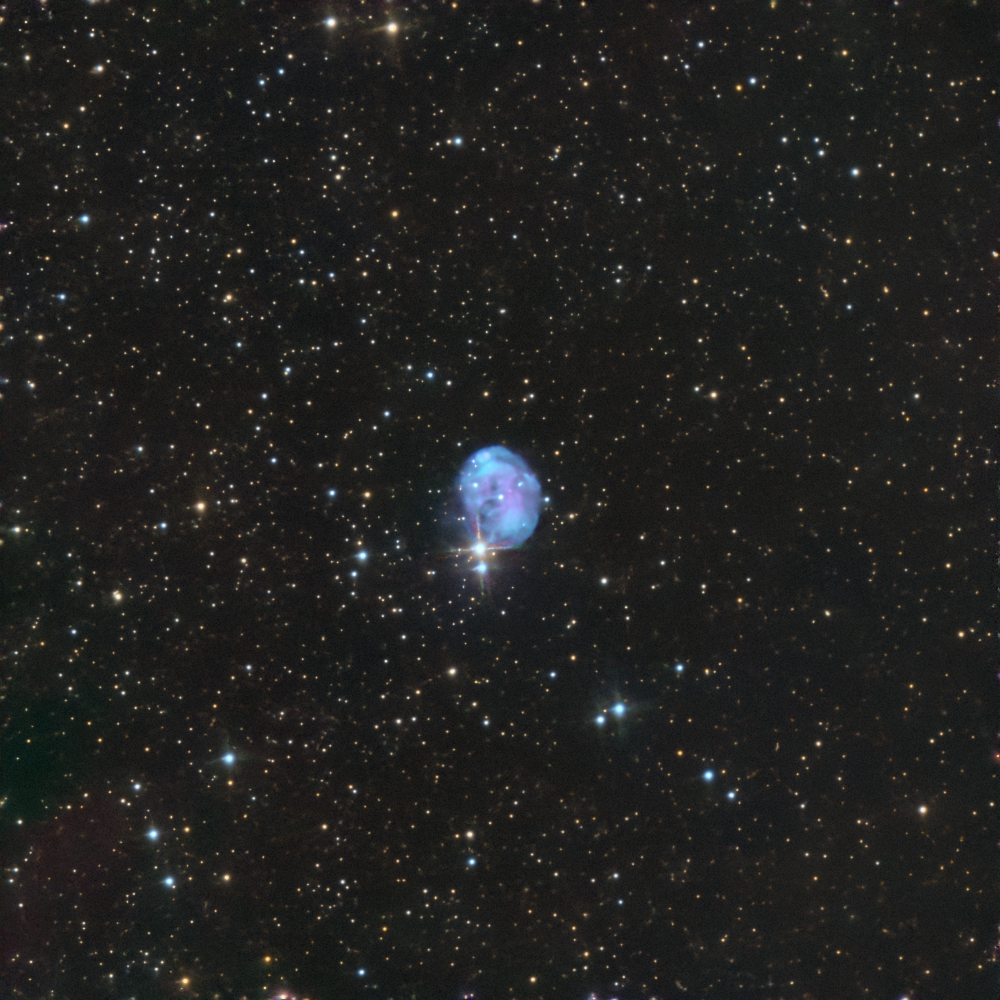
Here is an overview of the used equipment and the exposure times:
- Date: 2013
- Location: Krefeld
- Telescope/Lens: 10″ TS Newton
- Focal length [mm]: 1140
- Focal ratio: 4.5
- Mount: Losmandy G11
- Camera: Moravian 8300FW
- Filter: LRGB
- Exposure time [min]: 76:125:60:60
- Resolution: 0.97″/px
For the 2010 data the calibration, registration and the final processing was done with PixInsight.
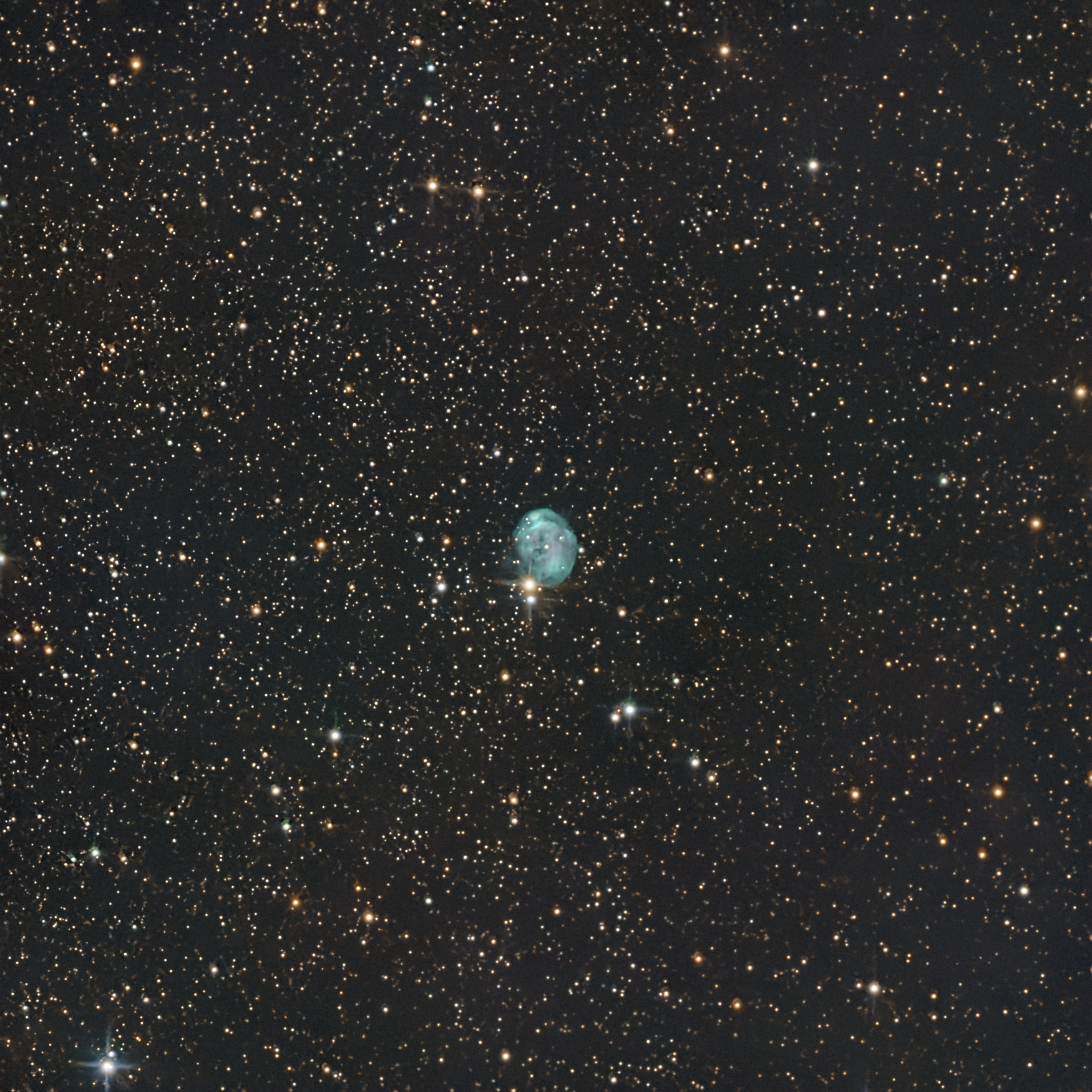
Here is an overview of the used equipment and the exposure times:
- Date: 2010
- Location: Krefeld
- Telescope/Lens: 10″ Orion Newton
- Focal length [mm]: 1200
- Focal ratio: 4.8
- Mount: Skywatcher NEQ6
- Camera: Canon 500Da
- Filter: OSC
- Exposure time [min]: 419
- Resolution: 0.81″/px




Leave a reply