

NGC 5005 and NGC 5033 from my own „Sterntaucher“ observatory
In 2020, I imaged the galaxy pair NGC 5005 and NGC 5033 using my dual-rig setup. The luminance data were captured with a higher-resolution telescope, while the RGB color information was recorded simultaneously with a second instrument. This approach allowed efficient acquisition of both detailed structural information and accurate color data, resulting in a deep LRGB image of this fascinating galaxy field.
Both galaxies are located in the constellation Canes Venatici and lie at distances of approximately 40 million light-years. Although they appear relatively close together in the sky and are members of the same general galaxy group, they exhibit remarkably different appearances and provide an interesting comparison of spiral galaxy morphology.
NGC 5005 is a large spiral galaxy viewed at a moderate inclination. Deep images reveal a bright central bulge crossed by intricate dust lanes and surrounded by tightly wound spiral arms. The galaxy contains significant amounts of gas and dust, as well as numerous regions of ongoing star formation. It is classified as a LINER galaxy (Low-Ionization Nuclear Emission-line Region), indicating a modest level of nuclear activity associated with its central supermassive black hole.
Nearby NGC 5033 presents a distinctly different appearance. This galaxy is viewed at a higher inclination and displays a more chaotic and asymmetric spiral structure. Prominent dust lanes cut across the disk, while numerous bright star-forming regions are visible throughout the spiral arms. NGC 5033 is also a well-known Seyfert galaxy, hosting an active galactic nucleus powered by matter accreting onto a central supermassive black hole. As a result, it has been the subject of extensive studies across optical, radio, infrared, and X-ray wavelengths.
One of the most interesting aspects of this field is the contrast between the two galaxies. NGC 5005 appears relatively smooth and orderly, while NGC 5033 exhibits a more irregular and dynamic structure. Together they provide an excellent illustration of the diversity found among nearby spiral galaxies. Deep observations also reveal numerous faint background galaxies scattered throughout the field, adding depth and scale to the image.
From a scientific perspective, both galaxies are important targets for studying the relationship between galactic structure, star formation, and nuclear activity. Their relative proximity allows astronomers to investigate fine details that would be difficult to observe in more distant systems.
The final LRGB image highlights the rich dust structures, subtle color variations, and numerous star-forming regions within both galaxies. It showcases not only two of the most attractive spiral galaxies in Canes Venatici but also the capabilities of the dual-rig imaging technique in capturing both high-resolution detail and natural color simultaneously.
Data calibration and registration and the final processing was done with PixInsight. The RGB Data was upscaled to the luminance data. The result was as follows:
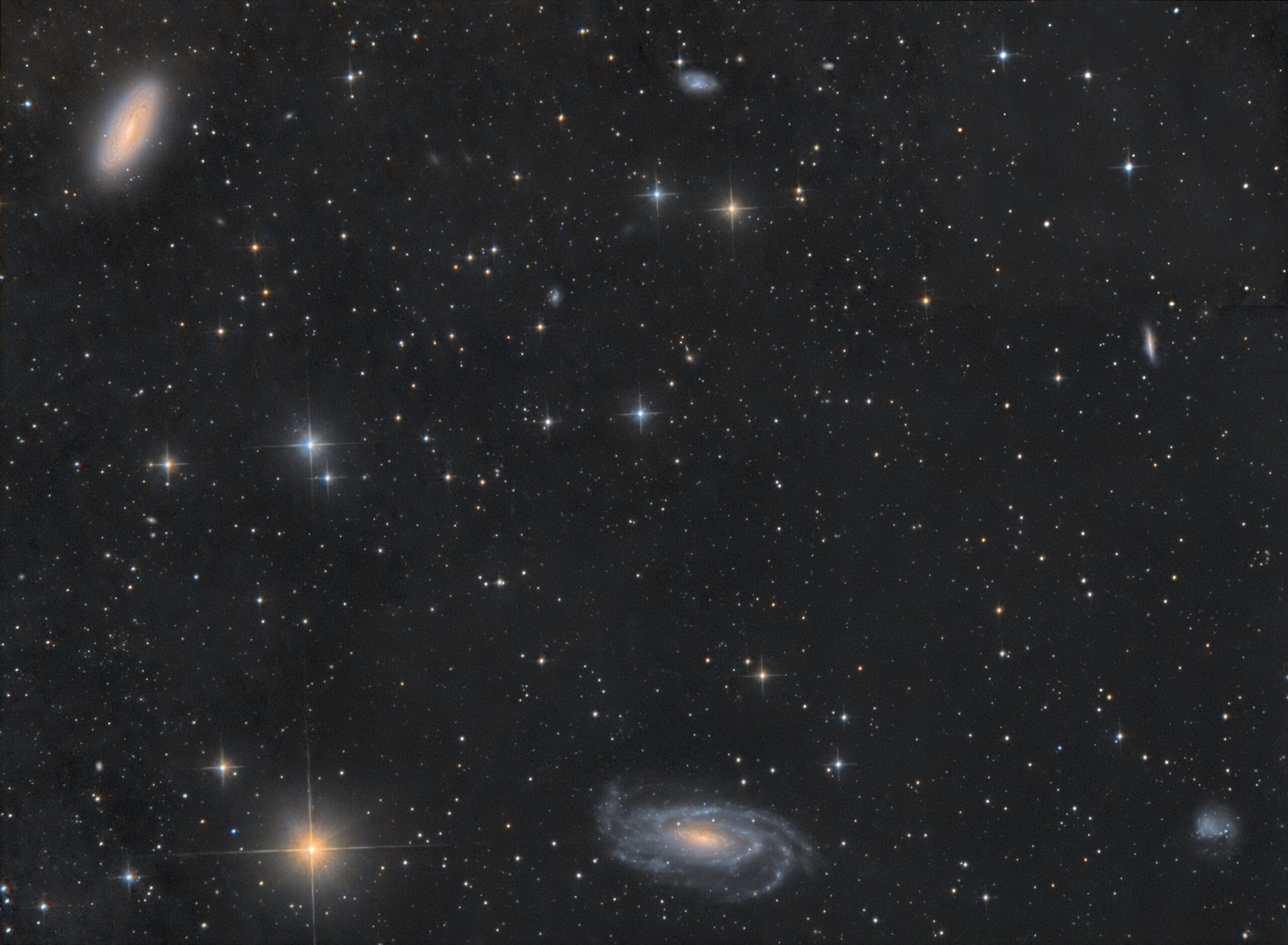

The faintest star in my image has an apparent magnitude of 22.2 magV (SDSS DR15).
The two highest redshift quasars [Flesh 2015] in the image are:
SDSS J131048.12+361557.3 z=3.43 magG=18.0 (Gaia DR2)
SDSS J131123.83+364140.5 z=2.87 magG=20.2 (Gaia DR2)
Here is an overview of the used equipment and the exposure times:
- Date: March 2020
- Location: Krefeld
- Telescope/Lens: 10″ Newton ohne Namen – TSQ-65ED Apo
- Focal length [mm]: 1000 – 420
- Focal ratio: 3.9 – 6.5
- Mount: Skywatcher EQ8
- Camera: Moravian G2 8300 FW – Moravian G3 16200 FW
- Filter: CLS – RGB
- Exposure time [min]: 1097 – 325:270:380
- Resolution: 1.11″/px – 2.95″/px




Leave a reply