

NGC 4449 from remote
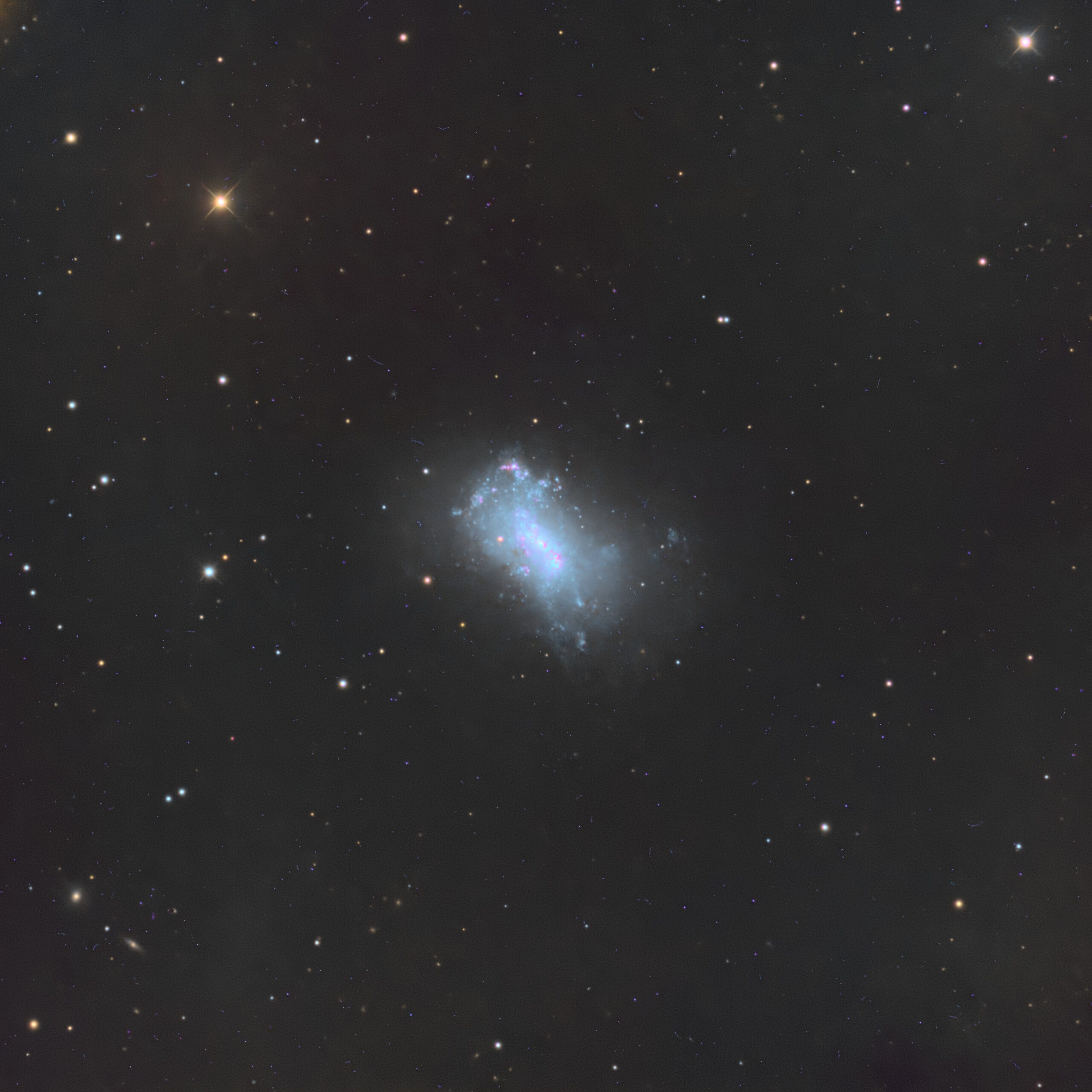
From time to time, I obtain data sets from remote observatories around the world. One of my favorite providers is Telescope Live, which operates telescopes in locations such as Chile, Australia, and Spain. One of the datasets I received in 2022 featured the irregular galaxy NGC 4449, acquired with a telescope in Spain.
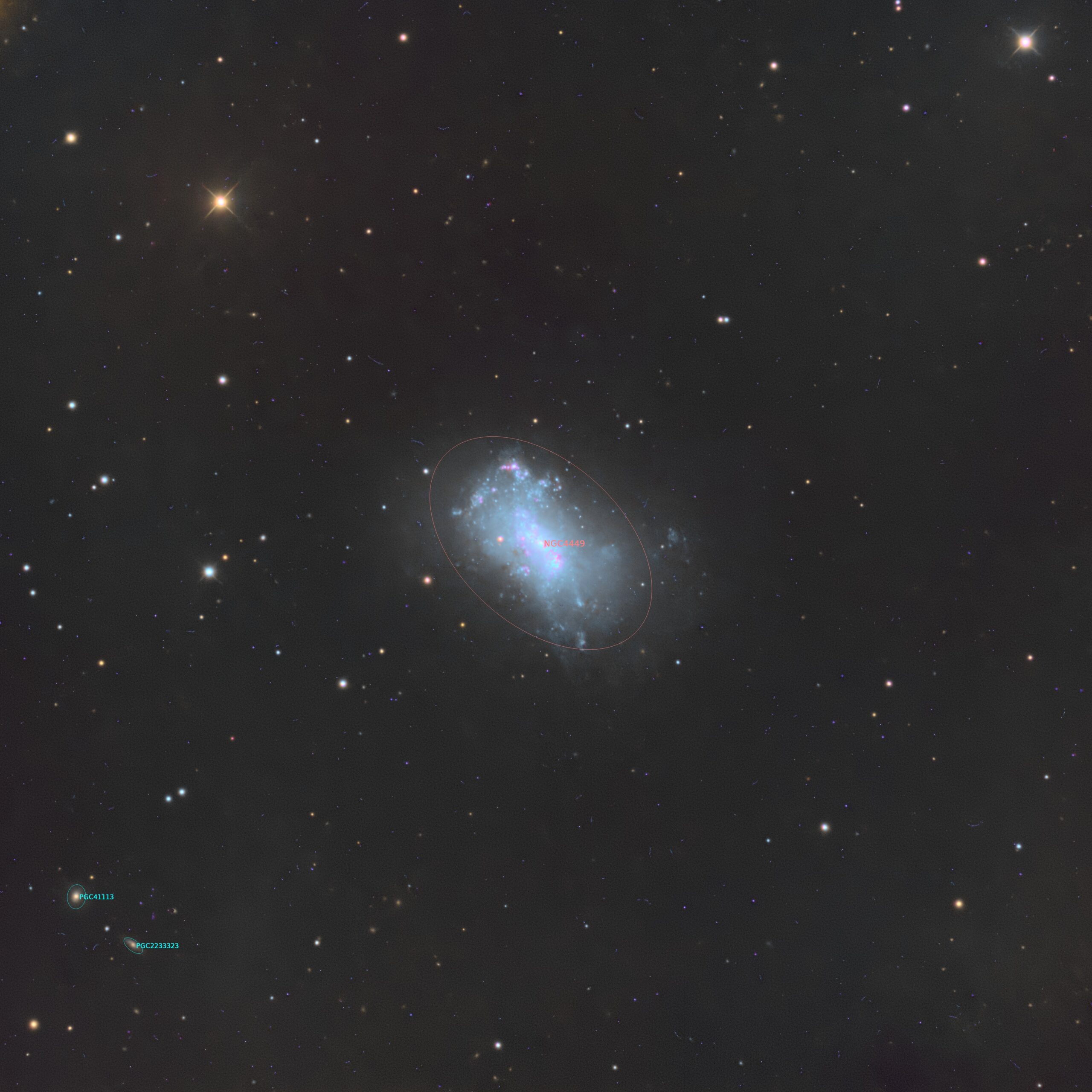
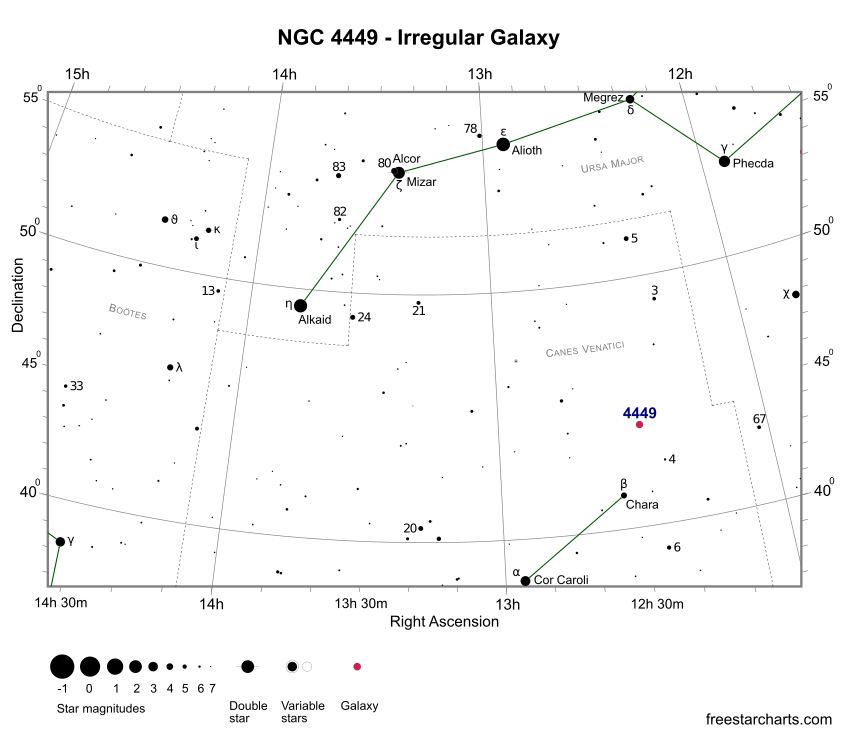
NGC 4449 is located in the constellation Canes Venatici at a distance of approximately 12 million light-years. It belongs to the Magellanic-type irregular galaxies, a class of galaxies that lack the well-defined spiral structure seen in larger systems such as the Milky Way. In appearance, NGC 4449 resembles an oversized version of the Large Magellanic Cloud, exhibiting a chaotic network of star-forming regions, dust clouds, and young stellar associations.
One of the most remarkable characteristics of NGC 4449 is its exceptionally high rate of star formation. The galaxy is considered a starburst galaxy, meaning that it is currently producing new stars at a significantly higher rate than would normally be expected for a galaxy of its size. Deep images reveal countless bright blue star clusters and luminous emission nebulae scattered throughout the galaxy, many of which contain massive young stars only a few million years old.
Astronomers believe that the vigorous star formation activity in NGC 4449 is at least partly the result of past gravitational interactions with smaller companion galaxies. Deep observations have revealed extensive stellar streams and tidal structures surrounding the galaxy, evidence that it has accreted smaller systems during its history. These interactions may have compressed large reservoirs of gas and triggered the intense star-forming activity observed today.
NGC 4449 is also notable for its rich population of young massive star clusters, some of which rival the masses of globular clusters despite being only a fraction of their age. These clusters provide valuable laboratories for studying how stars form and evolve in dense environments. In addition, the galaxy contains numerous supernova remnants and expanding shells of gas created by stellar winds and previous generations of massive stars.
The field surrounding NGC 4449 is particularly interesting because of the many faint background galaxies visible through and around the irregular galaxy. Deep exposures reveal subtle structures in the outer regions of the galaxy, including faint stellar halos and tidal debris that trace its complex evolutionary history.
The high-quality Telescope Live dataset from Spain allowed the intricate structure of NGC 4449 to be captured in excellent detail. The final image reveals a galaxy very different from the orderly spirals commonly photographed by astrophotographers, showcasing instead a dynamic and chaotic environment where star formation, stellar feedback, and gravitational interactions continue to shape the galaxy’s evolution.
The calibaration, registration and final processing was all performed with PixInsight. The result was as follows:
Here is an overview of the used equipment and the exposure times:
- Date: 2022
- Location: Spain
- Telescope/Lense: Officina Stellare Pro RC700
- Focal length [mm]: 5600
- Focal ratio: 8
- Mount: Equatorial fork mount
- Camera: FLI PL 16803
- Autoguiding: yes
- Filter: L:R:G:B
- Exposure time [min]: 30:75:75:75
- Resolution: 0.66″/px bin 2



Leave a reply