

NGC 4096 from my backyard
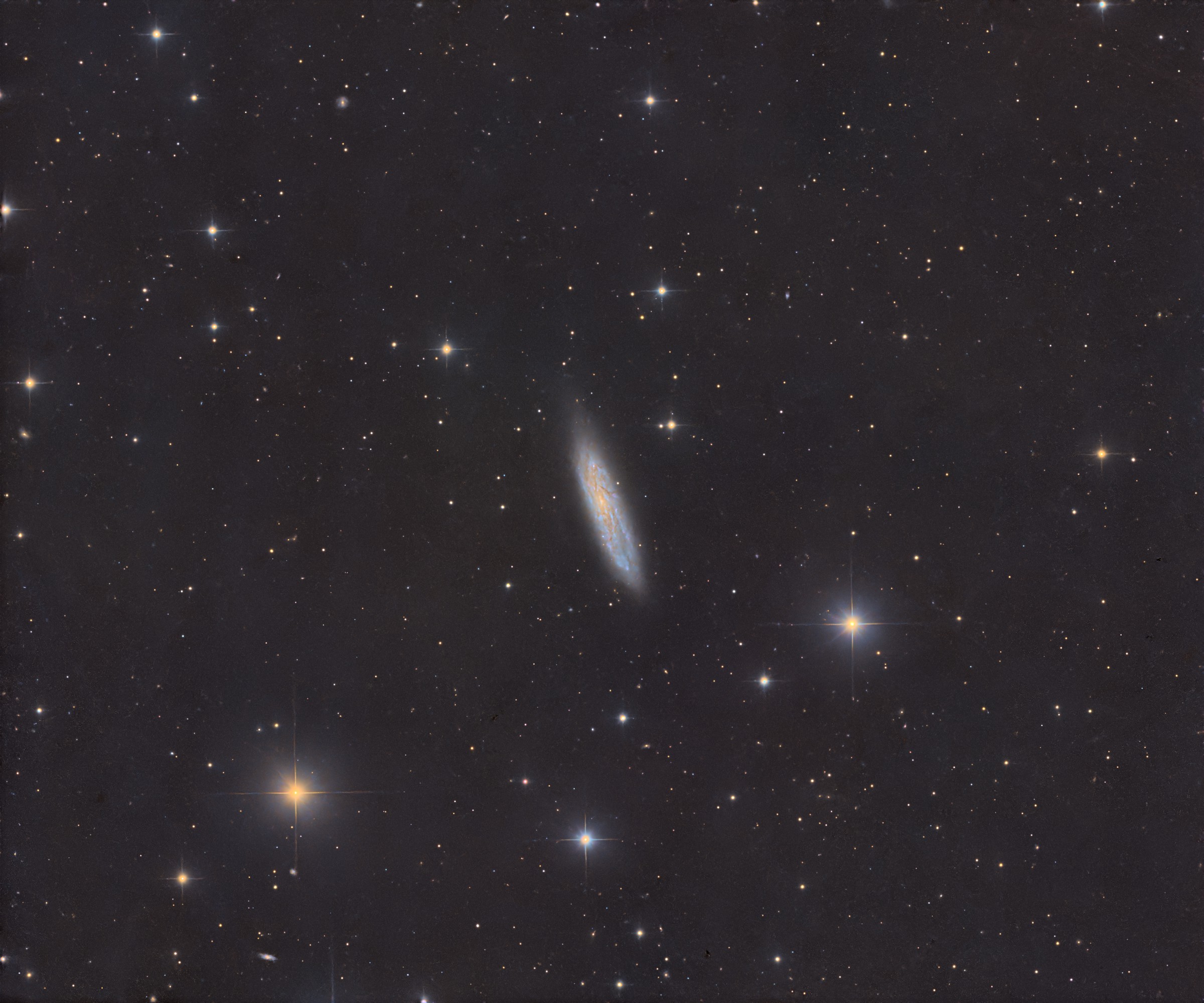
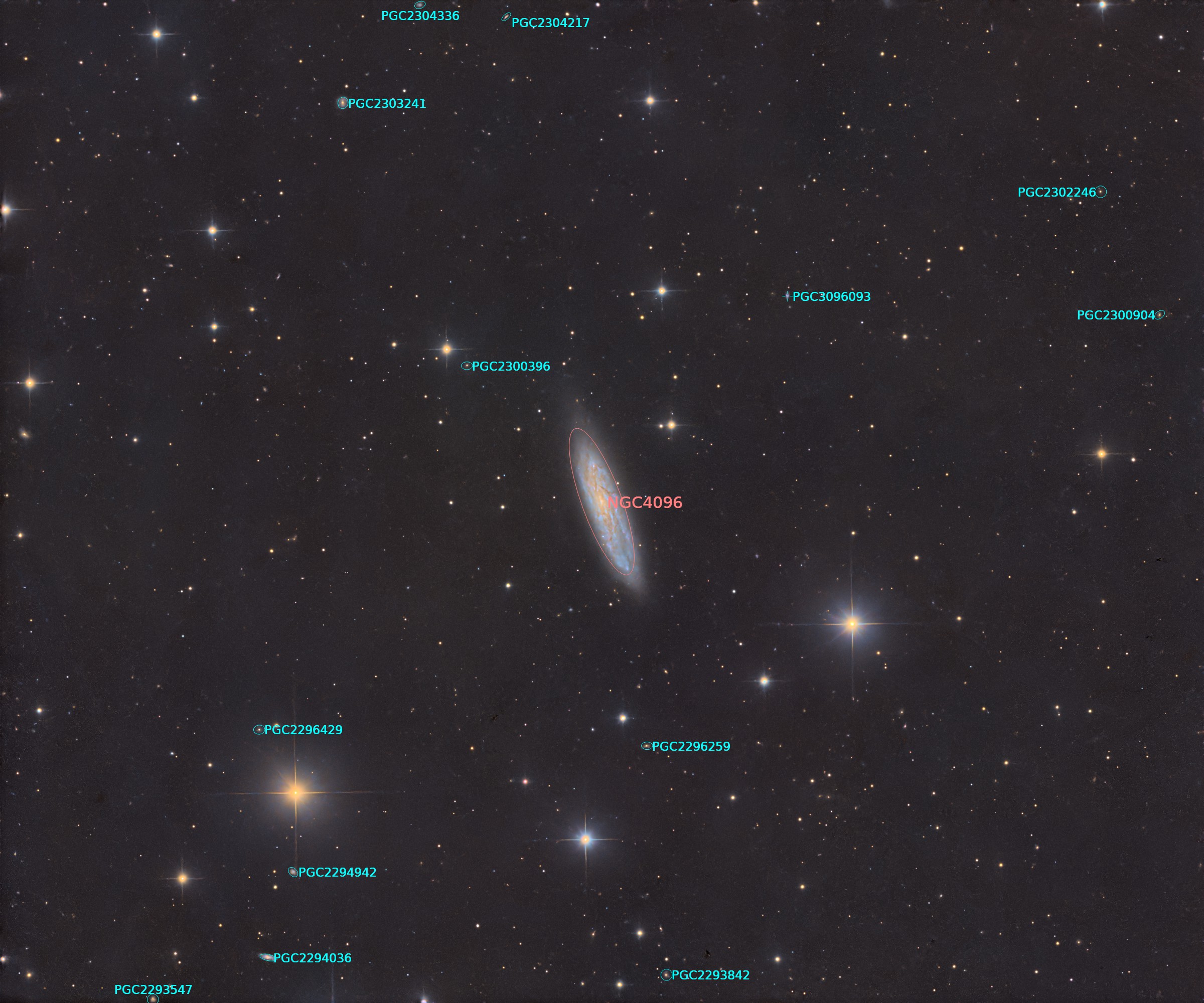
In 2016, I imaged the spiralgalaxy NGC 4096 from my backyard using a CCD camera and RGB filters.
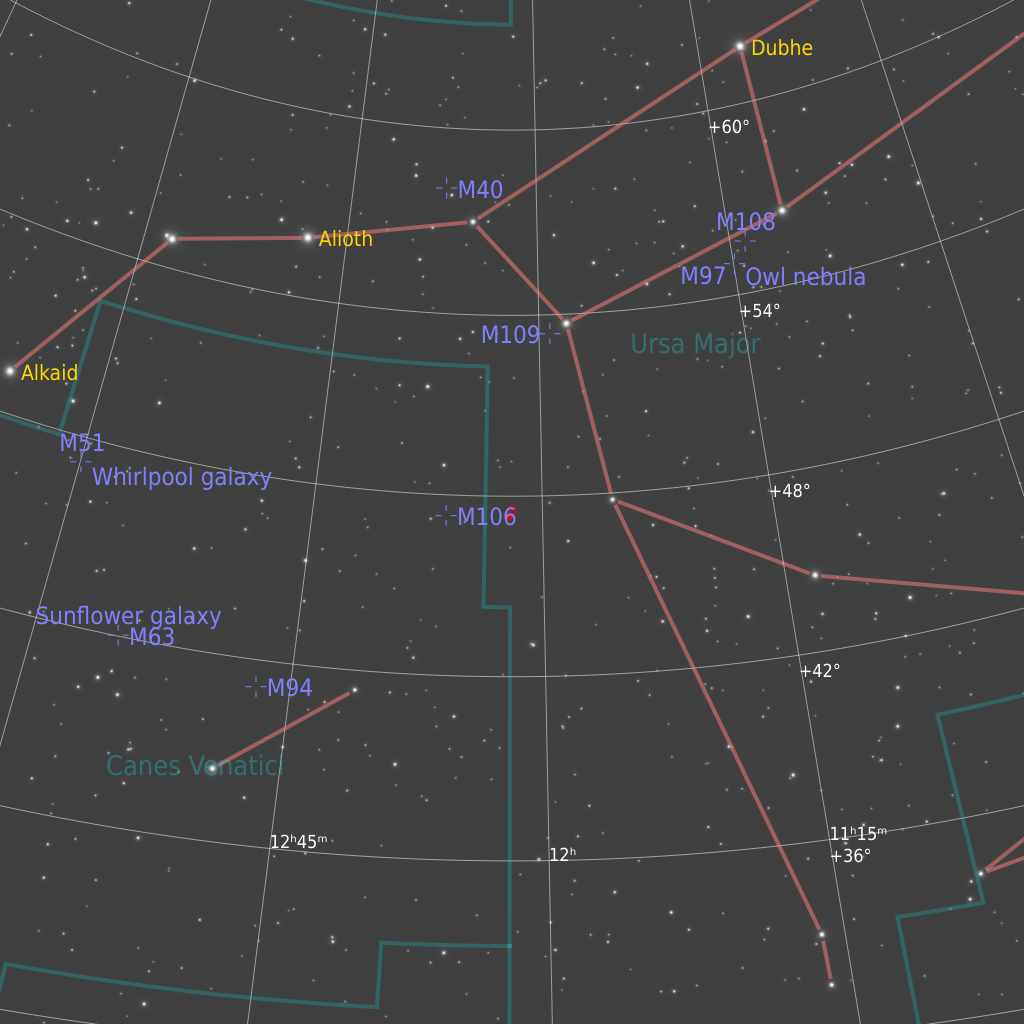
NGC 4096 is a spiral galaxy in Ursa Major, about 35 million light-years from Earth and roughly 80,000 light-years across. It is a fairly nearby example of a large disk galaxy, first discovered by William Herschel on March 9, 1788.
Appearance and structure
Astronomers generally describe NGC 4096 as an inclined spiral galaxy with a strong disk and multiple thin, well-defined arms. Some sources have suggested that it may contain a bar, but that feature has not been firmly proven, and its classification can vary between barred spiral and intermediate spiral in different catalogs. Its tilt is fairly high, with an inclination of about 76 degrees, so we see it at an angle rather than face-on.
The galaxy also shows noticeable asymmetry. Observations indicate that the northern side is stronger in carbon monoxide emission, while hydrogen and H-alpha emission are lopsided as well, following one of the spiral arms more strongly than the other. That kind of unevenness can be a clue that the galaxy has experienced tidal interactions, internal dynamical effects, or uneven gas distribution over time.
Physical properties
NGC 4096 has a total stellar mass estimated at about 6.13×10⁹ solar masses. Its star formation rate is modest, estimated at roughly 0.22 to 0.43 solar masses per year. That means it is actively forming new stars, but not at an especially dramatic pace compared with strongly starbursting galaxies.
Distance estimates vary somewhat depending on method. One set of measurements places it around 35 to 37.5 million light-years away, which is broadly consistent across different sources. Because it is relatively nearby on cosmic scales, astronomers can study its internal structure and gas distribution in more detail than they can for many more distant spirals.
Environment and group membership
NGC 4096 appears to belong to a larger galaxy group, though the exact group assignment differs among catalogues. One source places it in the LGG 269 group, while another associates it with the Messier 106 Group. A French catalog summary also notes that it may be part of a larger galaxy association tied to the NGC 4051 group or even a broader structure. These differing memberships are common in observational astronomy, since group definitions depend on the criteria used for distances and velocities.
Supernova history
Two supernovae have been recorded in NGC 4096. SN 1960H was a Type Ia peculiar event discovered in 1960, and SN 2014bi was a Type II-P supernova discovered in 2014. The presence of multiple supernovae makes the galaxy scientifically useful, because supernovae help astronomers study stellar evolution, distances, and the interstellar environment.
Why it matters
NGC 4096 is interesting because it combines several traits that make a galaxy worth studying: a clear spiral structure, detectable gas asymmetries, ongoing star formation, and a history of supernova activity. It is not one of the most famous galaxies in the sky, but it is representative of the kind of nearby spiral systems that help astronomers understand how disk galaxies evolve. In that sense, it is a useful laboratory for studying the balance between gas, stars, and structure in a normal spiral galaxy.
Data calibration and registration and the final processing was done with PixInsight. The result was as follows:
Here is an overview of the used equipment and the exposure times:
- Date: 2016
- Location: Krefeld
- Telescope/Lens: 10″ Newton ohne Namen
- Focal length [mm]: 1000
- Focal ratio: 3.9
- Mount: Losmandy G11
- Camera: Moravian G2 8300 FW
- Filter: RGB
- Exposure time [min]: 60:60:60
- Resolution: 1.11″/px



Leave a reply