

NGC 4088 from my own „Sterntaucher“ observatory
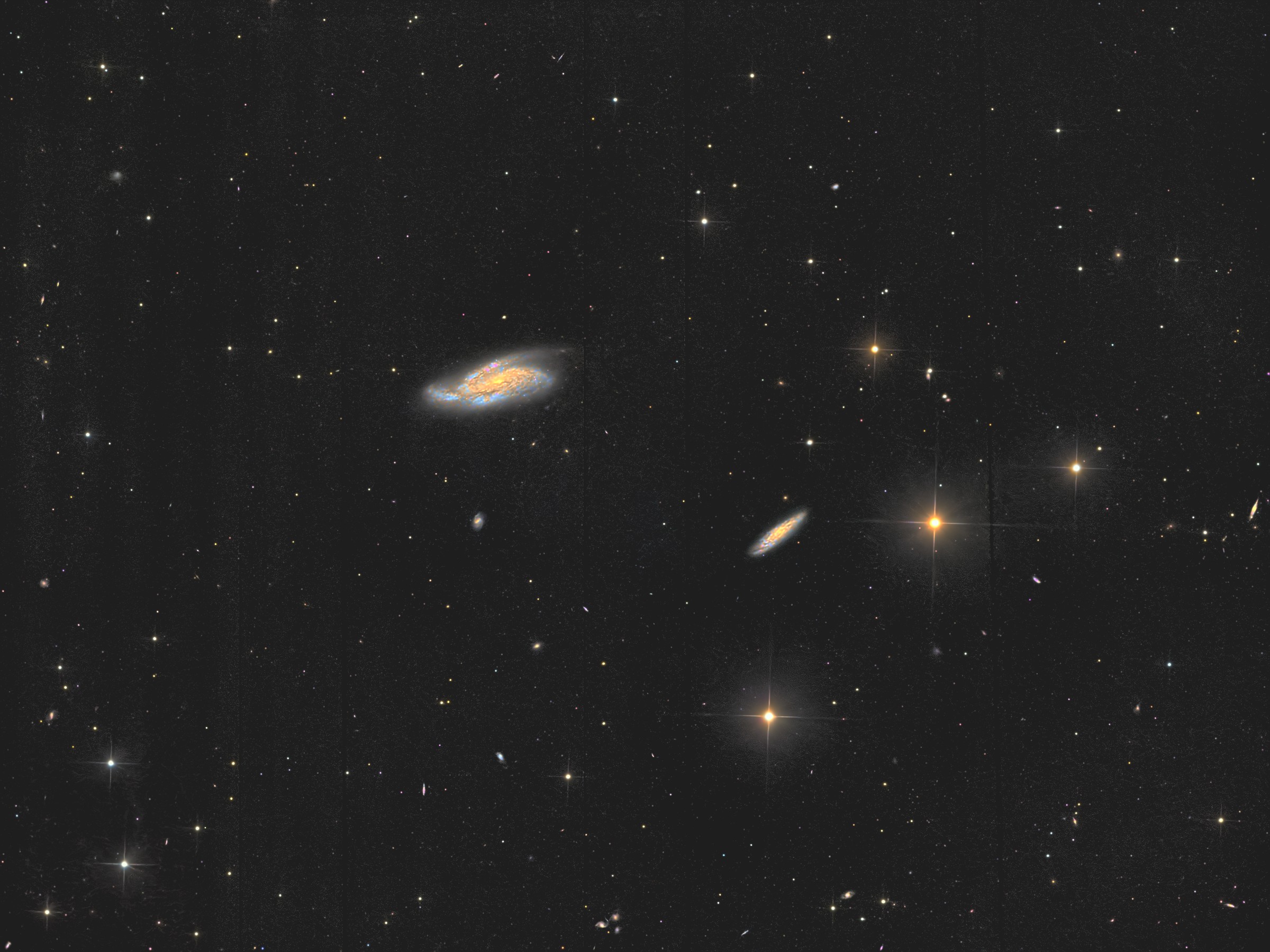
In 2022, I imaged the spiral galaxy NGC 4088 from my observatory in Krefeld using a dual-rig setup. The luminance data were captured with a higher-resolution optical system, while the RGB color information was recorded simultaneously with a second telescope. For the final LRGB image, the RGB data were carefully upscaled to match the resolution of the luminance frames, allowing the detailed structural information from the luminance channel to define the image while preserving accurate color from the RGB dataset.
Scientifically, NGC 4088 is a striking barred spiral galaxy located in the constellation Ursa Major, approximately 50 million light-years from Earth. Classified as SAB(rs)bc, it is viewed at a moderate inclination, allowing its rich spiral structure, dark dust lanes, and numerous star-forming regions to be observed in considerable detail.
NGC 4088 is a member of the M109 Group and forms a physical pair with the nearby galaxy NGC 4085. Gravitational interactions within this system are thought to contribute to the slightly asymmetric appearance of NGC 4088, particularly in its outer spiral arms. Deep images reveal a complex network of dust lanes winding through the disk, interspersed with numerous bright H II regions where active star formation is taking place.
One of the most remarkable features of NGC 4088 is the abundance of young stellar associations scattered throughout its spiral arms. These regions contain hot, massive stars whose intense ultraviolet radiation ionizes the surrounding hydrogen gas, producing bright emission nebulae visible in deep images. The galaxy therefore serves as an excellent example of ongoing star formation within a nearby spiral galaxy.
NGC 4088 has also attracted scientific interest because it has hosted several observed supernovae, including SN 2009dd and SN 2022jzc. Such events provide valuable information about stellar evolution and contribute to the enrichment of the interstellar medium with heavy elements produced during the lives and deaths of massive stars.
Deep observations reveal that the galaxy’s disk extends well beyond the bright central regions, containing faint stellar structures and diffuse outer arms. Numerous distant background galaxies are also visible throughout the field, adding depth and scale to the image. The bright central bulge is dominated by an older stellar population, while the spiral arms display a noticeably bluer color due to the presence of young stars and active star-forming regions.
The combination of high-resolution luminance data and carefully upscaled RGB information allowed the final LRGB image to capture both the fine structural details and the subtle color variations across the galaxy. The result highlights the intricate dust lanes, luminous star-forming regions, and graceful spiral pattern that make NGC 4088 one of the most attractive galaxies in Ursa Major.
Data calibration and registration and the final processing was done with PixInsight.
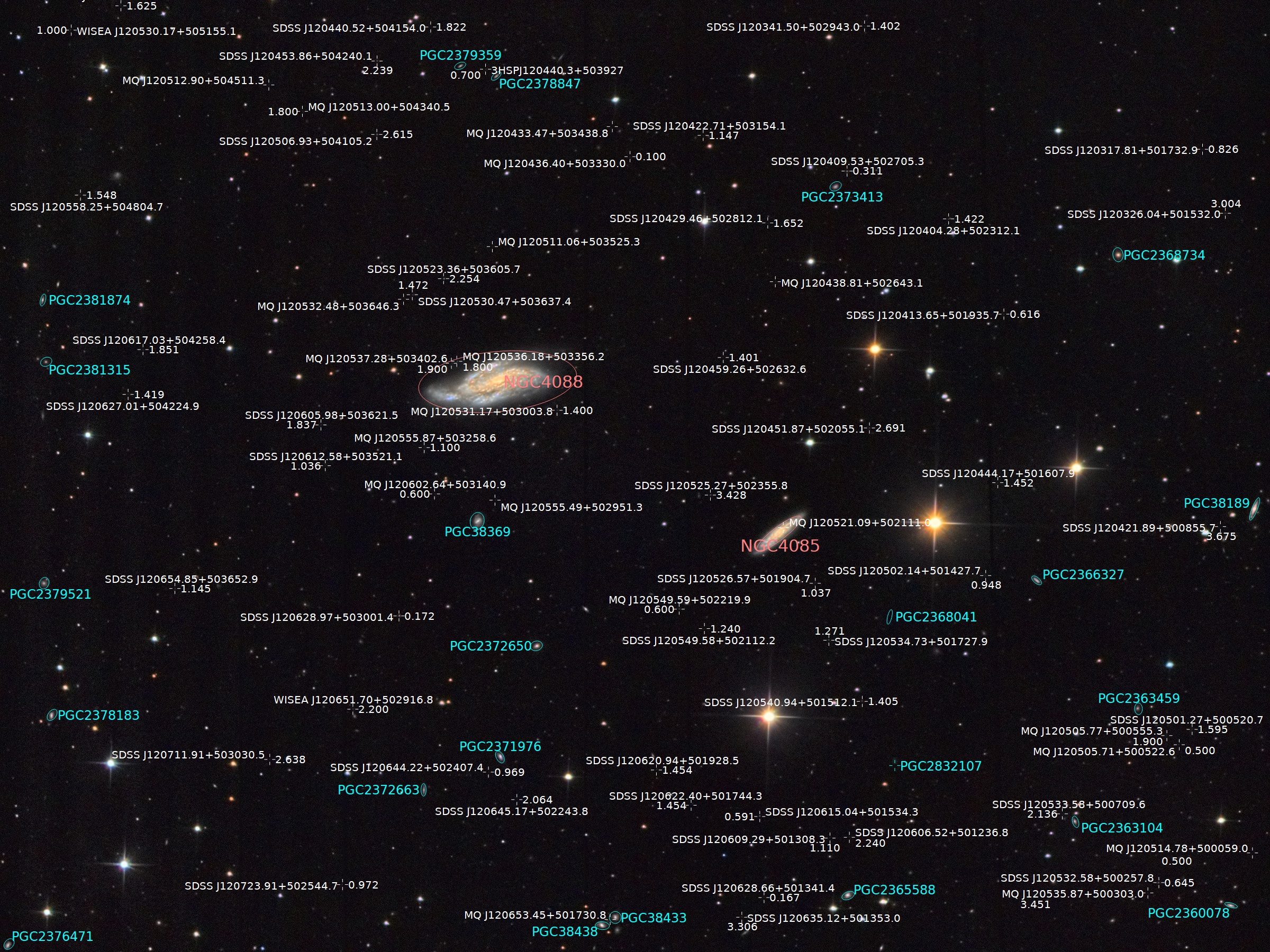
In the field were quiet a lot of quasars (see annotation). The three most distant of them are:
SDSS J120551.50+500609.9 with a redshift of 3.451 an apparent magB of 21.39 (2017,PASA,34,25).
SDSS J120525.27+502355.8 with a redshift of 3.428 an apparent magB of 21.31 (2017,PASA,34,25).
SDSS J120635.12+501353.0 with a redshift of 3.306 an apparent magB of 20.76 (2017,PASA,34,25).
The faintest object in this image has an apparent magnitude of approx. 21.4 magB (2017,PASA,34,25).
Here is an overview of the used equipment and the exposure times:
- Date: 2022
- Location: Krefeld
- Telescope/Lens: 10″ Newton ohne Namen – TSQ-65ED Apo
- Focal length [mm]: 1000 – 420
- Focal ratio: 3.9 – 6.5
- Mount: Skywatcher EQ8
- Camera: QSI 583WS – Moravian G3 16200 FW
- Filter: L – RGB
- Exposure time [min]: 820 – 255:190:220
- Resolution: 1.11″/px – 2.95″/px



Leave a reply