

NGC 3242 (Ghost of Jupiter) from Telescope Live CHI-1-CMOS
From time to time, I obtain data sets from remote observatories around the world. One of my favorite providers is Telescope Live, which operates telescopes in locations such as Chile, Australia, and Spain. One of the datasets I received in 2024 consisted of HSO narrowband data of the planetary nebula NGC 3242. The narrowband data provided excellent contrast and revealed subtle structural details that are difficult to capture with broadband imaging alone.
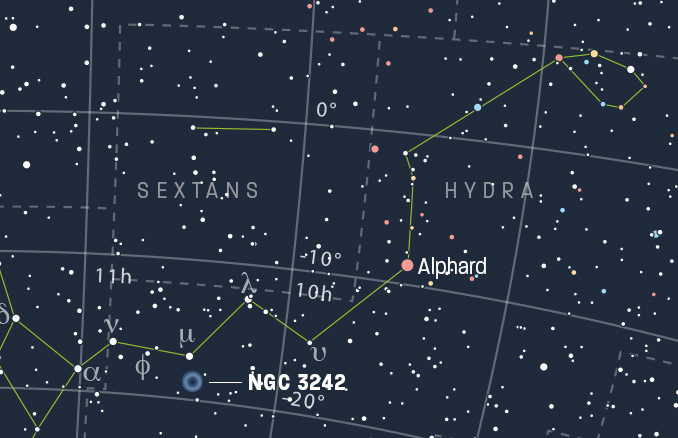
NGC 3242 is located in the constellation Hydra at a distance of approximately 4,000–5,000 light-years. It is one of the brightest and most studied planetary nebulae in the sky and is commonly known as the Ghost of Jupiter Nebula. Through small telescopes, its bluish-green appearance and nearly circular shape vaguely resemble a distant planet, leading to this popular nickname. Despite its bright appearance, NGC 3242 is not related to planets at all; instead, it represents a brief and spectacular phase in the life cycle of a Sun-like star.
The nebula was created when the progenitor star exhausted its nuclear fuel and entered the final stages of stellar evolution. During this phase, the star expelled its outer layers into space, creating an expanding shell of gas. The hot stellar remnant left behind has evolved into a white dwarf with a surface temperature exceeding 70,000 Kelvin. Intense ultraviolet radiation from this central star ionizes the surrounding gas, causing it to glow brightly in characteristic emission lines.
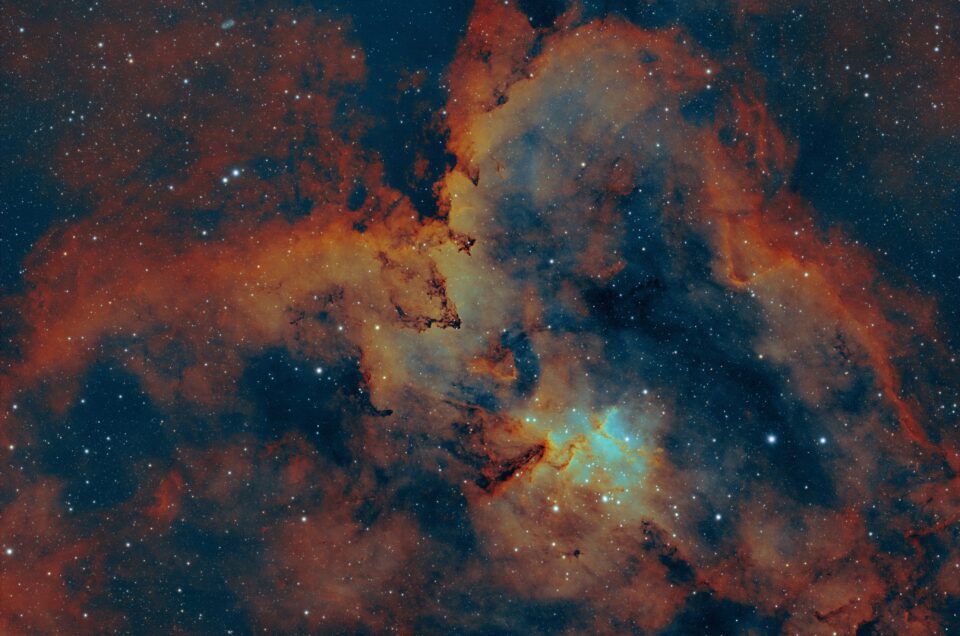
The HSO dataset records the nebula through hydrogen (Hα), sulfur ([S II]), and oxygen ([O III]) filters. Each of these emission lines traces different physical conditions within the nebula. Hydrogen highlights the overall distribution of ionized gas, sulfur often reveals regions affected by shock fronts and denser material, while oxygen traces highly excited gas close to the central star. Combining these channels produces a highly detailed image that not only emphasizes the beauty of the nebula but also visualizes the underlying astrophysical processes.
Although NGC 3242 appears relatively simple in small telescopes, deep images reveal a remarkably complex structure. The bright inner shell is surrounded by multiple nested envelopes, delicate filaments, arcs, and knots of gas. Observations have shown that the nebula is actually composed of several shells produced during different episodes of mass loss. Fast stellar winds emitted by the central white dwarf continue to interact with material ejected earlier, creating shock fronts and compressing the gas into intricate structures.
One of the most fascinating features of NGC 3242 is its extremely faint outer halo. This halo extends far beyond the bright central nebula and contains material expelled thousands of years before the formation of the inner shell. Detecting these outer structures requires very deep exposures and careful image processing. The halo provides astronomers with a valuable record of the mass-loss history of the progenitor star and offers insight into how Sun-like stars enrich the interstellar medium with heavy elements.
High-resolution observations have also revealed small jet-like features and symmetrical protrusions extending from the central regions. These structures suggest that the shaping of the nebula may have been influenced by magnetic fields, asymmetric stellar winds, or perhaps even an unseen binary companion. Such mechanisms are believed to play an important role in the formation of many planetary nebulae and remain an active area of research.
The high-quality HSO data from Telescope Live allowed for a detailed rendering of both the bright inner shell and the faint outer structures of this remarkable object. The final image highlights the rich interplay of hydrogen, sulfur, and oxygen emission while revealing the extraordinary complexity hidden within one of the sky’s most beautiful planetary nebulae. NGC 3242 serves as a striking reminder of the future fate awaiting stars similar to our own Sun and provides a fascinating glimpse into the processes that shape and enrich our galaxy.
Data calibration and registration and the final processing was done with PixInsight.
H was assigned to the red channel, O was assigned to the blue and green channel. The result was as follows:


The images were taken with the following equipment (Telescope Live CHI-1 CMOS):
- Date: 2024
- Location: El Sauce Observatory, Chile
- Telescope: Planwave CDK24
- Focal length [mm]: 3962
- Focal ratio: 6.5
- Mount: Mathis MI-1000/1250
- Camera: QHY 600M Pro
- Filter: Hα:[OIII][SII]
- Exposure time [min]: 125:125:130
- Resolution: 0.39″/px (2×2 binning)



Leave a reply