

NGC 3227 from my backyard
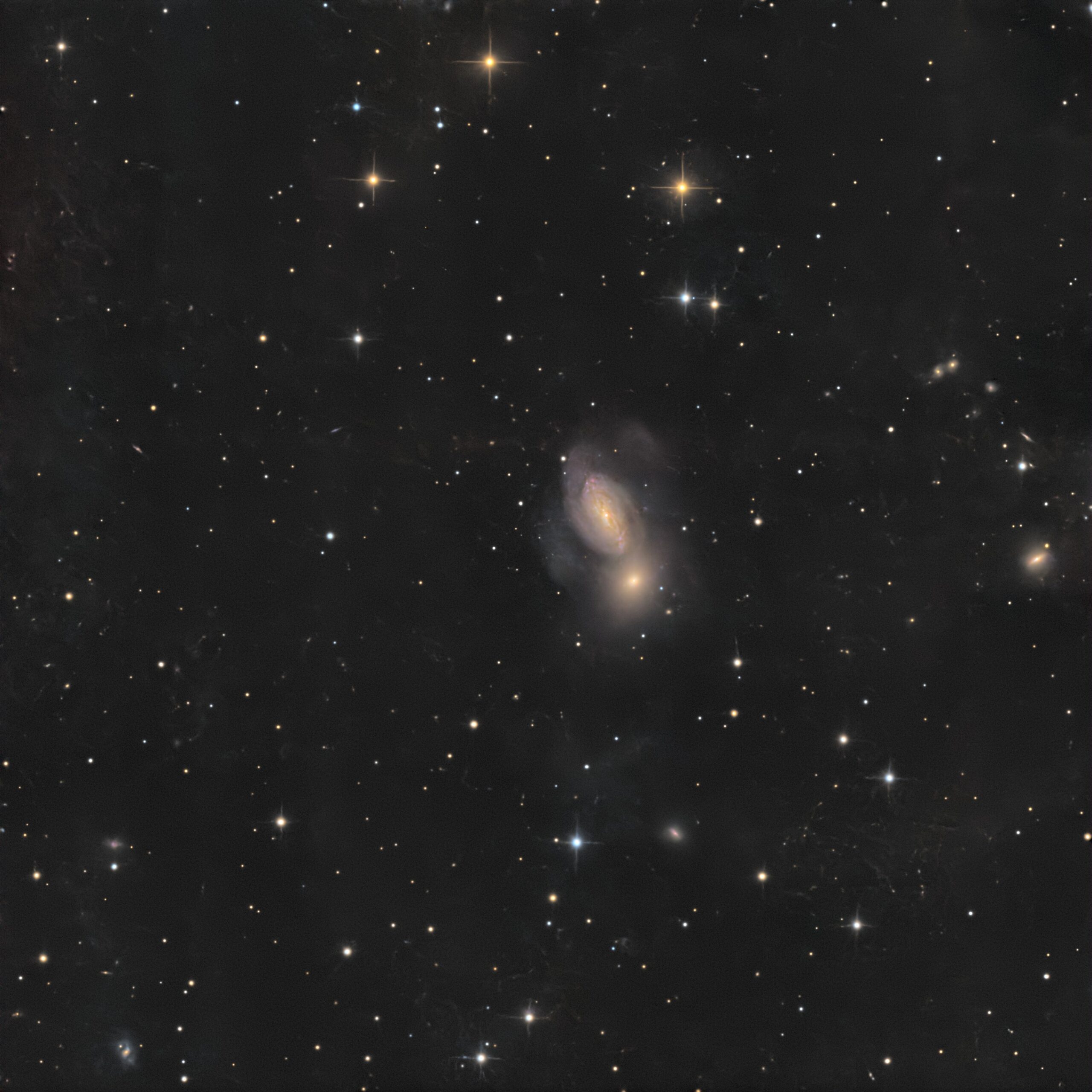
In 2015 and 2016, I imaged the interacting galaxy NGC 3227 from my backyard using a CCD camera and RGB filters. Both datasets were acquired with the same equipment and imaging technique. To improve the signal-to-noise ratio and reveal fainter structures, I combined all data from both years into a single final image.
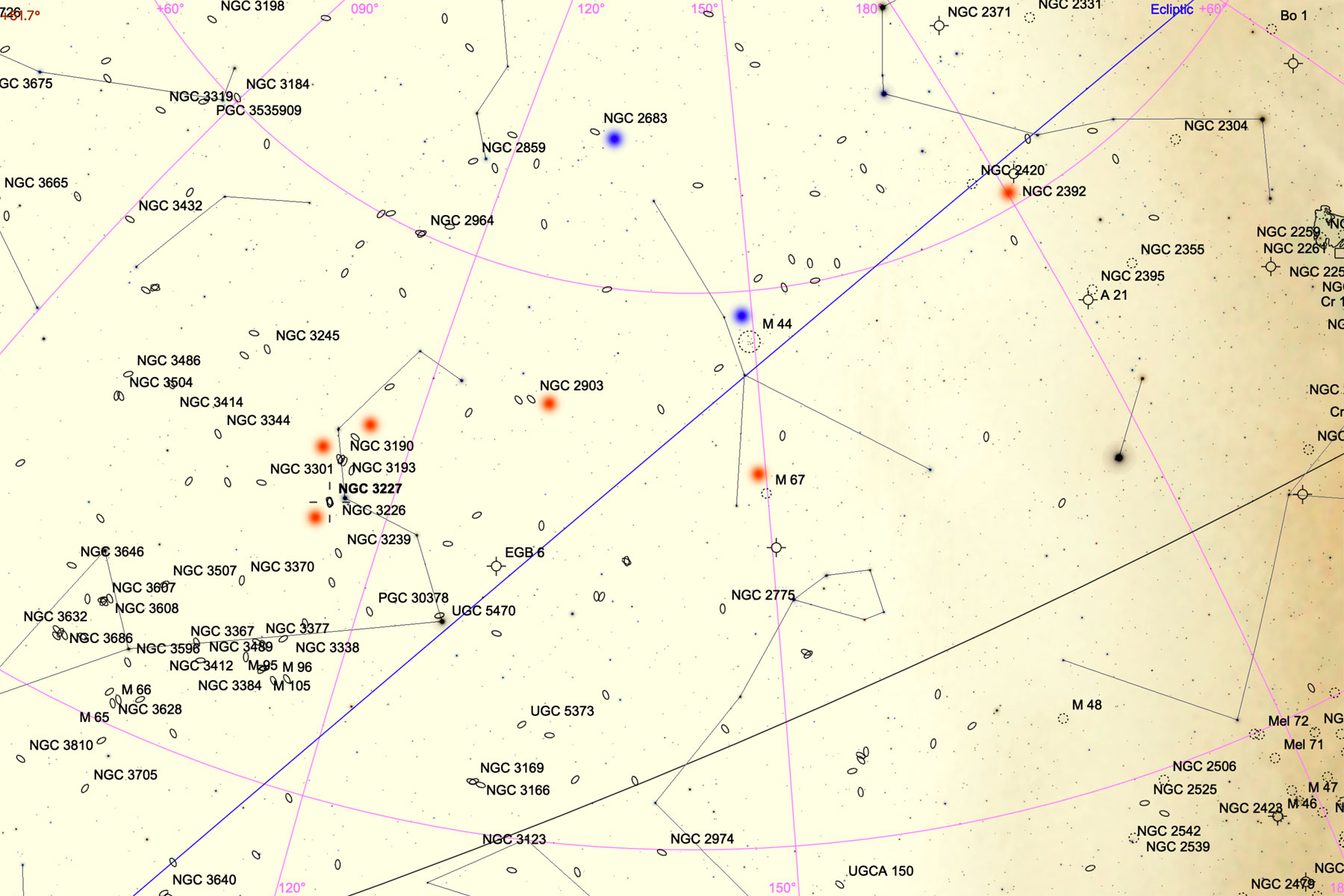
NGC 3227 is located in the constellation Leo at a distance of approximately 70 million light-years. It forms a well-known interacting pair with the nearby elliptical galaxy NGC 3226. The gravitational interaction between the two galaxies has significantly influenced their appearance, producing distorted spiral arms, tidal features, and enhanced star formation within NGC 3227.
Classified as a barred spiral galaxy, NGC 3227 is also an active galaxy with a Seyfert nucleus. At its center resides a supermassive black hole that actively accretes material, generating radiation across a wide range of wavelengths. This nuclear activity makes NGC 3227 an important target for professional astronomical research, particularly in studies of active galactic nuclei and galaxy evolution.
Deep images reveal a wealth of detail within the galaxy’s disk, including dark dust lanes, bright star-forming regions, and subtle asymmetries caused by the ongoing interaction with NGC 3226. The companion galaxy appears much smoother and more featureless, creating a striking contrast between the two systems. Faint tidal structures surrounding the pair provide visible evidence of the gravitational forces shaping both galaxies over hundreds of millions of years.
The combined data from 2015 and 2016 allowed significantly greater depth than either dataset alone, bringing out the delicate outer structures of the interacting system while preserving the fine detail in the galaxy’s central regions. The result highlights one of the most interesting interacting galaxy pairs in the spring sky and showcases the dynamic processes that drive galaxy evolution.
Data calibration and registration and the final processing was done with PixInsight. The result was as follows:
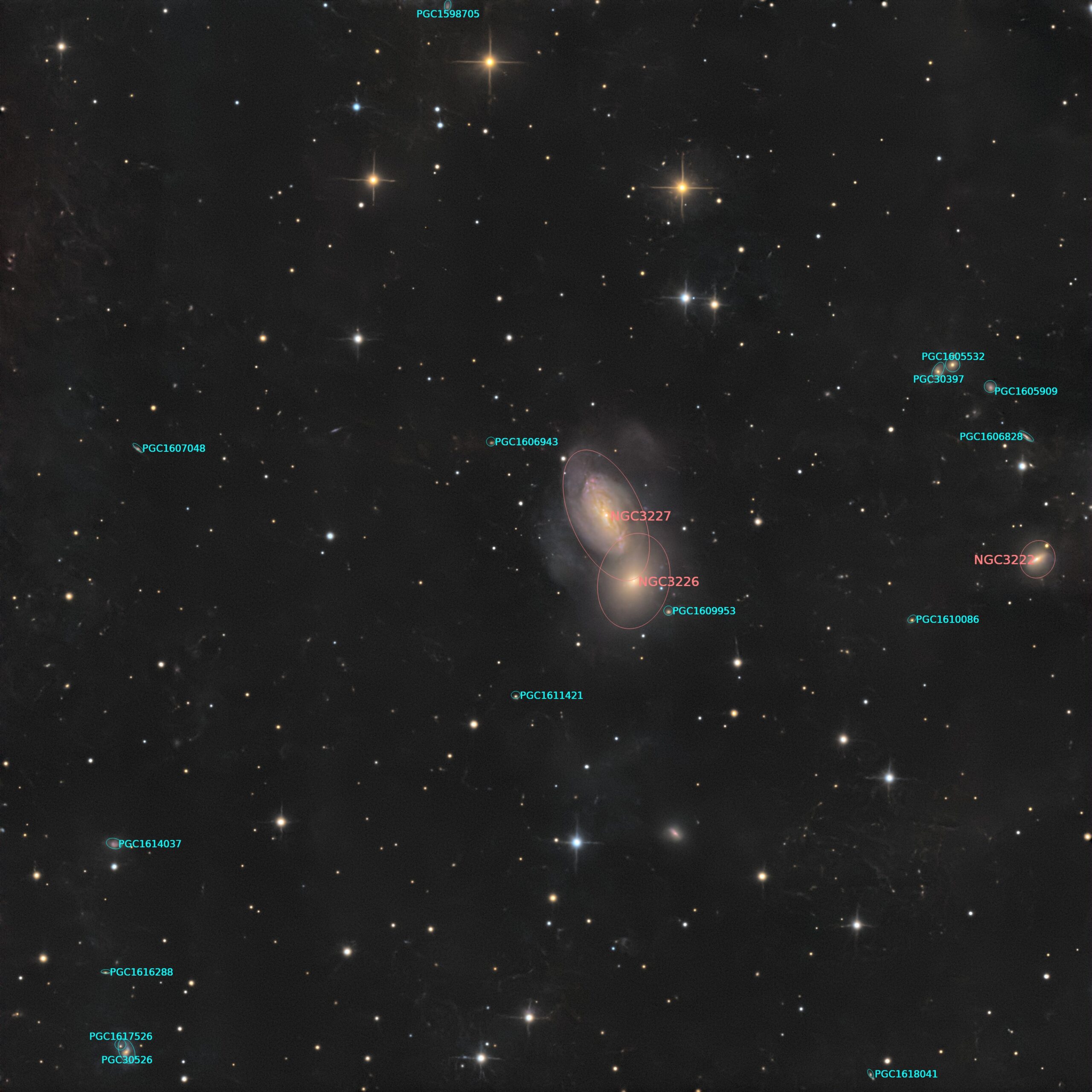
Here is an overview of the used equipment and the exposure times:
- Date: 2015, 2016
- Location: Krefeld
- Telescope/Lens: 10″ Newton ohne Namen
- Focal length [mm]: 1000
- Focal ratio: 3.9
- Mount: Losmandy G11
- Camera: Moravian G2 8300 FW
- Filter: RGB
- Exposure time [min]: 135:135:135
- Resolution: 1.11″/px



Leave a reply