

NGC 2736 (Pencil nebula)
I imaged the supernova remnant NGC 2736 several times over the years using datasets from different remote observatories and imaging systems. My first encounter with this fascinating object was in 2020, when I received a dataset from the Insight Observatory in Chile. This dataset was taken with a relatively long focal length and an older CCD camera, providing a highly detailed close-up view of the nebula’s intricate filamentary structure.
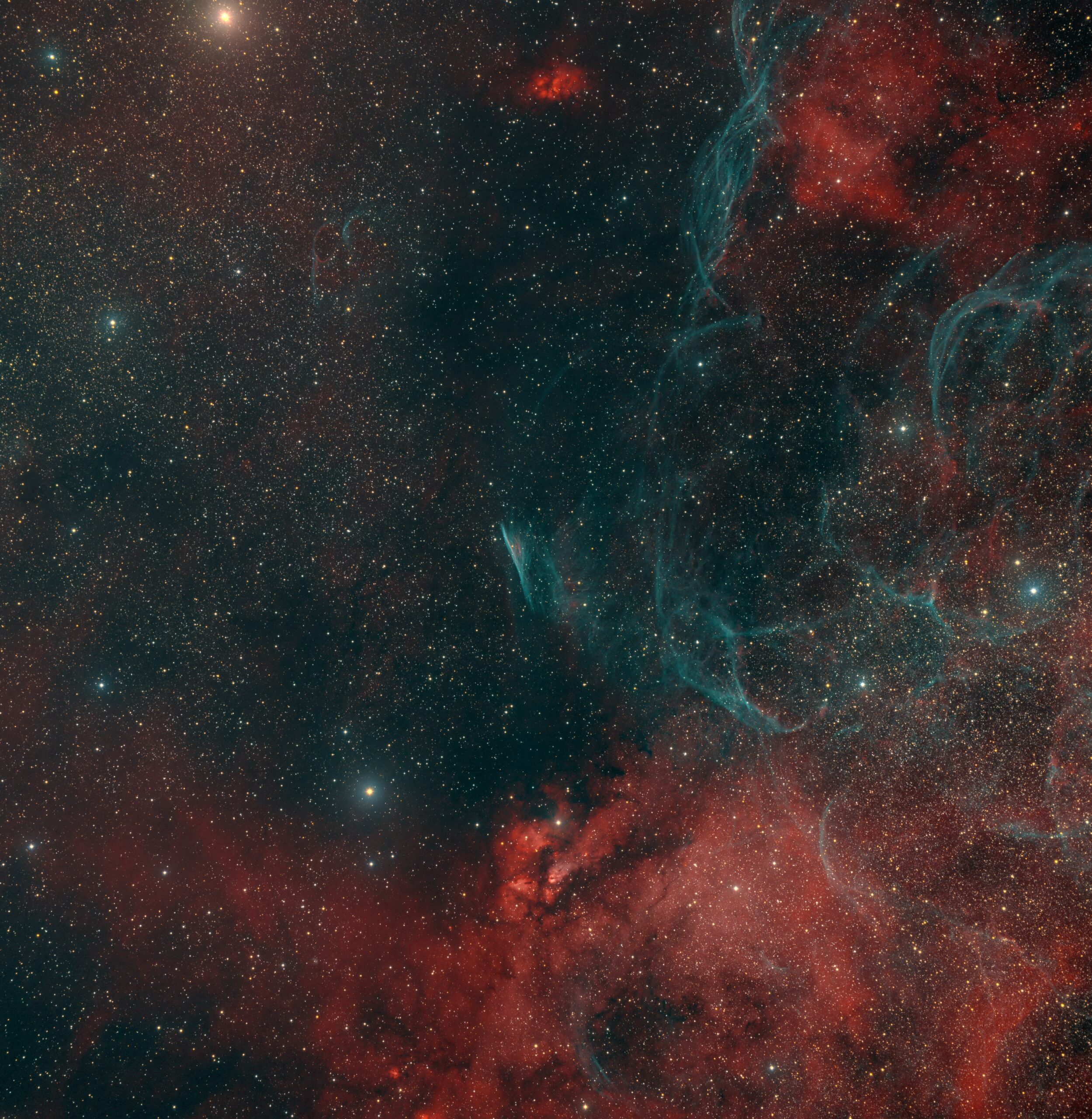
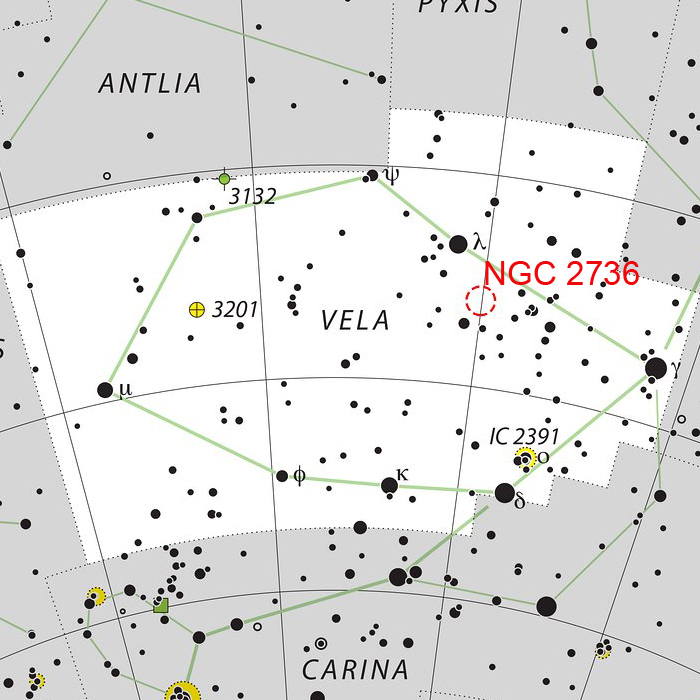
In 2021, I received a second dataset from Telescope Live, this time acquired in Australia with another CCD-based imaging system. Unlike the earlier close-up image, this dataset offered a much wider field of view, placing NGC 2736 into its larger astrophysical context within the enormous Vela Supernova Remnant. The wide-field perspective revealed how the Pencil Nebula connects to a vast network of shock fronts, arcs, and diffuse emission structures spread across a large portion of the constellation.
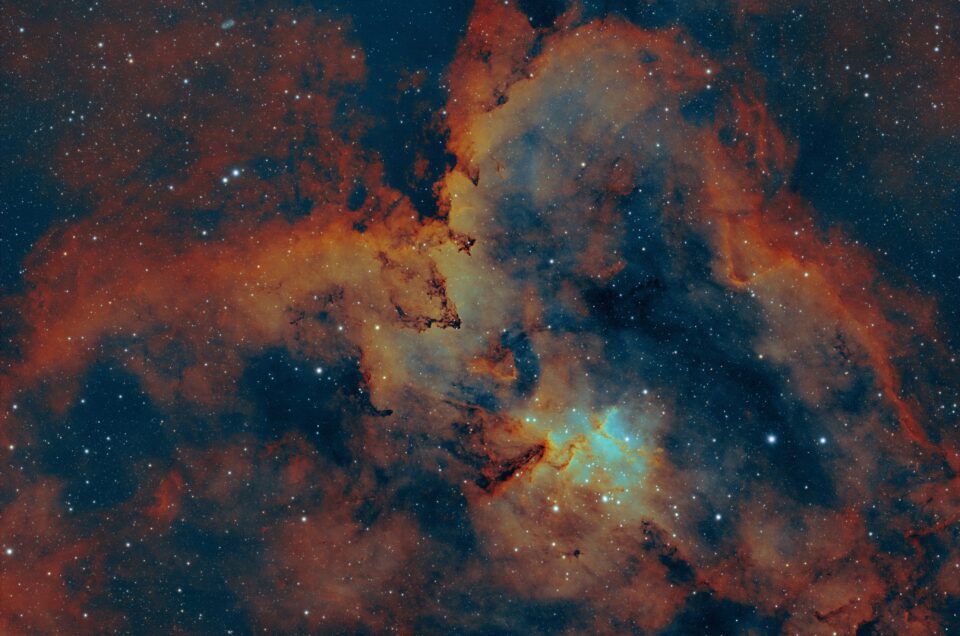
Most recently, in 2024, I imaged the object myself using the remote telescope of the VdS Remote Observatory at Hakos in Namibia. This dataset was recorded with a modern CMOS camera, whose high sensitivity and low read noise allowed for excellent contrast and the detection of extremely faint outer structures. Comparing the three datasets clearly demonstrates both the advantages of different image scales and the rapid technological evolution from older CCD systems to modern CMOS-based astrophotography.
Scientifically, NGC 2736 is one of the brightest and most visually striking filaments of the Vela Supernova Remnant, located approximately 800 light-years away in the constellation Vela. The Vela remnant itself is the expanding debris cloud of a massive star that exploded in a supernova event roughly 11,000 years ago. Because of its relatively close distance to Earth, the remnant covers an enormous apparent area on the sky, extending over many degrees.
NGC 2736 is commonly known as the Pencil Nebula, a nickname inspired by its thin, elongated appearance. However, the visible structure is not a simple linear object. High-resolution images reveal an extraordinarily complex network of twisted filaments, knots, and intertwined shock fronts. These structures form where the supernova blast wave collides with denser regions of the surrounding interstellar medium. The interaction compresses, heats, and ionizes the gas, causing it to glow strongly in emission lines such as Hα, [O III], and [S II].
The nebula’s remarkable filamentary appearance is strongly influenced by local density variations and magnetic fields within the interstellar medium. In some regions the shock front encounters denser gas clouds, producing brighter and sharper filaments, while lower-density regions appear more diffuse. The vivid blue-green structures frequently seen in images correspond mainly to doubly ionized oxygen ([O III]), which traces highly energized gas behind fast-moving shock fronts.
The Vela Supernova Remnant is also associated with the Vela Pulsar, a rapidly rotating neutron star left behind by the original stellar explosion. This pulsar emits across the electromagnetic spectrum and provides valuable insight into the physics of supernova remnants and neutron stars. Although the pulsar itself lies outside the immediate field of NGC 2736, the Pencil Nebula represents one visible fragment of the much larger and highly dynamic remnant system produced by the explosion.
From an astrophotographic perspective, NGC 2736 is a particularly rewarding target because it combines extremely fine structural detail with faint extended emission. Long integration times and narrowband imaging techniques are essential for revealing the full complexity of the nebula. The combination of close-up, wide-field, CCD, and CMOS datasets collected over several years allowed me to explore this remarkable object from multiple perspectives, highlighting both its scientific importance and its extraordinary visual beauty.
For the 2024 data the calibration and registration and the final processing was done with PixInsight. The result was as follows:
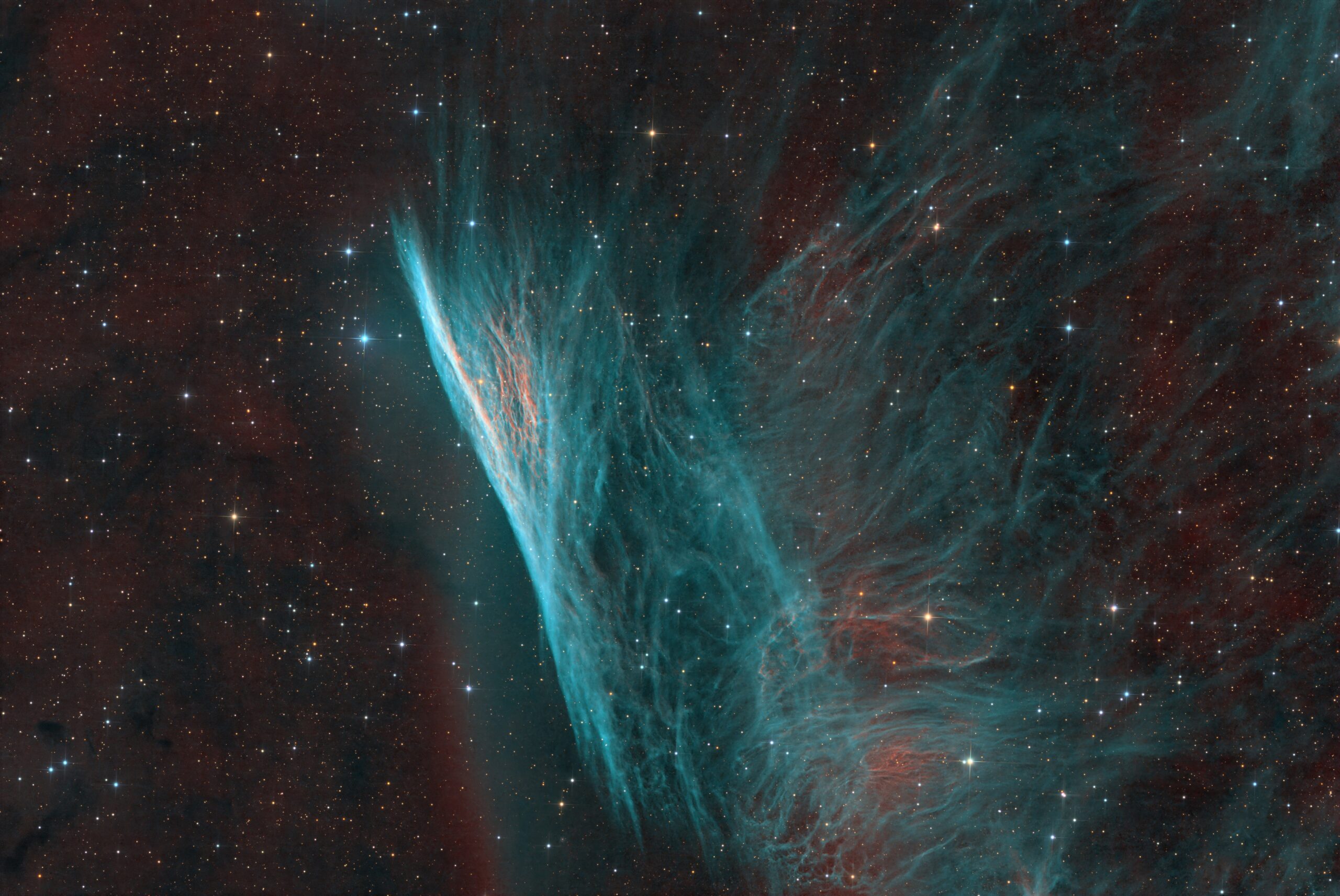
The images were taken with the following equipment:
- Date: 2024
- Location: Hakos, Namibia
- Telescope/Lens: TS 12″ Newton
- Focal length [mm]: 1391
- Focal ratio: 4.56
- Mount: 10Micron GM 3000
- Camera: Lacerta 2600 M
- Filter: Hα:[OIII]:R:G:B
- Exposure time [min]: 180:145:18:18:16
- Resolution: 0.56″/px
For the 2021 data the calibration and registration and the final processing was done with PixInsight. The result was as follows:
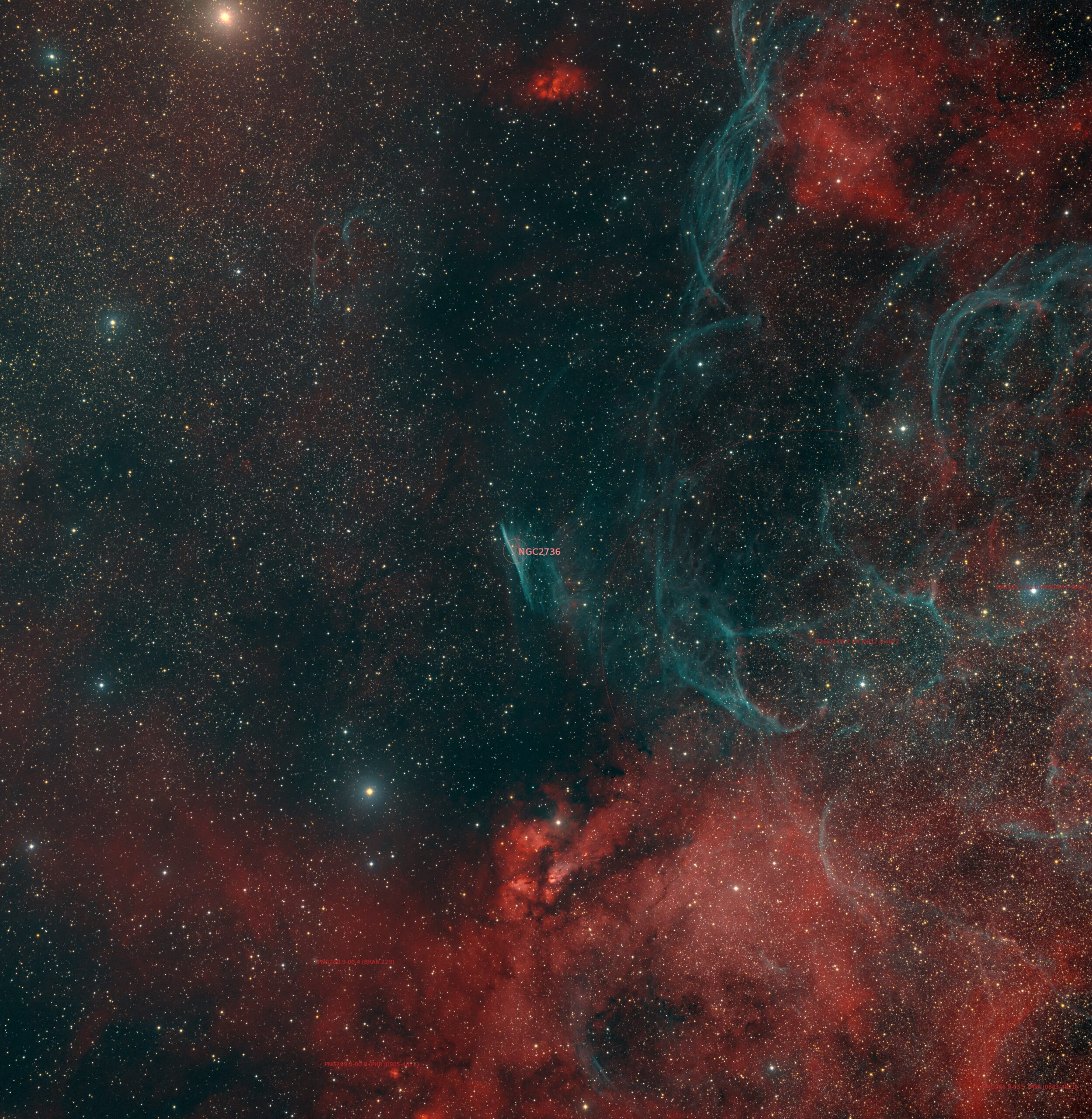
For the 2020 data the calibration and registration and the final processing was done with PixInsight. The result was as follows:
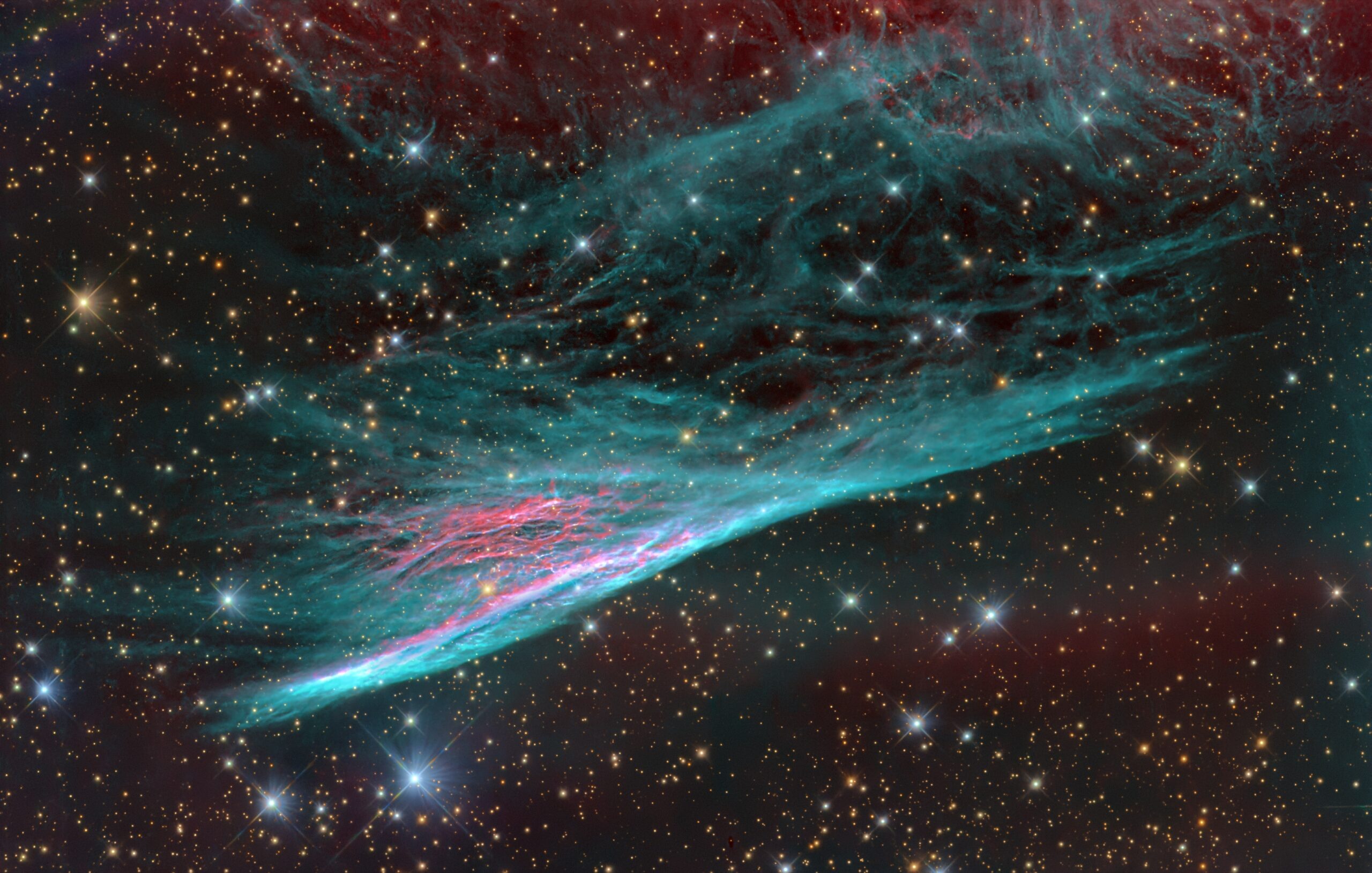
The images were taken with the following equipment:
- Date: 2020
- Location: Rio Hurtado Valley, Chile
- Telescope/Lens: Quasar 12.5″ f/9 Ritchey-Chretienn
- Focal length [mm]: 2857
- Focal ratio: 9
- Mount: Losmandy Titan
- Camera: SBIG STL11000
- Filter: Hα:[OIII]:R:G:B
- Exposure time [min]: 390:380:170:170:180
- Resolution: 0.65″/px



Leave a reply