

NGC 2403 from my own backyard
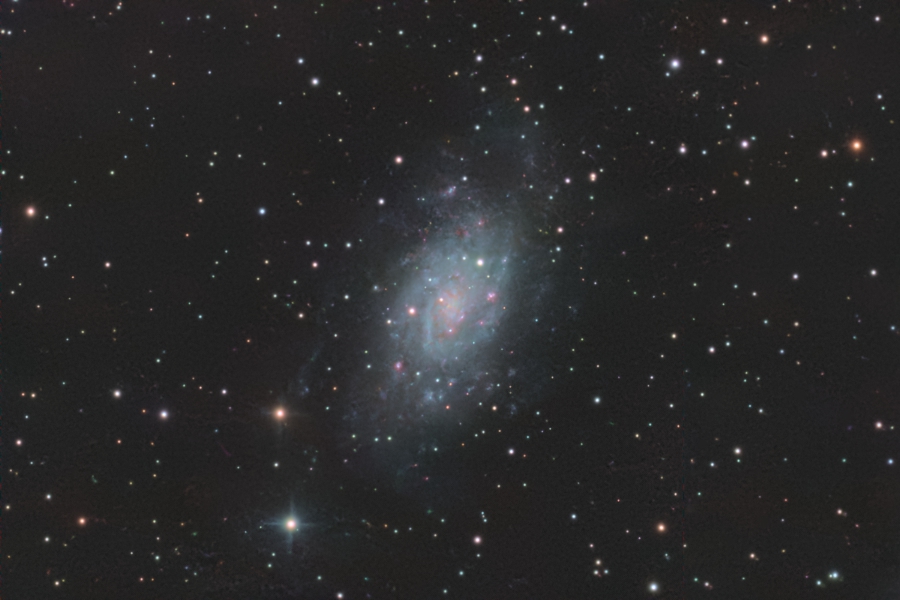
In 2010, I captured images of the spiral galaxy NGC 2403 from my backyard using my DSLR equipment. Despite the limitations of suburban skies, long integration times allowed the galaxy’s rich structure and numerous star-forming regions to become visible in the final image.
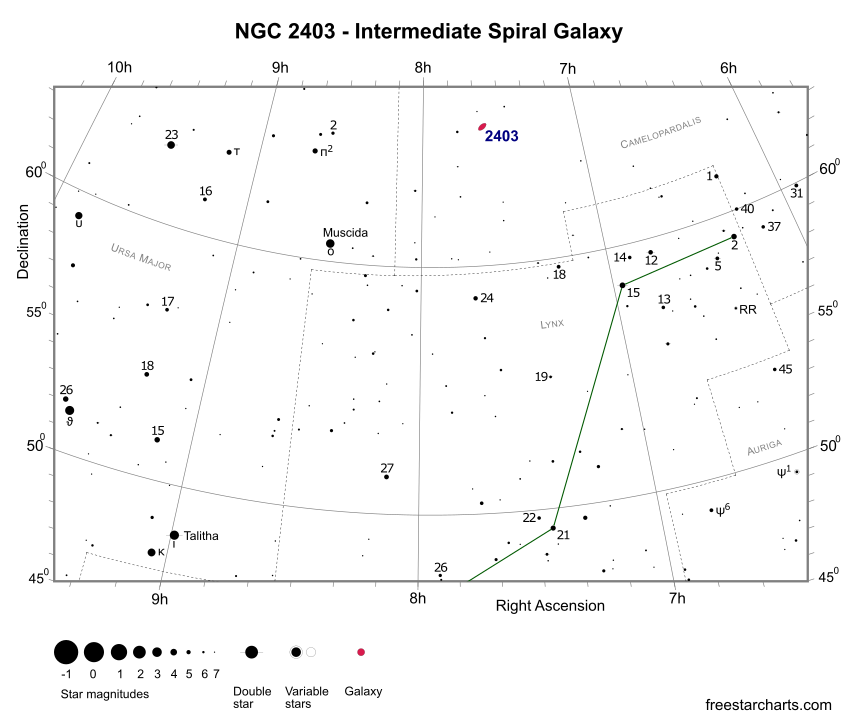
NGC 2403 is located in the constellation Camelopardalis at a distance of approximately 8–10 million light-years. It is a member of the M81 Group and is often considered a close analogue of the famous Messier 33 because of its similar structure and active star formation.
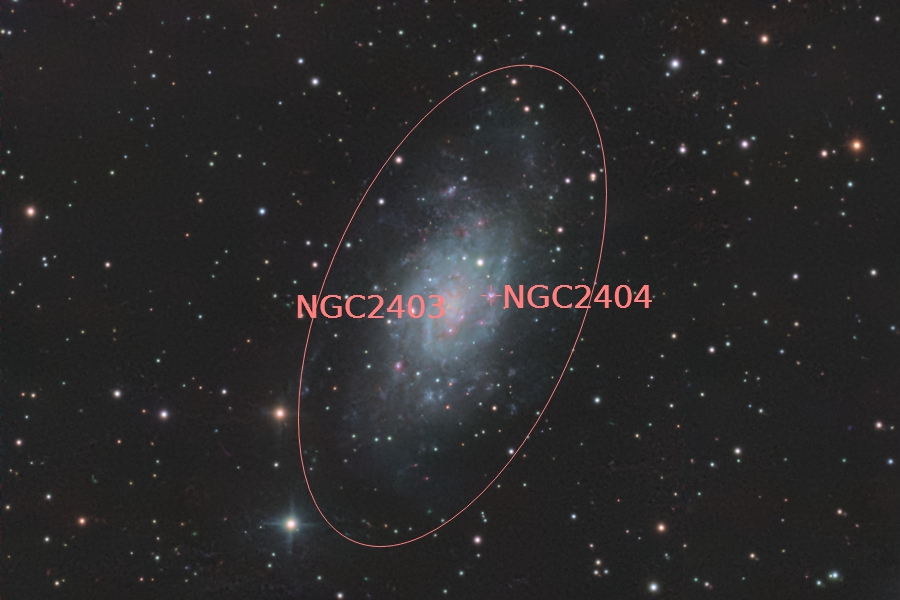
Classified as an intermediate spiral galaxy (SABcd), NGC 2403 displays loosely wound spiral arms rich in bright H II regions, many of which are large stellar nurseries containing young, massive stars. One of the most prominent of these regions is NGC 2404, a giant emission nebula within the galaxy that resembles the famous Tarantula Nebula in the Large Magellanic Cloud on a smaller scale.
Scientifically, NGC 2403 is an important nearby galaxy for studying star formation and galactic structure. It has hosted several observed supernovae and exhibits extensive regions of ionized gas and diffuse emission throughout its disk. Deep images also reveal a faint outer halo and subtle asymmetries within the spiral pattern.
Even with DSLR equipment from a backyard location, the galaxy’s bright core, patchy spiral arms, and numerous star-forming knots could already be captured, making this galaxy
a rewarding target and an excellent example of a nearby actively evolving spiral galaxy.
Data calibration and registration was done with Deepskystacker, the final processing was done with PixInsight.
The images were taken with the following equipment:
- Date: 2010
- Location: Krefeld
- Telescope/Lens: 8″ GSO Newton
- Focal length [mm]: 800
- Focal ratio: 4
- Mount: Skywatcher NEQ6
- Camera: Canon 300 Da
- Filter: OSC
- Exposure time [min]: 278
- Resolution: 2.51″/px



Leave a reply