

NGC 1923 and KMHK 833 from remote
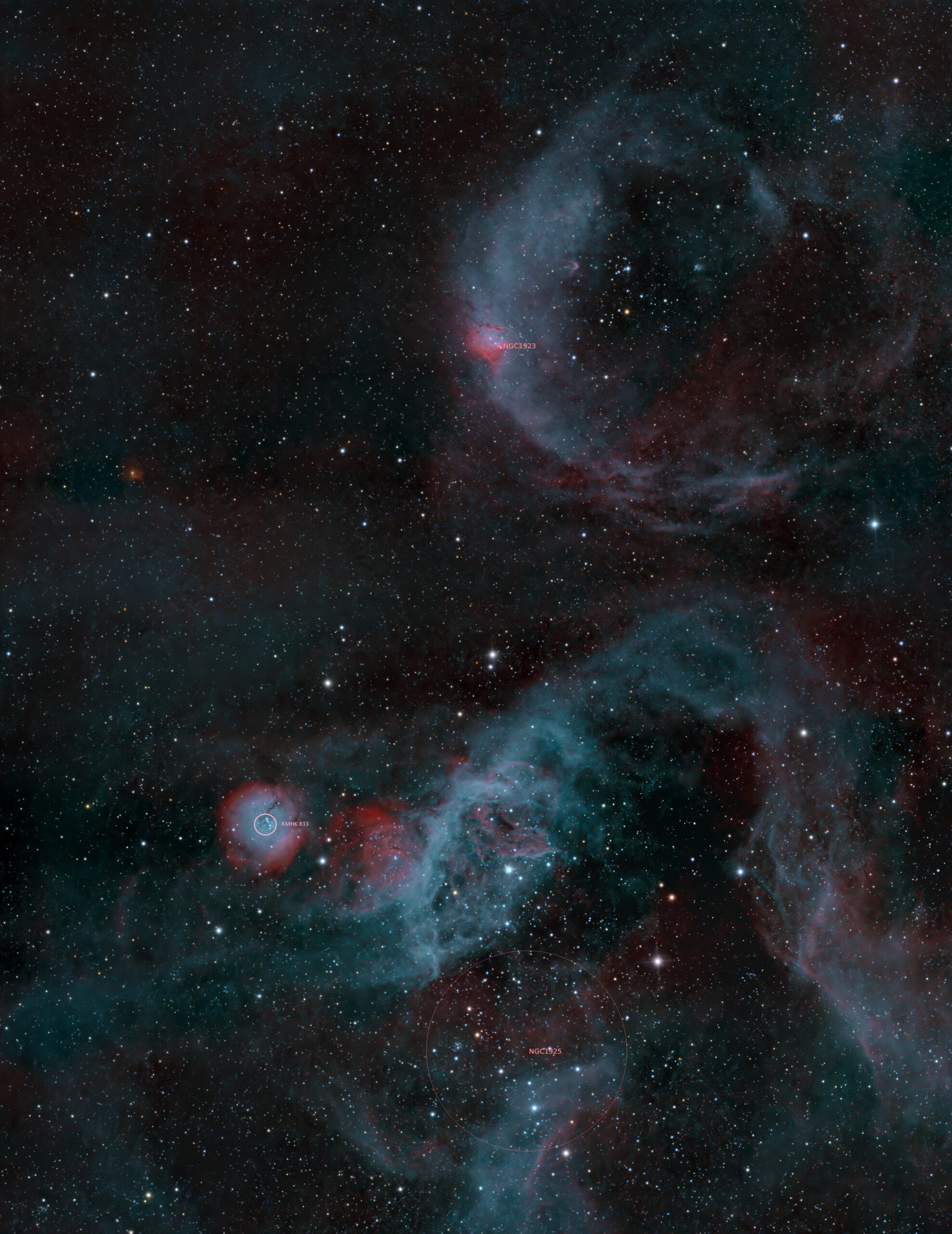
In 2024, I received two high-quality datasets of the open star cluster NGC 1923 and the young open star cluster KMHK 833 from Telescope Live, acquired with one of their telescopes in Chile, which build a mosaic of this region. The excellent observing conditions of the southern hemisphere provided very deep and detailed data.
KMHK 833 appears to be a young star cluster in the Large Magellanic Cloud. The designation “KMHK” refers to a cluster catalog used for Magellanic Cloud star clusters, so this is not a Milky Way object but part of the satellite galaxy system around the Milky Way.
The available catalog context points to KMHK 833 as one of many young stellar groupings in the LMC. The Magellanic Clouds contain a huge range of clusters, from ancient globular-like systems to very young, compact associations, and many of the young ones are still embedded in or near nebulosity. In that sense, KMHK 833 likely belongs to the star-forming side of the LMC population rather than the old-cluster side.
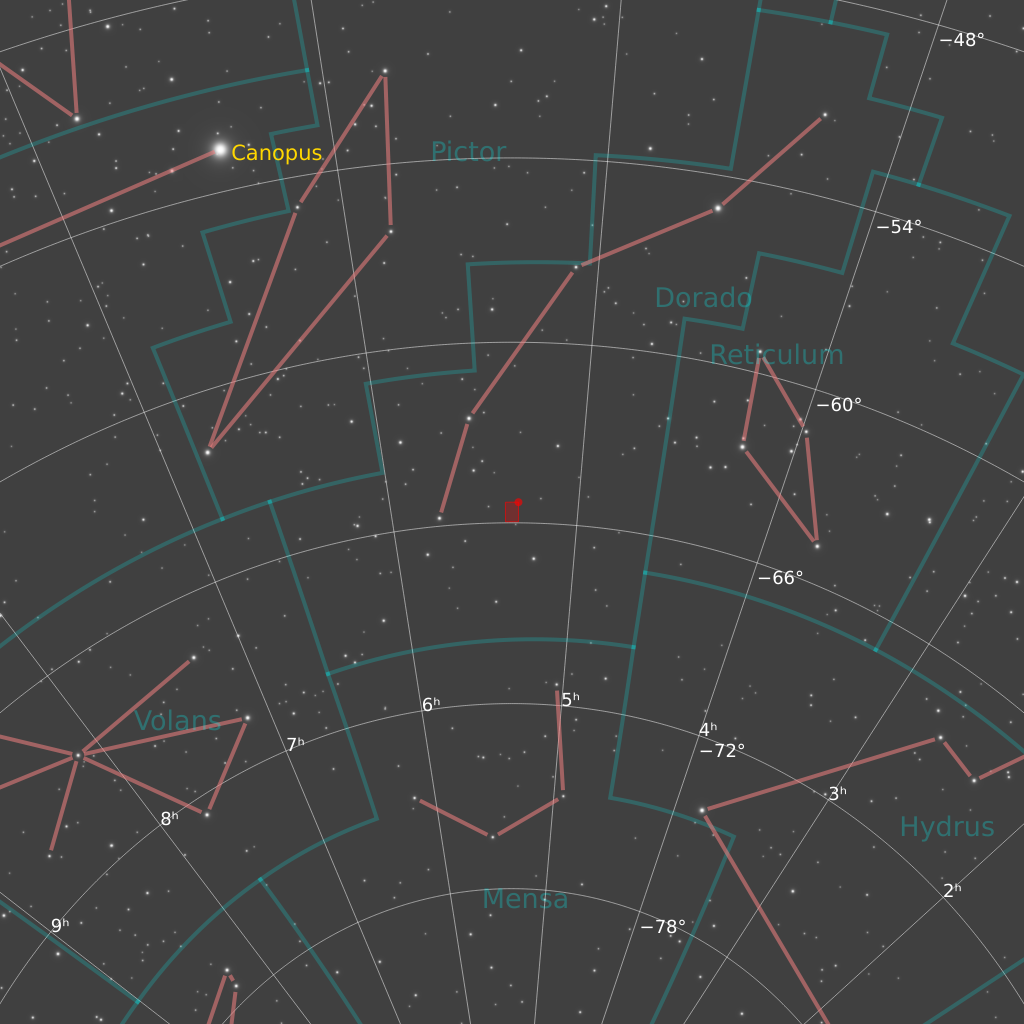
NGC 1923 is an open star cluster embedded in a faint nebula in the southern constellation Dorado, near the famous Large Magellanic Cloud (LMC). It is a relatively faint, compact cluster that is often overlooked in favor of the more spectacular LMC nebulae, but it is a well-defined member of the Dorado star-forming region.
NGC 1923 lies in the constellation Dorado and is cataloged as a “star cluster + nebula” in most databases. Its visual magnitude is around 11.2, so it requires at least a medium-sized telescope (roughly 150 mm aperture or more) to be seen clearly. Because it is south of the celestial equator, it is much more accessible from the southern hemisphere than from mid-northern latitudes.
The cluster is located in the general direction of the LMC, but it is a Galactic object in our own Milky Way rather than a member of the LMC itself. That places it at a distance of a few thousand light-years, typical for open clusters in the Galactic disk, rather than the roughly 160,000 light-years of the LMC.
NGC 1923 is classified as an open cluster with associated nebulosity, meaning it is a group of young stars that formed from the same cloud of gas and dust and are still surrounded by some of that material. Open clusters like this are usually a few million to a few hundred million years old, and they often retain traces of the original cloud that formed them.
In many images, the cluster appears as a compact concentration of stars embedded in a faint glow, with the surrounding nebulosity often only visible in long-exposure photographs or narrowband imaging. The nebulosity is likely ionized by the ultraviolet radiation from the hotter, more massive members of the cluster, similar to how other young clusters illuminate their natal gas.
The scientific value of NGC 1923 comes from its context rather than from being a uniquely spectacular object. It lies in the same broad region as the LMC and other rich southern fields, so it is part of a larger picture of star formation in the outer Milky Way. Studies of clusters in this area help astronomers understand how star-forming regions are distributed in the southern Galactic plane and how they relate to the Magellanic system.
Because NGC 1923 is relatively faint and not as well studied as nearby famous clusters (such as the Pleiades or the Orion Nebula Cluster), detailed information on its age, distance, and stellar content is more limited in the public literature. That makes it more of a “workhorse” object for cluster catalogs and deep-sky surveys than a headline target in research papers.
For observers, NGC 1923 is a modest but rewarding target in Dorado. It is best sought in a dark sky with a telescope of at least 150–200 mm aperture, where it should appear as a small, slightly fuzzy patch that resolves into a handful of stars at higher magnification. The associated nebulosity is unlikely to be obvious visually, but it can show up in long-exposure images, especially with hydrogen-alpha or narrowband filters.
Because it is in the same general area as the LMC, it is often imaged as part of a wider field that includes more famous objects, so it sometimes appears as a secondary target in deep-sky astrophotography.
The data calibration, registration and the final processing of the data was done with PixInsight. The result was as follows:

Here is an overview of the used equipment and the exposure times:
- Date: 2024
- Location: Chile
- Telescope/Lense: Planwave CDK24
- Focal length [mm]: 3962
- Focal ratio: 6.5
- Mount: Mathis MI-1000/1250
- Camera: QHY 600M Pro
- Autoguiding: yes
- Filter: HSO
- Exposure time [min]: each 150:150:150
- Resolution: 0.39″/px bin 2



Leave a reply