• Home
  • Blog
  • Astrophotography
    • Deep Sky
      • Galaxies (Galaxien)
      • Nebulae (Nebel)
      • Planetary Nebulae (Planetarische Nebel)
      • Globular Clusters (Kugelsternhaufen)
      • Open Clusters (Offene Sternhaufen)
      • Miscellaneous (Verschiedenes)
    • Solar System (Sonnensystem)
      • Comets (Kometen)
      • Moon (Mond)
      • Planets (Planeten)
      • Sun (Sonne)
  • Archiv

    • Juli 2026
    • Juni 2026
    • Mai 2026
    • April 2026
    • Februar 2026
    • Dezember 2025
    • November 2025
    • Oktober 2025
    • September 2025
    • August 2025
    • Juli 2025
    • Juni 2025
    • Mai 2025
    • April 2025
    • März 2025
    • Januar 2025
    • Dezember 2024
    • November 2024
    • Oktober 2024
    • September 2024
    • August 2024
    • Juli 2024
    • Juni 2024
    • Mai 2024
    • April 2024
    • März 2024
    • Februar 2024
    • Januar 2024
    • November 2023
    • Oktober 2023
    • September 2023
    • August 2023
    • Juli 2023
    • Juni 2023
    • Mai 2023
    • April 2023
    • März 2023
    • Februar 2023
    • Januar 2023
    • Dezember 2022
    • November 2022
    • Oktober 2022
    • September 2022
    • August 2022
    • Juni 2022
    • Mai 2022
    • April 2022
    • März 2022
    • Februar 2022
    • Januar 2022
    • Dezember 2021
    • November 2021
    • September 2021
    • August 2021
    • Juli 2021
    • März 2021
    • Februar 2021
    • November 2020
    • September 2020
    • August 2020
    • April 2020
    • März 2020
    • Februar 2020
    • Januar 2020
    • Dezember 2019
    • November 2019
    • Oktober 2019
    • September 2019
    • August 2019
    • Mai 2019
    • April 2019
    • März 2019
    • Dezember 2018
    • November 2018
    • Oktober 2018
    • September 2018
    • Juni 2018
    • Mai 2018
    • April 2018
    • März 2018
    • Februar 2018
    • Januar 2018
    • Oktober 2017
    • Juli 2017
    • Juni 2017
    • Januar 2017
    • Dezember 2016
    • September 2016
    • Mai 2016
    • März 2016
    • November 2015
    • Oktober 2015
    • Juli 2015
    • Mai 2015
    • März 2015
    • Februar 2015
    • September 2014
    • August 2014
    • März 2014
    • Februar 2014
    • Oktober 2013
    • September 2013
    • August 2013
    • April 2013
    • März 2013
    • November 2012
    • August 2012
    • Juli 2012
    • Mai 2012
    • März 2012
    • Januar 2012
    • November 2011
    • Oktober 2011
    • September 2011
    • August 2011
    • April 2011
    • März 2011
    • Oktober 2010
    • September 2010
    • August 2010
    • Juli 2010
    • April 2010
    • Juli 2009
    • Juli 2008
    • Januar 2008
    • Oktober 2007
    • Juli 2007
    • März 2007
    • Februar 2007
    • Juni 2006
    • Oktober 2005
    • September 2005
    • August 2005
    • Januar 2005
  • Kategorien

    • Asterism
    • Astrophotography
    • Barnard
    • Comet
    • Galaxies
    • Globular Cluster
    • IC
    • Messier
    • Moon
    • Nebula
    • NGC
    • Open cluster
    • Photography
    • Planetary Nebula
    • Travel
  • Meta

    • Anmelden
    • Eintrags-Feed
    • Kommentar-Feed
    • WordPress.org
  • Privacy Policy
  • Impressum
  • Haftungsausschluss
  • Cookie-Richtlinie
  • Datenschutzerklärung

wonderfuluniverse.de
  • Home
  • Blog
  • Astrophotography
    • Deep Sky
      • Galaxies (Galaxien)
      • Nebulae (Nebel)
      • Planetary Nebulae (Planetarische Nebel)
      • Globular Clusters (Kugelsternhaufen)
      • Open Clusters (Offene Sternhaufen)
      • Miscellaneous (Verschiedenes)
    • Solar System (Sonnensystem)
      • Comets (Kometen)
      • Moon (Mond)
      • Planets (Planeten)
      • Sun (Sonne)

NGC 1499 (California Nebula) from my backyard


In 2007 I imaged NGC 1499 (The California Nebula) from my own backyard using my DSLR equipment.


NGC 1499, better known as the California Nebula, is a large, diffuse emission nebula in the constellation Perseus, famous for its striking resemblance to the outline of the U.S. state of California. It is one of the nearest and best-known H II regions in the sky, and a classic target for wide-field astrophotography.

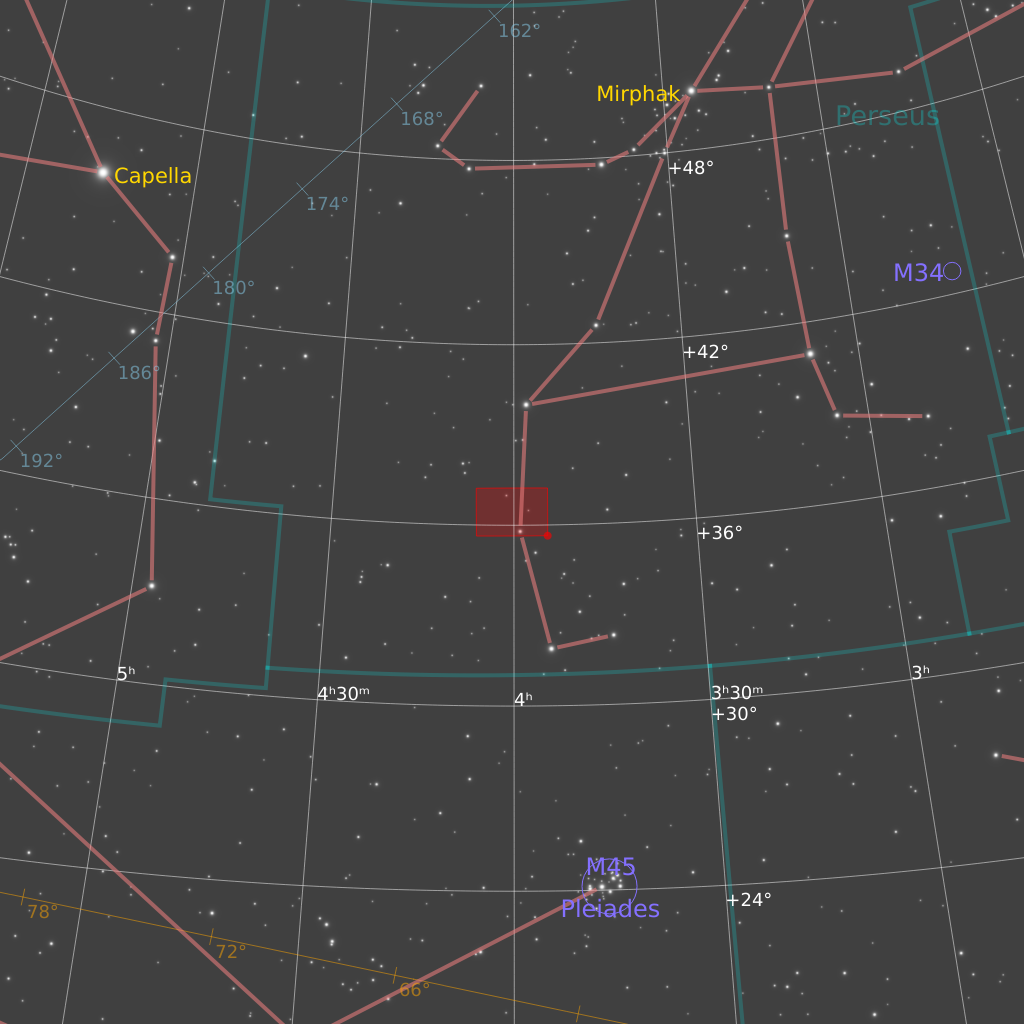
The nebula lies about 1,000 light-years from Earth (some sources give 1,000–1,500 light-years), making it one of the closest major emission nebulae to us. On the sky, it is located roughly 36 arcminutes north of the bright O-type star Xi Persei (ξ Per, Menkib). It is this star’s intense ultraviolet radiation that ionizes the hydrogen gas and makes the nebula glow.

The California Nebula is huge in apparent size, spanning about 2.5° × 1°, or roughly 145′ × 40′ in most catalogs—around five times the apparent width of the full Moon. At a distance of 1,000 light-years, that translates into a physical length of roughly 100 light-years and a width of several tens of light-years.

NGC 1499 is an H II region, meaning it is a cloud of ionized hydrogen gas where new stars are forming or have recently formed. The red-pink glow seen in photographs comes mainly from the H-alpha emission line at 656.3 nm, produced when electrons in hydrogen atoms recombine with protons and drop to lower energy levels. The nebula also emits strongly in H-beta and other hydrogen lines.

The ionizing source is the hot, massive O7.5III star Xi Persei, which lies just to the south of the nebula. Its powerful ultraviolet radiation strips electrons from the surrounding hydrogen, and the subsequent recombination produces the characteristic red emission. Infrared images show that Xi Persei is actually interacting with the cloud, carving cavities and shaping the nebula’s structure .

Visually, the California Nebula is challenging because it is very large but has a low surface brightness. Its integrated photographic magnitude is around 5.0–6.0, so it is technically within reach of binoculars or small telescopes under very dark skies, but the glow is spread over such a large area that it is easy to miss. Through a telescope with a wide field and an H-alpha or narrowband filter, the outline becomes more apparent, especially the bright “coastline” that defines the state-like shape.

In photographs, especially those taken with hydrogen-alpha filters, the nebula shows intricate filaments, bright rims, and darker lanes of dust that trace the edges of the ionized gas. The resemblance to California is most obvious in images that show the long, curved “coast” and the narrower “inland” region.

The California Nebula was discovered by the American astronomer Edward Emerson Barnard in 1884–1885 (sources vary slightly on the exact year). It was later included in the New General Catalog as NGC 1499 and in the Sharpless catalog as Sh2-220. Its nickname “California Nebula” comes directly from its outline, which reminded early observers and photographers of the shape of the U.S. state.

NGC 1499 is scientifically valuable as one of the nearest large H II regions, making it a useful laboratory for studying the structure of ionized gas, the effects of massive-star radiation on molecular clouds, and the physics of star formation. Because it is relatively close and projected against a rich star field, it is also a good target for measuring distances, extinction, and the three-dimensional distribution of gas and dust in the Perseus region.

Data calibration and registration and the final processing was done with PixInsight. The result was as follows:
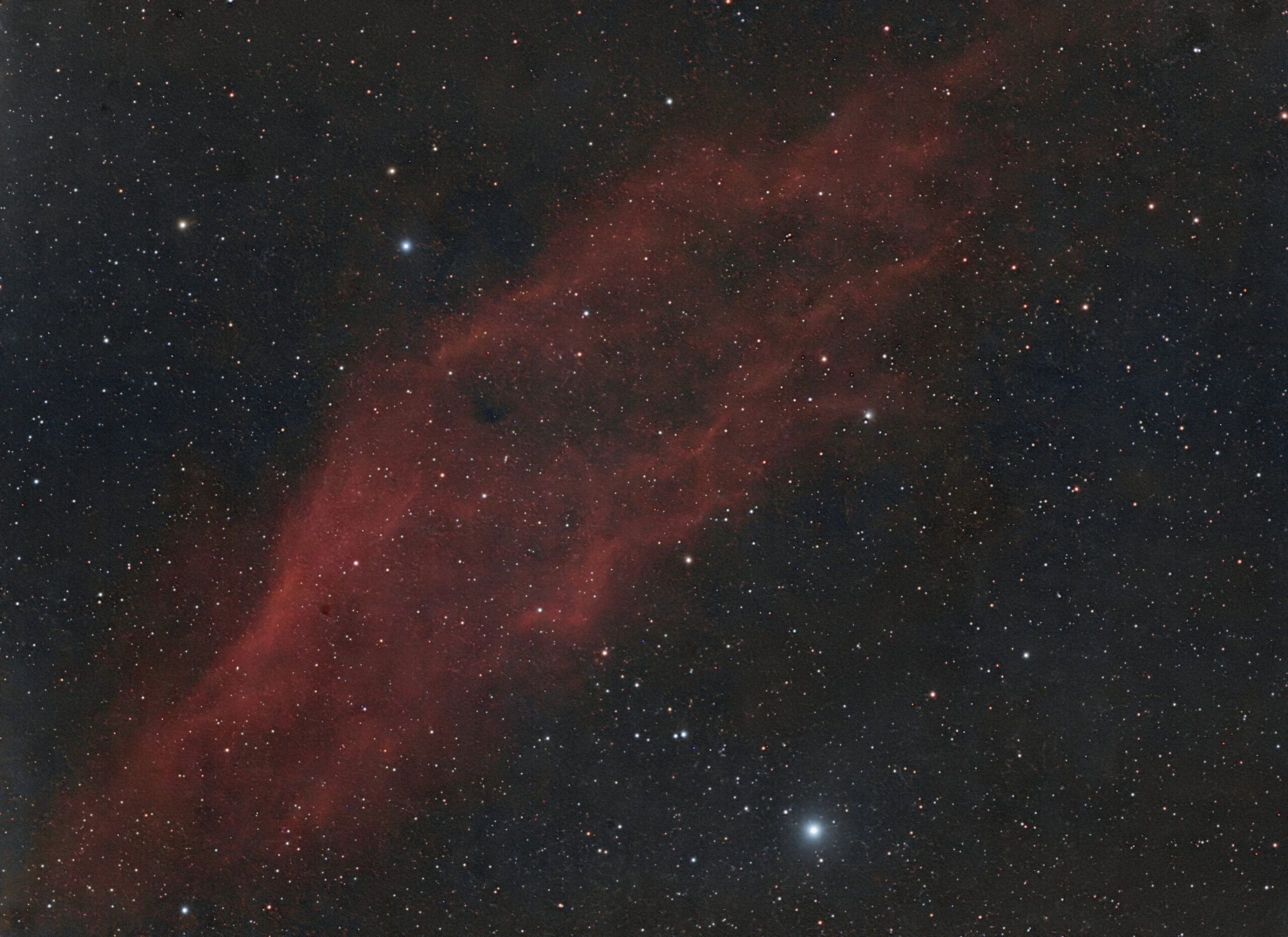
NGC 1499, Krefeld, 2006


The images were taken with the following equipment:

  • Date: 2007
  • Location: Krefeld
  • Telescope/Lens: Pentax 75
  • Focal length [mm]: 500
  • Focal ratio: 6.7
  • Mount: Vixen GPDX
  • Camera: Canon 300 Da
  • Filter: OSC
  • Exposure time [min]: 20
  • Resolution: 3.04″/px


NGC 1499 Finder Chart


Stephan Küppers


You might also like
IC 1318
15. Juli 2026
NGC 7000 with IC 5070
24. Juni 2026
Sh2-129, Outters 4
29. Mai 2026

Leave a reply

Schreibe einen Kommentar Antwort abbrechen

Deine E-Mail-Adresse wird nicht veröffentlicht. Erforderliche Felder sind mit * markiert


© Stephan Küppers 2020-2022

Cookie-Zustimmung verwalten
Wir verwenden Cookies, um unsere Website und unseren Service zu optimieren.
Funktional Immer aktiv
Die technische Speicherung oder der Zugang ist unbedingt erforderlich für den rechtmäßigen Zweck, die Nutzung eines bestimmten Dienstes zu ermöglichen, der vom Teilnehmer oder Nutzer ausdrücklich gewünscht wird, oder für den alleinigen Zweck, die Übertragung einer Nachricht über ein elektronisches Kommunikationsnetz durchzuführen.
Vorlieben
Die technische Speicherung oder der Zugriff ist für den rechtmäßigen Zweck der Speicherung von Präferenzen erforderlich, die nicht vom Abonnenten oder Benutzer angefordert wurden.
Statistiken
Die technische Speicherung oder der Zugriff, der ausschließlich zu statistischen Zwecken erfolgt. Die technische Speicherung oder der Zugriff, der ausschließlich zu anonymen statistischen Zwecken verwendet wird. Ohne eine Vorladung, die freiwillige Zustimmung deines Internetdienstanbieters oder zusätzliche Aufzeichnungen von Dritten können die zu diesem Zweck gespeicherten oder abgerufenen Informationen allein in der Regel nicht dazu verwendet werden, dich zu identifizieren.
Marketing
Die technische Speicherung oder der Zugriff ist erforderlich, um Nutzerprofile zu erstellen, um Werbung zu versenden oder um den Nutzer auf einer Website oder über mehrere Websites hinweg zu ähnlichen Marketingzwecken zu verfolgen.
  • Optionen verwalten
  • Dienste verwalten
  • Verwalten von {vendor_count}-Lieferanten
  • Lese mehr über diese Zwecke
Einstellungen anzeigen
  • {title}
  • {title}
  • {title}