

NGC 1360 – VdS Remote Hakos
As a member of the VdS remote observatory group, I have the opportunity to use the VdS remote observatory in Hakos, Namibia. Members are allowed to process both their own observations obtained at the site as well as data recorded by other users. In this case, the final result is based on a dataset kindly provided by Rainer Sparenberg.
The processed image shows the planetary nebula NGC 1360, located in the constellation Fornax. Often referred to as the “Robin’s Egg Nebula,” NGC 1360 is a large and relatively evolved planetary nebula situated about 1,500 light-years from Earth. Unlike many planetary nebulae that show sharply defined shells, NGC 1360 has a smooth, diffuse appearance with only weakly defined edges, indicating that the expanding gas envelope is already dispersing into the surrounding interstellar medium.
At its center lies a very hot white dwarf, the exposed core of a Sun-like star that shed its outer layers near the end of its stellar evolution. The ultraviolet radiation from this remnant core ionizes the surrounding gas, causing it to glow primarily in oxygen and hydrogen emission lines. Deep images also reveal subtle internal structures and faint arcs within the nebula, which are thought to result from variations in the mass-loss process during the late stages of the progenitor star’s life.
Because of its large apparent size and relatively low surface brightness, NGC 1360 is a challenging but rewarding target for deep imaging, particularly under the dark southern skies of Namibia.As a member of the VdS remote observatory group, I have the opportunity to use the VdS remote observatory in Hakos, Namibia. You are allowed to process your own data obtained there as well as the data of other users.
In this case I use the data of Rainer Sparenberg for my result.
Data calibration and registration and the final processing was done with PixInsight.
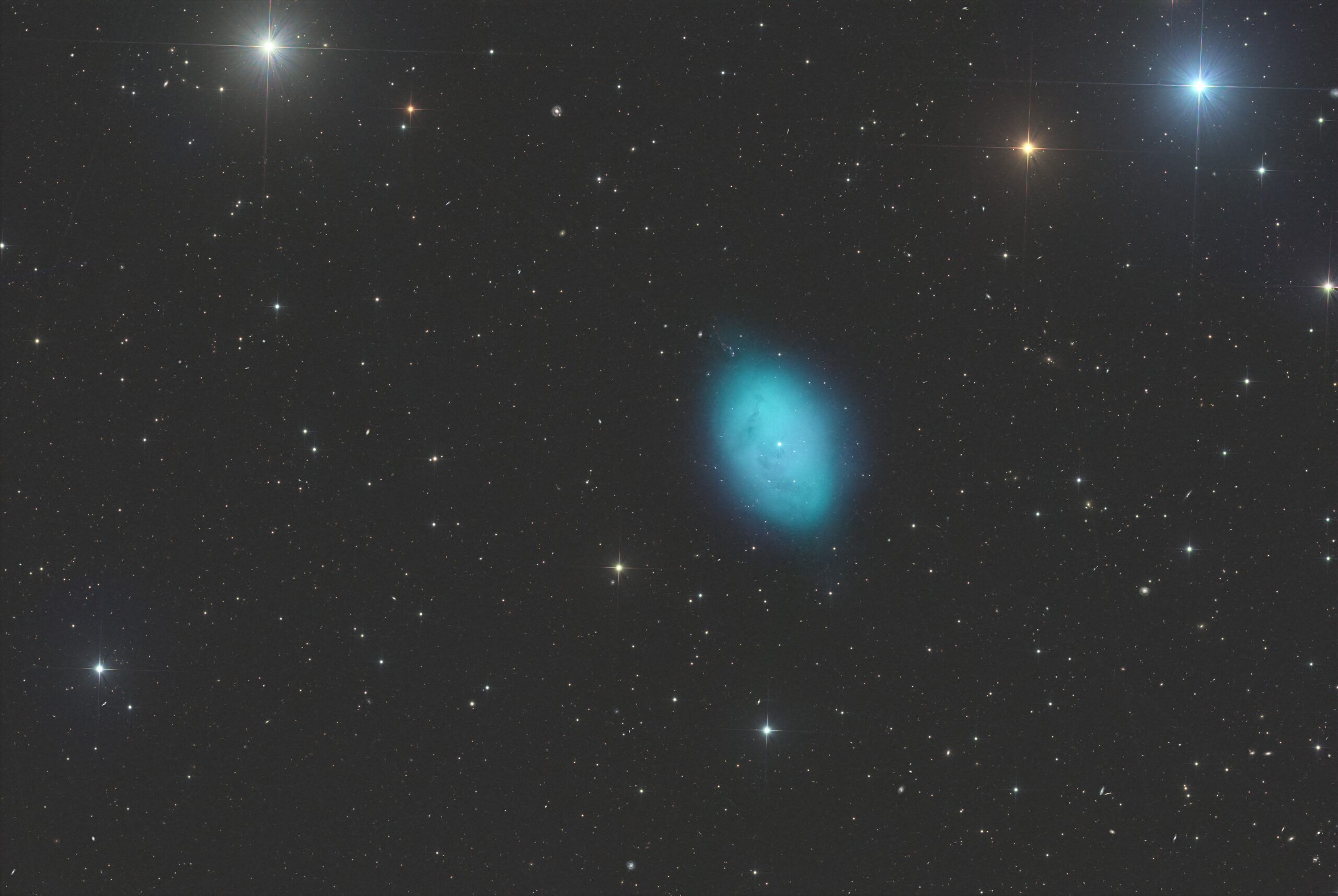
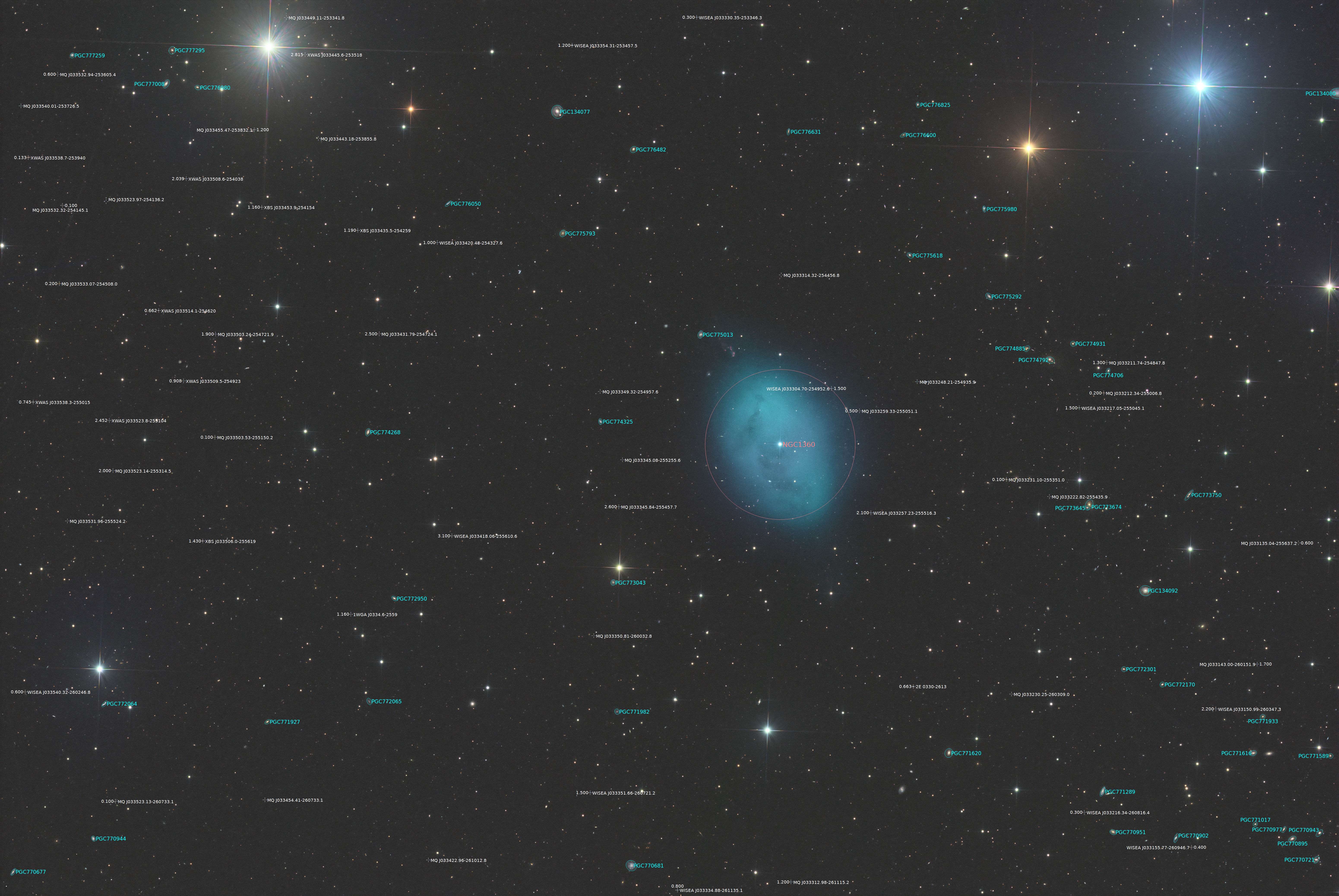
This image shows a lot of galaxies and quasars. The most distant of them is:
MQ J033345.84-255457.7 with a redshift of 2.6 an apparent magv of 21.1 (SDSS DR17).
The faintest object in this image has an apparent magnitude of approx. 22 mag (2017,PASA,34,25).
The images were taken with the following equipment:
- Location: Hakos, Namibia
- Telescope: TS 12“ Newton-Astrograph
- Focal length [mm]: 1391
- Focal ratio: 4.56
- Mount: 10Micron GM3000
- Camera: Lacerta DeepSkyPro2600 (mono)
- Filter: L:R:G:B
- Exposure time [min]: 50:25:35:20
- Resolution: 0.56″/px



Leave a reply