

NGC 1023 from my backyard
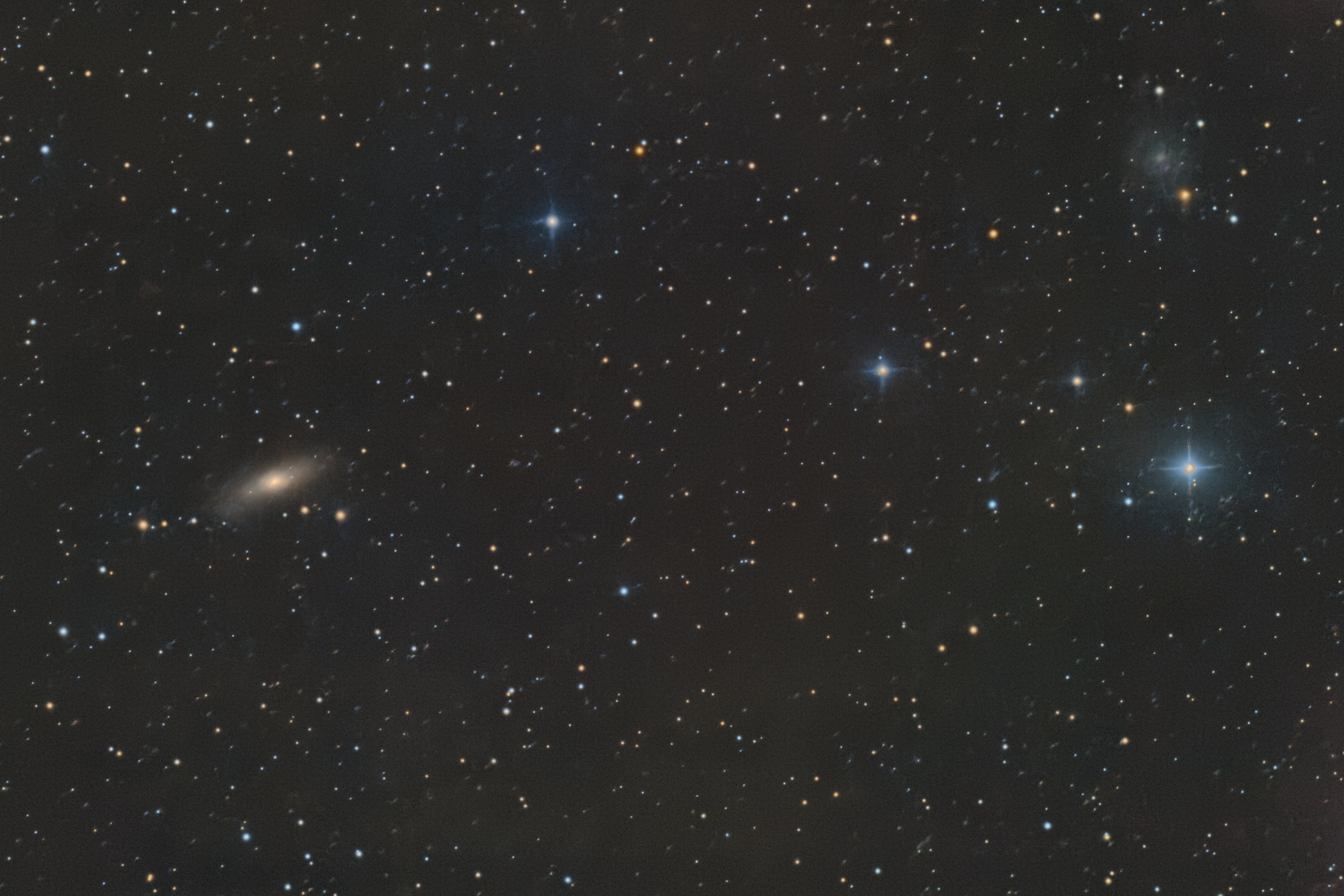
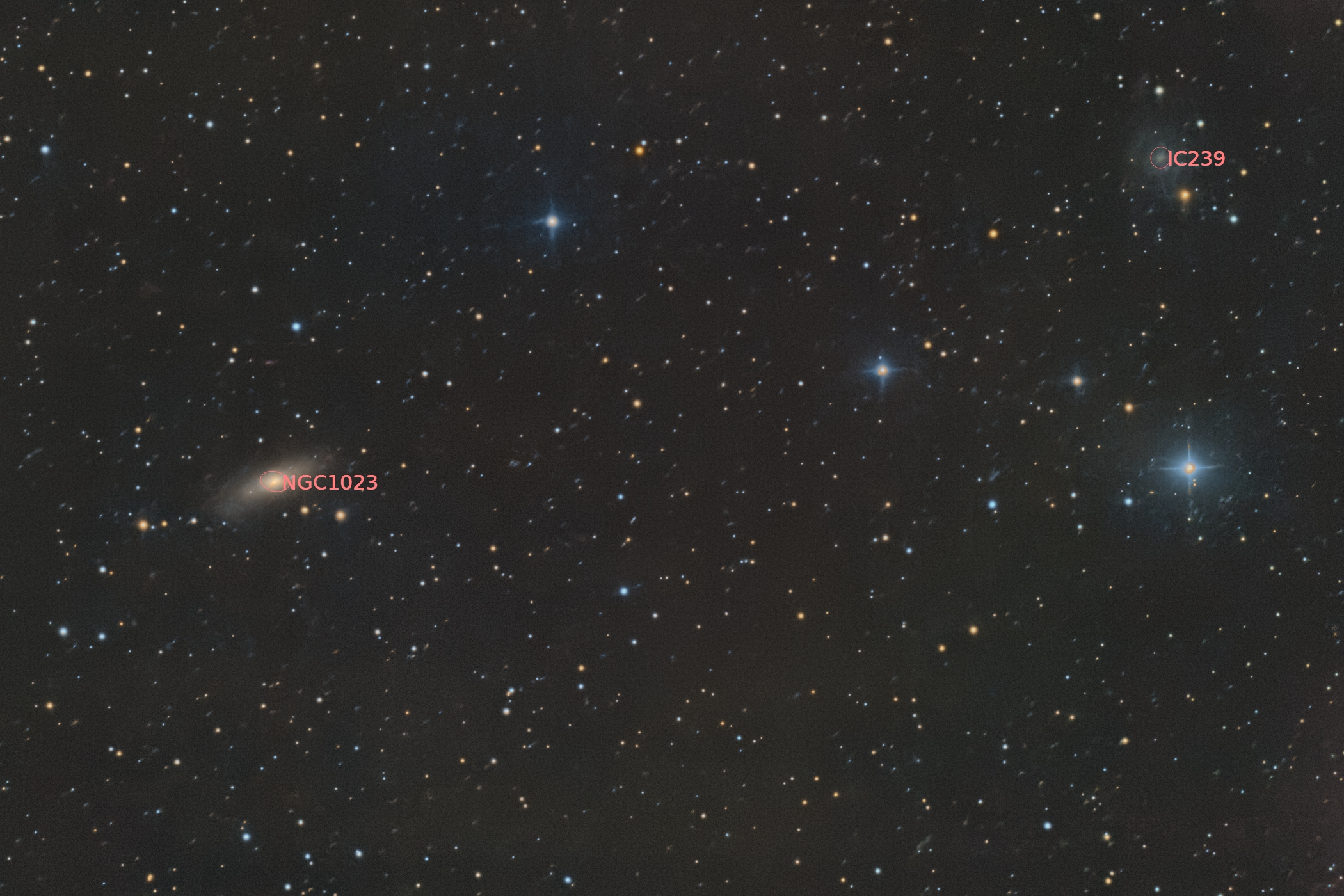
In 2005, I imaged the galaxy NGC 1023 using my DSLR equipment, revealing the galaxy IC 239 in the same field of view.
NGC 1023 and IC 239 are two of the brighter members of the NGC 1023 Group, a small, nearby collection of galaxies in the constellations Perseus and Andromeda. They are close enough on the sky—only about 47 arcminutes apart—to be seen in the same wide-field view, and they are physically associated as part of the same gravitationally bound group.
NGC 1023 is a barred lenticular galaxy (type SB0 or SB(rs)0), meaning it has a central bulge and a flattened disk like a spiral galaxy, but it lacks prominent spiral arms and has little ongoing star formation. It lies in Perseus at a distance of roughly 30–35 million light-years (about 9–11 Mpc), though published estimates range from ~21 to ~64 million light-years depending on the method. Its apparent magnitude is around 10.3–10.7, making it accessible to medium-sized amateur telescopes under dark skies.
The galaxy spans about 100,000 light-years in diameter, comparable to the Milky Way, but its disk is smooth and featureless, dominated by older stars. One of its most interesting features is a small, irregular companion galaxy, NGC 1023A, which was once thought to be a lopsided spiral arm on the eastern side of NGC 1023 but is now known to be a separate, tidally interacting companion.
NGC 1023 also hosts a supermassive black hole at its center, with a mass estimated between 40 million and 60 million solar masses. Hubble Space Telescope observations have shown that stars very close to the nucleus orbit in a small, flattened disk at speeds up to 2.1 million km/h, under the black hole’s strong gravitational influence.
IC 239 is a spiral galaxy of type SAB(rs)cd, located in the neighboring constellation Andromeda. It lies at a similar distance to NGC 1023, around 35–46 million light-years away, with different catalogs giving slightly different values (some place it at ~22 Mpc or ~65,000 light-years across). Its apparent magnitude is about 11.1–11.3, so it is somewhat fainter and more diffuse than NGC 1023, but still reachable with moderate apertures.
IC 239 is classified as a mixed spiral (intermediate between barred and unbarred) with loosely wound arms and a relatively small central bulge. Its angular size is about 4.2′ × 4.0′, corresponding to a physical diameter of roughly 50,000–65,000 light-years. The galaxy has a radial velocity of about 900 km/s, indicating it is receding from us as part of the local expansion of the Universe.
Together with NGC 1003, DDO 22, and several fainter dwarfs, NGC 1023 and IC 239 form the NGC 1023 Group (also cataloged as LGG 70). This group contains about 19 members in total, with a mean distance of roughly 22–26 million light-years (7–8 Mpc) from the Milky Way. The group is part of the Local Supercluster and is one of the nearer galaxy groups outside the Local Group, making it useful for studying galaxy interactions and evolution in a low-density environment.
The proximity of NGC 1023 and IC 239 on the sky, combined with their similar distances, strongly suggests they are physically related and may have experienced some gravitational interaction in the past.
The pair has been studied in some detail, particularly in neutral hydrogen (H I) observations. In NGC 1023, the H I gas is detected out to the Holmberg radius and shows rotation, but the distribution is asymmetrical, possibly due to past interactions or accretion. In IC 239, neutral hydrogen extends to more than twice the Holmberg radius, with a warped distribution and non-circular motions, again hinting at environmental effects within the group.
These characteristics make NGC 1023 and IC 239 valuable for understanding how galaxies in small groups exchange gas, distort each other’s disks, and evolve over time.
The data calibration, registration and the final processing was done with PixInsight. The result was as follows:
Here is an overview of the used equipment and the exposure times:
- Date: 2005
- Location: Krefeld
- Telescope/Lense: 8″ GSO Newton
- Focal length [mm]: 800
- Focal ratio: 4
- Mount: Vixen GP-DX
- Camera: Canon 300Da
- Autoguiding: no
- Filter: OSC
- Exposure time [min]: 5
- Resolution: 1.88″/px


Leave a reply