

Messier 71 (NGC 6838) from my backyard
In 2010, I captured images of the globular cluster Messier 71 (M71) from my backyard observatory in Krefeld using my DSLR equipment. Despite the modest setup and the challenges posed by suburban light pollution, the observations successfully revealed the cluster’s characteristic loose and open appearance. At the time, imaging globular clusters with a DSLR required careful acquisition and processing to resolve individual stars while preserving the dense central region, making M71 a particularly rewarding target.
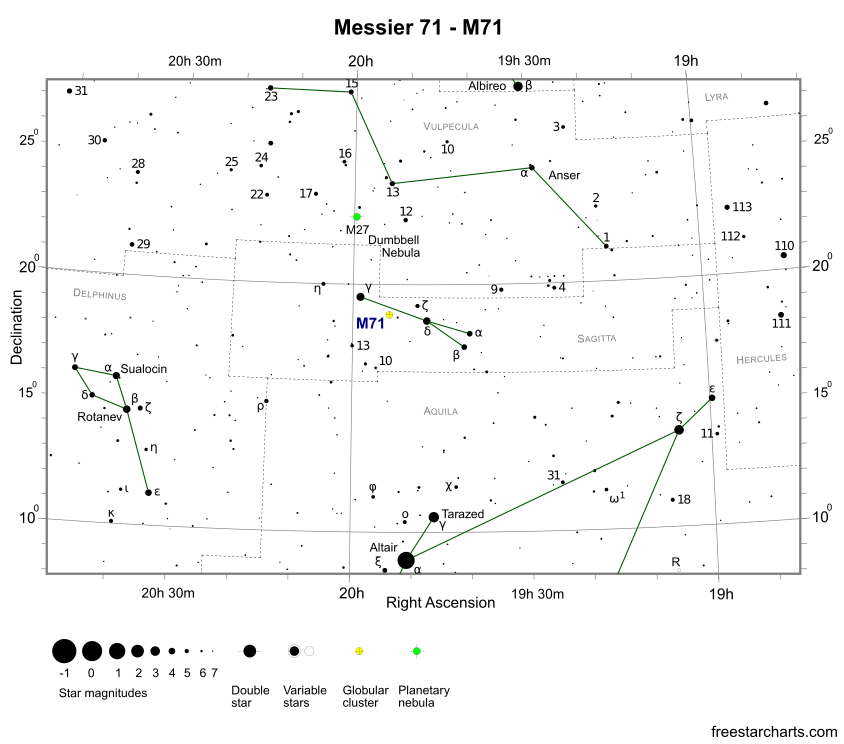
Located in the constellation Sagitta, Messier 71 lies at a distance of approximately 13,000 light-years and spans about 27 light-years in diameter. Unlike the great globular clusters such as Messier 13 or Omega Centauri, M71 is relatively sparse and has a much lower stellar density. For many decades, astronomers debated whether it was in fact a globular cluster or an unusually rich open cluster. Modern photometric and spectroscopic studies have confirmed that M71 is a genuine globular cluster, although one of the least concentrated known in the Milky Way.
The cluster is estimated to be around 9 to 10 billion years old, making it significantly younger than many classical globular clusters, which often exceed 12 billion years in age. It contains tens of thousands of stars, many of which are evolved red giant stars approaching the final stages of their evolution. The relatively low central concentration allows numerous individual stars to be resolved even in amateur telescopes, giving M71 its distinctive granular appearance.
One reason for M71’s unusual structure is its location within the disk of the Milky Way rather than in the Galactic halo, where most globular clusters reside. Over billions of years, repeated gravitational interactions with giant molecular clouds and passages through the Galactic disk are thought to have stripped away many of its outer stars. As a result, M71 is less massive and less densely populated than most other globular clusters.
Data calibration and registration was done with DeepSkyStacker and the final processing was done with PixInsight. The result was as follows:
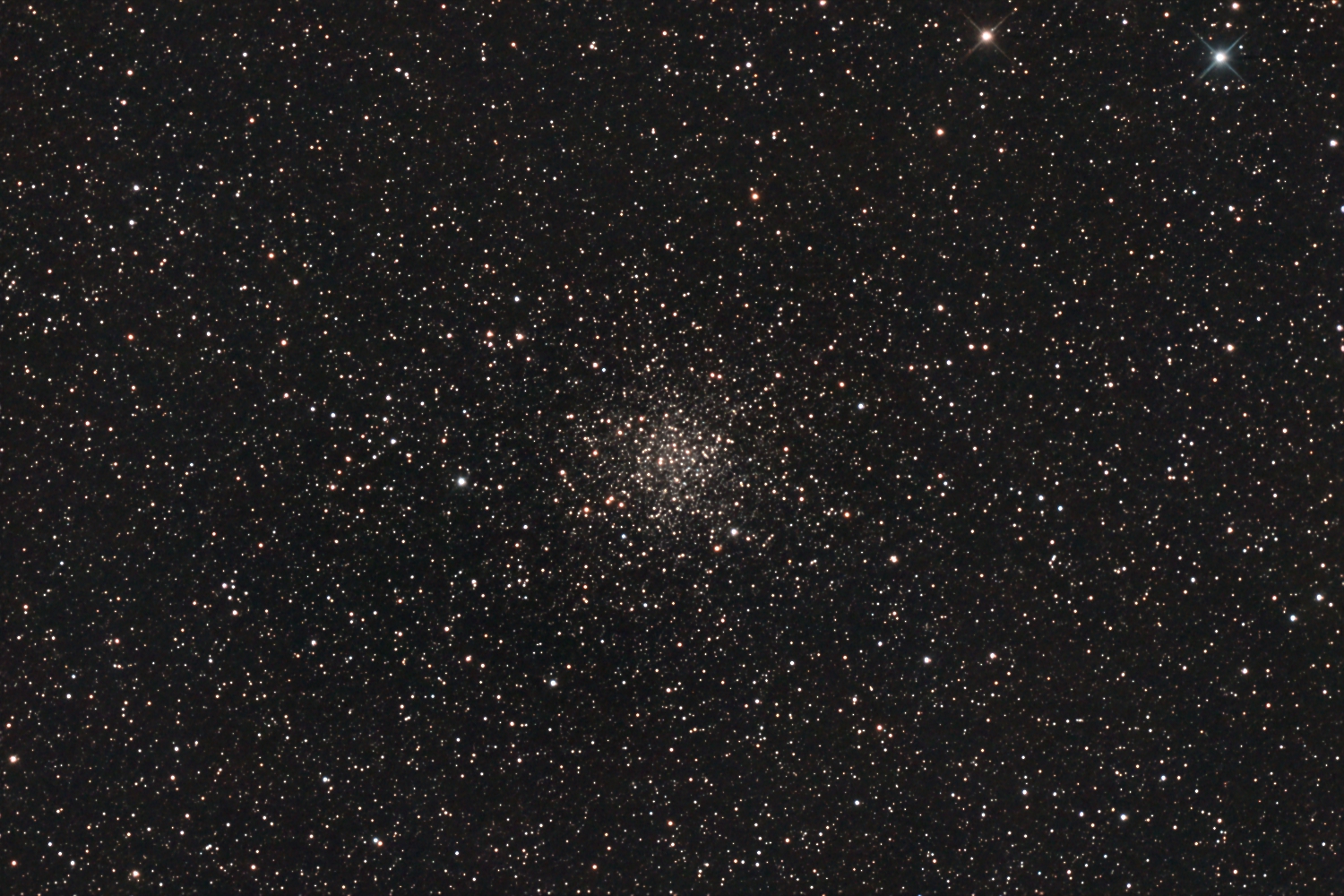
The images were taken with the following equipment:
- Date: 2010
- Location: Krefeld
- Telescope: Orion 10″ Newton
- Focal length [mm]: 1200
- Focal ratio: 4.8
- Mount: Skywatcher NEQ6 Synscan
- Camera: Canon 300Da
- Filter: OSC
- Exposure time [min]: 125
- Resolution: 1.28″/px



Leave a reply