

Messier 13 (NGC 6205) from my own backyard, observatory and abroad
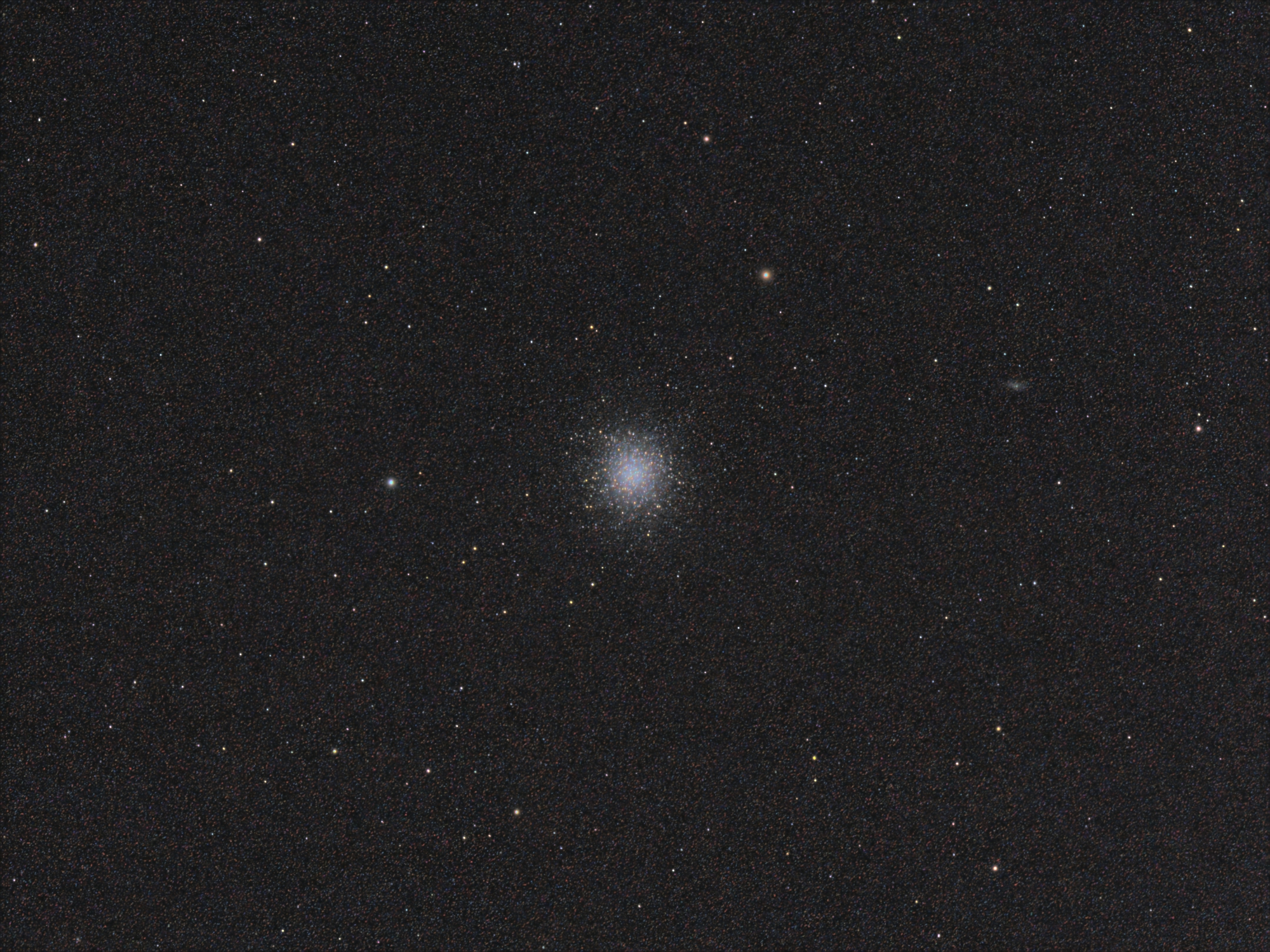
I have imaged the famous globular cluster Messier 13 several times over the years, using a wide variety of equipment and imaging techniques. The most recent image was captured from my backyard with my new Seestar S30 Pro smart telescope, demonstrating how modern compact systems are now capable of producing impressive deep-sky results with minimal setup effort.
Located in the constellation Hercules, M13 is often referred to as the Great Hercules Globular Cluster and is one of the brightest and best-known globular clusters in the northern sky. It lies at a distance of approximately 22,000 light-years and contains several hundred thousand stars packed into a region only about 145 light-years across. The cluster is estimated to be more than 11 billion years old, making it one of the oldest stellar systems in the Milky Way.
Deep images of M13 reveal a dense and highly concentrated stellar core surrounded by countless resolved outer stars. The cluster contains a rich population of red giant stars, horizontal branch stars, and several known variable stars. It is also home to the famous Barnard 29, a rare blue post-asymptotic giant branch star that stands out clearly against the otherwise warm-colored stellar population.
Over the years, revisiting M13 with different generations of equipment—from early DSLR systems to CCD and CMOS cameras, and now a compact smart telescope—has provided an interesting perspective on the technological evolution of amateur astrophotography. Even with the relatively small aperture of the Seestar S30 Pro, modern sensors and automated processing make it possible to capture the beauty and complexity of this ancient stellar system directly from a suburban backyard.
Registration and the final image processing were carried out using PixInsight. To improve the effective image resolution and better sample the stellar details within the dense core of the cluster, the data were processed with 2× drizzle integration. This technique helped to recover fine structural detail and improve star separation, particularly in the crowded central regions of Messier 13.
The result was as follows:
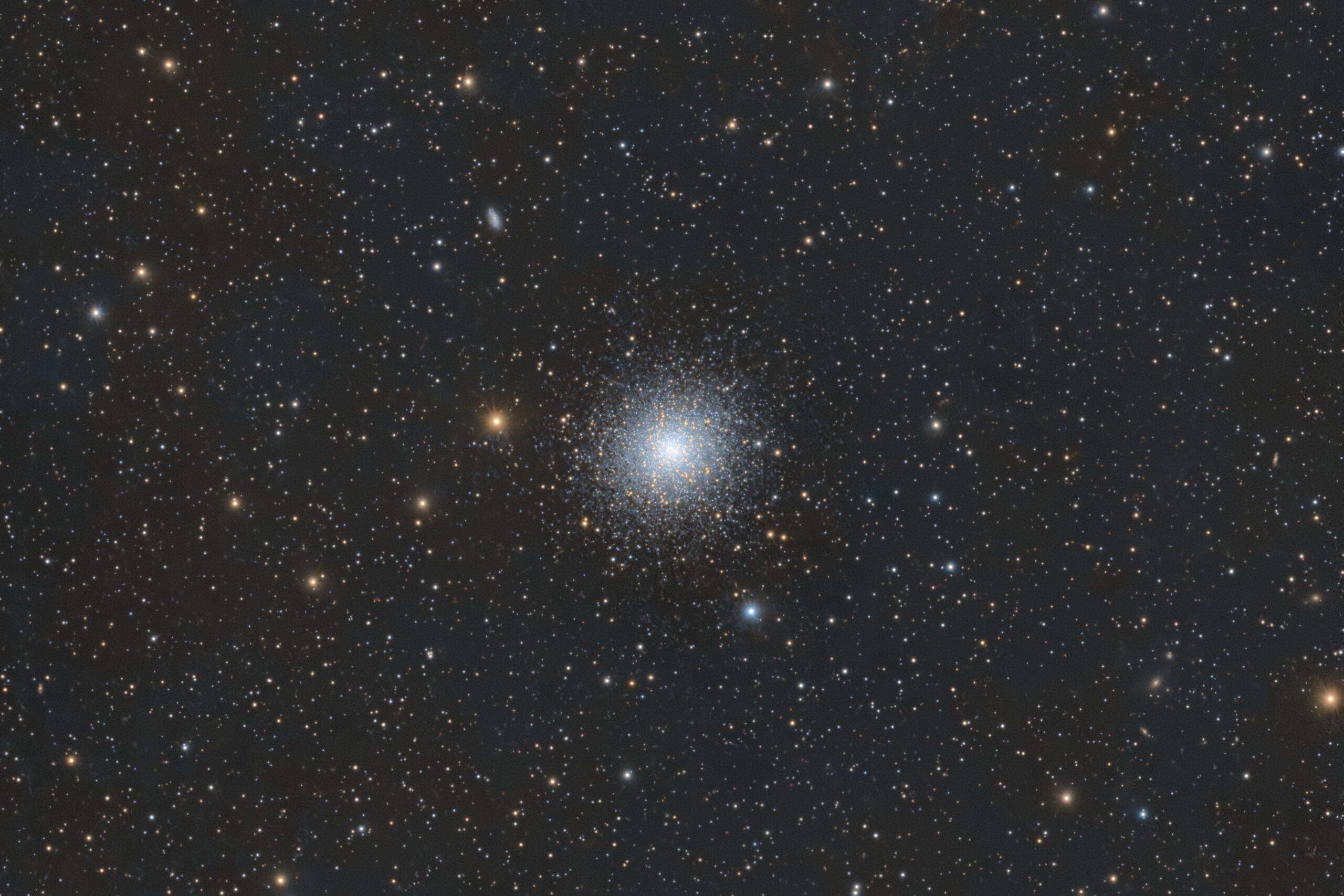
The images were taken with the following equipment:
- Date: 2026
- Seestar S30 Pro
- Focal length [mm]: 160
- Focal ratio: 5.3
- Mount: Seestar, EQ Mode
- Camera: Seestar Tele
- Filter: OSC
- Exposure time: 250
- Resolution: 1.84″/px (drizzle 2)

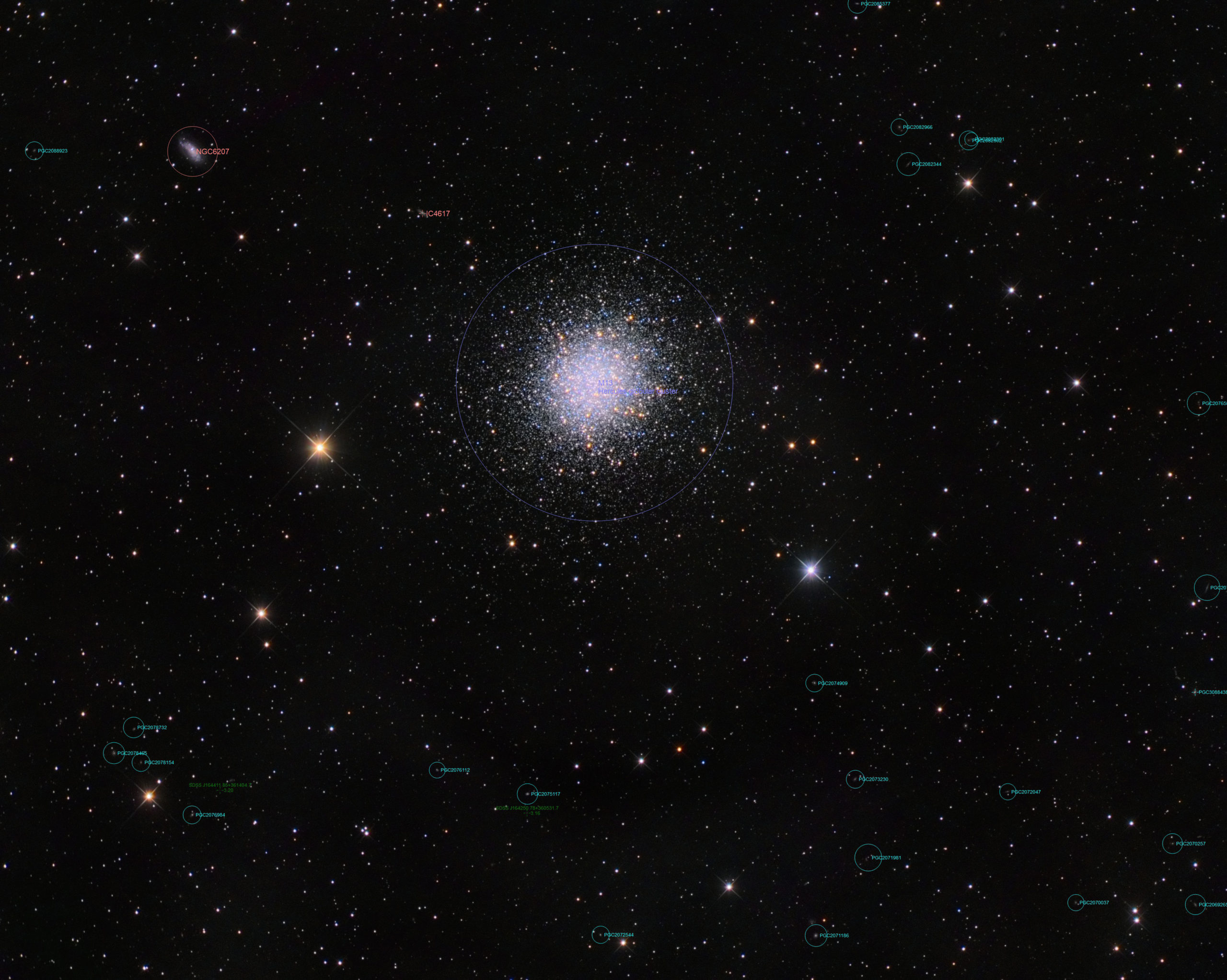
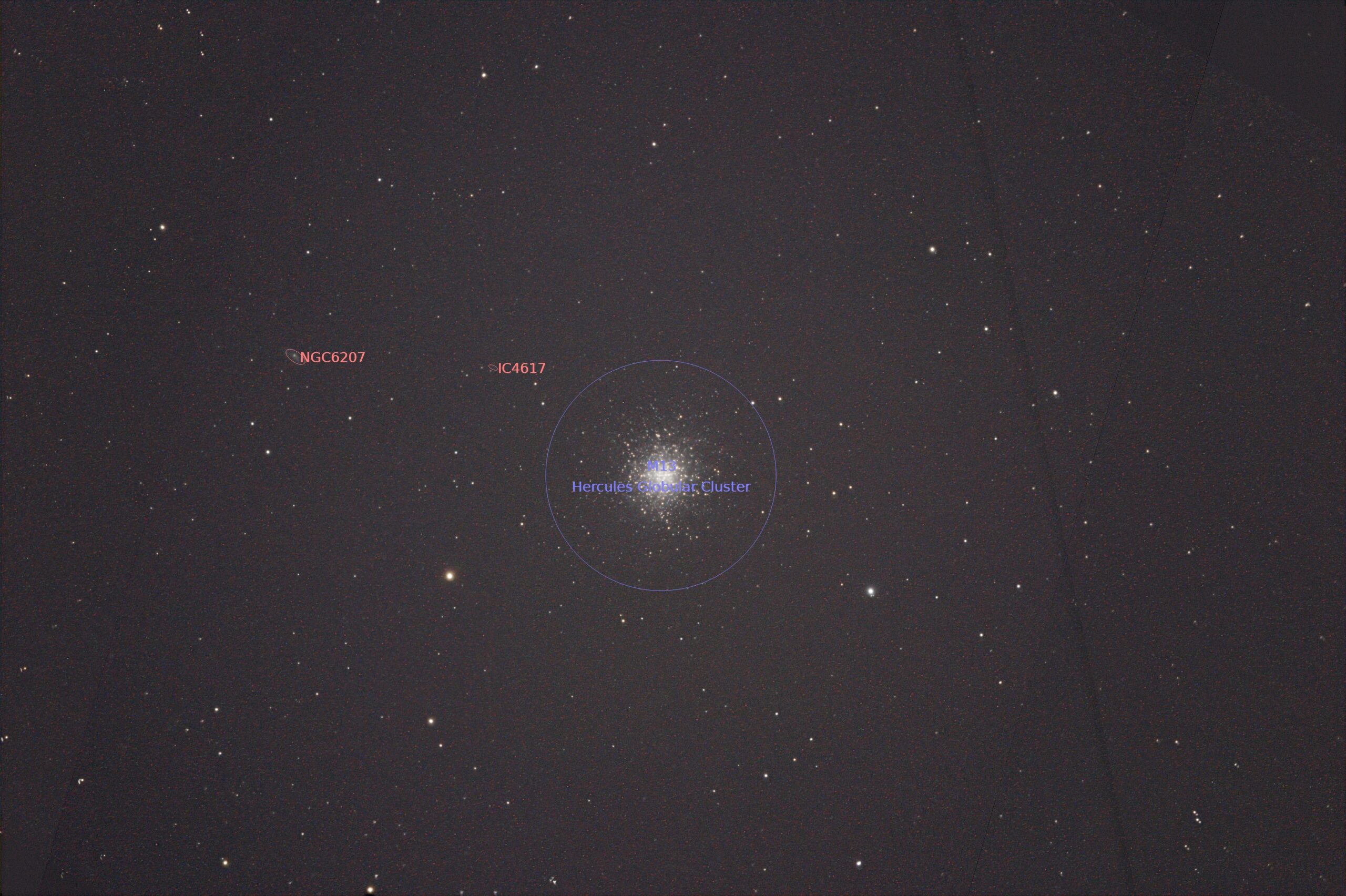
The two highest redshift quasars [Flesh 2015] in the image are:
SDSS J164411.85+361404.7 z=3.20 magG=20.4 (Gaia DR2)
SDSS J164250.78+360531.7 z=3.16 magG=19.3 (Gaia DR2)
The images were taken with the following equipment:
- Date: 2019
- Telescope: 10″ Newton ohne Namen – TSQ-65ED Apo
- Focal length [mm]: 1000 – 420
- Focal ratio: 3.9 – 6.5
- Mount: Skywatcher EQ 8
- Camera: Moravian G3 16200 FW – Moravian G2 8300 FW
- Filter: L – R:G:B
- Exposure time: 420 – 170:180:130
- Resolution: 1.23″/px – 2.65″/px
In 2010 I took some images of Messier 13 from my own backyard.
Data calibration and registration was done with DeepSkyStacker and the final processing was done with PixInsight. The result was as follows:
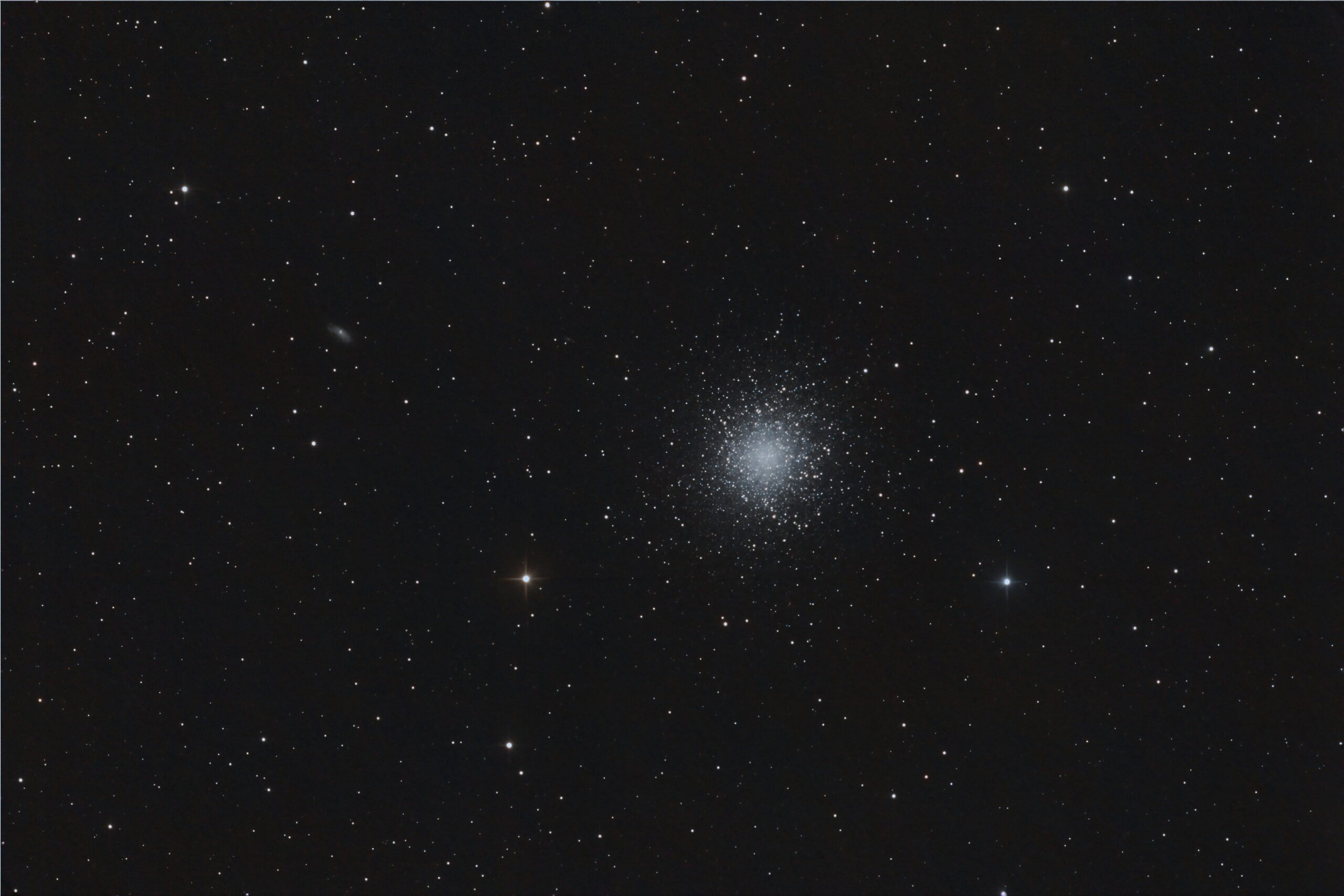
The images were taken with the following equipment:
- Date: 2010
- Telescope: GSO 8″ Newton
- Focal length [mm]: 800
- Focal ratio: 4
- Mount: Skywatcher NEQ 6
- Camera: Canon 300 Da
- Filter: OSC
- Exposure time: 180
- Resolution: 1.88″/px
In 2008 I took some images of Messier 13 from my own backyard.
Data calibration and registration was done with DeepSkyStacker and the final processing was done with PixInsight. The result was as follows:
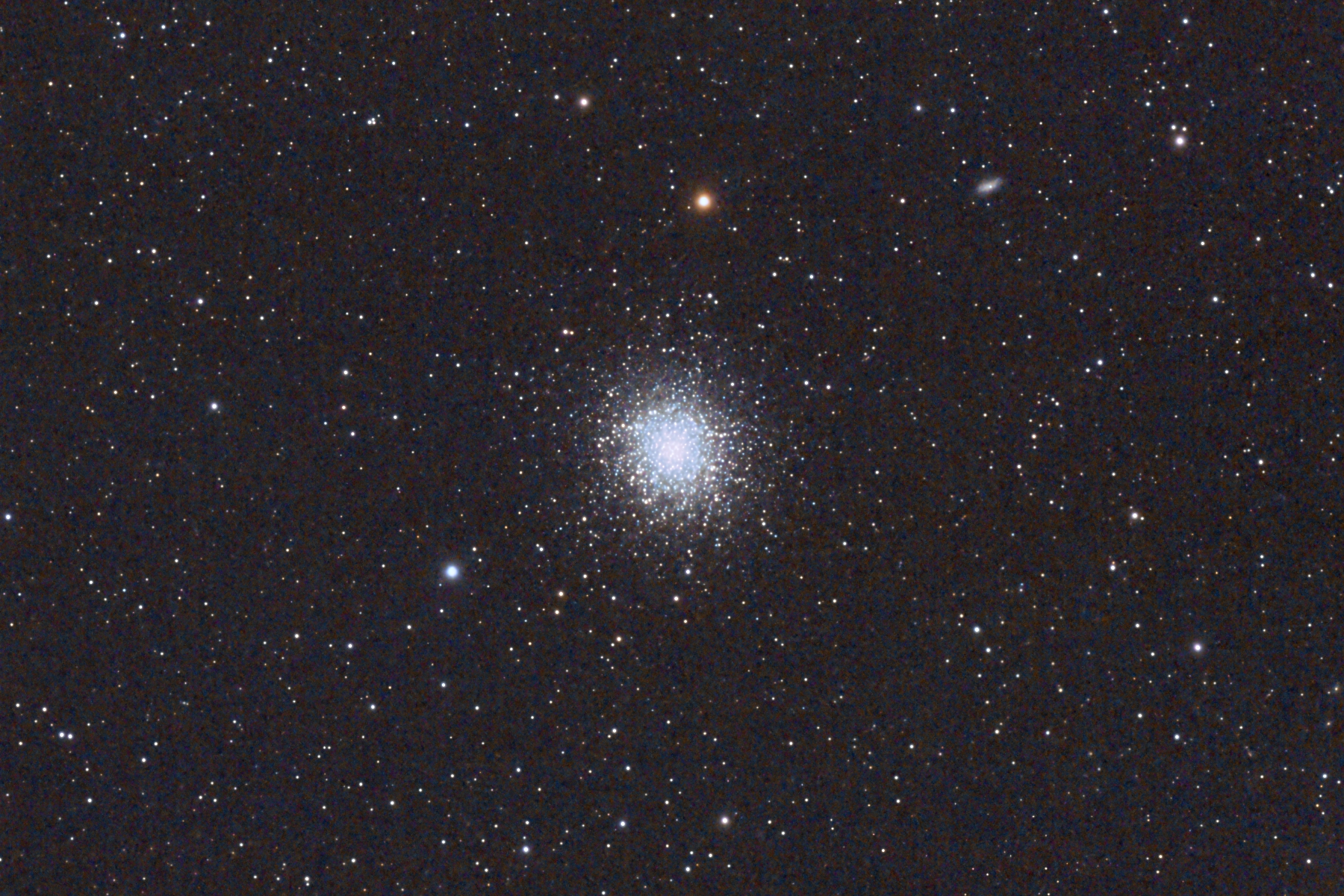
The images were taken with the following equipment:
- Date: 2008
- Telescope: Pentax 75 SDHF
- Focal length [mm]: 500
- Focal ratio: 6.7
- Mount: Vixen GP-DX
- Camera: Canon 300 Da
- Filter: OSC
- Exposure time: 24
- Resolution: 3.04″/px
In 2005 I took some images of Messier 13 during a stay at the astrofarm Hakos.
Data calibration and registration was done with DeepSkyStacker and the final processing was done with PixInsight. The result was as follows:
The images were taken with the following equipment:
- Date: 2005
- Telescope: Rubinar lens
- Focal length [mm]: 500
- Focal ratio: 5.6
- Mount: Liebscher
- Camera: Canon 300 Da
- Filter: OSC
- Exposure time: 16
- Resolution: 2.7″/px
The first time I imaged Messier 13 was in 2005 from my own backyard.
Data calibration and registration was done with DeepSkyStacker and the final processing was done with PixInsight. The result was as follows:
The images were taken with the following equipment:
- Date: 2005
- Telescope: GSO 8″ Newton
- Focal length [mm]: 800
- Focal ratio: 4
- Mount: Skywatcher HEQ-5
- Camera: Canon 300 Da
- Filter: OSC
- Exposure time: 5
- Resolution: 1.88″/px


Leave a reply