

Messier 11 (Wild Duck Cluster)
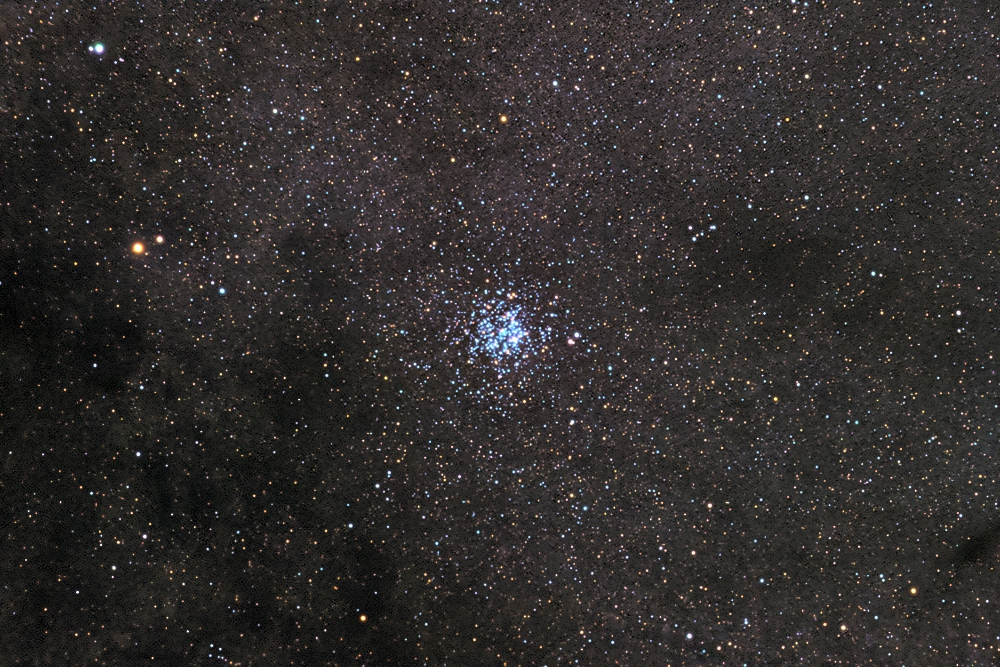
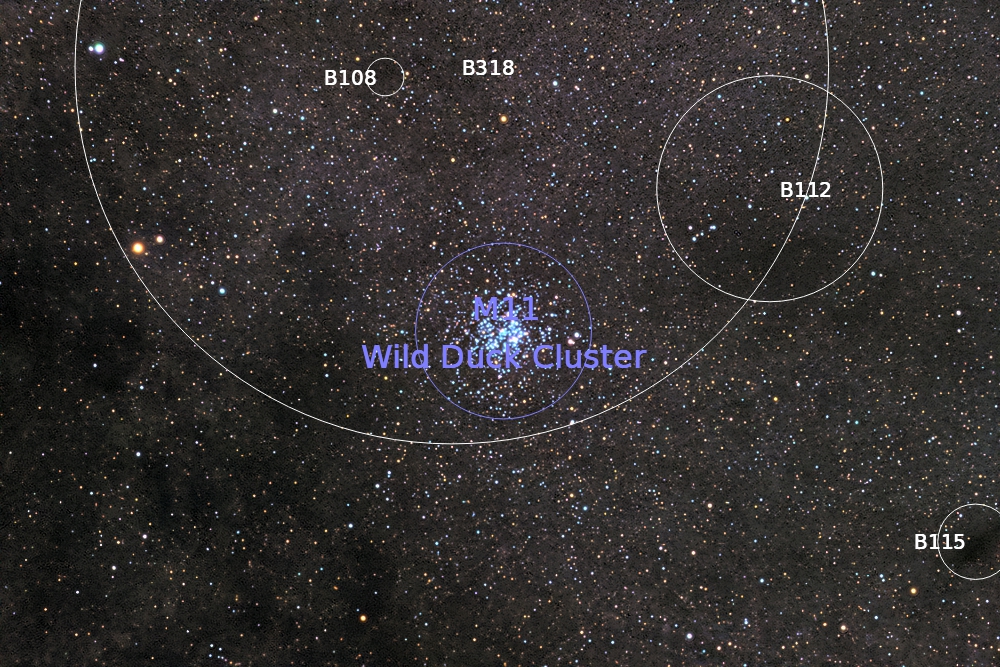
In 2006, during a stay at the Tivoli Astrofarm in Namibia, I imaged the magnificent open cluster Messier 11 using my DSLR equipment. The exceptionally dark skies and excellent transparency of the Namibian winter provided ideal conditions for capturing this spectacular southern star cluster. Even with relatively modest equipment, the rich stellar population and surrounding Milky Way star field were recorded with impressive depth and color.
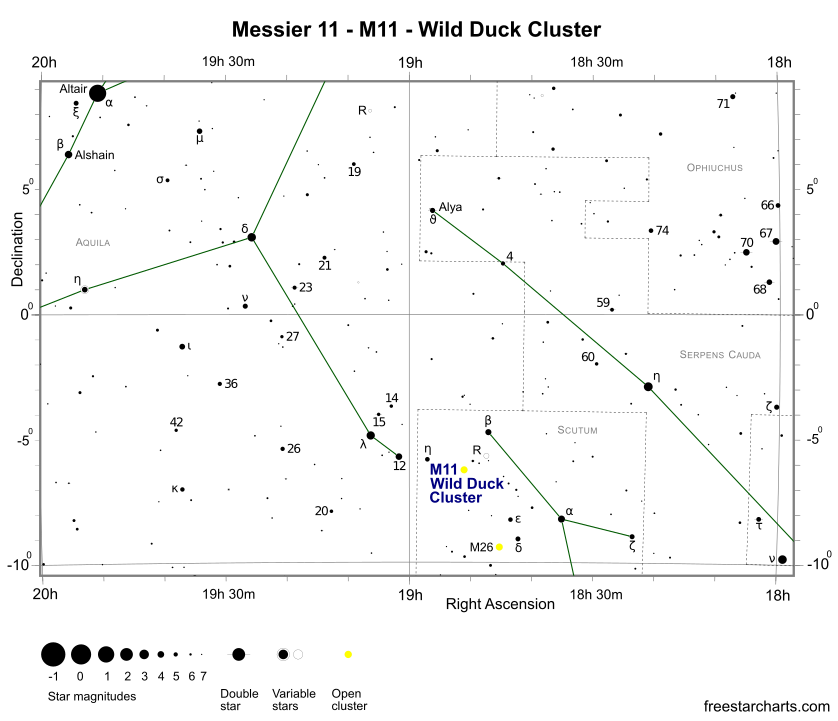
Messier 11 (M11), better known as the Wild Duck Cluster, is one of the richest and most compact open star clusters in the Milky Way. It lies in the constellation Scutum, near the bright Scutum Star Cloud, and contains on the order of 2,900 stars packed into a relatively small region of space.
M11 is located roughly 6,000–6,200 light-years from Earth in the Sagittarius Arm of our Galaxy. On the sky, it spans about 14–32 arcminutes depending on how far out you trace its fainter members—comparable to or slightly smaller than the apparent diameter of the full Moon. With a visual magnitude around 5.8–6.3, it is just on the edge of naked-eye visibility under very dark skies, and appears as a hazy patch that resolves into a dense swarm of stars in binoculars and small telescopes.science.nasa+6
The name “Wild Duck Cluster” comes from the roughly V-shaped arrangement of its brightest stars, which to early observers resembled a flock of ducks in flight. Modern high-resolution images show a very dense, almost globular-cluster-like center surrounded by a rich sprinkling of fainter stars.
Messier 11’s richness is one of its defining features. Estimates of the number of member stars cluster around 2,900–3,000, making it one of the most populated open clusters known. About 500 stars brighter than magnitude 14 and roughly 870 brighter than magnitude 16.5 have been counted as likely members. Its total mass is estimated around 2,900–11,000 solar masses depending on the method—quite massive for an open cluster.
The cluster contains a mix of hot B-type main-sequence stars and many yellow and red giant stars, reflecting its intermediate age. Photometric and evolutionary studies give ages around 220–316 million years. That age means that the most massive, hottest O-type stars that were born with the cluster have already evolved off the main sequence, leaving slightly less massive B-type stars as the brightest blue members.
Structurally, M11 has a compact core and an extended halo. One study quotes a core radius of about 1.23 parsecs (roughly 4 light-years) and a tidal radius of about 29 parsecs (95 light-years). Other sources give a physical diameter around 23–57 light-years, depending on how far the outer members are considered. That combination—small dense core, extended outer envelope—adds to the impression of a mini globular cluster, even though its age and stellar mix clearly mark it as an open cluster.wikipedia+3
The cluster is also somewhat reddened by interstellar dust along the line of sight, with a visual extinction around 1.3 magnitudes. That extinction affects distance and brightness estimates and is one reason why different sources can give slightly different numbers for its properties.
Unlike some older globular clusters, M11 is relatively metal-rich. Its iron abundance is quoted around [Fe/H] ≈ +0.17, meaning it has slightly more heavy elements than the Sun. That metal richness fits with its location in the inner disk of the Milky Way and its age of only a few hundred million years; it formed from gas that had already been enriched by previous generations of stars.
M11 sits on the northern edge of the Scutum Star Cloud, a rich section of the Milky Way thick with stars and gas. Observationally, that placement makes the field stunning, but it also complicates membership studies because many unrelated background and foreground stars lie along the same line of sight.universetoday+2
For observers, Messier 11 is a favorite target because it offers a striking visual combination: a dense, bright core, a recognizable “wild duck” shape of bright stars, and a rich background of Milky Way fields. Through a small telescope it looks like a grainy triangle of light; larger instruments resolve hundreds of stars into a glittering swarm.
Scientifically, M11 is important as a relatively massive, metal-rich open cluster with a well-populated color–magnitude diagram and a known age. It helps astronomers test models of stellar evolution, cluster dynamics, and the enrichment history of the Galactic disk.
The data calibration and registration were done using DeepSkyStacker, while the final image processing was performed in PixInsight.
The images were taken with the following equipment:
- Location: Tivoli, Namibia
- Telescope: Rubinar lens
- Focal length [mm]: 500
- Focal ratio: 5.6
- Mount: Vixen Atlux
- Camera: Canon 300 Da
- Filter: OSC
- Exposure time [min]: 17
- Resolution: 4.25″/px



Leave a reply