• Home
  • Blog
  • Astrophotography
    • Deep Sky
      • Galaxies (Galaxien)
      • Nebulae (Nebel)
      • Planetary Nebulae (Planetarische Nebel)
      • Globular Clusters (Kugelsternhaufen)
      • Open Clusters (Offene Sternhaufen)
      • Miscellaneous (Verschiedenes)
    • Solar System (Sonnensystem)
      • Comets (Kometen)
      • Sun (Sonne)
      • Moon (Mond)
      • Mars
      • Jupiter
      • Saturn
      • Other Planets ( Andere Planeten)
  • Archiv

    • August 2026
    • Juli 2026
    • Juni 2026
    • Mai 2026
    • April 2026
    • Februar 2026
    • Januar 2026
    • Dezember 2025
    • November 2025
    • Oktober 2025
    • September 2025
    • August 2025
    • Juli 2025
    • Juni 2025
    • Mai 2025
    • April 2025
    • März 2025
    • Januar 2025
    • Dezember 2024
    • November 2024
    • Oktober 2024
    • September 2024
    • August 2024
    • Juli 2024
    • Juni 2024
    • Mai 2024
    • April 2024
    • März 2024
    • Februar 2024
    • Januar 2024
    • November 2023
    • Oktober 2023
    • September 2023
    • August 2023
    • Juli 2023
    • Juni 2023
    • Mai 2023
    • April 2023
    • März 2023
    • Februar 2023
    • Januar 2023
    • Dezember 2022
    • November 2022
    • Oktober 2022
    • September 2022
    • August 2022
    • Juli 2022
    • Juni 2022
    • Mai 2022
    • April 2022
    • März 2022
    • Februar 2022
    • Januar 2022
    • Dezember 2021
    • November 2021
    • September 2021
    • August 2021
    • Juli 2021
    • März 2021
    • Februar 2021
    • November 2020
    • September 2020
    • August 2020
    • April 2020
    • März 2020
    • Februar 2020
    • Januar 2020
    • Dezember 2019
    • November 2019
    • Oktober 2019
    • September 2019
    • August 2019
    • Mai 2019
    • April 2019
    • März 2019
    • Dezember 2018
    • November 2018
    • Oktober 2018
    • September 2018
    • Juni 2018
    • Mai 2018
    • April 2018
    • März 2018
    • Februar 2018
    • Januar 2018
    • Oktober 2017
    • Juli 2017
    • Juni 2017
    • März 2017
    • Januar 2017
    • Dezember 2016
    • September 2016
    • Mai 2016
    • März 2016
    • November 2015
    • Oktober 2015
    • Juli 2015
    • Mai 2015
    • März 2015
    • Februar 2015
    • September 2014
    • August 2014
    • März 2014
    • Februar 2014
    • Oktober 2013
    • September 2013
    • August 2013
    • April 2013
    • März 2013
    • November 2012
    • August 2012
    • Juli 2012
    • Mai 2012
    • März 2012
    • Januar 2012
    • November 2011
    • Oktober 2011
    • September 2011
    • August 2011
    • April 2011
    • März 2011
    • Oktober 2010
    • September 2010
    • August 2010
    • Juli 2010
    • April 2010
    • Juli 2009
    • Juli 2008
    • Januar 2008
    • Oktober 2007
    • Juli 2007
    • März 2007
    • Februar 2007
    • Juni 2006
    • Oktober 2005
    • September 2005
    • August 2005
    • Januar 2005
  • Kategorien

    • Asterism
    • Astrophotography
    • Barnard
    • Comet
    • Galaxies
    • Globular Cluster
    • IC
    • Messier
    • Moon
    • Nebula
    • NGC
    • Open cluster
    • Photography
    • Planetary Nebula
    • Travel
  • Meta

    • Anmelden
    • Eintrags-Feed
    • Kommentar-Feed
    • WordPress.org
  • Privacy Policy
  • Impressum
  • Haftungsausschluss
  • Cookie-Richtlinie
  • Datenschutzerklärung

wonderfuluniverse.de
  • Home
  • Blog
  • Astrophotography
    • Deep Sky
      • Galaxies (Galaxien)
      • Nebulae (Nebel)
      • Planetary Nebulae (Planetarische Nebel)
      • Globular Clusters (Kugelsternhaufen)
      • Open Clusters (Offene Sternhaufen)
      • Miscellaneous (Verschiedenes)
    • Solar System (Sonnensystem)
      • Comets (Kometen)
      • Sun (Sonne)
      • Moon (Mond)
      • Mars
      • Jupiter
      • Saturn
      • Other Planets ( Andere Planeten)

Messier 107 (NGC 6171) – VdS Remote Hakos and remote


As a member of the VdS Remote Observatory Group, I again had the opportunity in 2024 to make use of the excellent facilities at Hakos, Namibia. For my imaging project of Messier 107 (M107), I employed both telescopes of the VdS remote observatory simultaneously, combining the strengths of the larger instrument for high-resolution detail with the wide-field capability of the second system. This dual-setup approach provides a deeper and more complete dataset than would be possible with a single telescope alone. In addition to my own observations, I received a high-quality LRGB dataset of Messier 107 (NGC 6171) from Telescope Live, acquired under the pristine skies of Chile in 2025.

Messier 107, or M107, is a globular cluster in the constellation Ophiuchus and one of the faintest and loosest objects in the Messier catalog. It is also known as NGC 6171 and sometimes the Crucifix Cluster. Although it looks modest in small telescopes, it is actually a dense, ancient swarm of stars bound together by gravity.science.

M107 lies about 20,000–21,000 light-years from Earth, near the Galactic plane and roughly 9,800 light-years from the Galactic Center. Its apparent size is about 13 arcminutes across, which corresponds to a real diameter of roughly 80 light-years. Its apparent visual magnitude is around 8.8–8.9, so it is visible in binoculars from a dark site and is a fairly easy telescopic target in summer.science.

Globular clusters are old, tightly bound systems containing hundreds of thousands of stars, and M107 is no exception. It is classified as a Class X globular cluster on the old Shapley–Sawyer concentration scale, meaning it is relatively loose compared with the most compact globulars. That loose appearance is one reason it can seem less dramatic than brighter clusters like M13, even though its stellar population is rich and ancient.

M107 is thought to be extremely old, with estimates around 12–14 billion years. That puts it among the oldest known globular clusters and means it formed early in the Milky Way’s history. Its stars are metal-poor, with an iron abundance around [Fe/H] ≈ -0.95, showing that they formed before the Galaxy had been heavily enriched by earlier generations of stars. In plain terms, M107 is a fossil relic from the Milky Way’s youth.

The cluster is also notable for containing a significant number of variable stars. Sources mention 22 to 25 known variables, including RR Lyrae stars and at least one probable SX Phoenicis variable. RR Lyrae variables are especially valuable because they are old, pulsating stars often used to probe distances and cluster properties. M107 also contains blue stragglers, which are stars that appear younger and bluer than expected for such an old cluster.

M107 is moving toward us at about 147 km/s. Because it lies close to the Galactic plane, it may be affected by the Milky Way’s tidal field more than many higher-latitude globular clusters. Some studies estimate its mass at roughly 60,000 to 180,000 solar masses, though the exact number depends on the method used. That is a lot of mass, but spread over a surprisingly loose volume.

M107 has an interesting discovery history. It was found by Pierre Méchain in 1782 and independently observed by William Herschel in 1793, but it was not added to the Messier catalog until 1947 by Helen Sawyer Hogg. That makes it one of the last Messier objects to be formally recognized. Its late inclusion is a reminder that the Messier list was assembled gradually and corrected over time.science.

For observers, M107 is a rewarding target because its loose structure makes it relatively easy to resolve in a small-to-medium telescope. From a dark sky site it can be seen in binoculars, but it becomes much more impressive in an 8-inch telescope or larger, where many stars begin to separate into a grainy halo. The best time to observe it is during the summer months, especially July.

All data calibration, registration, and final processing were performed in PixInsight.
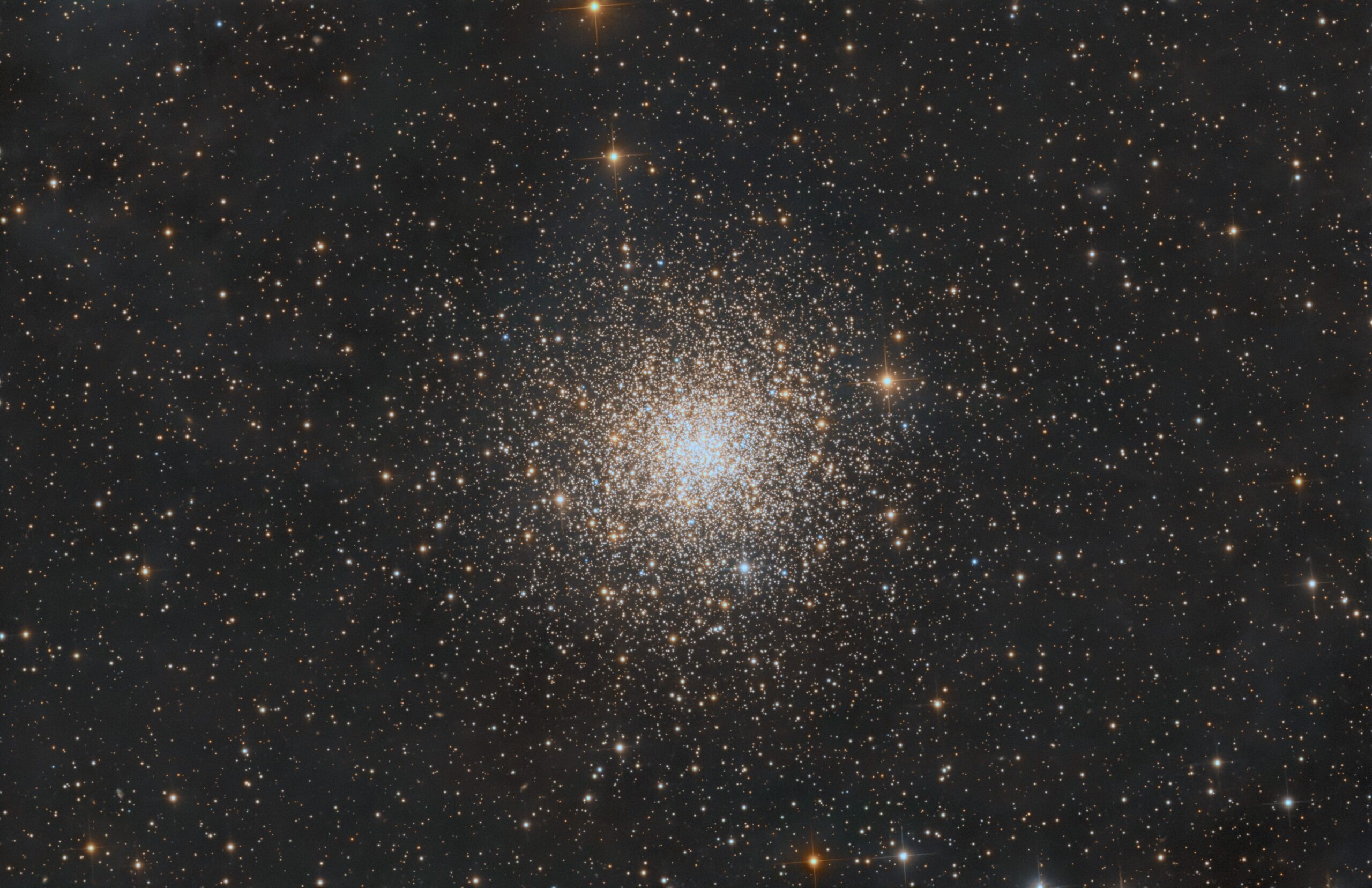
Messier 107, Telescope Live, Chile, 2025


The images were taken with the following equipment:

  • Date: 2025
  • Location: El Sauce Observatory, Chile
  • Telescope/Lens: Planwave CDK24
  • Focal length [mm]: 3962
  • Focal ratio: 6.5
  • Mount: Mathis MI-1000/1250
  • Camera: QHY 600M Pro
  • Filter: LRGB
  • Exposure time [min]: 195:210:195:200
  • Resolution: 0.39″/px (bin2)


All data calibration, registration, and final processing were performed in PixInsight.
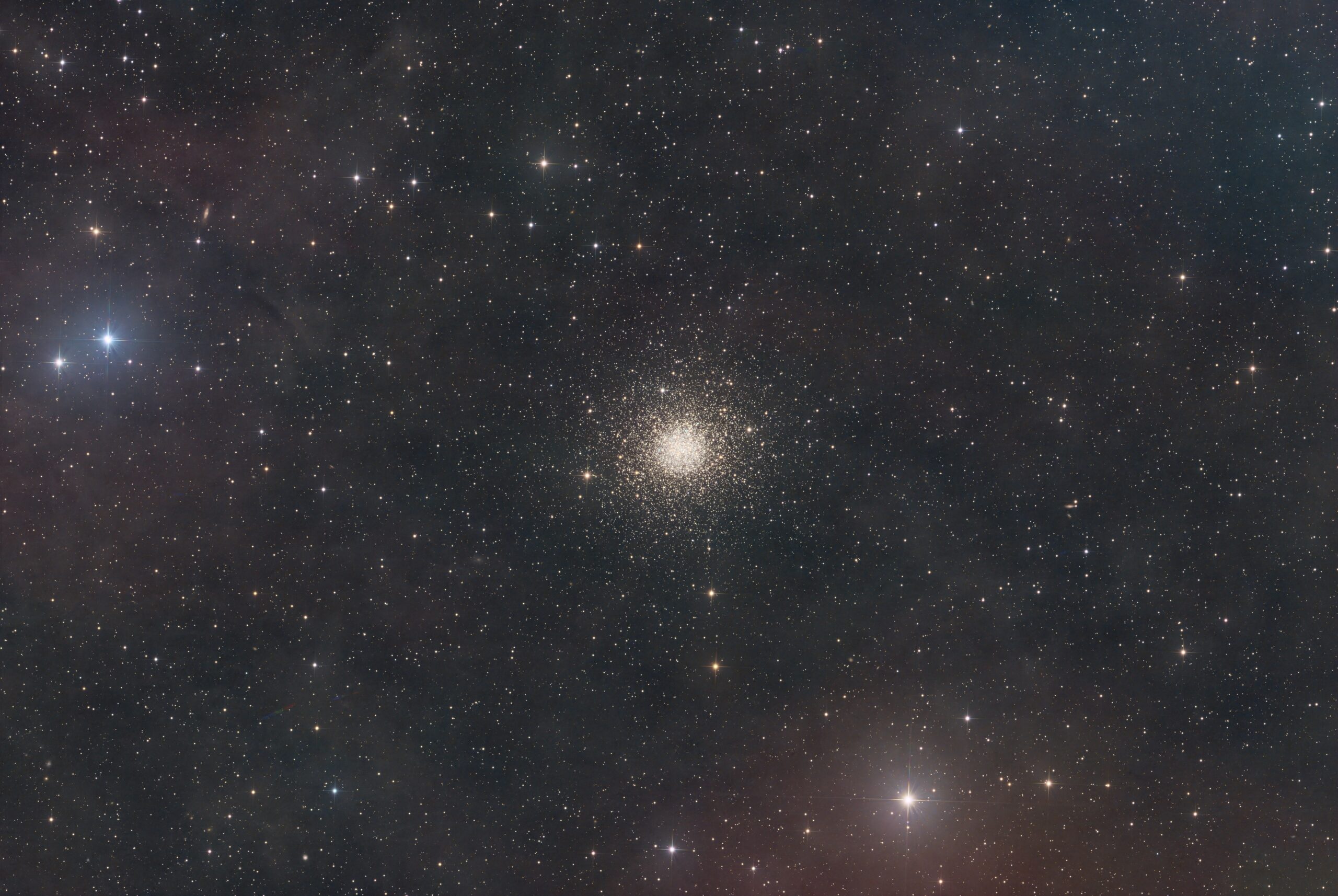
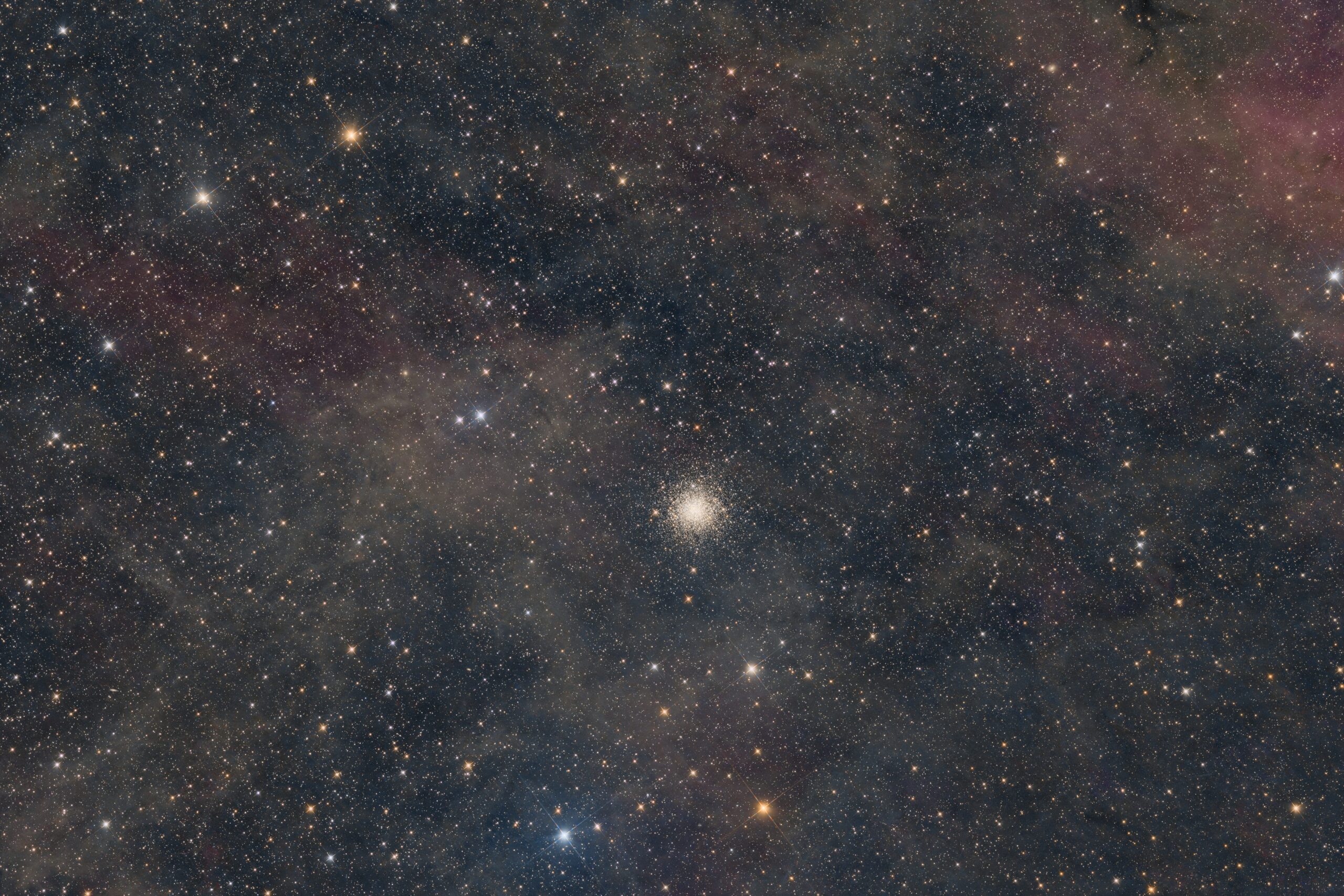
Messier 107, VdS-remote, Hakos, Namibia, 2024, 12"
Messier 107, VdS-remote, Hakos, Namibia, 2024, 12″
Messier 107, 12", annotated
Messier 107, 12″, annotated


The images were taken with the following equipment:

  • Date: 2024
  • Location: Hakos, Namibia
  • Telescope/Lens: TS 12“ Newton-Astrograph
  • Focal length [mm]: 1391
  • Focal ratio: 4.56
  • Mount: 10Micron GM3000
  • Camera: Lacerta DeepSkyPro2600 (mono)
  • Filter: RGB
  • Exposure time [min]: 65:65:65
  • Resolution: 0.56″/px


Messier 107, VdS-remote, Hakos, Namibia, 2024, TAK
Messier 107, TAK, annotated

In the image you can find many quasars. The most distant of them is:

PS1 J163118.21-124308.6 with a redshift of 3.455.


The images were taken with the following equipment:

  • Date: 2024
  • Location: Hakos, Namibia
  • Telescope/Lens: Takahashi Epsilon-160ED
  • Focal length [mm]: 535
  • Focal ratio: 3.3
  • Mount: 10Micron GM3000
  • Camera: Lacerta DeepSkyPro2600 C
  • Filter: Clear
  • Exposure time [min]: 159
  • Resolution: 1.45″/px


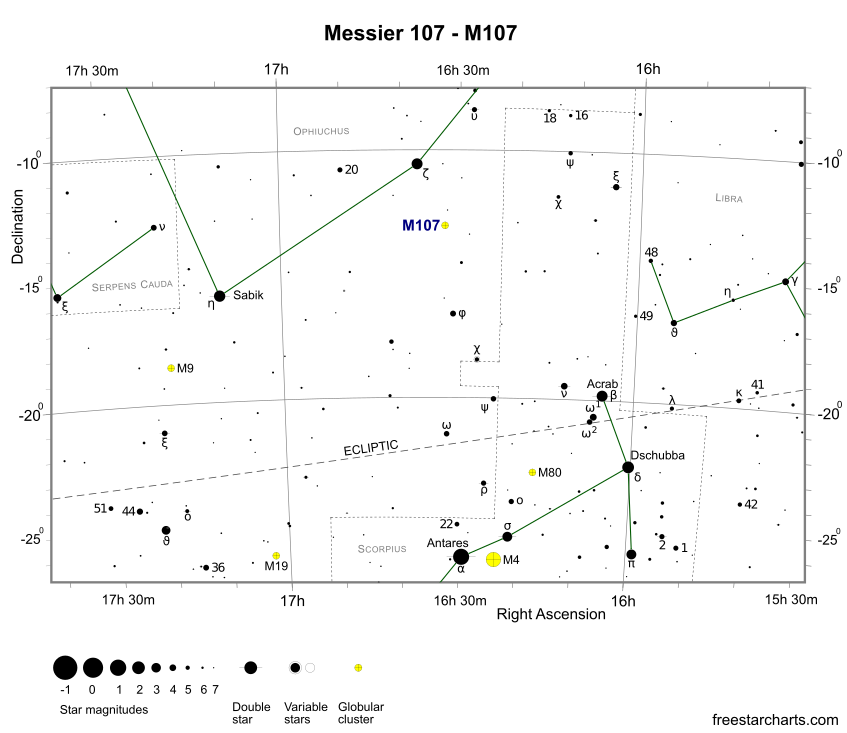
M107 Finder Chart
M107 Finder Chart

Stephan Küppers


You might also like
IC 1805 (Heart Nebula)
12. August 2026
IC 1318
15. Juli 2026
NGC 7000 with IC 5070
24. Juni 2026

Leave a reply

Schreibe einen Kommentar Antwort abbrechen

Deine E-Mail-Adresse wird nicht veröffentlicht. Erforderliche Felder sind mit * markiert


© Stephan Küppers 2020-2026

Cookie-Zustimmung verwalten
Wir verwenden Cookies, um unsere Website und unseren Service zu optimieren.
Funktional Immer aktiv
Die technische Speicherung oder der Zugang ist unbedingt erforderlich für den rechtmäßigen Zweck, die Nutzung eines bestimmten Dienstes zu ermöglichen, der vom Teilnehmer oder Nutzer ausdrücklich gewünscht wird, oder für den alleinigen Zweck, die Übertragung einer Nachricht über ein elektronisches Kommunikationsnetz durchzuführen.
Vorlieben
Die technische Speicherung oder der Zugriff ist für den rechtmäßigen Zweck der Speicherung von Präferenzen erforderlich, die nicht vom Abonnenten oder Benutzer angefordert wurden.
Statistiken
Die technische Speicherung oder der Zugriff, der ausschließlich zu statistischen Zwecken erfolgt. Die technische Speicherung oder der Zugriff, der ausschließlich zu anonymen statistischen Zwecken verwendet wird. Ohne eine Vorladung, die freiwillige Zustimmung deines Internetdienstanbieters oder zusätzliche Aufzeichnungen von Dritten können die zu diesem Zweck gespeicherten oder abgerufenen Informationen allein in der Regel nicht dazu verwendet werden, dich zu identifizieren.
Marketing
Die technische Speicherung oder der Zugriff ist erforderlich, um Nutzerprofile zu erstellen, um Werbung zu versenden oder um den Nutzer auf einer Website oder über mehrere Websites hinweg zu ähnlichen Marketingzwecken zu verfolgen.
  • Optionen verwalten
  • Dienste verwalten
  • Verwalten von {vendor_count}-Lieferanten
  • Lese mehr über diese Zwecke
Einstellungen anzeigen
  • {title}
  • {title}
  • {title}