

LDN 1235 (Dark Shark Nebula)
From time to time I obtain data sets from remote observatories. For the dark nebula LDN 1235 I received two datasets, one in 2022 and one in 2024 from Telescope Live, and one dataset in 2018 from DeepSkyWest.
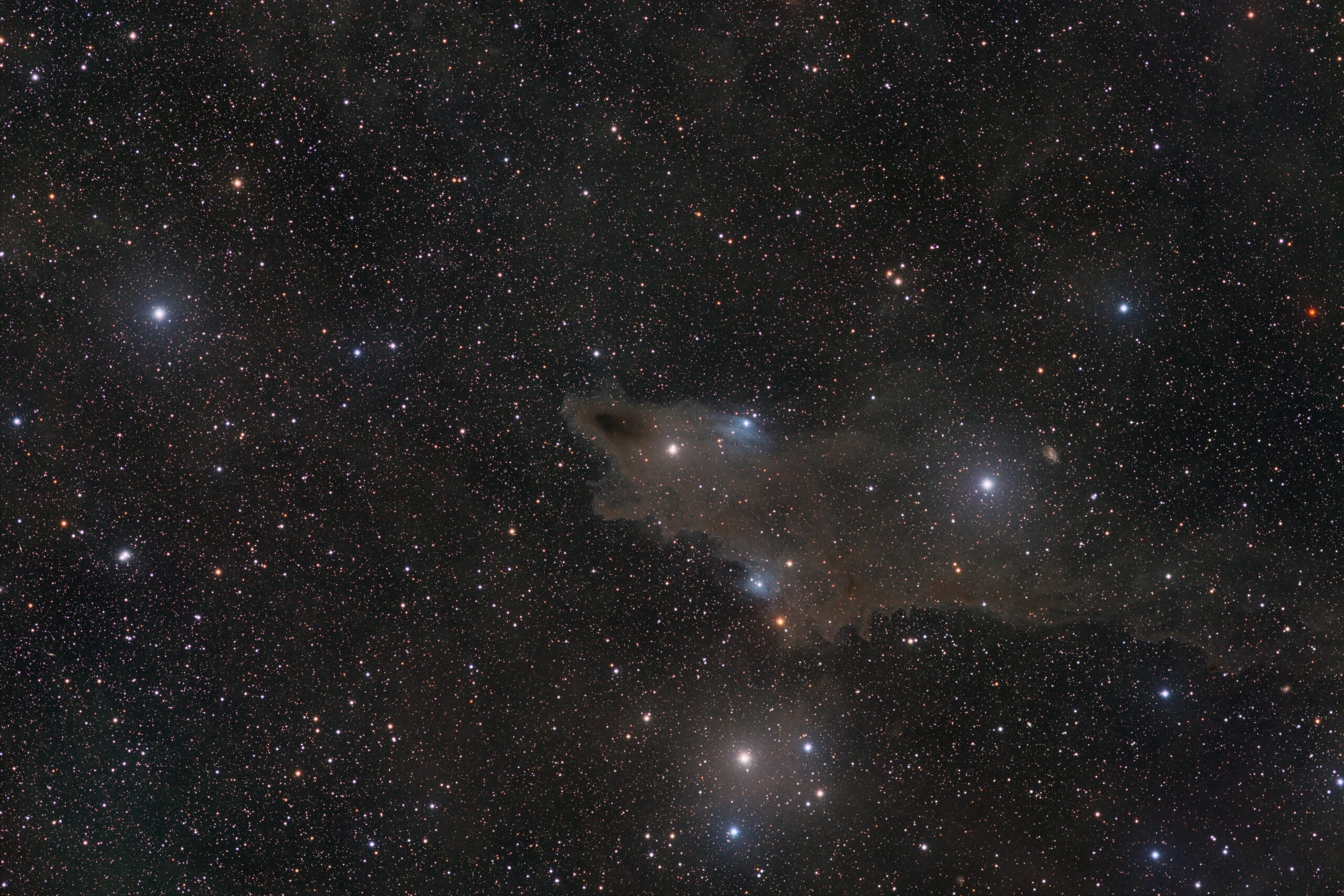
LDN 1235 is a striking dark nebula in the northern constellation Cepheus, best known as the Shark Nebula or Dark Shark Nebula because its dense, curved dust lanes strongly resemble a shark swimming through the starry background. It is a complex of dark, reflection, and faint emission nebulosity, and one of the most photogenic dark clouds in the northern sky.
Technically, LDN 1235 refers specifically to the darkest, most compact part of the complex—the oval “head” or “eye” of the shark. The entire “Shark Nebula” is much larger, stretching over about 2 degrees on the sky (roughly four times the apparent diameter of the full Moon) and including several cataloged components.
The complex contains:
- LDN 1235: the main dark nebula, the densest part of the cloud.
- LBN 541 and LBN 546: small blue reflection nebulae within the same field, illuminated by nearby B-type stars.
- vdB 149 and vdB 150: reflection nebulae in the van den Bergh catalog, lit by the stars BD+72 1018 and HD 210806 (both B8IV).
- A faint H II region, cataloged as LBN 111.07+14.08 (also called LBN 535 in some sources), which is a very weak ionized region embedded in the cloud.
Because the dust is so thick, LDN 1235 obscures the background stars and creates a sharp silhouette against the Milky Way.
The Shark Nebula lies at a distance of roughly 650–670 light-years (about 200–210 parsecs) from Earth. At that distance, its physical extent is about 15 light-years across, making it a substantial molecular cloud on Galactic scales. It is relatively nearby, which is one reason it shows such fine detail in deep images despite being very faint.
LDN 1235 is not just a passive cloud of dust; it is an active star-forming region. The densest parts of the nebula host young stellar objects and pre-main-sequence stars with estimated ages of 1–5 million years. The presence of reflection nebulae, an H II region, and embedded young stars indicates that new stars are forming inside the cloud and beginning to illuminate and erode their natal material.
Because the cloud is so close, it is a good target for studying low-mass star formation, dust properties, and the transition from dark cloud to illuminated nebula. Some studies also suggest that parts of the cloud may exhibit Extended Red Emission (ERE), a faint photoluminescence caused by dust grains being excited by ultraviolet radiation.
Visually, LDN 1235 is extremely challenging. It does not emit much visible light of its own; instead, it is seen primarily by the way it blocks background starlight and by the faint glow of embedded reflection nebulae. That makes it a demanding target for astrophotography, often requiring long total exposures, excellent dark skies, and careful processing to reveal the shark-like shape and the subtle red and blue nebulosity.
In images, the “head” of the shark corresponds to the main dark oval of LDN 1235, while the “body” and “tail” are formed by more diffuse dust lanes extending to the west. The two bright blue reflection nebulae (vdB 149 and vdB 150) add color contrast and help define the shark’s “eye” and “gill” region.
The Shark Nebula is interesting both scientifically and aesthetically. As a nearby star-forming cloud with embedded young stars, reflection nebulae, and a faint H II region, it provides a compact example of how dense molecular clouds evolve into illuminated stellar nurseries. As an imaging target, it is prized for its unmistakable shark shape, the interplay of dark and bright nebulosity, and the challenge it presents to capture such a faint object.
For the Telescope Live CMOS data the calibration, registration and the final processing was done with PixInsight. The result was as follows:
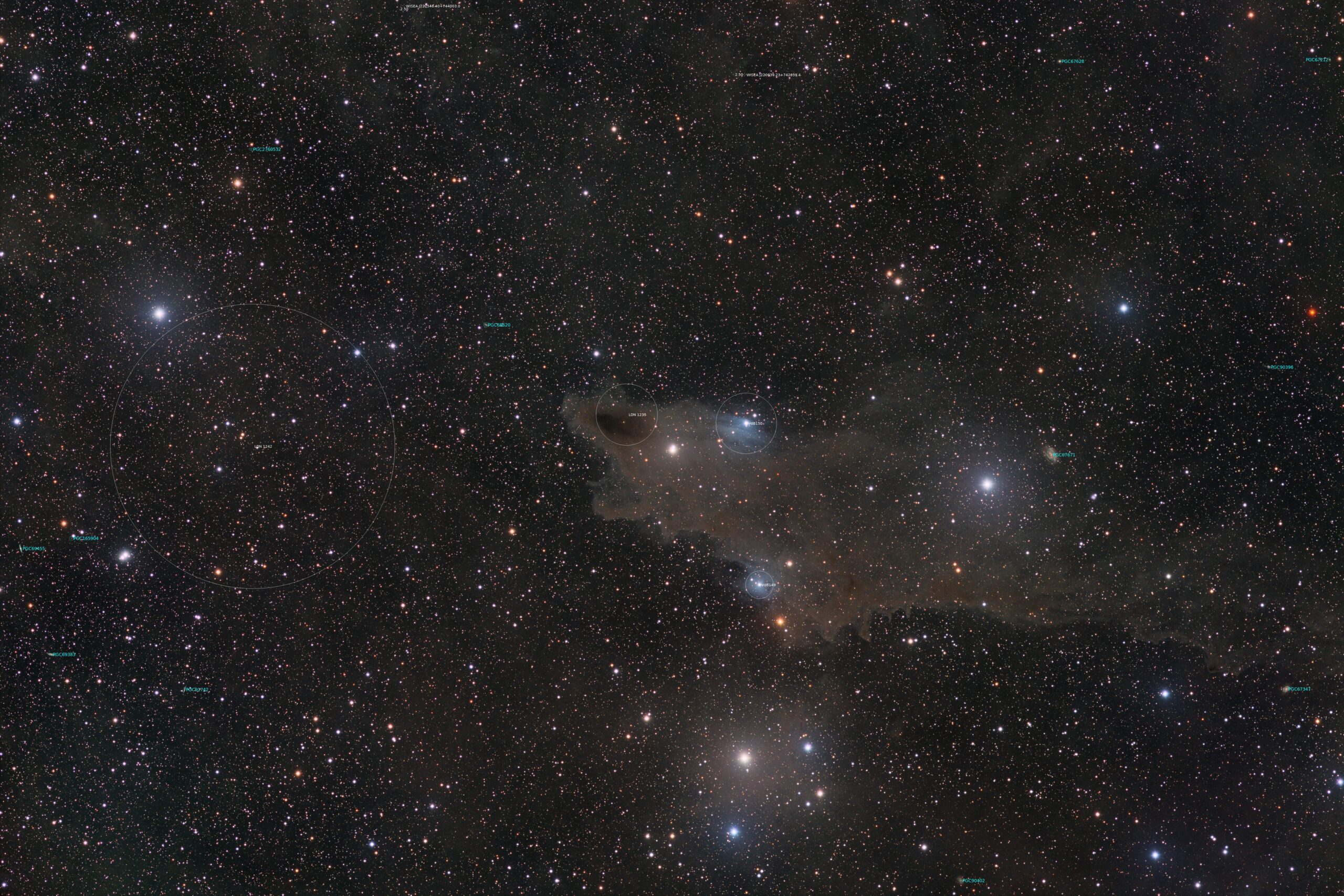
LDN 1235 annotated
In the field were quiet a lot of quasars. The two most distant of them (see annotation) are:
WISEA J220939.23+742859.4 with a redshift of 2.5
WISEA J222546.40+744003.0 with a redshift of 2.5
The images were taken with the following equipment (CHI-1 CCD and CMOS, Telescope Live):
- Date: 2022 – 2024
- Location: IC Observatory, Spain
- Telescope/Lense: Takahashi FSQ-106ED
- Focal length [mm]: 390
- Focal ratio: 3.6
- Mount: Paramount MX+
- Camera: FLI Proline 16803 – QHY 600M Pro
- Filter: L:R:G:B – L:R:G:B
- Exposure time [min]: 100:120:110:120 – 30:30:30:15
- Resolution: 4.75″/px – 2.03″/px
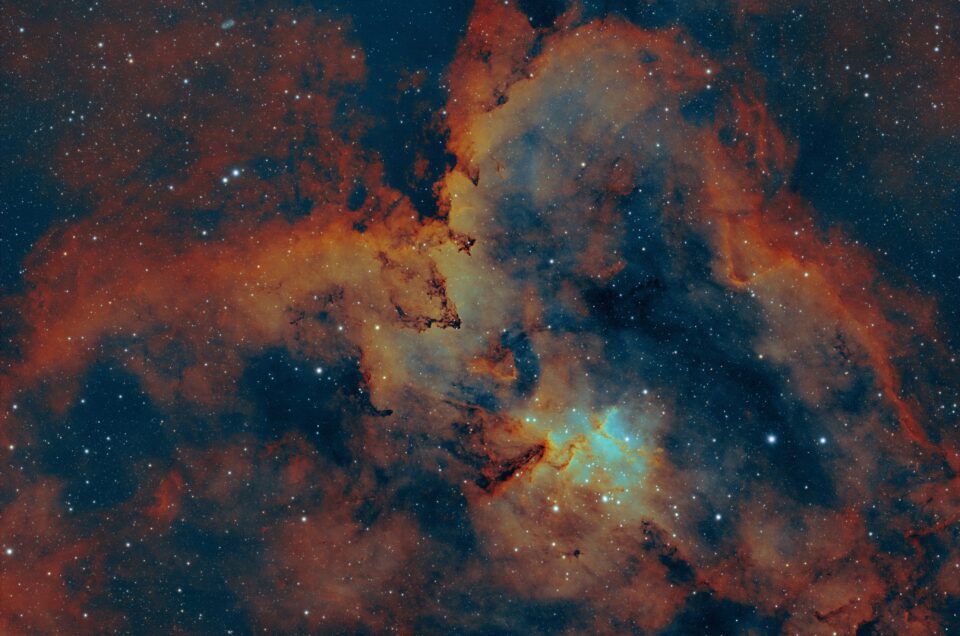
For the DSW data the calibration, registration and final processing were performed with PixInsight. The result was as follows:
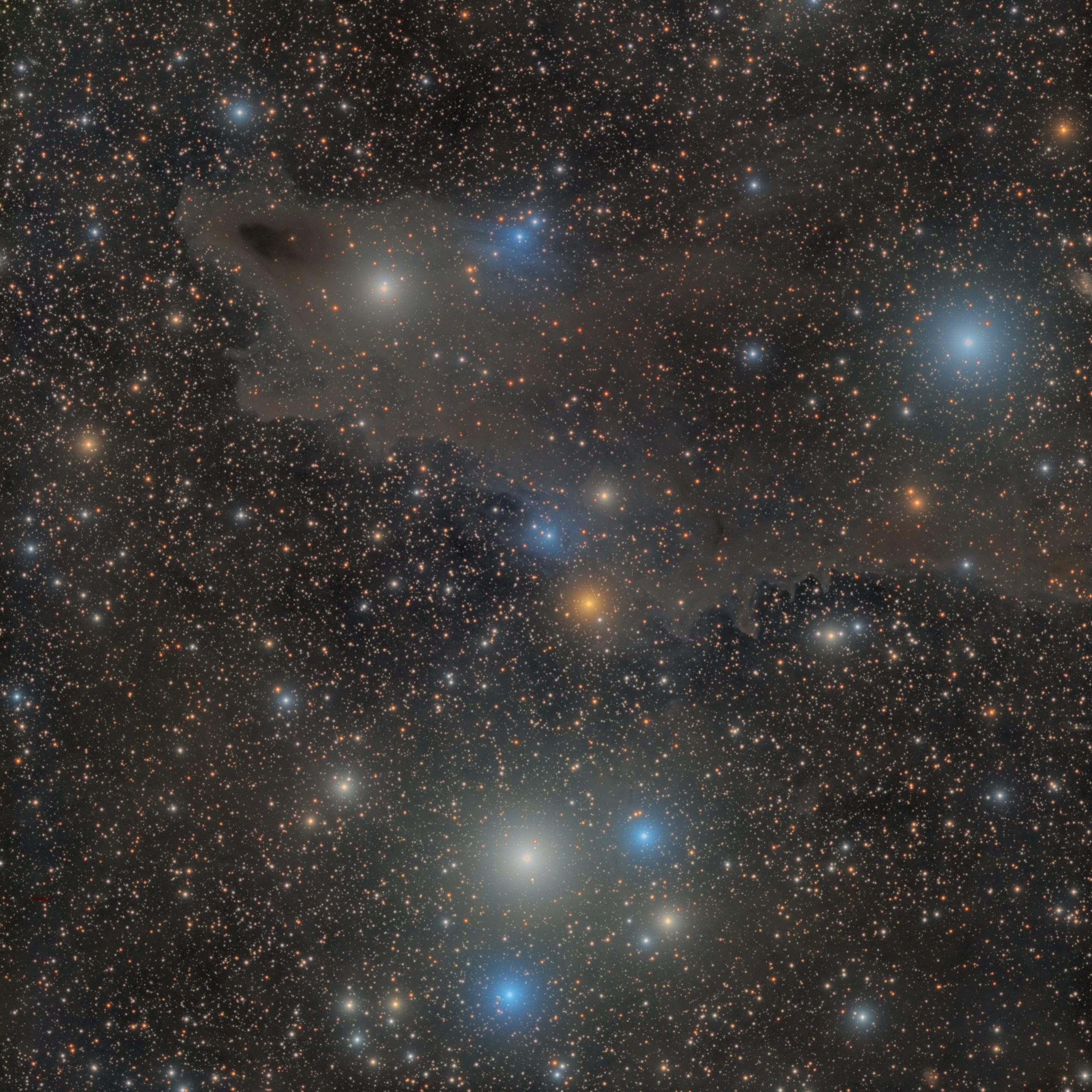
The images were taken with the following equipment (DSW):
- Date: 2018
- Location: rowe, New Mexico
- Telescope/Lense: Astrophysics RH305
- Focal length [mm]: 1159
- Focal ratio: 3.8
- Mount: Paramount ME
- Camera: SBIG STX 1680
- Filter: L:R:G:B
- Exposure time [min]: 310:290:230:260
- Resolution: 1.66″/px



Leave a reply