

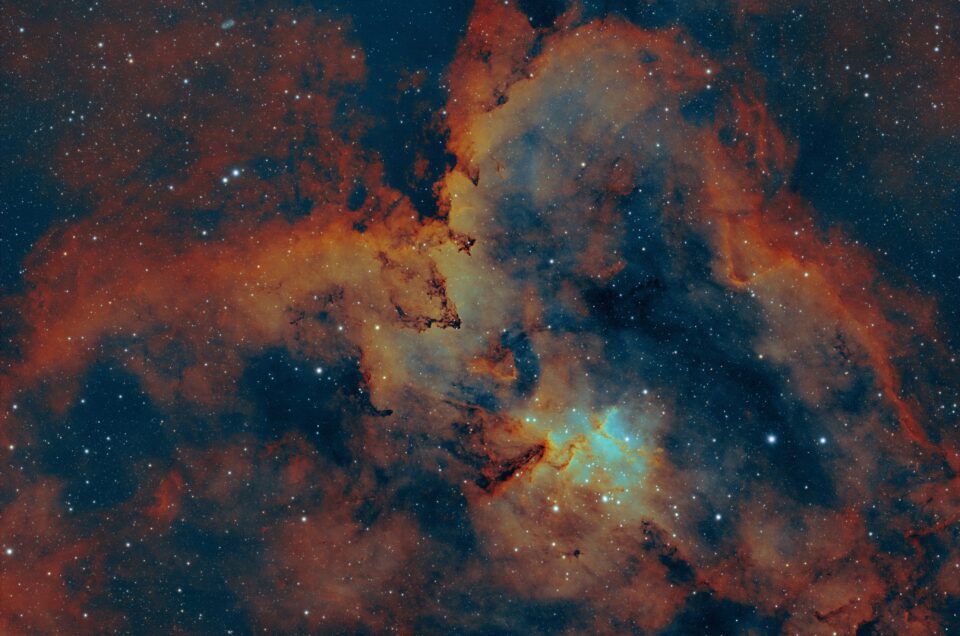
IC 1396A (Elephant’s Trunk Nebula) from my backyard and remote
In 2009, I photographed the iconic Elephant’s Trunk Nebula (IC 1396A) from my backyard observatory using a DSLR camera. Nearly a decade later, in 2018, I revisited this fascinating region using a professionally acquired SHO narrowband dataset from Deep Sky West (DSW) in New Mexico. The combination of sulfur, hydrogen, and oxygen emission revealed a wealth of fine structures that were impossible to capture with my original DSLR image.
The Elephant’s Trunk Nebula, cataloged as IC 1396A, is one of the best-known star-forming clouds in Cepheus and a visually dramatic part of the much larger IC 1396 emission complex. It is a dense, dark globule of gas and dust with a bright, curved rim, and that shape is what gives it the famous “elephant’s trunk” appearance.
IC 1396A is not a standalone nebula in the usual sense; it is a compact pillar-like structure embedded inside a huge ionized region. The entire IC 1396 complex is lit up by a massive star, HD 206267, whose ultraviolet radiation ionizes the surrounding hydrogen gas. The Elephant’s Trunk is one of the densest parts of that cloud, so it can resist the radiation longer than the thinner material around it.
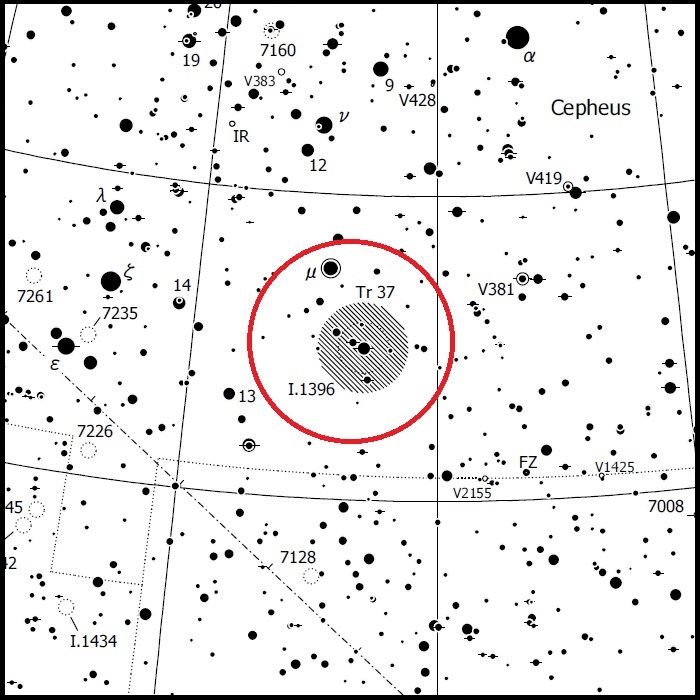
The structure lies about 2,400 light-years from Earth in the constellation Cepheus. The trunk itself is roughly 20 to 30 light-years long, while the larger IC 1396 region stretches over 100 light-years across and spans more than 5 degrees of sky. That makes the nebula physically large, even though it is faint enough that it usually needs long-exposure imaging to be seen well.
The visible glow is mostly ionized hydrogen, which shines when ultraviolet light strips electrons from the gas and the electrons later recombine. The bright rim on the trunk’s edge marks the interface where the cloud is being illuminated and eroded by nearby massive stars. Dust and gas inside the trunk absorb much of the light, which is why the body of the structure appears dark against the brighter background.
The Elephant’s Trunk is scientifically important because it is an active nursery for new stars. Infrared observations revealed several very young protostars hidden inside the dense cloud, some less than 100,000 years old. A pair of young stars at the tip has already cleared a small cavity, showing that newborn stars are actively reshaping the very cloud they formed in. That is a classic example of triggered star formation: radiation and winds compress the cloud, helping new stars collapse out of it.
The Elephant’s Trunk Nebula is a textbook case for studying how massive stars influence their surroundings. It shows both sides of stellar feedback: destruction of the cloud by erosion and creation of new stars by compression. Because it is nearby by Galactic standards, astronomers can study the detailed structure of the cloud, the embedded protostars, and the ionized rim much more precisely than in distant star-forming regions.
For the DSW data the calibration, registration and final processing were performed with PixInsight.
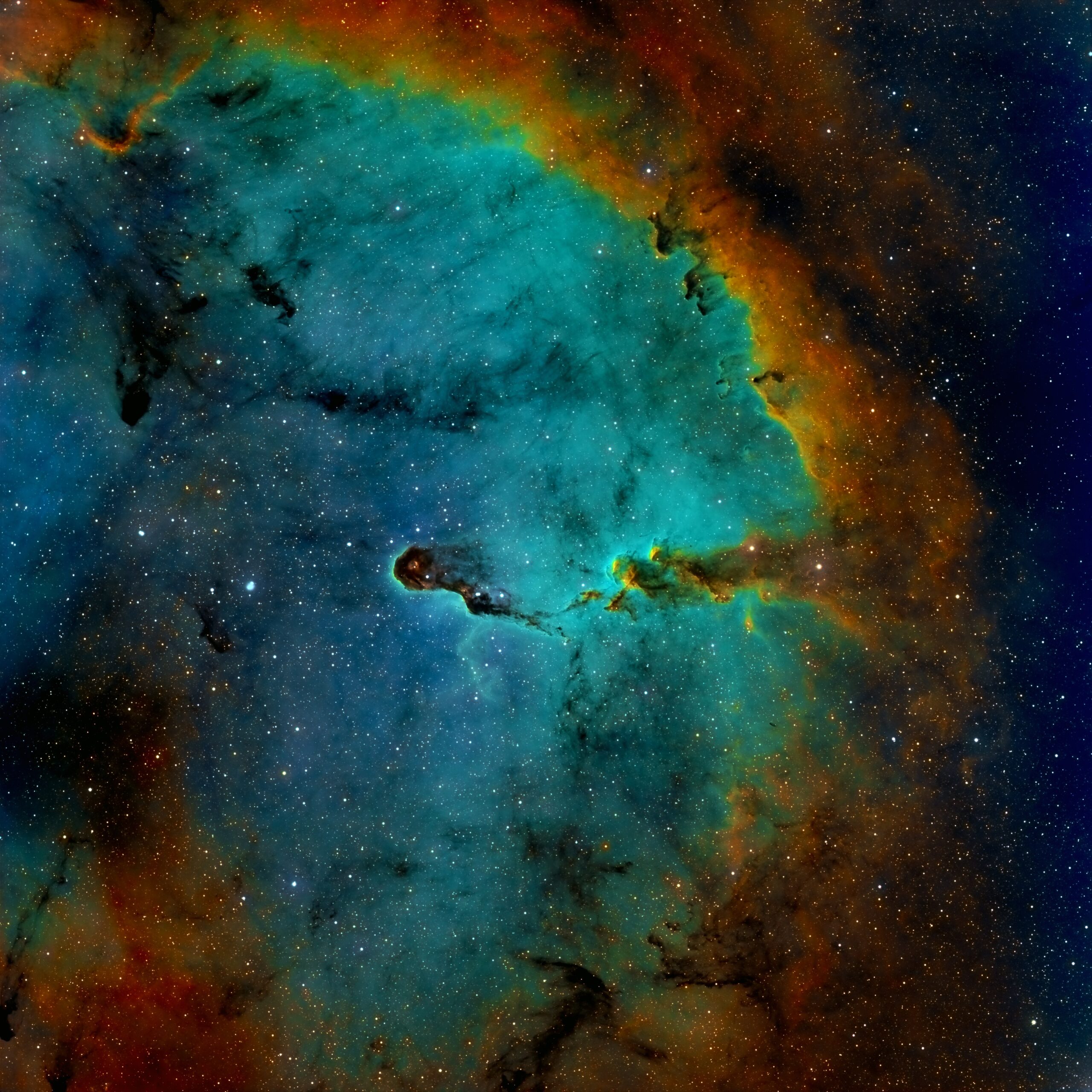
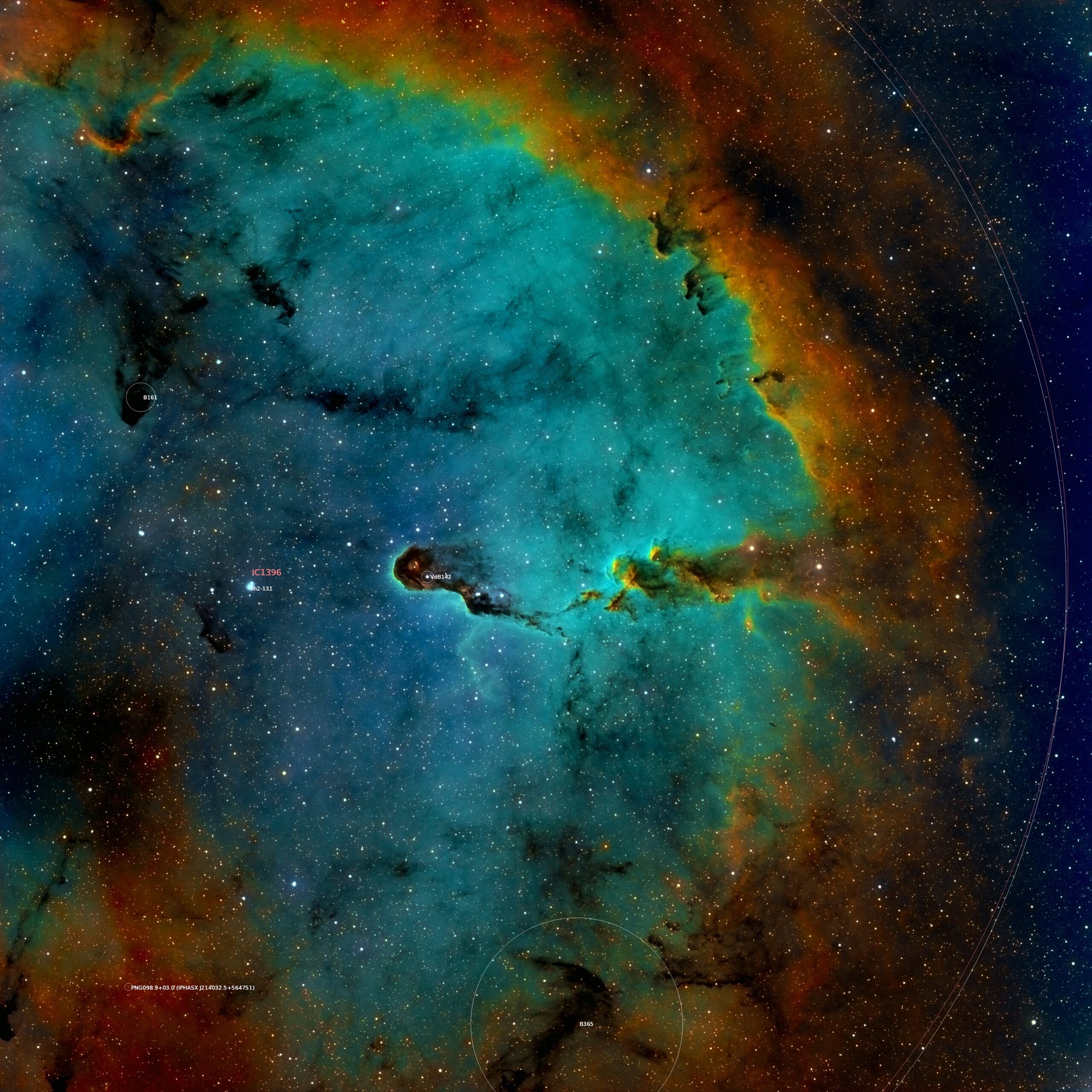
The images were taken with the following equipment (DSW):
- Date: 2018
- Location: Rowe, New Mexico
- Telescope/Lens: Astro Physics RH305
- Focal length [mm]: 1159
- Focal ratio: 3.8
- Mount: Paramount ME
- Camera: SBIG STX16803
- Filter: Hα:[OIII][SII]
- Exposure time [min]: 760:460:560
- Resolution: 1.66″/px
For the 2009 data the calibration and registration were performed with DeepSkyStacker and final processing was done with PixInsight.
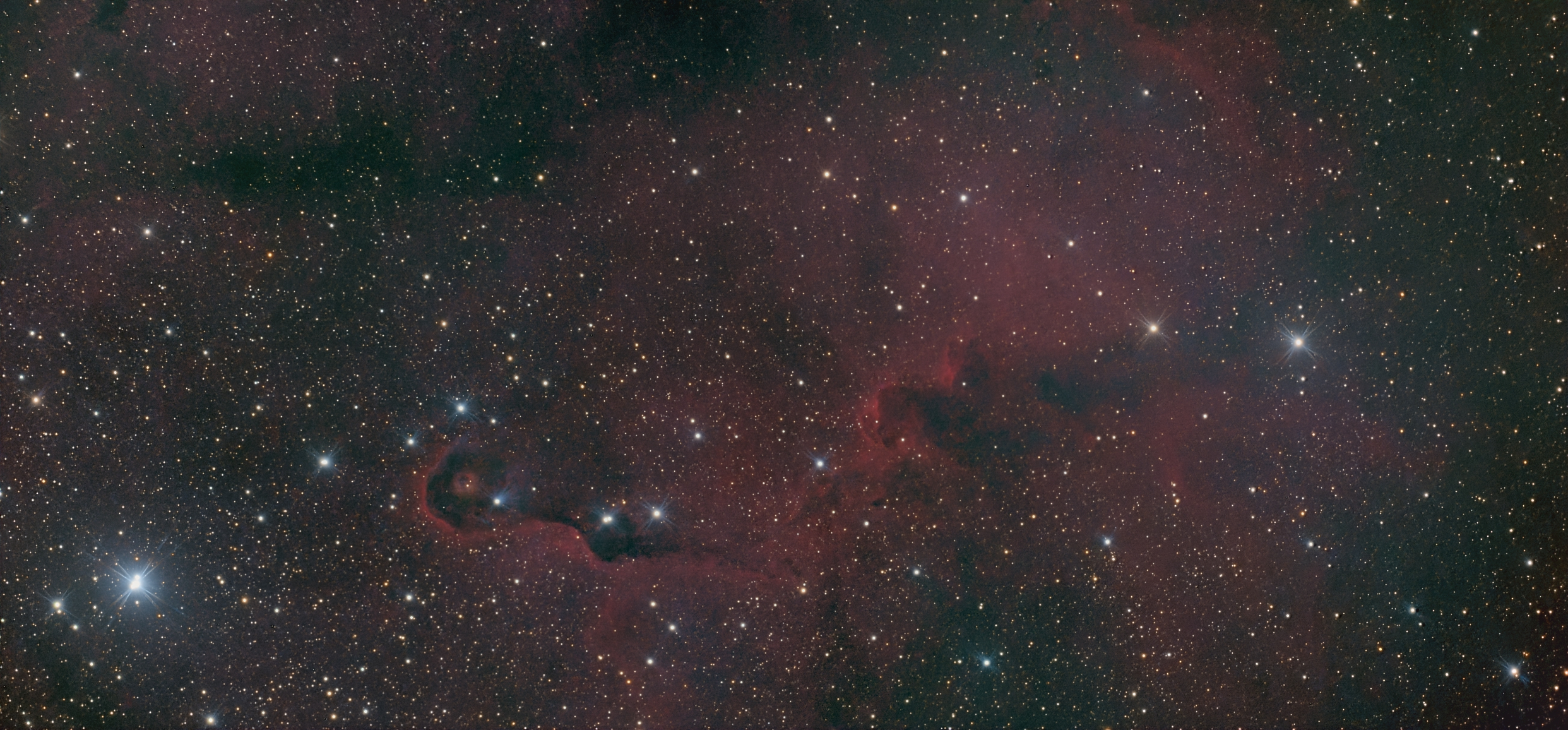
The images were taken with the following equipment:
- Date: 2009
- Location: Krefeld
- Telescope/Lens: 8″ GSO Newton
- Focal length [mm]: 800
- Focal ratio: 4
- Mount: Skywatcher NEQ6
- Camera: Canon 300Da
- Filter: OSC
- Exposure time [min]: 260
- Resolution: 2.64″/px



Leave a reply