• Home
  • Blog
  • Astrophotography
    • Deep Sky
      • Galaxies (Galaxien)
      • Nebulae (Nebel)
      • Planetary Nebulae (Planetarische Nebel)
      • Globular Clusters (Kugelsternhaufen)
      • Open Clusters (Offene Sternhaufen)
      • Miscellaneous (Verschiedenes)
    • Solar System (Sonnensystem)
      • Comets (Kometen)
      • Moon (Mond)
      • Planets (Planeten)
      • Sun (Sonne)
  • Archiv

    • Juli 2026
    • Juni 2026
    • Mai 2026
    • April 2026
    • Februar 2026
    • Januar 2026
    • Dezember 2025
    • November 2025
    • Oktober 2025
    • September 2025
    • August 2025
    • Juli 2025
    • Juni 2025
    • Mai 2025
    • April 2025
    • März 2025
    • Januar 2025
    • Dezember 2024
    • November 2024
    • Oktober 2024
    • September 2024
    • August 2024
    • Juli 2024
    • Juni 2024
    • Mai 2024
    • April 2024
    • März 2024
    • Februar 2024
    • Januar 2024
    • November 2023
    • Oktober 2023
    • September 2023
    • August 2023
    • Juli 2023
    • Juni 2023
    • Mai 2023
    • April 2023
    • März 2023
    • Februar 2023
    • Januar 2023
    • Dezember 2022
    • November 2022
    • Oktober 2022
    • September 2022
    • August 2022
    • Juli 2022
    • Juni 2022
    • Mai 2022
    • April 2022
    • März 2022
    • Februar 2022
    • Januar 2022
    • Dezember 2021
    • November 2021
    • September 2021
    • August 2021
    • Juli 2021
    • März 2021
    • Februar 2021
    • November 2020
    • September 2020
    • August 2020
    • April 2020
    • März 2020
    • Februar 2020
    • Januar 2020
    • Dezember 2019
    • November 2019
    • Oktober 2019
    • September 2019
    • August 2019
    • Mai 2019
    • April 2019
    • März 2019
    • Dezember 2018
    • November 2018
    • Oktober 2018
    • September 2018
    • Juni 2018
    • Mai 2018
    • April 2018
    • März 2018
    • Februar 2018
    • Januar 2018
    • Oktober 2017
    • Juli 2017
    • Juni 2017
    • Januar 2017
    • Dezember 2016
    • September 2016
    • Mai 2016
    • März 2016
    • November 2015
    • Oktober 2015
    • Juli 2015
    • Mai 2015
    • März 2015
    • Februar 2015
    • September 2014
    • August 2014
    • März 2014
    • Februar 2014
    • Oktober 2013
    • September 2013
    • August 2013
    • April 2013
    • März 2013
    • November 2012
    • August 2012
    • Juli 2012
    • Mai 2012
    • März 2012
    • Januar 2012
    • November 2011
    • Oktober 2011
    • September 2011
    • August 2011
    • April 2011
    • März 2011
    • Oktober 2010
    • September 2010
    • August 2010
    • Juli 2010
    • April 2010
    • Juli 2009
    • Juli 2008
    • Januar 2008
    • Oktober 2007
    • Juli 2007
    • März 2007
    • Februar 2007
    • Juni 2006
    • Oktober 2005
    • September 2005
    • August 2005
    • Januar 2005
  • Kategorien

    • Asterism
    • Astrophotography
    • Barnard
    • Comet
    • Galaxies
    • Globular Cluster
    • IC
    • Messier
    • Moon
    • Nebula
    • NGC
    • Open cluster
    • Photography
    • Planetary Nebula
    • Travel
  • Meta

    • Anmelden
    • Eintrags-Feed
    • Kommentar-Feed
    • WordPress.org
  • Privacy Policy
  • Impressum
  • Haftungsausschluss
  • Cookie-Richtlinie
  • Datenschutzerklärung

wonderfuluniverse.de
  • Home
  • Blog
  • Astrophotography
    • Deep Sky
      • Galaxies (Galaxien)
      • Nebulae (Nebel)
      • Planetary Nebulae (Planetarische Nebel)
      • Globular Clusters (Kugelsternhaufen)
      • Open Clusters (Offene Sternhaufen)
      • Miscellaneous (Verschiedenes)
    • Solar System (Sonnensystem)
      • Comets (Kometen)
      • Moon (Mond)
      • Planets (Planeten)
      • Sun (Sonne)

GUM 16


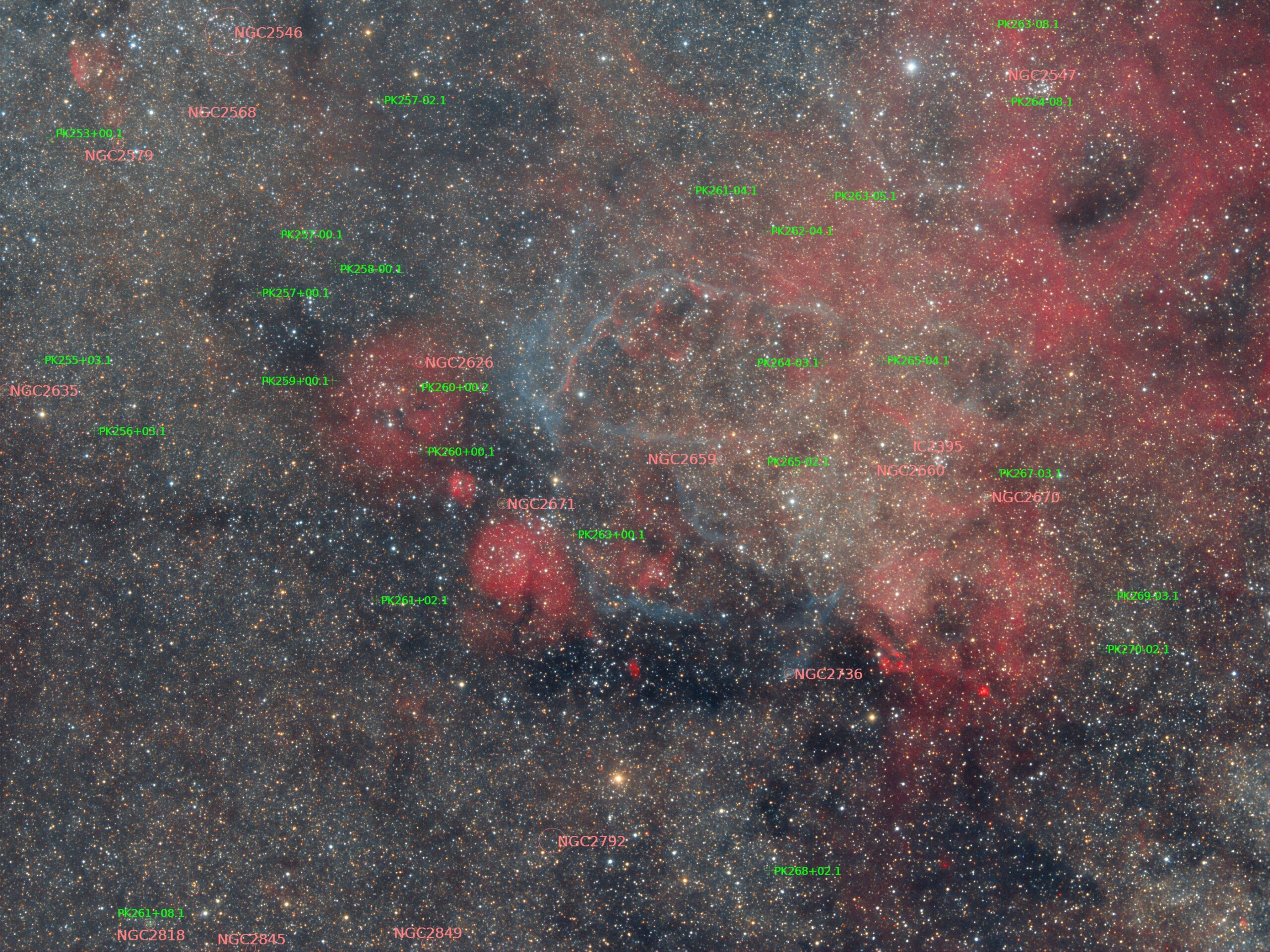
I have imaged the spectacular region surrounding Gum 16 and the Vela Supernova Remnant (Vela SNR) on two occasions, more than a decade apart. During a stay at the Tivoli Astrofarm in Namibia in 2015, I captured the region in HαRGB (HRGB) under the exceptionally dark skies of the southern hemisphere. More recently, in 2026, I received a high-quality SHO narrowband dataset of the same field from Astrophotomarket, acquired in Australia. The two datasets offered complementary views of one of the most complex and fascinating regions of the southern Milky Way, while also illustrating the remarkable advances in astrophotographic imaging over the intervening years.

The Vela Supernova Remnant and Gum 16 are the same broad object: a huge, nearby shell of expanding gas left behind by a Type II supernova that exploded roughly 11,000 to 12,300 years ago. In your image-centered view, Gum 16 is the bright H-alpha filamentary nebula embedded within the larger Vela SNR field, so the two names are often used together even though one refers to the remnant as a whole and the other to the Gum catalog designation.

The Vela SNR is one of the nearest supernova remnants to Earth, lying roughly 800–936 light-years away depending on the source. Because it is so close, it covers an enormous area of sky—about 8 degrees across—making it one of the largest and most impressive supernova remnants visible from the southern hemisphere. The expanding debris is still moving outward at around 1,200 km/s, so what you see is the long-lived aftermath of a stellar explosion, not a static cloud.

The original star was massive enough to end its life in a core-collapse supernova, leaving behind a neutron star at the center. That neutron star is the famous Vela Pulsar (PSR B0833−45 / PSR J0835−4510), one of the best examples of a pulsar associated directly with a supernova remnant. This link is scientifically important because it provides clear evidence that massive stars can explode and leave neutron stars behind.

Gum 16 is the catalog name from Colin Gum’s survey of southern H-alpha nebulae, and it refers to the bright emission features in the Vela remnant. In images, Gum 16 often appears as cyan or red filaments, arcs, and shock fronts. Some of the most recognizable structures in the broader field include the Pencil Nebula (NGC 2736), which is a narrow, bright filament formed where the blast wave is hitting denser interstellar gas. These filamentary structures are shock-heated and ionized gas, tracing where the remnant is plowing into the surrounding medium.

Because it is both nearby and large, Vela SNR is a laboratory for studying supernova shock waves, pulsars, and the interaction between exploding stellar debris and the interstellar medium. Astronomers use it to examine how supernovae distribute heavy elements, compress nearby gas, and reshape the local Galactic environment. The remnant’s proximity also lets researchers resolve fine structures that would be impossible to study in a more distant object.

The remnant is also part of a richer southern-sky neighborhood. Deep wide-field images often include other Gum catalog objects, dark lanes, and emission clouds around the Vela SNR, making the region a visually complex mosaic of stellar death and interstellar structure.

If you’re looking at an image centered on Gum 16, you are looking at the glowing, shredded remains of a star that exploded about 11,000 years ago. The Vela Pulsar marks the collapsed core, while the wispy filaments and bright edges show where the blast wave is still racing through space. It’s one of the best nearby examples of how a supernova remnant evolves over time—and one of the most beautiful.

For the Astrophotomarket data the calibration, registration, and final image processing were carried out in PixInsight.
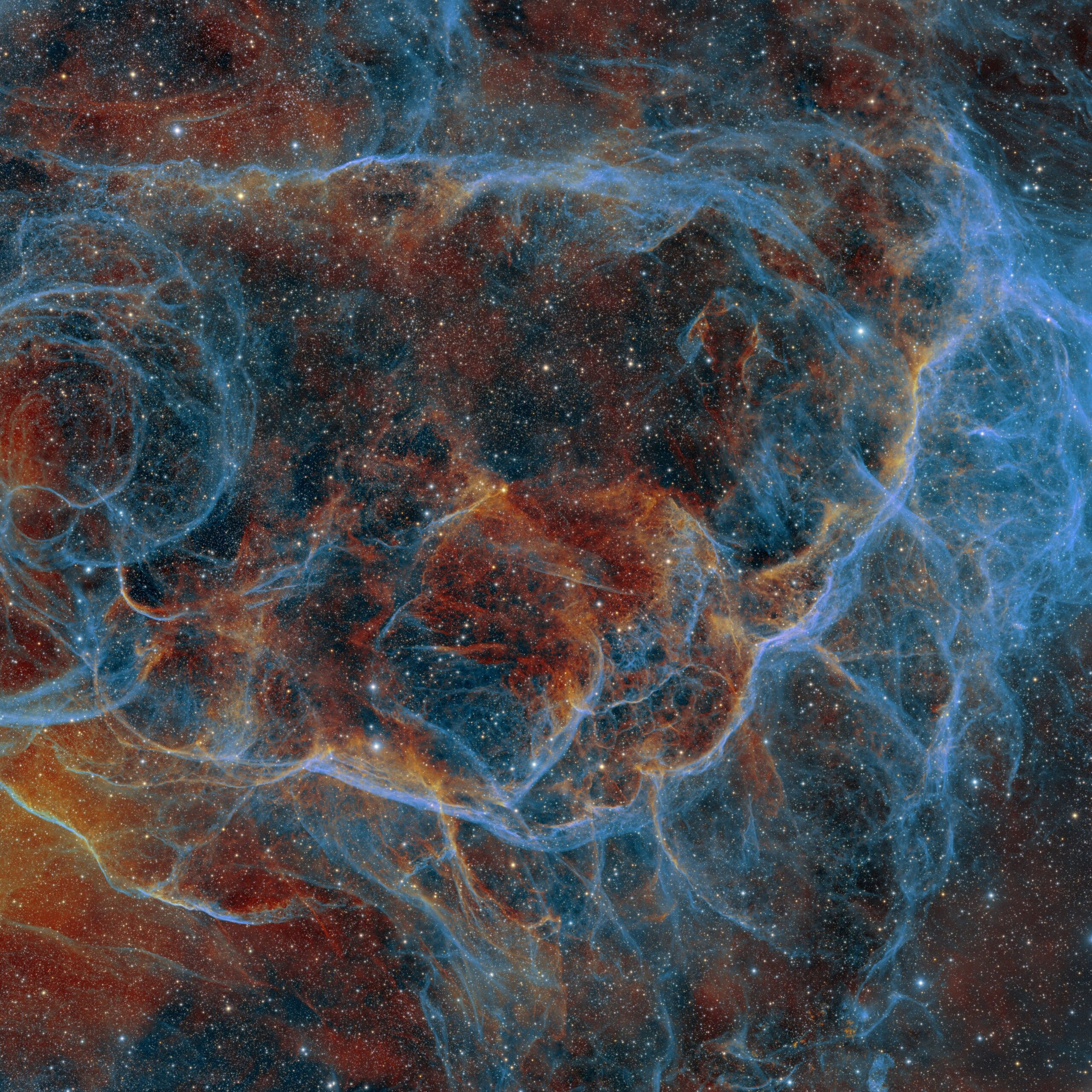
Vela SNR - GUM 16, Astrophotomarket, Australia, 2026
Vela SNR – GUM 16, Astrophotomarket, Australia, 2026
Vela SNR, GUM 16 annotated


The images were taken with the following equipment:

  • Date: 2026
  • Location: Australia
  • Telescope: Takahashi FSQ-N
  • Focal length [mm]: 530
  • Focal ratio: 5
  • Mount: Software Bisque
  • Camera: FLI Proline 16803
  • Filter: Hα:[OIII]:[SII]
  • Exposure time [min]: 630:630:630
  • Resolution: 3.5″/px


For the 2015 data the calibration, registration, and final image processing were carried out in PixInsight
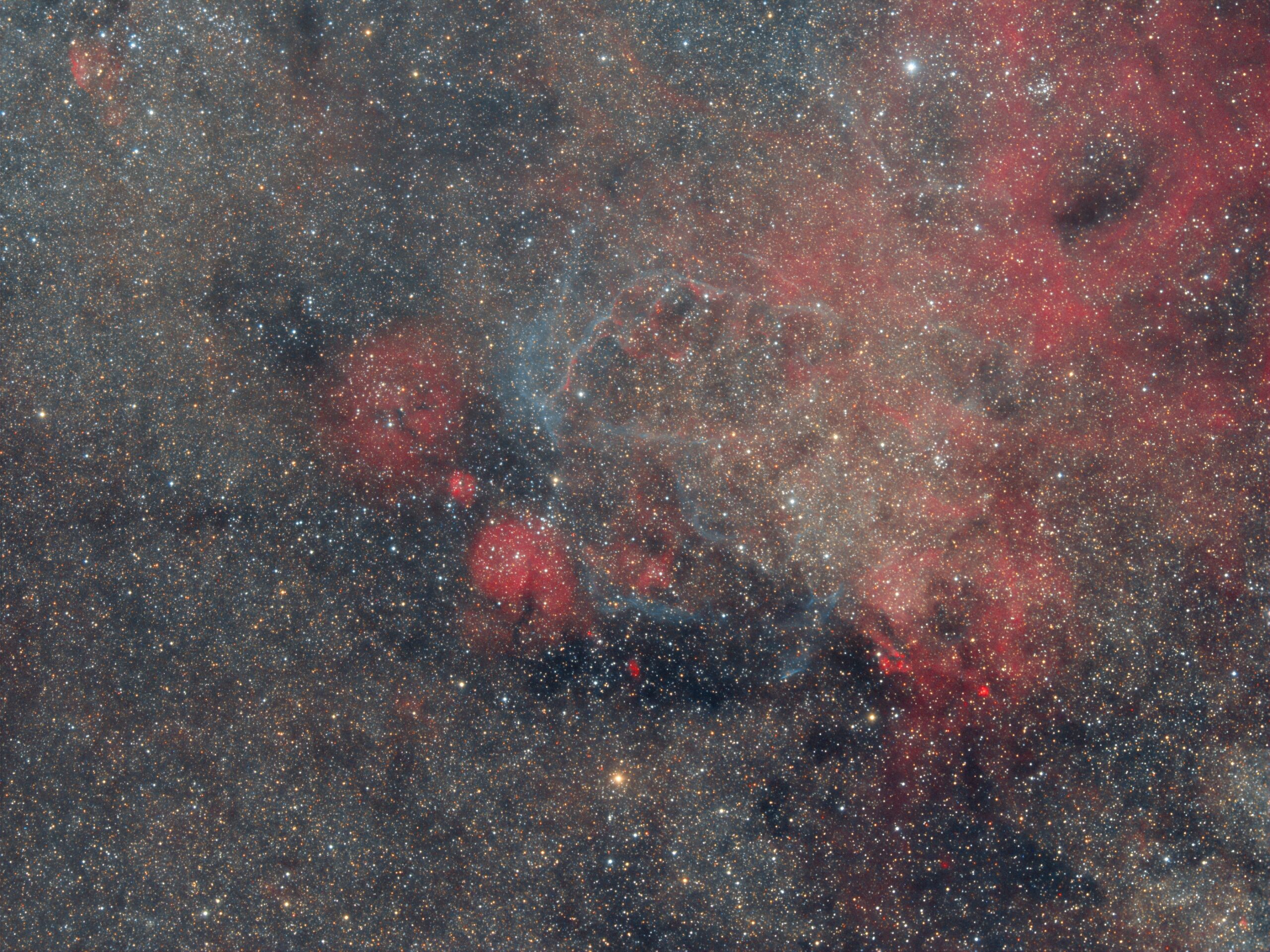
GUM 16, (Tivoli, Namibia), 2015
Vela SNR, (Tivoli, Namibia), 2015
Vela SNR annotated
Vela SNR annotated


The images were taken with the following equipment:

  • Date: 2015
  • Location: Tivoli, Namibia
  • Telescope: Canon 24-105mm lens
  • Focal length [mm]: 50
  • Focal ratio: 4
  • Mount: Losmandy G11
  • Camera: Moravian FW8300
  • Filter: Hα:[OIII]:R:G:B
  • Exposure time [min]: 80:80:30:30:30
  • Resolution: 23.5″/px


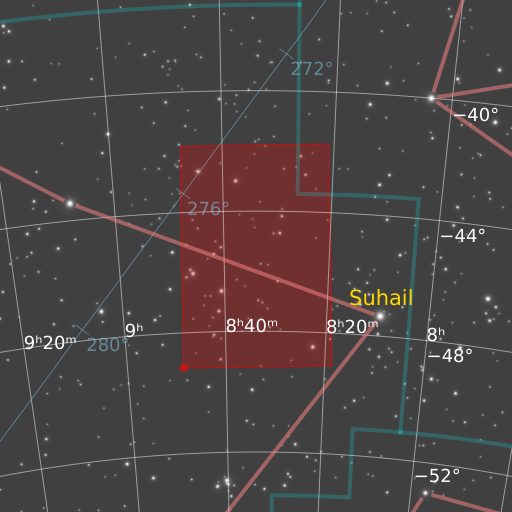
Vela SNR Finder Chart

Stephan Küppers


You might also like
IC 1318
15. Juli 2026
NGC 7000 with IC 5070
24. Juni 2026
Sh2-129, Outters 4
29. Mai 2026

Leave a reply

Schreibe einen Kommentar Antwort abbrechen

Deine E-Mail-Adresse wird nicht veröffentlicht. Erforderliche Felder sind mit * markiert


© Stephan Küppers 2020-2022

Cookie-Zustimmung verwalten
Wir verwenden Cookies, um unsere Website und unseren Service zu optimieren.
Funktional Immer aktiv
Die technische Speicherung oder der Zugang ist unbedingt erforderlich für den rechtmäßigen Zweck, die Nutzung eines bestimmten Dienstes zu ermöglichen, der vom Teilnehmer oder Nutzer ausdrücklich gewünscht wird, oder für den alleinigen Zweck, die Übertragung einer Nachricht über ein elektronisches Kommunikationsnetz durchzuführen.
Vorlieben
Die technische Speicherung oder der Zugriff ist für den rechtmäßigen Zweck der Speicherung von Präferenzen erforderlich, die nicht vom Abonnenten oder Benutzer angefordert wurden.
Statistiken
Die technische Speicherung oder der Zugriff, der ausschließlich zu statistischen Zwecken erfolgt. Die technische Speicherung oder der Zugriff, der ausschließlich zu anonymen statistischen Zwecken verwendet wird. Ohne eine Vorladung, die freiwillige Zustimmung deines Internetdienstanbieters oder zusätzliche Aufzeichnungen von Dritten können die zu diesem Zweck gespeicherten oder abgerufenen Informationen allein in der Regel nicht dazu verwendet werden, dich zu identifizieren.
Marketing
Die technische Speicherung oder der Zugriff ist erforderlich, um Nutzerprofile zu erstellen, um Werbung zu versenden oder um den Nutzer auf einer Website oder über mehrere Websites hinweg zu ähnlichen Marketingzwecken zu verfolgen.
  • Optionen verwalten
  • Dienste verwalten
  • Verwalten von {vendor_count}-Lieferanten
  • Lese mehr über diese Zwecke
Einstellungen anzeigen
  • {title}
  • {title}
  • {title}