

Messier 91 from remote
In 2022, I received a high-quality LRGB dataset of Messier 91 from Telescope Live, acquired under the pristine skies of Chile.
Messier 91, also known as NGC 4548, is a barred spiral galaxy in the constellation Coma Berenices and a member of the Virgo Cluster. It is often described as one of the faintest Messier objects, not because it is intrinsically tiny, but because its light is spread over a relatively low-surface-brightness disk.science.
M91 is classified as an SBb or similar barred spiral, meaning it has a strong central bar and loosely wound spiral arms. Its apparent size is about 5.4 × 4.3 arcminutes, so it looks much smaller than the full Moon, but in reality it is a substantial galaxy. Depending on the distance estimate used, its actual diameter is around 85,000 to 105,000 light-years, placing it in the same general size class as the Milky Way.
The galaxy is oriented fairly face-on from our perspective, which makes its bar and arms easier to study than in edge-on systems. In images, you can often see a bright central bar with spiral structure wrapping outward from the ends rather than from the very center.
Distances for M91 vary somewhat across sources, but they are generally in the range of 50 to 63 million light-years. It is a Virgo Cluster galaxy, so it lies in a crowded galactic neighborhood where member galaxies interact gravitationally and move through hot intracluster gas.
M91 has a famous place in Messier history because it was long considered a “missing Messier object.” Charles Messier recorded it incorrectly, and for many years astronomers could not identify which real galaxy he meant. The object was later recovered and matched to NGC 4548, solving one of the catalog’s more famous puzzles.
M91 is often described as an anemic galaxy, meaning it has relatively little neutral hydrogen gas and a low rate of star formation compared with similar spirals. That low gas content makes its spiral arms look weak and its overall disk less contrasty than in brighter, more active spirals. The likely reason is ram-pressure stripping: as M91 moves through the hot gas inside the Virgo Cluster, some of its own interstellar gas gets stripped away.
That matters because gas is the raw material for making new stars. With less gas available, star formation slows, and the galaxy becomes less lively over time. So M91 is a good example of how a cluster environment can gradually change a spiral galaxy’s appearance and evolutionary path.
Several sources describe M91 as a LINER galaxy and even a weak Seyfert galaxy, implying some low-level activity in its nucleus. That suggests there may be a supermassive black hole at the center accreting gas, though not in the dramatic way seen in quasars or very active galaxies. One source estimates that black hole at about 25 million solar masses.
M91 also shows a large-scale H I deficiency and a relatively weak amount of molecular gas, both consistent with environmental stripping in the Virgo Cluster. In other words, its chemistry and structure tell a story of a galaxy being shaped by the cluster around it, not just by its own internal evolution.
For amateur astronomers, M91 is a rewarding challenge: bright enough to be found with a modest telescope, but subtle enough that its structure takes patience to appreciate. The bar, disk, and faint spiral arms become more obvious with larger apertures and steady skies. Because it is both historically interesting and physically distinctive, it is one of the more fascinating Virgo galaxies to observe.
Data calibration and registration and the final processing was done with PixInsight. The result was as follows:
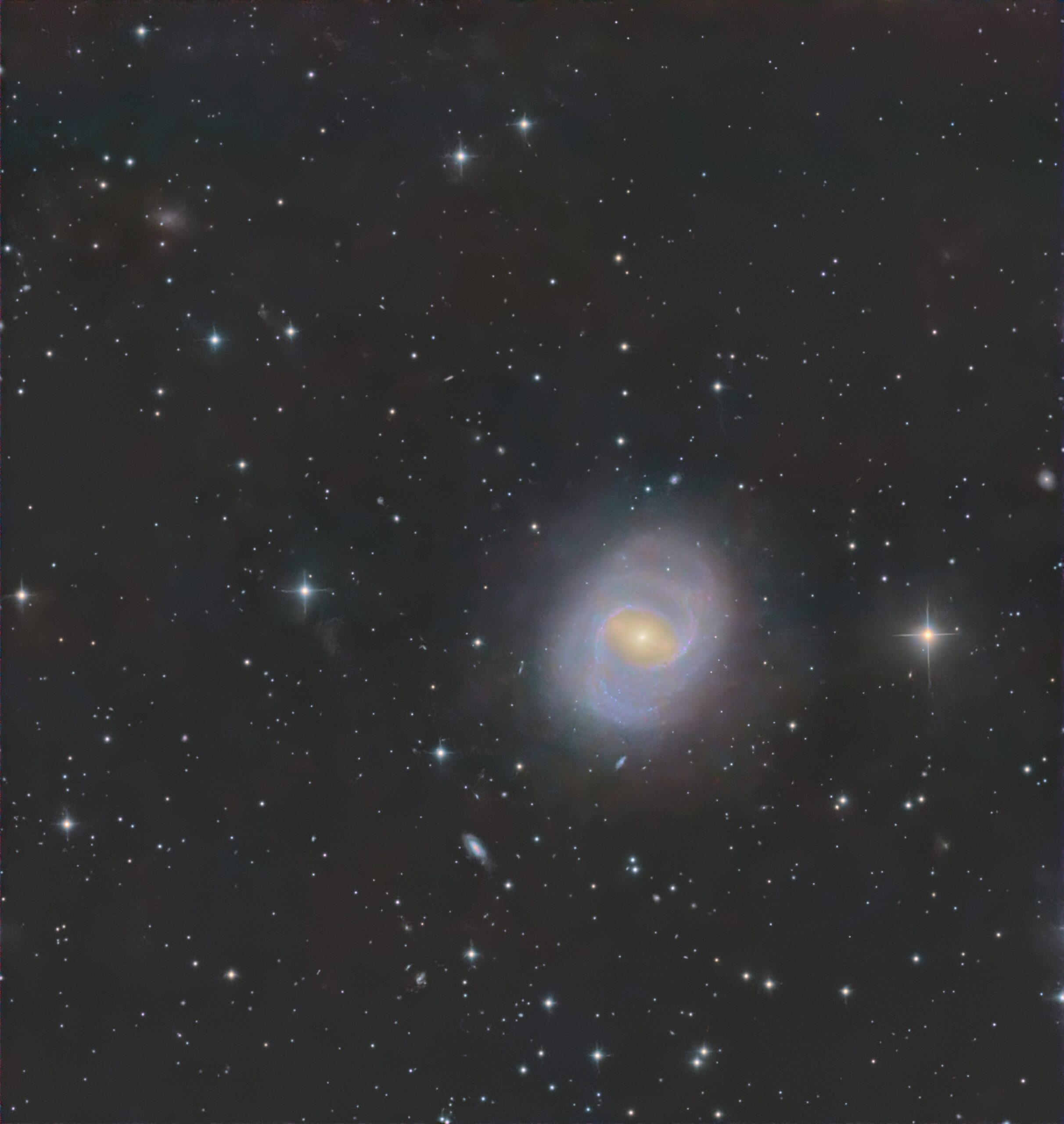
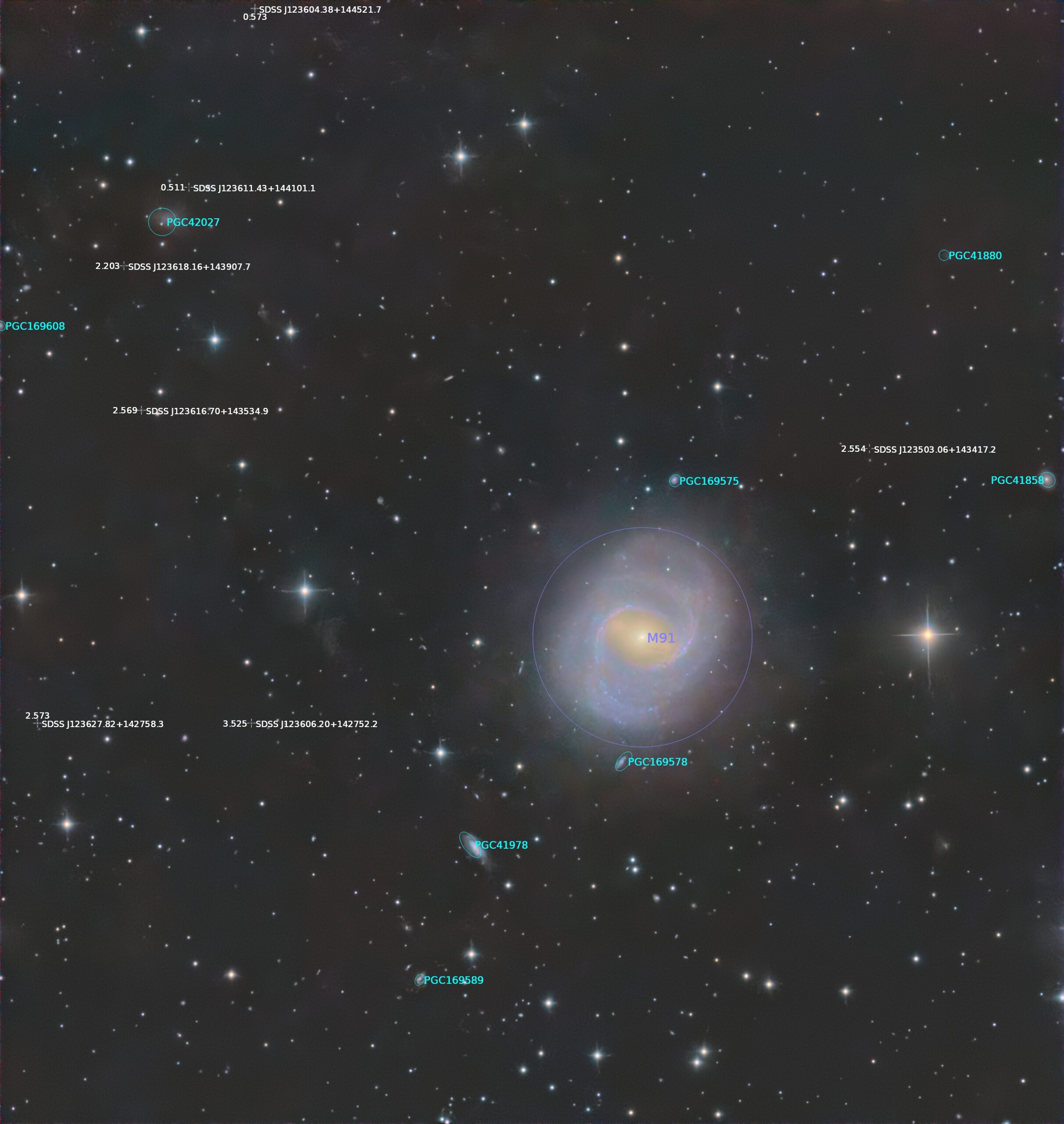
In addition to the magnificent spiral structure of Messier 91, the image also contains several distant quasars. The most distant identified object is SDSS J123606.20+142752.2, with a measured redshift of z = 3.525. This corresponds to a lookback time of approximately 11.9 billion years, meaning the light recorded in this image began its journey when the Universe was only about 1.9 billion years old—less than 15% of its present age.
The images were taken with the following equipment (Telescope Live CHI-1):
- Date: 2022
- Telescope/Lens: Planwave CDK24
- Focal length [mm]: 3900
- Focal ratio: 6.5
- Mount: Mathis MI-1000/1250
- Camera: FLI Proline 9000
- Filter: LRGB
- Exposure time [min]: 45:45:45:45
- Resolution: 0.62″/px


Leave a reply