• Home
  • Blog
  • Astrophotography
    • Deep Sky
      • Galaxies (Galaxien)
      • Nebulae (Nebel)
      • Planetary Nebulae (Planetarische Nebel)
      • Globular Clusters (Kugelsternhaufen)
      • Open Clusters (Offene Sternhaufen)
      • Miscellaneous (Verschiedenes)
    • Solar System (Sonnensystem)
      • Comets (Kometen)
      • Moon (Mond)
      • Planets (Planeten)
      • Sun (Sonne)
  • Archiv

    • Juli 2026
    • Juni 2026
    • Mai 2026
    • April 2026
    • Februar 2026
    • Januar 2026
    • Dezember 2025
    • November 2025
    • Oktober 2025
    • September 2025
    • August 2025
    • Juli 2025
    • Juni 2025
    • Mai 2025
    • April 2025
    • März 2025
    • Januar 2025
    • Dezember 2024
    • November 2024
    • Oktober 2024
    • September 2024
    • August 2024
    • Juli 2024
    • Juni 2024
    • Mai 2024
    • April 2024
    • März 2024
    • Februar 2024
    • Januar 2024
    • November 2023
    • Oktober 2023
    • September 2023
    • August 2023
    • Juli 2023
    • Juni 2023
    • Mai 2023
    • April 2023
    • März 2023
    • Februar 2023
    • Januar 2023
    • Dezember 2022
    • November 2022
    • Oktober 2022
    • September 2022
    • August 2022
    • Juli 2022
    • Juni 2022
    • Mai 2022
    • April 2022
    • März 2022
    • Februar 2022
    • Januar 2022
    • Dezember 2021
    • November 2021
    • September 2021
    • August 2021
    • Juli 2021
    • März 2021
    • Februar 2021
    • November 2020
    • September 2020
    • August 2020
    • April 2020
    • März 2020
    • Februar 2020
    • Januar 2020
    • Dezember 2019
    • November 2019
    • Oktober 2019
    • September 2019
    • August 2019
    • Mai 2019
    • April 2019
    • März 2019
    • Dezember 2018
    • November 2018
    • Oktober 2018
    • September 2018
    • Juni 2018
    • Mai 2018
    • April 2018
    • März 2018
    • Februar 2018
    • Januar 2018
    • Oktober 2017
    • Juli 2017
    • Juni 2017
    • Januar 2017
    • Dezember 2016
    • September 2016
    • Mai 2016
    • März 2016
    • November 2015
    • Oktober 2015
    • Juli 2015
    • Mai 2015
    • März 2015
    • Februar 2015
    • September 2014
    • August 2014
    • März 2014
    • Februar 2014
    • Oktober 2013
    • September 2013
    • August 2013
    • April 2013
    • März 2013
    • November 2012
    • August 2012
    • Juli 2012
    • Mai 2012
    • März 2012
    • Januar 2012
    • November 2011
    • Oktober 2011
    • September 2011
    • August 2011
    • April 2011
    • März 2011
    • Oktober 2010
    • September 2010
    • August 2010
    • Juli 2010
    • April 2010
    • Juli 2009
    • Juli 2008
    • Januar 2008
    • Oktober 2007
    • Juli 2007
    • März 2007
    • Februar 2007
    • Juni 2006
    • Oktober 2005
    • September 2005
    • August 2005
    • Januar 2005
  • Kategorien

    • Asterism
    • Astrophotography
    • Barnard
    • Comet
    • Galaxies
    • Globular Cluster
    • IC
    • Messier
    • Moon
    • Nebula
    • NGC
    • Open cluster
    • Photography
    • Planetary Nebula
    • Travel
  • Meta

    • Anmelden
    • Eintrags-Feed
    • Kommentar-Feed
    • WordPress.org
  • Privacy Policy
  • Impressum
  • Haftungsausschluss
  • Cookie-Richtlinie
  • Datenschutzerklärung

wonderfuluniverse.de
  • Home
  • Blog
  • Astrophotography
    • Deep Sky
      • Galaxies (Galaxien)
      • Nebulae (Nebel)
      • Planetary Nebulae (Planetarische Nebel)
      • Globular Clusters (Kugelsternhaufen)
      • Open Clusters (Offene Sternhaufen)
      • Miscellaneous (Verschiedenes)
    • Solar System (Sonnensystem)
      • Comets (Kometen)
      • Moon (Mond)
      • Planets (Planeten)
      • Sun (Sonne)

Sh2-140 from remote


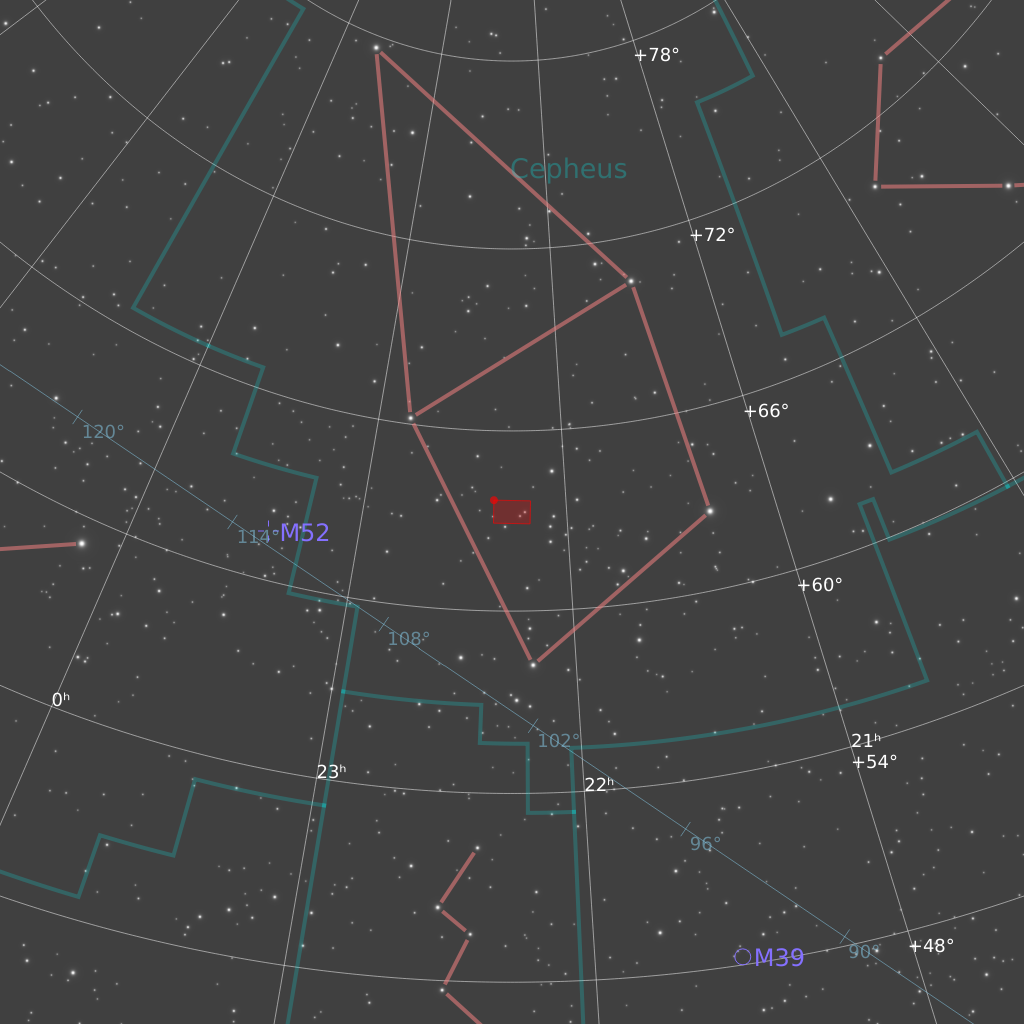
In 2018 I received an LRGBHa dataset of Sharpless 140 (Sh2‑140) from Deep Sky West (DSW), acquired under the dark, high‑altitude skies of New Mexico, capturing in detail a rich star‑forming region within the Cepheus molecular complex. Sh2‑140 is an H II emission nebula and part of the larger Cepheus bubble, a ring‑like structure of molecular gas and dust energized by massive stars in the nearby OB association. Situated in the constellation Cepheus at a distance of about 2,900–3,000 light‑years from the Solar System, the nebula spans roughly 24 arcminutes on the sky, corresponding to a physical size of about 25 light‑years.

Sh2‑140, also catalogued as LBN 1204, lies on the south‑west edge of the dark molecular cloud LDN 1204, where the ionized gas of the H II region meets dense, cold dust. This interface is visible in your dataset as a bright, sharply defined rim of H‑alpha emission—essentially a bow shock—where intense ultraviolet radiation from hot young stars impacts the surface of the cloud and ionizes the gas. The primary ionizing source is HD 211880, a blue‑white main‑sequence star of spectral type B0.5V with a visual magnitude of about 7.7, whose radiation drives the expansion of the nebula into the surrounding interstellar medium.

Within and behind this bright rim, Sh2‑140 hosts an embedded cluster of young stellar objects and protostars, many of which are invisible in the optical but revealed in infrared and radio observations. Early infrared surveys identified several sources (IRS 1, IRS 2, IRS 3 and later additions) that trace protostellar objects still enshrouded in dense circumstellar dust and molecular gas. These proto‑stars are in the process of accreting material from their natal envelopes and disks, making Sh2‑140 a prime example of a stellar nursery where star formation can be studied at different stages—from deeply embedded protostars to more evolved young stars that already contribute to the ionization of the nebula.

The physical conditions in the region reflect this active star formation: dust temperatures of around 35 K and a dust mass of several hundred solar masses indicate a large reservoir of cold material available for future stellar birth. The surfaces of the nebular clouds are rich in complex organic molecules such as polycyclic aromatic hydrocarbons (PAHs), which fluoresce under ultraviolet radiation and contribute to the mid‑infrared brightness of the region. In your LRGBHa dataset, most of the glowing gas is hydrogen, captured strongly in the Ha channel around 656.3 nm, while the RGB channels record a mix of stellar continuum and weaker emission from elements like oxygen, which adds green‑blue hues to the brightest knots and filaments.

The LRGBHa combination you received from DeepSkyWest is well suited to teasing out the layered structure of Sh2‑140. The luminance (L) frames emphasize fine detail and faint structures across the field, revealing the filamentary nature of the ionization front and the complex interplay of bright emission and dark absorption features around LDN 1204. The narrowband Ha data isolate the ionized hydrogen, allowing you to highlight the bow‑shock rim and the diffuse H II region while suppressing broadband background and light pollution—crucial for a relatively low‑surface‑brightness nebula. The RGB data provide natural color: deep reds from hydrogen emission, subtle greens and blues where oxygen or scattered starlight contribute, and the color spread of field stars across the Cepheus bubble.

In wide‑field imagery, Sh2‑140 appears on the edge of the Cepheus ring or bubble, a large shell of gas and dust thought to have been shaped by past episodes of stellar winds and supernova explosions from massive stars in Cep OB2. The radiation from HD 211880 and neighboring young stars compresses the surface of LDN 1204, possibly triggering new star formation via radiation‑driven implosion of dense clumps—an example of feedback, where existing stars influence the birth of future generations.

The data calibration, registration and the final processing was done with PixInsight. The result was as follows:
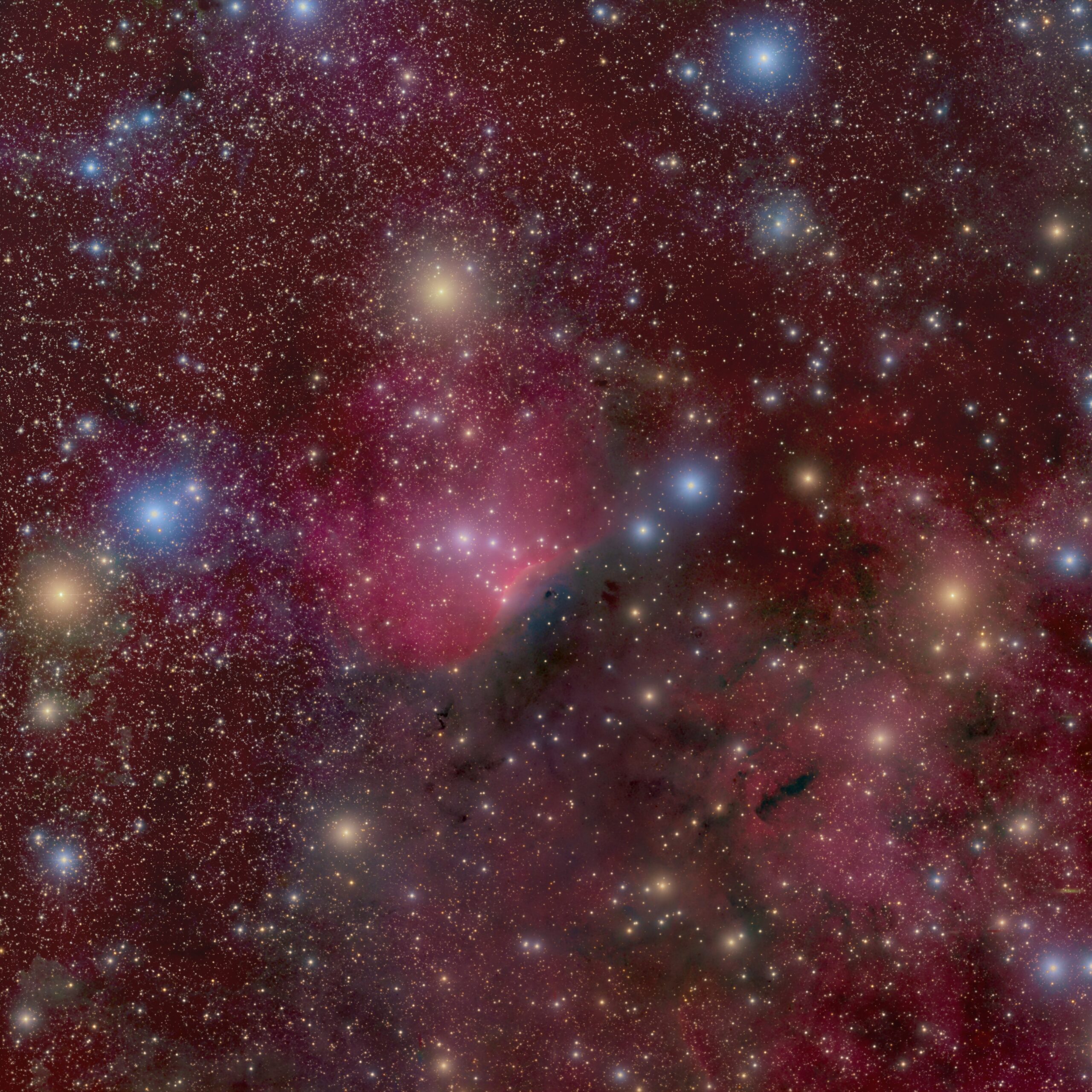
Sh2-140, DSW, Rowe, New Mexico, 2018
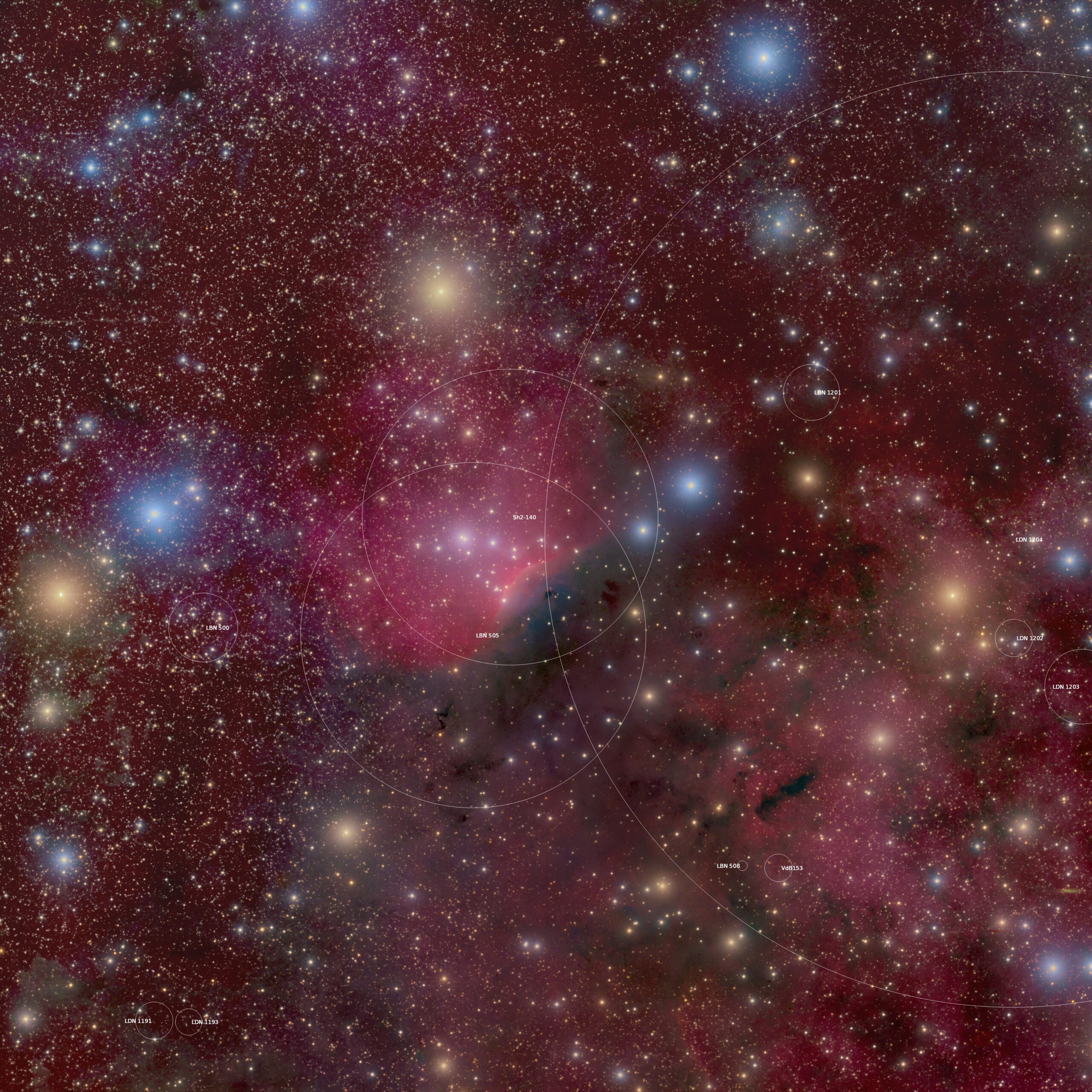
Sh2-140 annotated
Sh2-140 annotated


Here is an overview of the used equipment and the exposure times

  • Date: 2018
  • Location: Rowe, New Mexico
  • Telescope/Lense: Astrophysics RH305
  • Focal length [mm]: 1158
  • Focal ratio: 3.8
  • Mount: Paramount ME
  • Camera: SBIG STX 16803
  • Filter: LRGBHα
  • Exposure time [min]: 250:190:190:190:700
  • Resolution: 1.66″/px


Sh2-140 Finder Chart

Stephan Küppers


You might also like
IC 1318
15. Juli 2026
NGC 7000 with IC 5070
24. Juni 2026
Sh2-129, Outters 4
29. Mai 2026

Leave a reply

Schreibe einen Kommentar Antwort abbrechen

Deine E-Mail-Adresse wird nicht veröffentlicht. Erforderliche Felder sind mit * markiert


© Stephan Küppers 2020-2022

Cookie-Zustimmung verwalten
Wir verwenden Cookies, um unsere Website und unseren Service zu optimieren.
Funktional Immer aktiv
Die technische Speicherung oder der Zugang ist unbedingt erforderlich für den rechtmäßigen Zweck, die Nutzung eines bestimmten Dienstes zu ermöglichen, der vom Teilnehmer oder Nutzer ausdrücklich gewünscht wird, oder für den alleinigen Zweck, die Übertragung einer Nachricht über ein elektronisches Kommunikationsnetz durchzuführen.
Vorlieben
Die technische Speicherung oder der Zugriff ist für den rechtmäßigen Zweck der Speicherung von Präferenzen erforderlich, die nicht vom Abonnenten oder Benutzer angefordert wurden.
Statistiken
Die technische Speicherung oder der Zugriff, der ausschließlich zu statistischen Zwecken erfolgt. Die technische Speicherung oder der Zugriff, der ausschließlich zu anonymen statistischen Zwecken verwendet wird. Ohne eine Vorladung, die freiwillige Zustimmung deines Internetdienstanbieters oder zusätzliche Aufzeichnungen von Dritten können die zu diesem Zweck gespeicherten oder abgerufenen Informationen allein in der Regel nicht dazu verwendet werden, dich zu identifizieren.
Marketing
Die technische Speicherung oder der Zugriff ist erforderlich, um Nutzerprofile zu erstellen, um Werbung zu versenden oder um den Nutzer auf einer Website oder über mehrere Websites hinweg zu ähnlichen Marketingzwecken zu verfolgen.
  • Optionen verwalten
  • Dienste verwalten
  • Verwalten von {vendor_count}-Lieferanten
  • Lese mehr über diese Zwecke
Einstellungen anzeigen
  • {title}
  • {title}
  • {title}