• Home
  • Blog
  • Astrophotography
    • Deep Sky
      • Galaxies (Galaxien)
      • Nebulae (Nebel)
      • Planetary Nebulae (Planetarische Nebel)
      • Globular Clusters (Kugelsternhaufen)
      • Open Clusters (Offene Sternhaufen)
      • Miscellaneous (Verschiedenes)
    • Solar System (Sonnensystem)
      • Comets (Kometen)
      • Moon (Mond)
      • Planets (Planeten)
      • Sun (Sonne)
  • Archiv

    • Juli 2026
    • Juni 2026
    • Mai 2026
    • April 2026
    • Februar 2026
    • Dezember 2025
    • November 2025
    • Oktober 2025
    • September 2025
    • August 2025
    • Juli 2025
    • Juni 2025
    • Mai 2025
    • April 2025
    • März 2025
    • Januar 2025
    • Dezember 2024
    • November 2024
    • Oktober 2024
    • September 2024
    • August 2024
    • Juli 2024
    • Juni 2024
    • Mai 2024
    • April 2024
    • März 2024
    • Februar 2024
    • Januar 2024
    • November 2023
    • Oktober 2023
    • September 2023
    • August 2023
    • Juli 2023
    • Juni 2023
    • Mai 2023
    • April 2023
    • März 2023
    • Februar 2023
    • Januar 2023
    • Dezember 2022
    • November 2022
    • Oktober 2022
    • September 2022
    • August 2022
    • Juni 2022
    • Mai 2022
    • April 2022
    • März 2022
    • Februar 2022
    • Januar 2022
    • Dezember 2021
    • November 2021
    • September 2021
    • August 2021
    • Juli 2021
    • März 2021
    • Februar 2021
    • November 2020
    • September 2020
    • August 2020
    • April 2020
    • März 2020
    • Februar 2020
    • Januar 2020
    • Dezember 2019
    • November 2019
    • Oktober 2019
    • September 2019
    • August 2019
    • Mai 2019
    • April 2019
    • März 2019
    • Dezember 2018
    • November 2018
    • Oktober 2018
    • September 2018
    • Juni 2018
    • Mai 2018
    • April 2018
    • März 2018
    • Februar 2018
    • Januar 2018
    • Oktober 2017
    • Juli 2017
    • Juni 2017
    • Januar 2017
    • Dezember 2016
    • September 2016
    • Mai 2016
    • März 2016
    • November 2015
    • Oktober 2015
    • Juli 2015
    • Mai 2015
    • März 2015
    • Februar 2015
    • September 2014
    • August 2014
    • März 2014
    • Februar 2014
    • Oktober 2013
    • September 2013
    • August 2013
    • April 2013
    • März 2013
    • November 2012
    • August 2012
    • Juli 2012
    • Mai 2012
    • März 2012
    • Januar 2012
    • November 2011
    • Oktober 2011
    • September 2011
    • August 2011
    • April 2011
    • März 2011
    • Oktober 2010
    • September 2010
    • August 2010
    • Juli 2010
    • April 2010
    • Juli 2009
    • Juli 2008
    • Januar 2008
    • Oktober 2007
    • Juli 2007
    • Februar 2007
    • Juni 2006
    • Oktober 2005
    • September 2005
    • August 2005
    • Januar 2005
  • Kategorien

    • Asterism
    • Astrophotography
    • Barnard
    • Comet
    • Galaxies
    • Globular Cluster
    • IC
    • Messier
    • Moon
    • Nebula
    • NGC
    • Open cluster
    • Photography
    • Planetary Nebula
    • Travel
  • Meta

    • Anmelden
    • Eintrags-Feed
    • Kommentar-Feed
    • WordPress.org
  • Privacy Policy
  • Impressum
  • Haftungsausschluss
  • Cookie-Richtlinie
  • Datenschutzerklärung

wonderfuluniverse.de
  • Home
  • Blog
  • Astrophotography
    • Deep Sky
      • Galaxies (Galaxien)
      • Nebulae (Nebel)
      • Planetary Nebulae (Planetarische Nebel)
      • Globular Clusters (Kugelsternhaufen)
      • Open Clusters (Offene Sternhaufen)
      • Miscellaneous (Verschiedenes)
    • Solar System (Sonnensystem)
      • Comets (Kometen)
      • Moon (Mond)
      • Planets (Planeten)
      • Sun (Sonne)

Sharpless 68 – VdS Remote Hakos


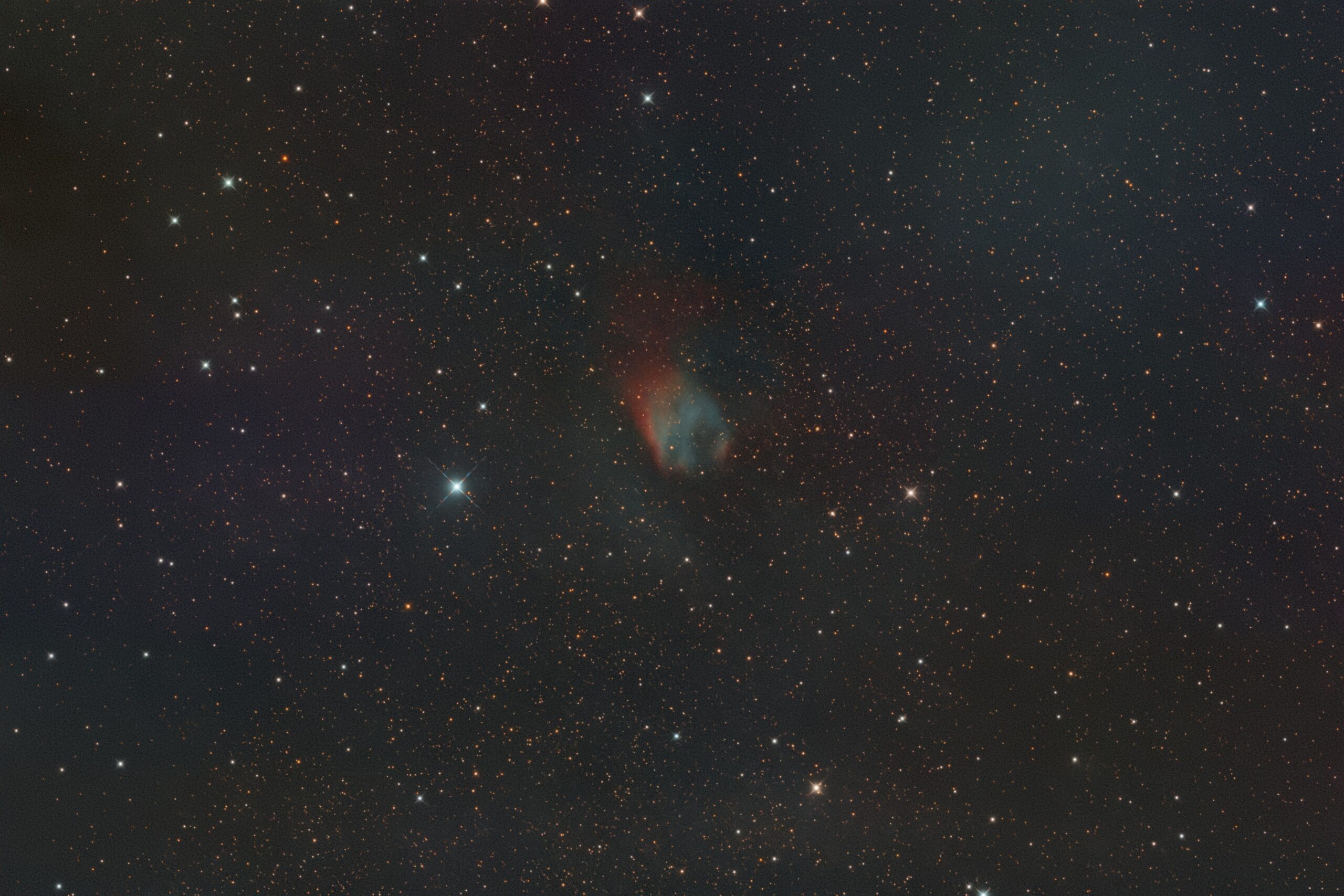
In 2025, together with my astrophotography companion Karsten Möller, I imaged the remarkable emission nebula Sh2-68 using both telescopes of the VdS Remote Observatory at Hakos, Namibia. By operating the two observatory systems simultaneously, we obtained a deep dataset with excellent signal-to-noise ratio, allowing us to record the nebula’s extremely faint hydrogen emission and its extensive filamentary structures. The exceptionally dark skies of Hakos were essential for revealing this elusive object, which is among the faintest targets in the Sharpless catalogue.

Unlike most Sharpless objects, Sh2-68 is not an H II region but the highly evolved remnant of a planetary nebula. Located in the constellation Serpens, it lies approximately 1,300 light-years from Earth and represents one of the largest known planetary nebulae on the sky, spanning nearly three degrees. Its enormous apparent size results from both its physical expansion over tens of thousands of years and its relatively close distance.

The nebula was formed when a Sun-like star reached the end of its life and expelled its outer layers into interstellar space. At its center lies a hot white dwarf, the exposed stellar core that emits enough ultraviolet radiation to ionize the expanding shell of gas. Unlike the bright, compact planetary nebulae often seen in amateur telescopes, Sh2-68 has expanded to such an extent that its surface brightness has become extremely low, making it a challenging target even under pristine skies.

One of the most fascinating aspects of Sh2-68 is its interaction with the interstellar medium. The central white dwarf is moving rapidly through space, and as the nebula encounters the surrounding gas, its originally symmetrical shell has become distorted. The leading edge appears compressed, while the trailing material has been stretched into long, diffuse filaments. This interaction provides astronomers with an excellent opportunity to study how aging planetary nebulae gradually disperse into the interstellar medium, recycling chemically enriched material that will eventually contribute to future generations of stars and planets.

Deep Hα imaging reveals the nebula as an intricate web of faint arcs, wisps, and diffuse emission extending over a vast area of the sky. Capturing these delicate structures requires many hours of exposure under exceptionally dark conditions, making remote observatories such as the VdS Remote Observatory at Hakos ideally suited for this type of project.

The 2025 observations obtained with the two telescopes beautifully reveal this ghostly relic of stellar evolution. Although far less spectacular at first glance than many bright emission nebulae, Sh2-68 tells a compelling story about the final stages in the life of a Sun-like star and its gradual return of enriched material to the Galaxy. The resulting image is both scientifically interesting and aesthetically unique, capturing one of the sky’s most elusive and expansive planetary nebulae.

The data the calibration, registration, and final processing were performed in PixInsight. The result was as follows:
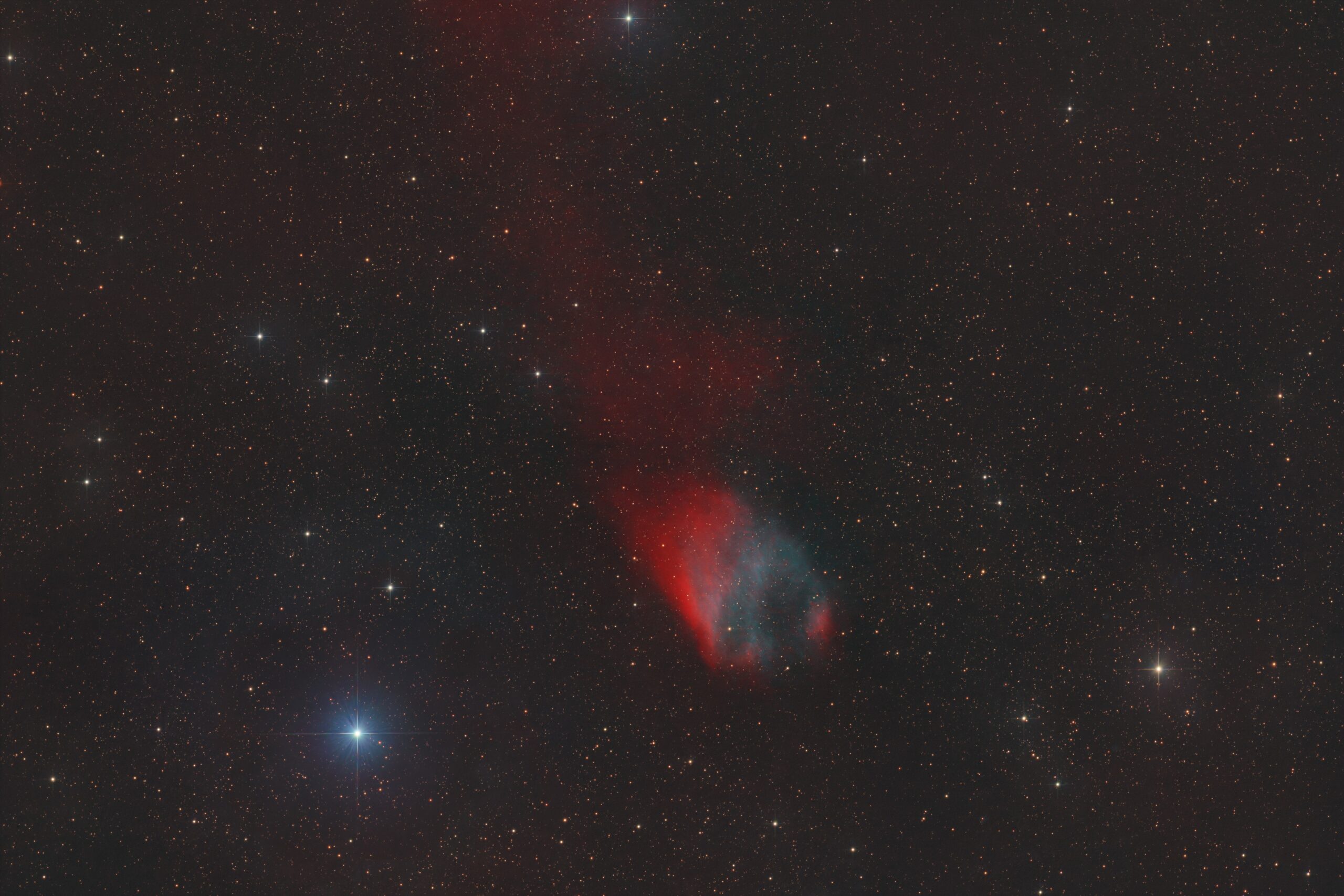
Sharpless 68 (Newton), VdS-remote, Hakos, Namibia, 2025


The images were taken with the following equipment:

  • Date: 2025
  • Location: Hakos, Namibia
  • Telescope/Lens: TS 12“ Newton-Astrograph
  • Focal length [mm]: 1391
  • Focal ratio: 4.56
  • Mount: 10Micron GM3000
  • Camera: Lacerta DeepSkyPro2600 (mono)
  • Filter: RGBHαOIII
  • Exposure time [min]: 36:36:42:800:230
  • Resolution: 0.56″/px


Sharpless 68 (TAK), VdS-remote, Hakos, Namibia, 2025
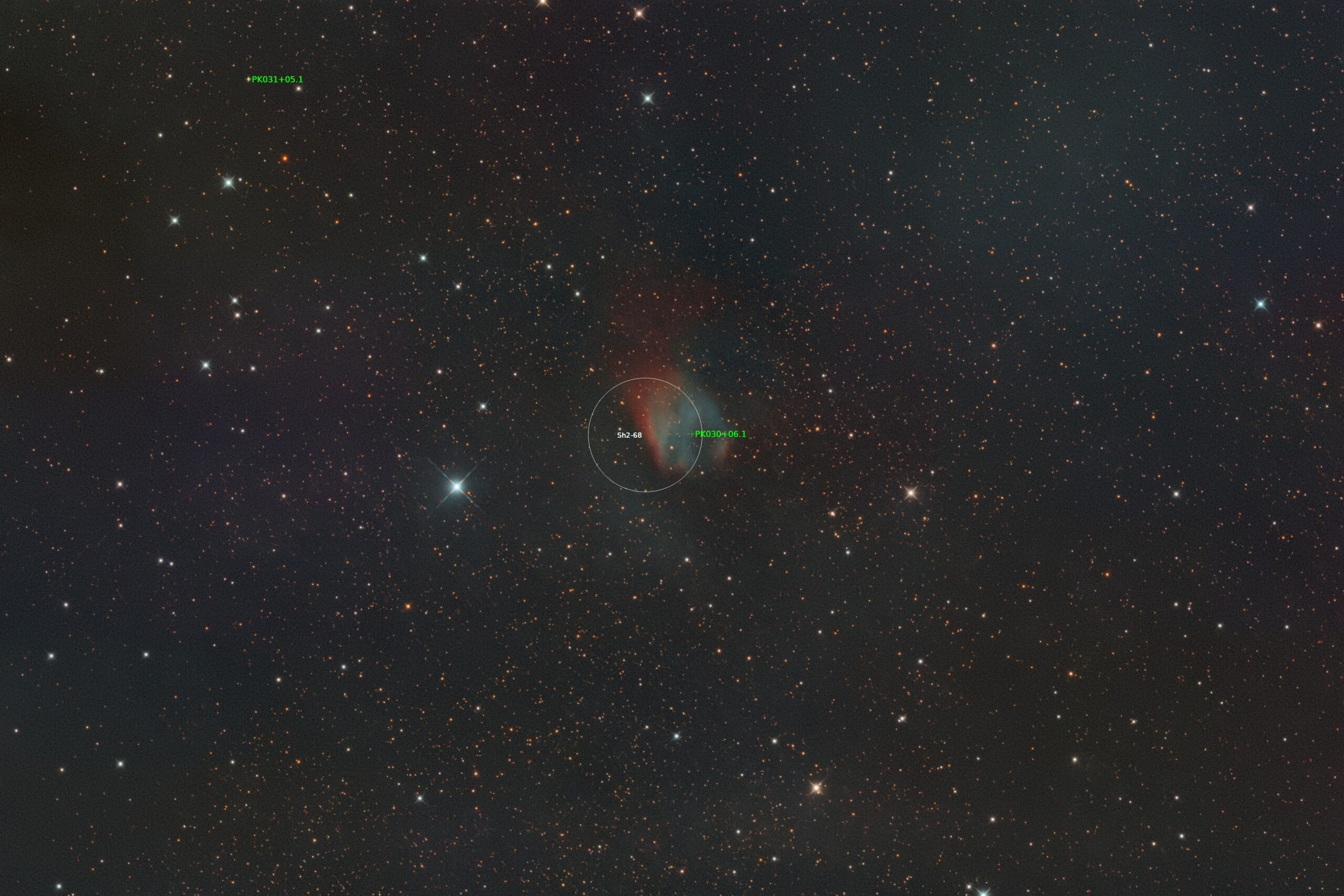
Sharpless 68 (TAK) annotated


The images were taken with the following equipment:

  • Date: 2025
  • Location: Hakos, Namibia
  • Telescope/Lens: Takahashi Epsilon-160ED
  • Focal length [mm]: 535
  • Focal ratio: 3.3
  • Mount: 10Micron GM3000
  • Camera: Lacerta DeepSkyPro2600 C
  • Filter: Clear, DB
  • Exposure time [min]: 777
  • Resolution: 1.45″/px


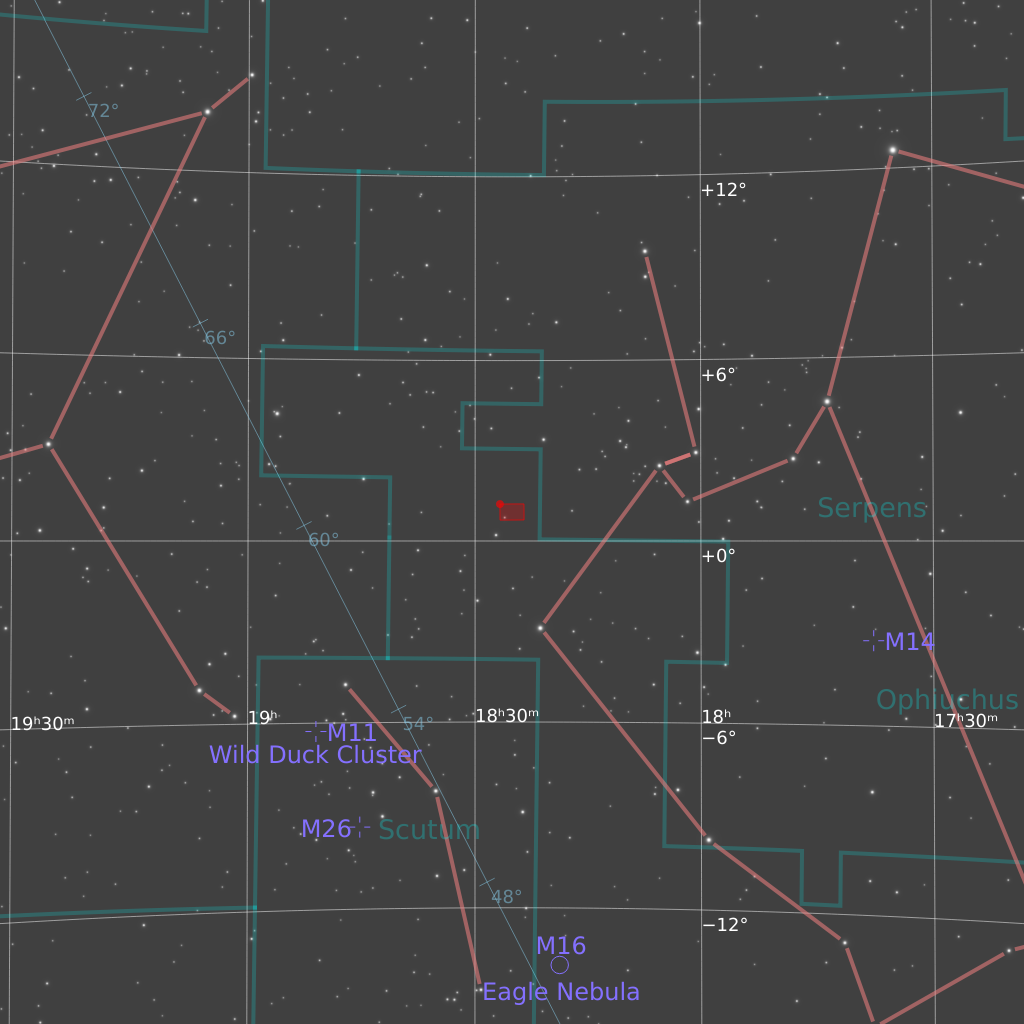
Sharpless 68 Finder Chart


Stephan Küppers


You might also like
IC 1318
15. Juli 2026
NGC 7000 with IC 5070
24. Juni 2026
Sh2-129, Outters 4
29. Mai 2026

Leave a reply

Schreibe einen Kommentar Antwort abbrechen

Deine E-Mail-Adresse wird nicht veröffentlicht. Erforderliche Felder sind mit * markiert


© Stephan Küppers 2020-2022

Cookie-Zustimmung verwalten
Wir verwenden Cookies, um unsere Website und unseren Service zu optimieren.
Funktional Immer aktiv
Die technische Speicherung oder der Zugang ist unbedingt erforderlich für den rechtmäßigen Zweck, die Nutzung eines bestimmten Dienstes zu ermöglichen, der vom Teilnehmer oder Nutzer ausdrücklich gewünscht wird, oder für den alleinigen Zweck, die Übertragung einer Nachricht über ein elektronisches Kommunikationsnetz durchzuführen.
Vorlieben
Die technische Speicherung oder der Zugriff ist für den rechtmäßigen Zweck der Speicherung von Präferenzen erforderlich, die nicht vom Abonnenten oder Benutzer angefordert wurden.
Statistiken
Die technische Speicherung oder der Zugriff, der ausschließlich zu statistischen Zwecken erfolgt. Die technische Speicherung oder der Zugriff, der ausschließlich zu anonymen statistischen Zwecken verwendet wird. Ohne eine Vorladung, die freiwillige Zustimmung deines Internetdienstanbieters oder zusätzliche Aufzeichnungen von Dritten können die zu diesem Zweck gespeicherten oder abgerufenen Informationen allein in der Regel nicht dazu verwendet werden, dich zu identifizieren.
Marketing
Die technische Speicherung oder der Zugriff ist erforderlich, um Nutzerprofile zu erstellen, um Werbung zu versenden oder um den Nutzer auf einer Website oder über mehrere Websites hinweg zu ähnlichen Marketingzwecken zu verfolgen.
  • Optionen verwalten
  • Dienste verwalten
  • Verwalten von {vendor_count}-Lieferanten
  • Lese mehr über diese Zwecke
Einstellungen anzeigen
  • {title}
  • {title}
  • {title}