

NGC 6894 from my backyard
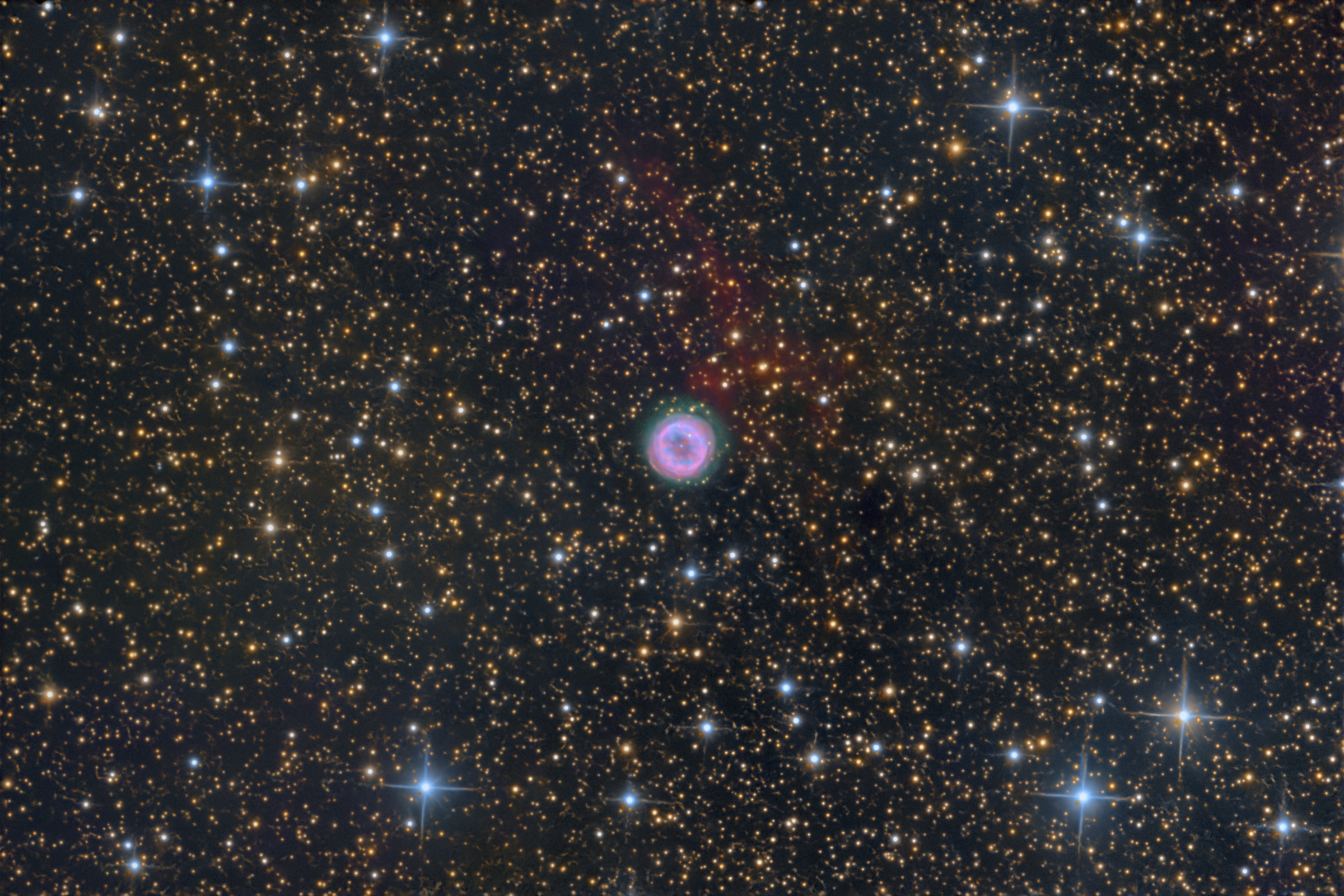
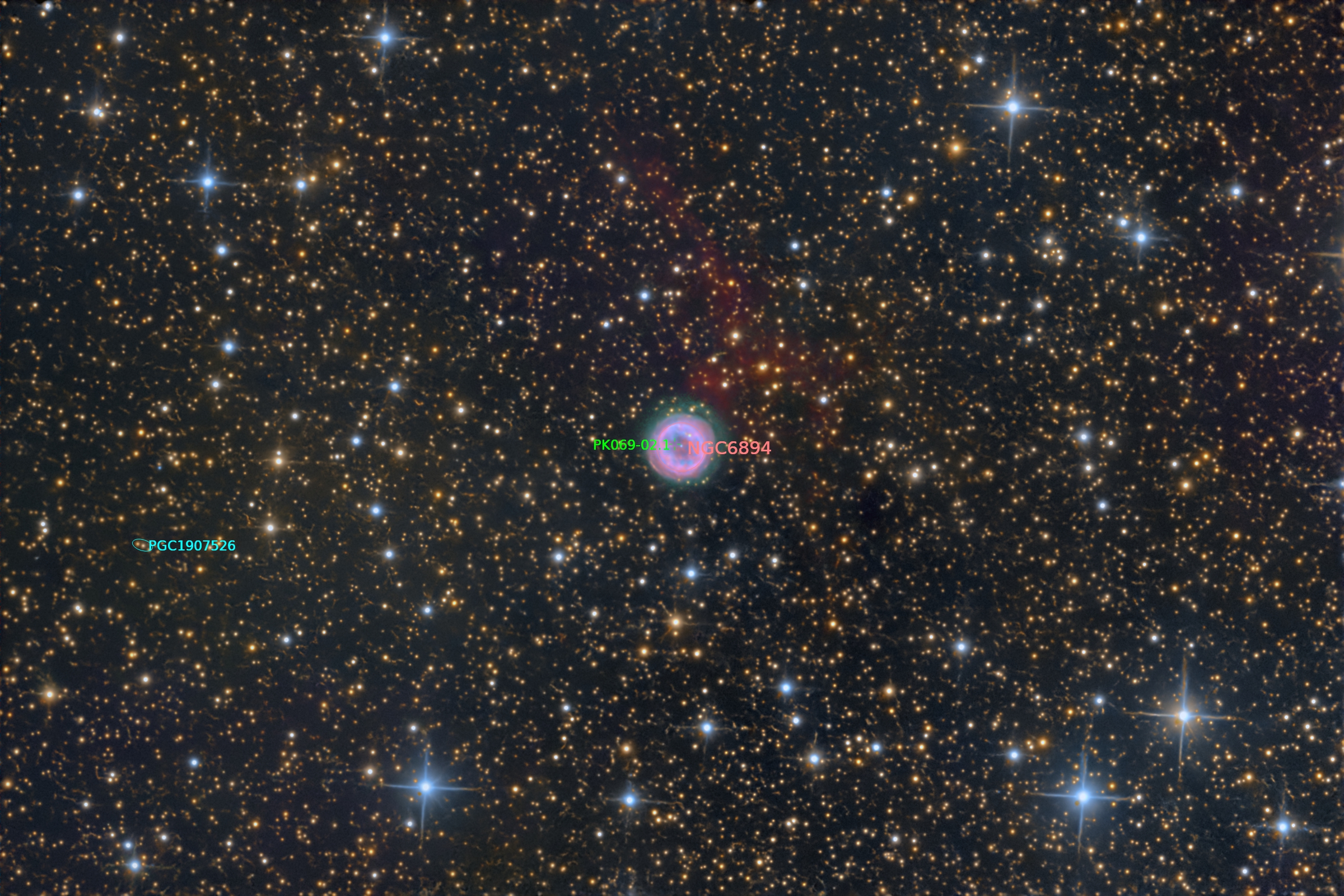
In 2012, I imaged the planetary nebula NGC 6894 from my backyard observatory in Krefeld using my CCD equipment. Although relatively small and faint, NGC 6894 proved to be a rewarding target for deep imaging. Careful acquisition and long exposure times allowed the delicate structure of the nebula to be recorded despite the challenges posed by suburban skies. The final image reveals not only the nebula itself but also the rich stellar background of the constellation Cygnus.
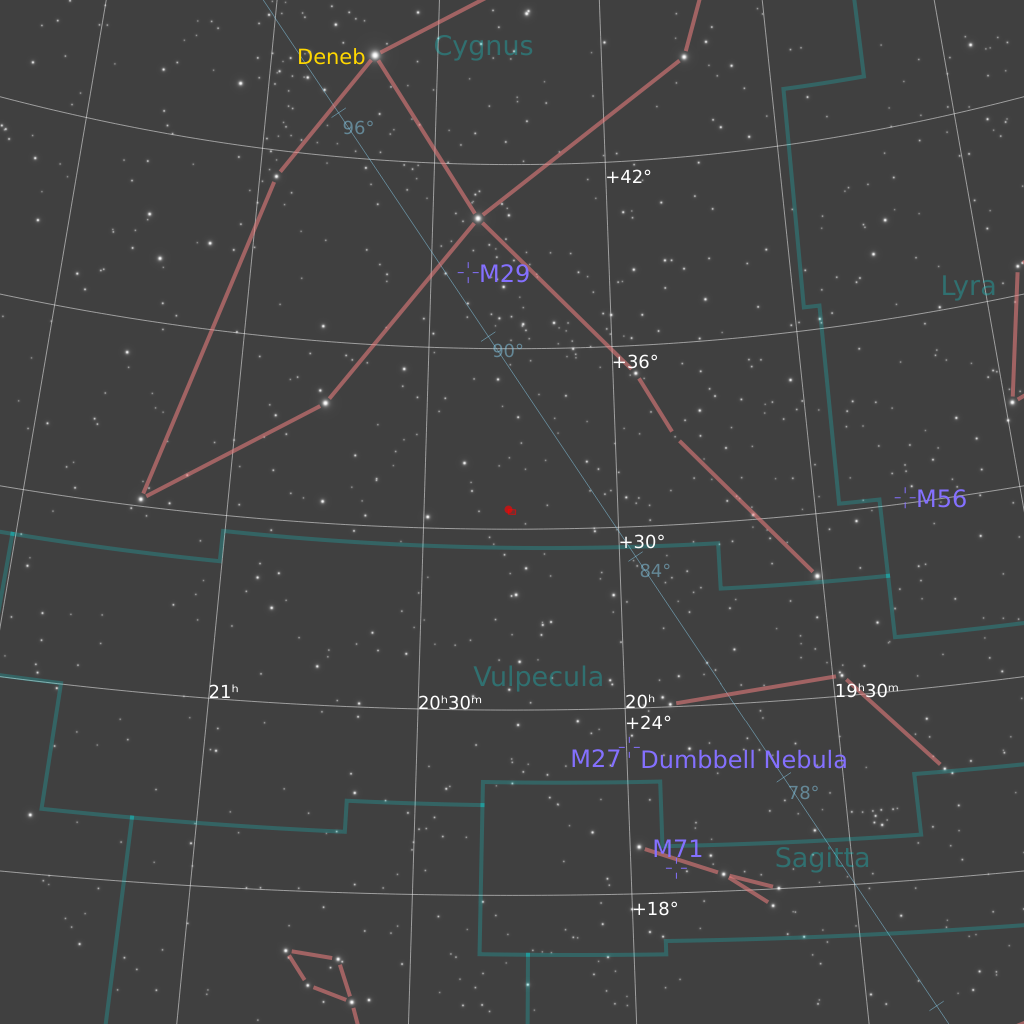
NGC 6894 is located in the constellation Cygnus, approximately 5,000 light-years from Earth. It is a relatively evolved planetary nebula, formed when a Sun-like star reached the end of its life and expelled its outer layers into space. The remaining stellar core has become an extremely hot white dwarf, whose intense ultraviolet radiation ionizes the expanding shell of gas, causing it to glow in characteristic emission lines such as Hα, [O III], and [N II].
Unlike many of the brighter planetary nebulae, NGC 6894 has a rather subtle appearance. It consists of a nearly circular shell with a brighter rim surrounding a more diffuse interior. High-resolution observations reveal a complex structure of faint filaments and irregular brightness variations, indicating that the expanding gas has been shaped by multiple episodes of mass loss and interactions between stellar winds during the final stages of the progenitor star’s evolution.
The nebula has a relatively low surface brightness, making it a challenging object for visual observers as well as astrophotographers. Deep exposures are required to reveal the full extent of the shell, while careful image processing helps to preserve its delicate structure without overwhelming the surrounding star field. Its small angular size also makes it particularly well suited for imaging with telescopes of moderate to long focal length.
From a scientific perspective, NGC 6894 represents a later stage in the evolution of planetary nebulae. As the nebula continues to expand, its gas gradually becomes more diffuse and will eventually disperse into the interstellar medium. The heavy elements released during this process—including carbon, nitrogen, and oxygen—will become part of future generations of stars and planetary systems, illustrating the important role planetary nebulae play in the chemical evolution of our Galaxy.
The image obtained in 2012 demonstrates that even relatively faint and lesser-known planetary nebulae can reveal considerable beauty when recorded with sufficient exposure time and careful processing. Surrounded by the dense star fields of Cygnus, NGC 6894 appears as a delicate glowing shell—a reminder of the final evolutionary stages of a star much like our own Sun and an elegant example of the continuous cycle of stellar birth, evolution, and death in the Milky Way.
Data calibration and registration and the final processing was done with PixInsight.
Here is an overview of the used equipment and the exposure times:
- Date: 2012
- Location: Krefeld
- Telescope/Lens: 10″ TS Newton
- Focal length [mm]: 1140
- Focal ratio: 4.5
- Mount: Skywatcher NEQ6
- Camera: Moravian 8300FW
- Filter: L:R:G:B:Hα:[OIII]
- Exposure time [min]: 180:70:70:105:175:70
- Resolution: 0.49″/px (Drizzle 2)



Leave a reply