

NGC 6823 from my backyard
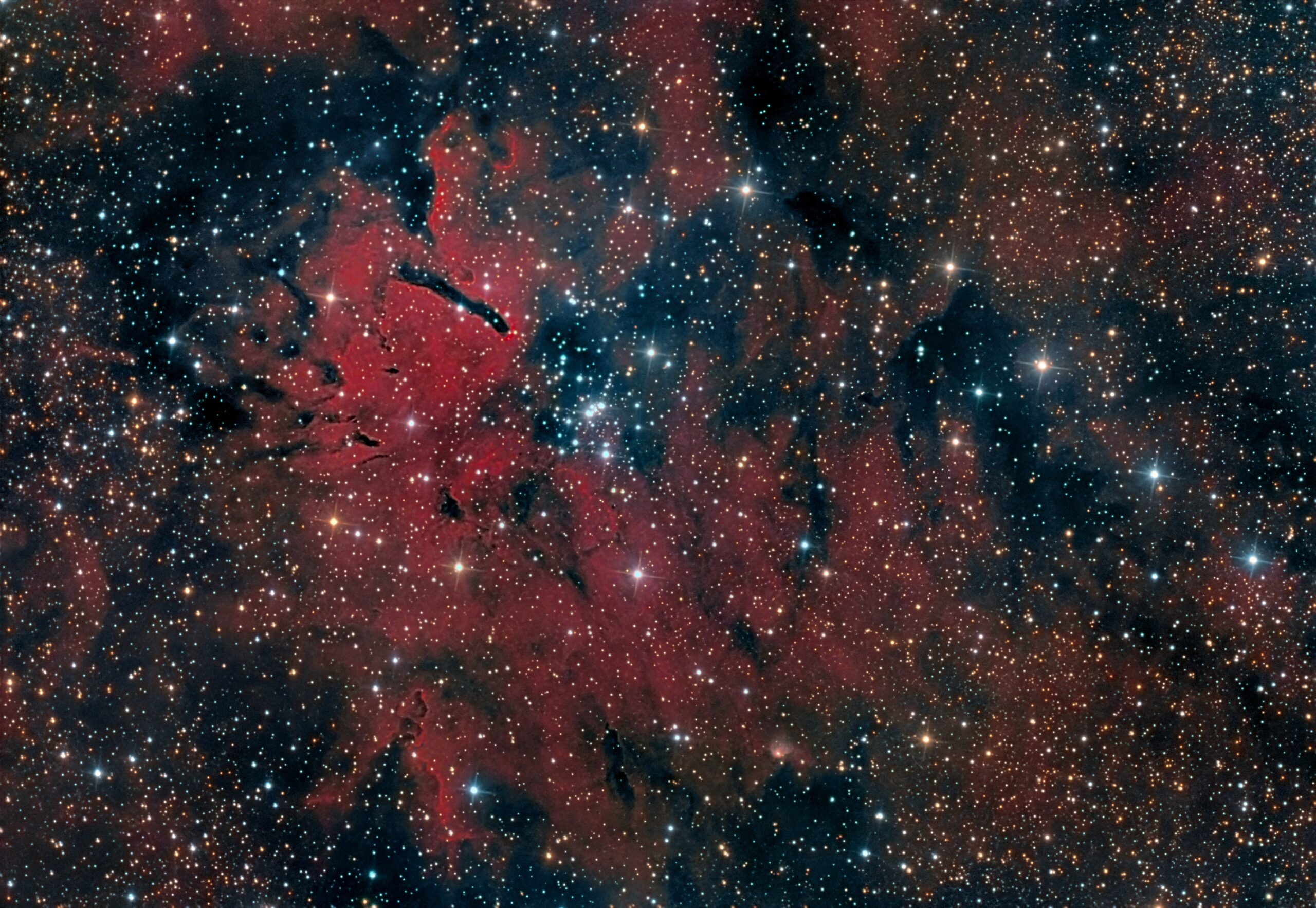
In 2015, I imaged the beautiful combination of the open cluster NGC 6823 and the surrounding emission nebula NGC 6820 from my backyard in Krefeld using my CCD equipment. The image was acquired in HRGB, combining Hα data with broadband RGB to enhance the intricate emission structures while preserving the natural colors of the surrounding star field. The resulting image reveals both the young stellar cluster and the glowing hydrogen clouds from which it was born.
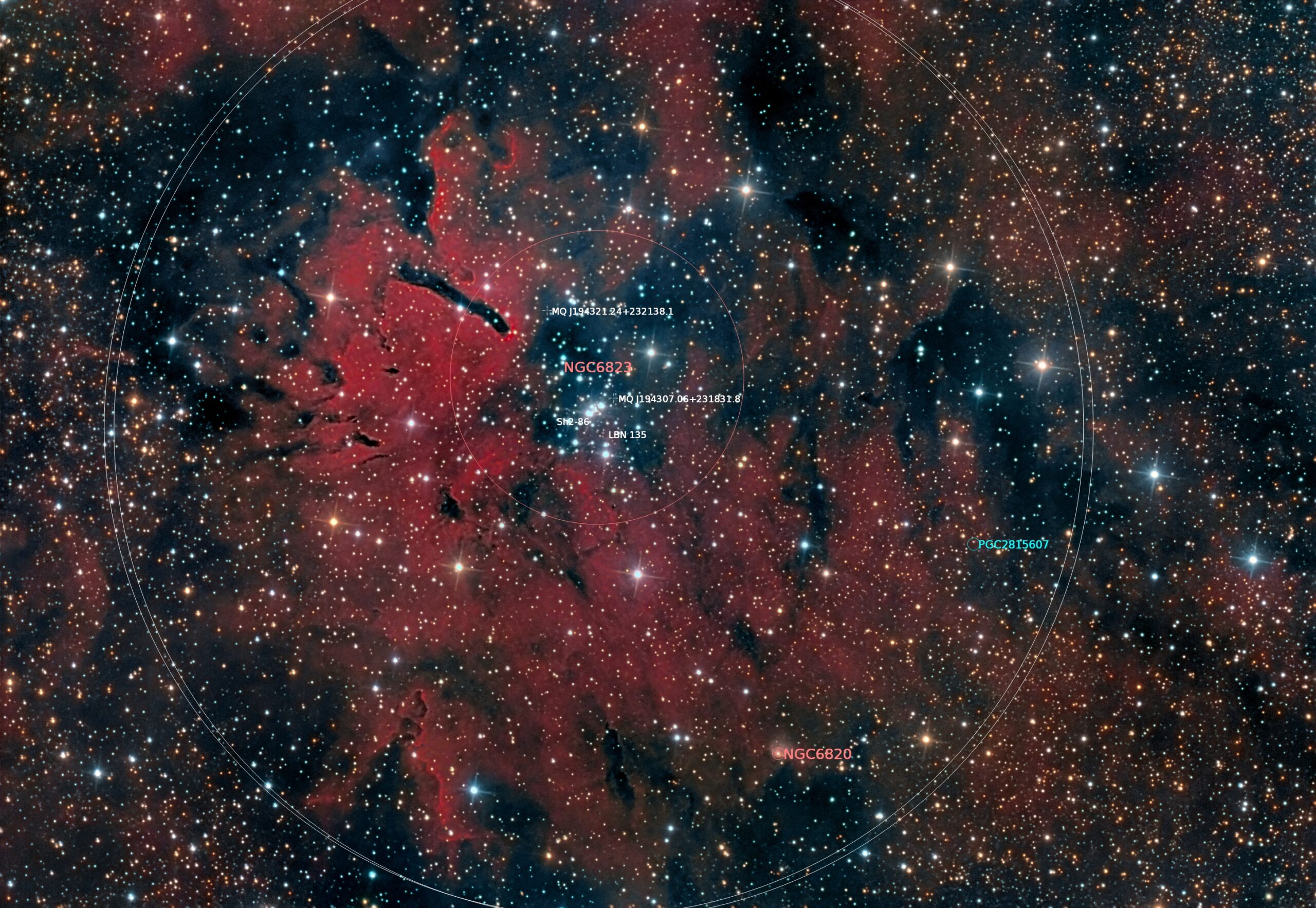
Located in the constellation Vulpecula, NGC 6820 and NGC 6823 lie at a distance of approximately 6,000 light-years. Together they form one of the Milky Way’s active star-forming regions, where young massive stars interact with the surrounding interstellar medium. While NGC 6820 is the glowing emission nebula, NGC 6823 is the embedded open cluster whose hot, luminous stars provide the ultraviolet radiation that ionizes the surrounding hydrogen gas.
The open cluster NGC 6823 is remarkably young, with an estimated age of only 2 to 7 million years. It contains numerous hot O- and B-type stars, whose intense radiation and powerful stellar winds continue to sculpt the surrounding nebula. These massive stars illuminate the gas clouds, producing the characteristic red Hα emission that dominates the region. At the same time, their energetic winds compress nearby molecular clouds, potentially triggering the formation of a new generation of stars.
NGC 6820 itself is a complex network of glowing gas, dark dust lanes, and dense molecular clouds. The nebula contains numerous Bok globules and compact condensations where protostars are still forming. These dense clouds appear as dark silhouettes against the bright emission background and represent the earliest stages of stellar evolution. The combination of bright ionized gas and opaque dust structures makes the region particularly attractive for narrowband imaging.
One of the most striking features of this field is the intricate interaction between young stars and the surrounding nebula. Radiation from the cluster has carved cavities into the molecular cloud while simultaneously producing bright ionization fronts and delicate filamentary structures. These processes provide astronomers with an excellent opportunity to study how massive stars influence their natal environment and regulate subsequent star formation.
From a scientific perspective, NGC 6820 and NGC 6823 are important examples of sequential star formation, where one generation of massive stars influences the birth of the next. The region has therefore been extensively studied in optical, infrared, and radio wavelengths, revealing both the exposed stellar population and numerous embedded young stellar objects hidden within the dust.
The final HRGB image beautifully combines the natural colors of the stars with the enhanced hydrogen emission, revealing the complex interplay between the young open cluster and its surrounding nebula. It captures one of the finest star-forming regions in Vulpecula and demonstrates that, with careful acquisition and processing, detailed narrowband images of emission nebulae can be obtained even from a suburban backyard.
Data calibration and registration and the final processing was done with PixInsight. The result was as follows:
Here is an overview of the used equipment and the exposure times:
- Date: 2015
- Location: Krefeld
- Telescope/Lens: 10″ Newton ohne Namen
- Focal length [mm]: 1000
- Focal ratio: 3.9
- Mount: Losmandy G11
- Camera: Moravian G2 8300 FW
- Filter: RGBHα
- Exposure time [min]: 60:60:60:120
- Resolution: 1.11″/px



Leave a reply