

NGC 3199 – VdS Remote Hakos
As a member of the VdS Remote Observatory group, I have the opportunity to use the remote observatory at Hakos in Namibia. Members are not only allowed to process their own observations but also the data acquired by other participants. This collaborative approach provides access to a wide variety of interesting targets and allows different processing techniques to be applied to the same dataset.
For the image presented here, I used data of the emission nebula NGC 3199, acquired in 2024 by Klaus Weisensee with the equipment of the VdS Remote Observatory. While the original data acquisition was carried out by Klaus, all calibration, registration, and final image processing were performed by me.
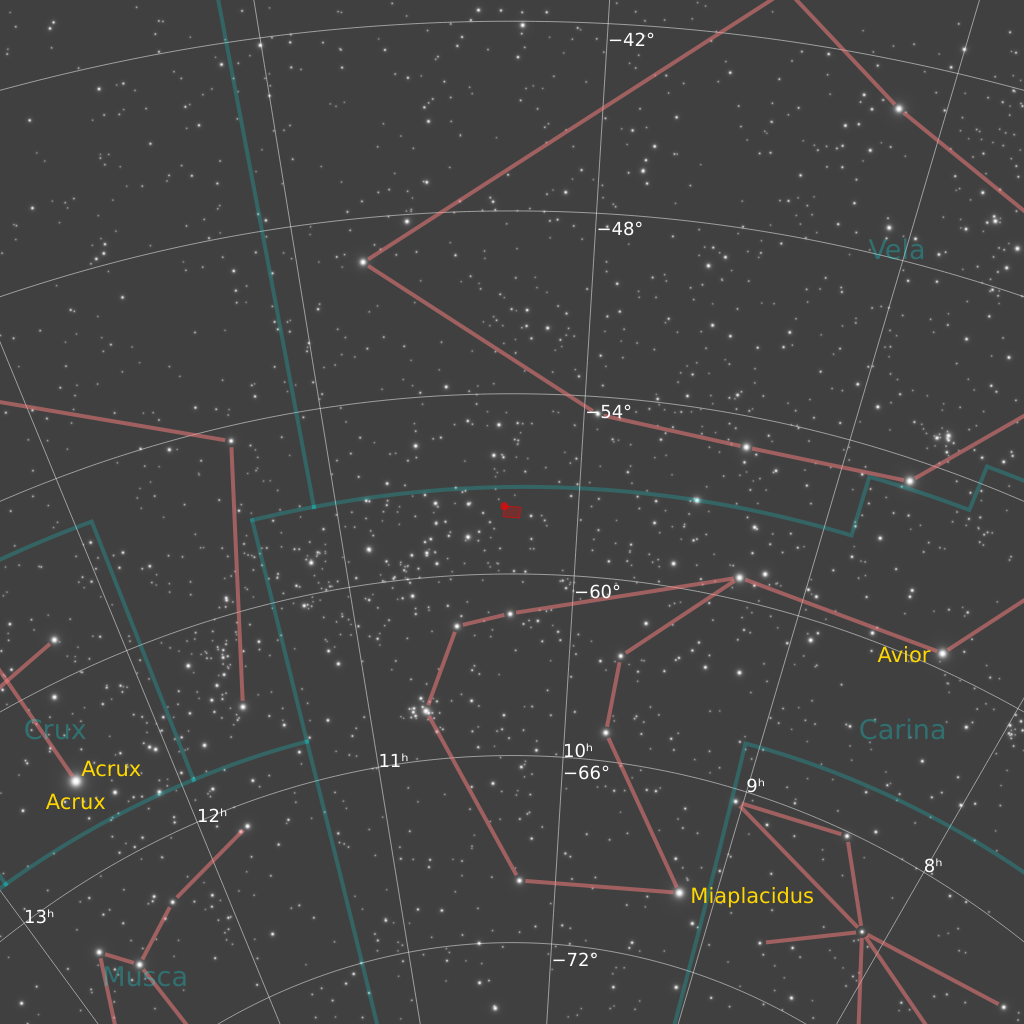
NGC 3199 is located in the constellation Carina at a distance of approximately 7,500 light-years. The nebula is closely associated with the remarkable WR 18, an extremely hot and massive Wolf–Rayet star. These rare stars represent a short-lived phase in the evolution of the most massive stars, characterized by powerful stellar winds that expel material at velocities of several thousand kilometers per second.
For many years, NGC 3199 was thought to be a simple bubble blown into the surrounding interstellar medium by the intense stellar wind of WR 18. More recent observations, however, suggest a more complex picture. The nebula’s asymmetric appearance is likely caused by the interaction of the stellar wind with a non-uniform environment, producing the bright arc-shaped structure that dominates the nebula. The star itself is moving through the surrounding gas, creating a bow-shock-like feature similar to the wake of a ship moving through water.
Deep images reveal intricate filaments, shock fronts, and turbulent structures throughout the nebula. Particularly prominent is the strong [O III] emission, which produces the characteristic blue-green appearance often seen in narrowband images. Hydrogen emission outlines additional structures and reveals the interaction between the energetic stellar wind and the surrounding gas clouds.
NGC 3199 provides astronomers with an excellent opportunity to study the final evolutionary stages of massive stars before they eventually explode as supernovae. The nebula preserves a record of the enormous amounts of energy and material injected into the interstellar medium by WR 18, contributing to the chemical enrichment and dynamical evolution of the surrounding region.
The high-quality data obtained under the pristine skies of Hakos allowed the delicate filaments and subtle emission structures of this fascinating nebula to be captured in great detail. The result showcases both the beauty of NGC 3199 and the powerful astrophysical processes that continue to shape it.
Data calibration and registration and the final processing was done with PixInsight.
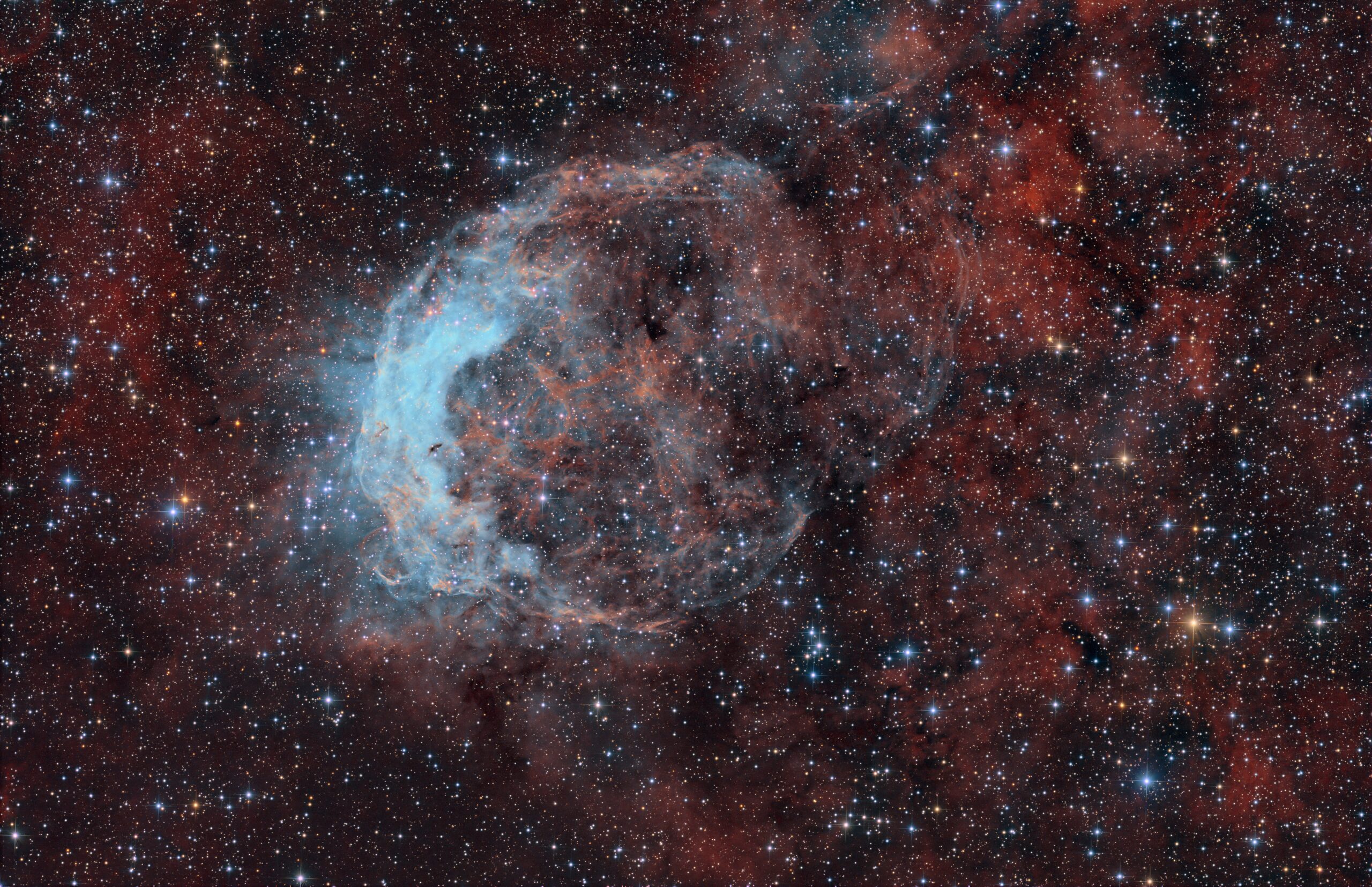
The images were taken with the following equipment:
- Date: 2024
- Location: Hakos, Namibia
- Telescope/Lens: TS 12“ Newton-Astrograph
- Focal length [mm]: 1391
- Focal ratio: 4.56
- Mount: 10Micron GM3000
- Camera: Lacerta DeepSkyPro2600 (mono)
- Filter: L:R:G:B:Hα:[OIII]
- Exposure time [min]: 44:60:60:60:70:75
- Resolution: 0.56″/px

You might also like


Leave a reply