

Messier 38 (NGC 1912) from my own backyard and observatory
The open cluster M38 (NGC 1912) lies in the constellation Auriga, forming a loosely concentrated but visually rich field of stars. Its members are mostly young, blue-white stars, creating a bright, irregular pattern that stands out beautifully against the darker background of the winter Milky Way.
Just to the south lies the much smaller and more compact open cluster NGC 1907, which provides a striking visual and structural contrast to M38. While M38 spans a broad region and displays a scattered arrangement of hot, luminous stars, NGC 1907 appears as a tight, subdued knot of older, yellower stars — almost like a distant, fossilized echo of its larger neighbor. Together, they form one of the most aesthetically pleasing cluster pairings in the northern sky.
I have photographed this region twice, the most recent session being in 2021 with my own „Sterntaucher“ observatory. During that session, I imaged the field in parallel using two cameras and telescopes mounted together: Hα data were collected with my 10″ Newtonian, while RGB data were captured with my small apochromatic refractor. The RGB frames were upscaled to match the resolution of the Hα data for combined processing.
For the wide-field version, I used only the RGB dataset.
The data calibration, registration, and final image processing were all performed in PixInsight
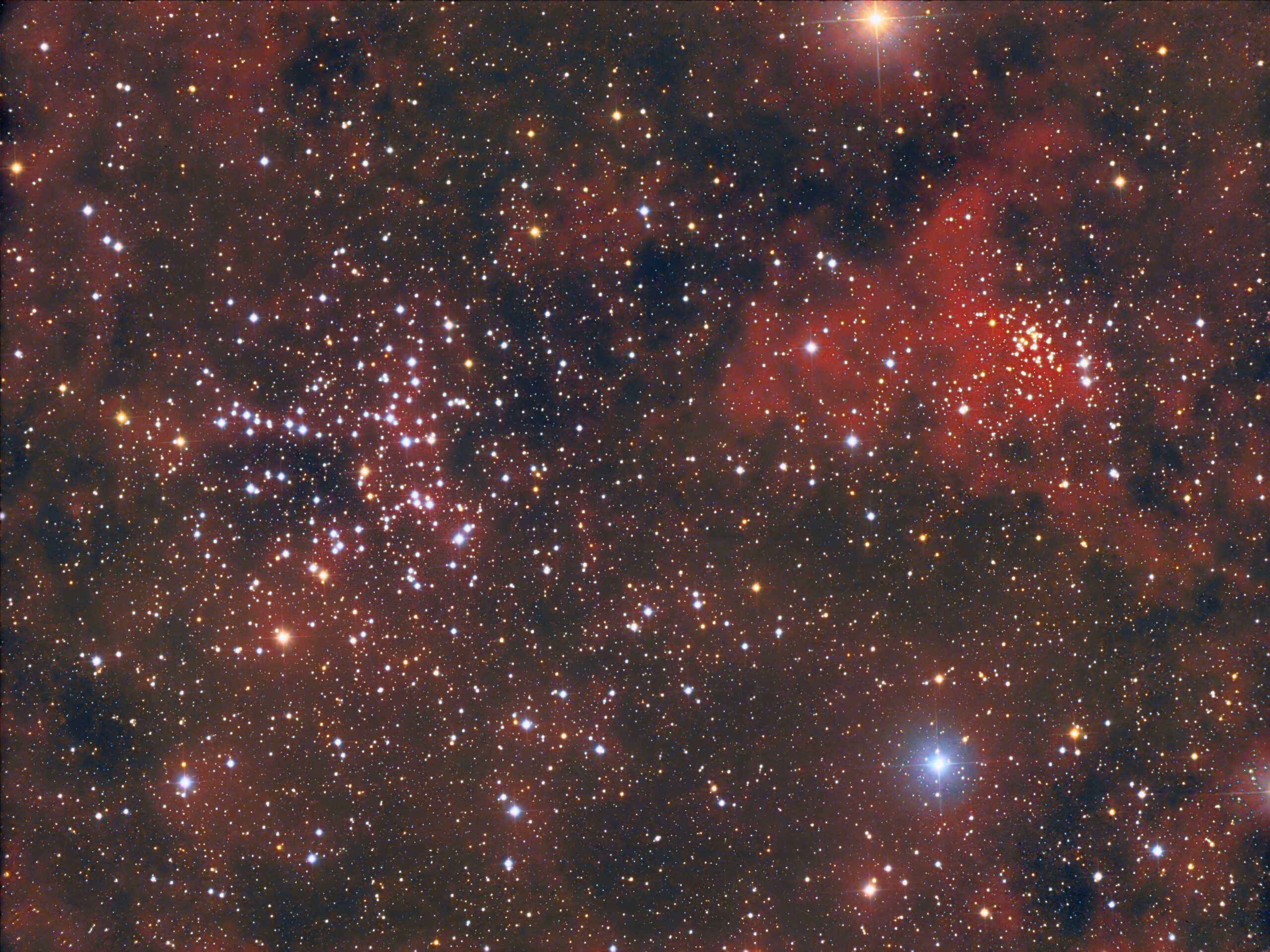

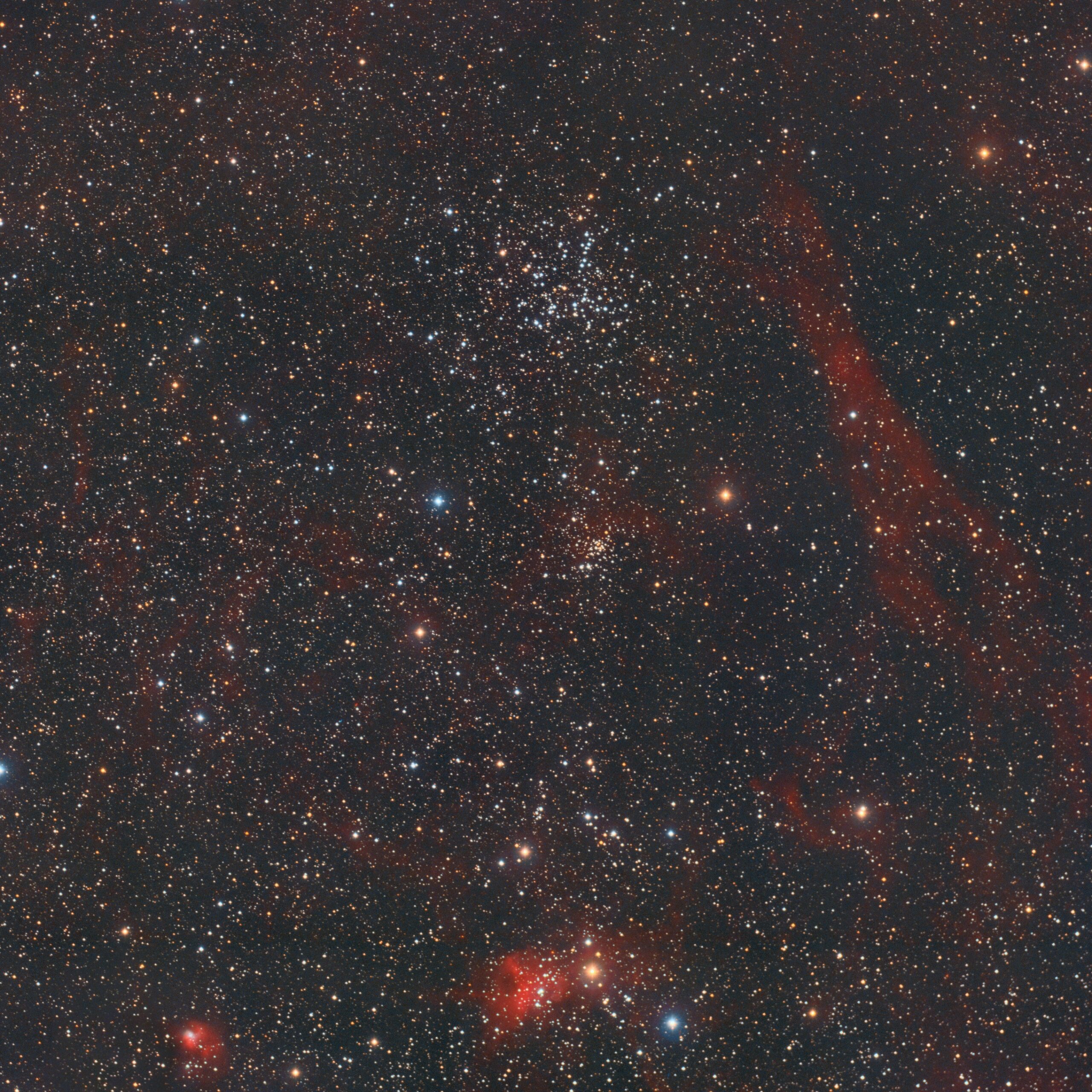
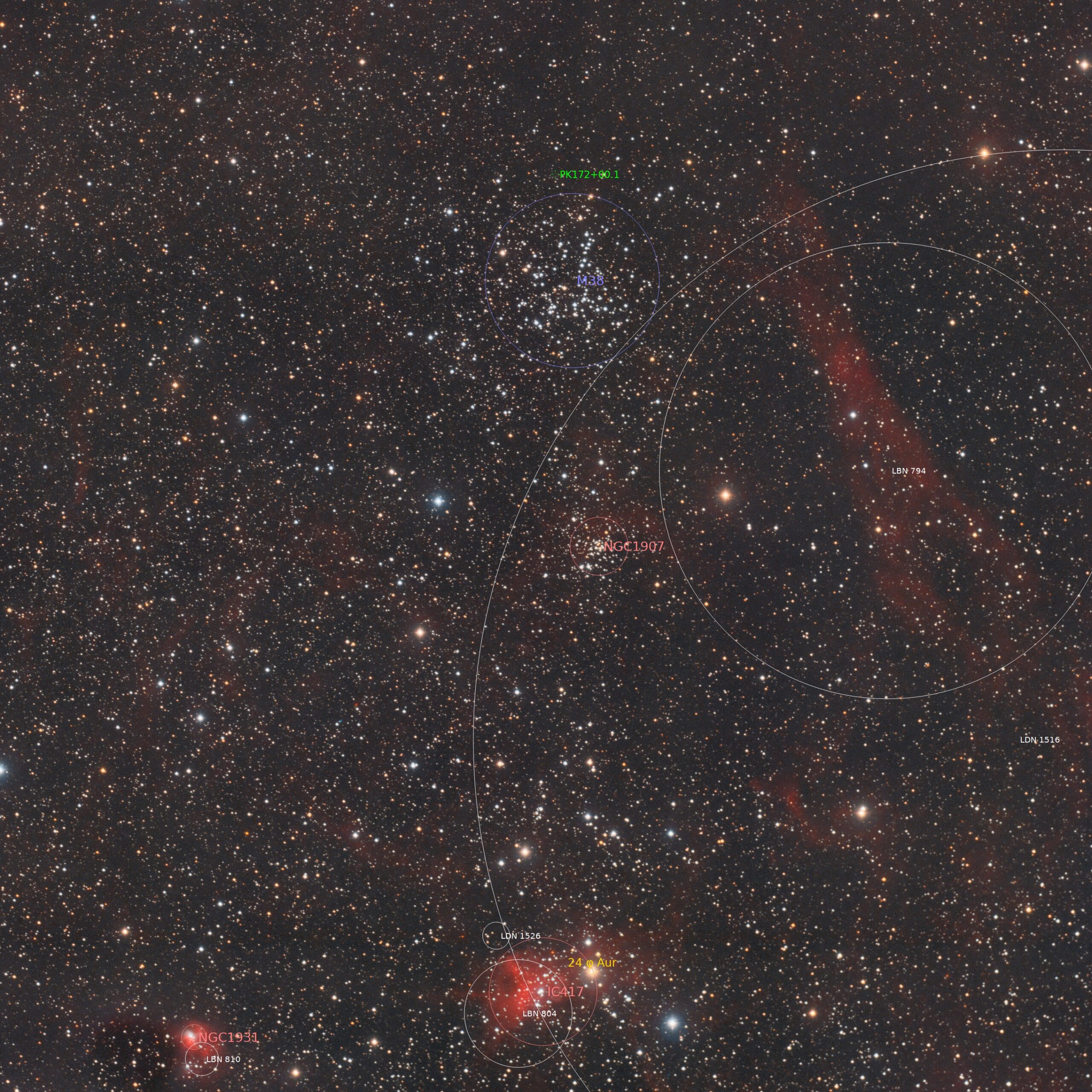
The images were taken with the following equipment:
- Date: 2021
- Location: Krefeld, Germany
- Telescope: 10″ Newton ohne Namen – TS IS 65 Apo
- Focal length [mm]: 1000 – 420
- Focal ratio: 3.9 – 6.5
- Mount: Skywatcher EQ8
- Camera: Moravian 8300FW – Moravian 16200FW
- Filter: Hα – R:G:B
- Exposure time [min]: 570 – 175:285:180
- Resolution: 1.11″/px – 2.92″/px
My first succesful images of this object I took in 2011 from my own backyard. The data calibration and registration was done with DeepSkyStacker and the final processing was done with PixInsight. The result was as follows:

The images were taken with the following equipment:
- Date: 2011
- Location: Krefeld, Germany
- Telescope: 10″ Orion Newton
- Focal length [mm]: 1200
- Focal ratio: 4.8
- Mount: Skywatcher NEQ6
- Camera: Canon 500Da
- Filter: OSC
- Exposure time [min]: 54
- Resolution: 3.2″/px


Leave a reply