

NGC 3115 from remote
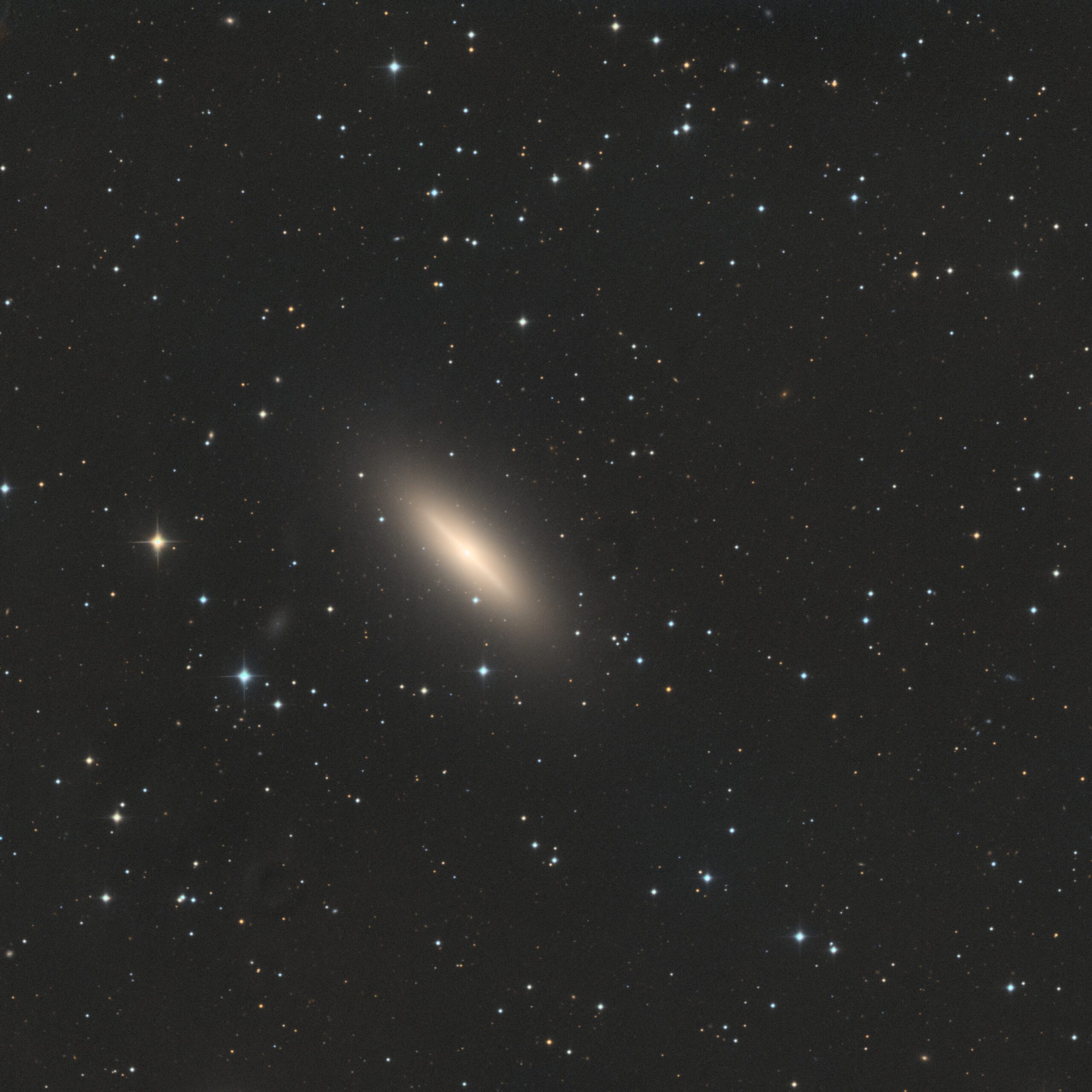
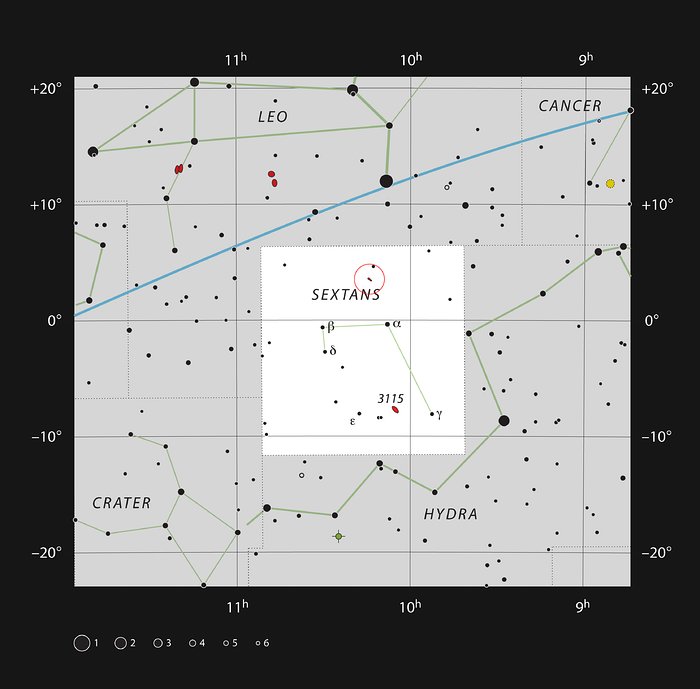
From time to time I obtain data sets from remote observatories. One of my favorite providers is Telescope Live with telescopes in e.g. Chile, Australia and Spain. One of the data sets I received, was data from the galaxy NGC 3115, located in the constellation Sextans.
NGC 3115 is one of the finest examples of a lenticular galaxy (S0 type) and lies at a distance of approximately 32 million light-years. Because of its bright central bulge and thin, highly inclined disk, it is often nicknamed the “Spindle Galaxy.” Visually, it appears as a graceful transition object between elliptical and spiral galaxies, possessing a prominent stellar disk but lacking the well-defined spiral arms and active star-forming regions seen in typical spiral galaxies.
The galaxy is believed to be one of the nearest examples of a system that has largely exhausted its reservoir of cold gas. As a result, star formation has nearly ceased, leaving behind an older population of yellow and red stars that dominates its appearance. This gives NGC 3115 a smooth and elegant structure, with subtle dust features and a bright, elongated central bulge embedded within a razor-thin stellar disk.
Scientifically, NGC 3115 is particularly important because it hosts one of the closest known supermassive black holes outside the Local Group. Measurements indicate that the black hole contains roughly one to two billion solar masses, making it one of the most massive black holes in a nearby galaxy. Observations with large professional observatories have revealed that the motions of stars near the nucleus are strongly influenced by this enormous concentration of mass, providing valuable evidence for the existence of supermassive black holes in galactic centers.
The galaxy is also surrounded by a rich system of globular clusters, numbering in the thousands. These ancient stellar systems provide important clues about the formation history of NGC 3115 and suggest that the galaxy has experienced multiple merger and accretion events during its evolution. Studies of its globular cluster population have helped astronomers understand how large galaxies assemble their mass over cosmic timescales.
Deep imaging reveals not only the bright spindle-shaped disk but also an extended stellar halo surrounding the galaxy. Numerous faint background galaxies can often be detected throughout the field, emphasizing the depth of the image and the vast distances involved.
The high-quality Telescope Live dataset allowed for detailed processing of the galaxy’s subtle structure, highlighting the smooth stellar disk, the luminous central bulge, and the delicate outer halo. The result showcases one of the most elegant galaxies in the southern sky and an object of considerable scientific importance for the study of galaxy evolution and supermassive black holes.
Data calibration and registration and the final processing was done with PixInsight. The result was as follows:
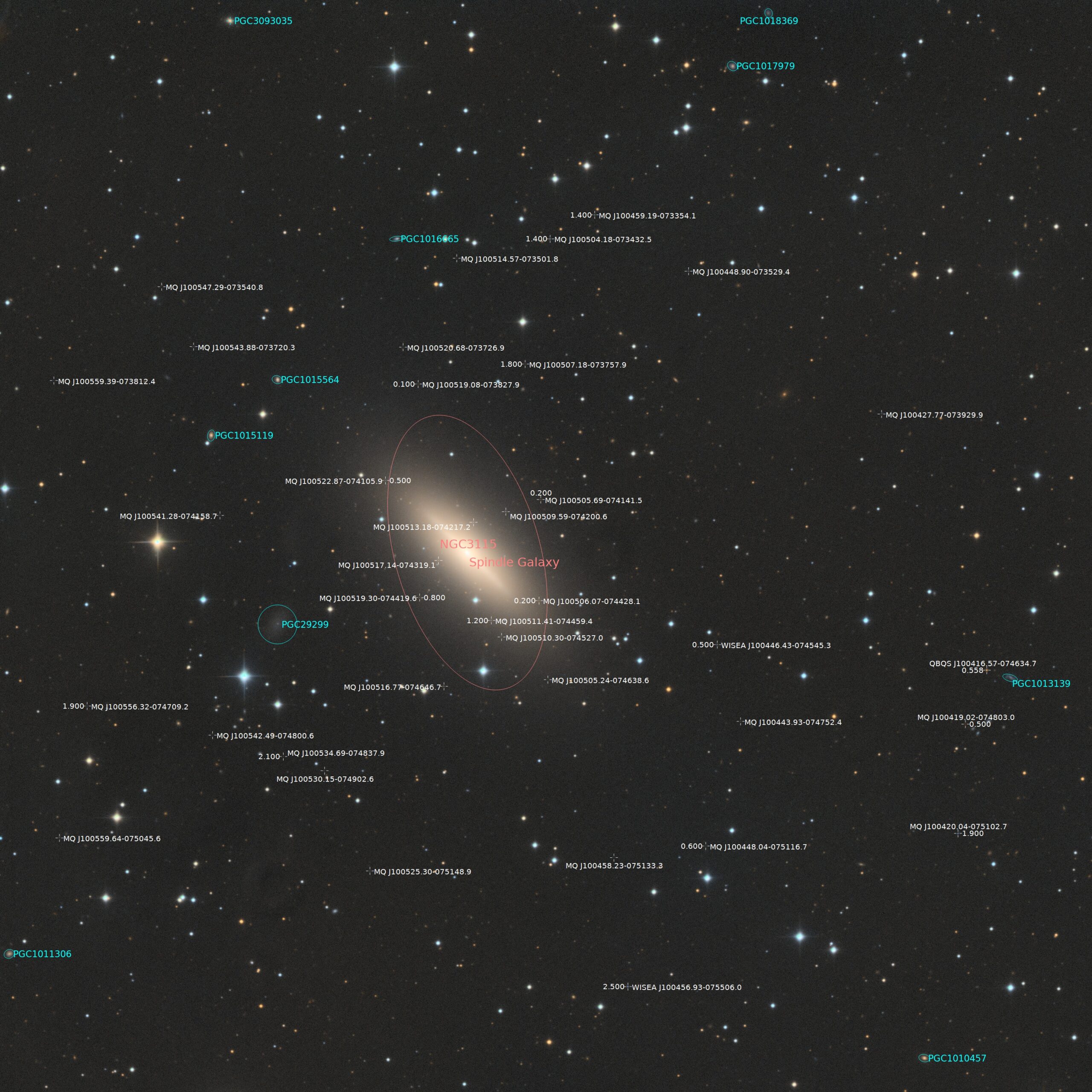
In the field were quiet a lot of quasars (see annotation). The two most distant of them are:
WISEA J100456.93-075506.0 with a redshift of 2.5 and an apparent magB of 19.93 (2017,PASA,34,25).
MQ J100534.69-074837.9 with a redshift of 2.1 and an apparent magB of 22.18 (2017,PASA,34,25).
The faintest object in this image has an apparent magnitude of approx. 22.2 magB (2017,PASA,34,25).
The images were taken with the following equipment (Telescope Live CHI-1):
- Date: 2021
- Telescope/Lens: Planwave CDK24
- Focal length [mm]: 3900
- Focal ratio: 6.5
- Mount: Mathis MI-1000/1250
- Camera: FLI Proline 9000
- Filter: LRGB
- Exposure time [min]: 100:100:100:100
- Resolution: 0.62″/px


Leave a reply