

NGC 660 from Namibia
In 2013, during a stay at the astrofarm Tivoli in Namibia, I imaged the remarkable galaxy NGC 660 using a rented observatory setup. The dark southern skies provided excellent transparency and contrast, allowing the galaxy’s unusual structure to stand out clearly against the background.
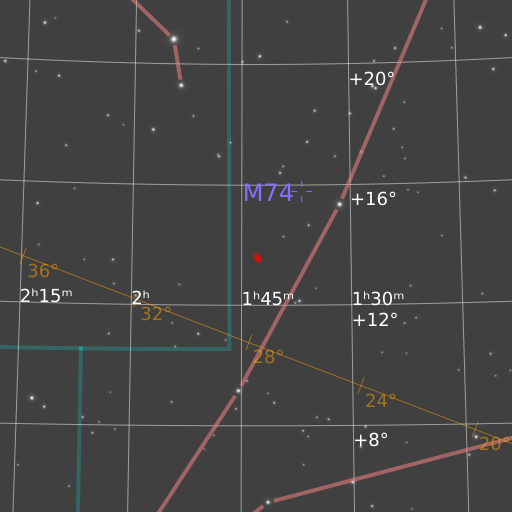
NGC 660, located in the constellation Pisces, lies roughly 40–50 million light-years away. It is best known as a polar ring galaxy, a rare and fascinating type of system in which a substantial ring of gas, dust, and stars orbits nearly perpendicular to the main galactic disk. This peculiar configuration is thought to result from a past gravitational interaction or the accretion of material from a companion galaxy.
Deep imaging reveals the warped main disk crossed by a striking dust lane, while the extended polar ring appears tilted at a dramatic angle. The system shows active star formation, particularly within the ring structure, making it an excellent example of how galactic interactions can reshape morphology and trigger new stellar populations. Capturing this galaxy under Namibia’s pristine skies was a rewarding opportunity to document one of the more exotic structures in nearby extragalactic astronomy.
Data calibration and registration were performed with DeepSkyStacker, and the final processing was completed in PixInsight.
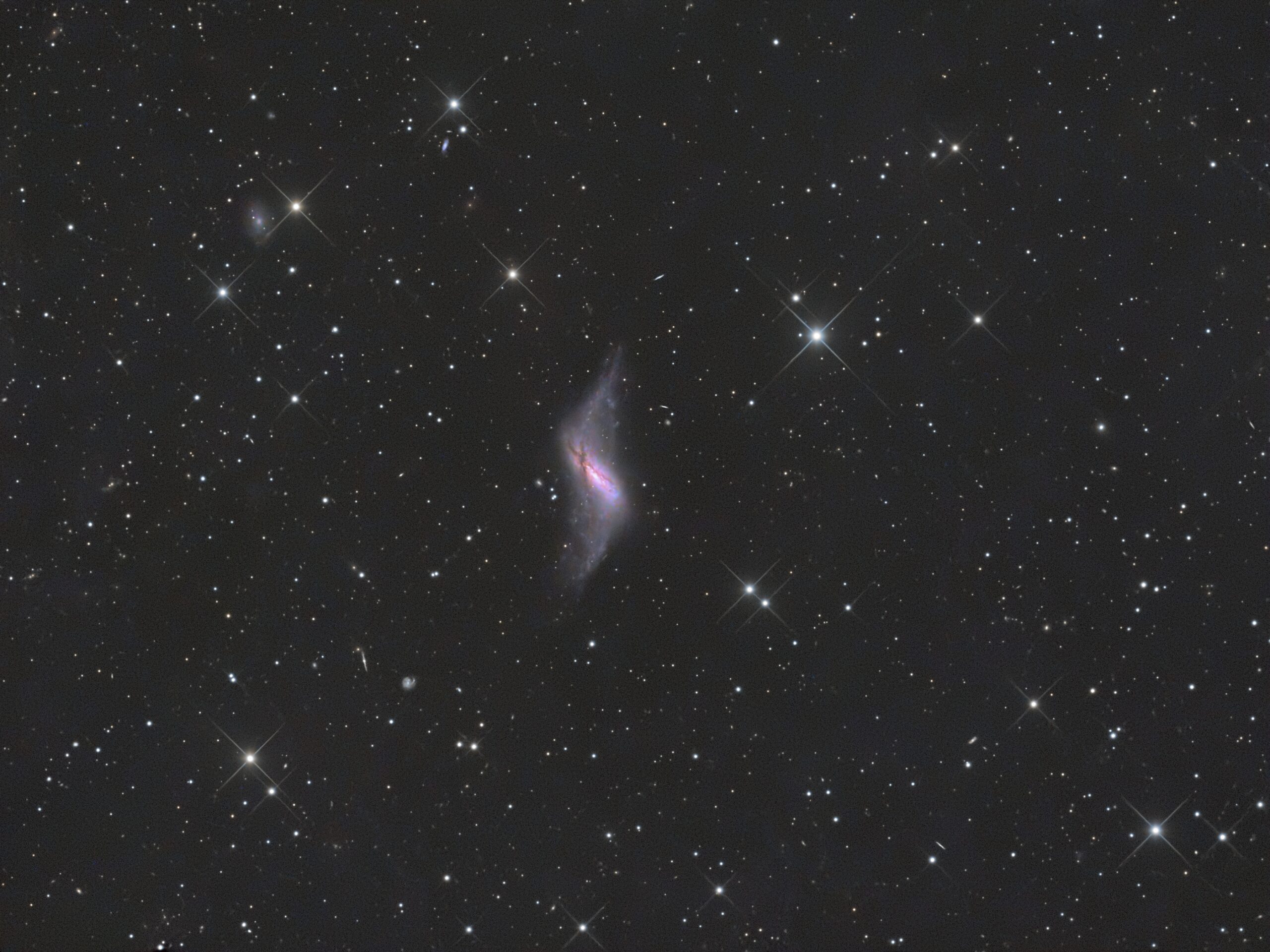
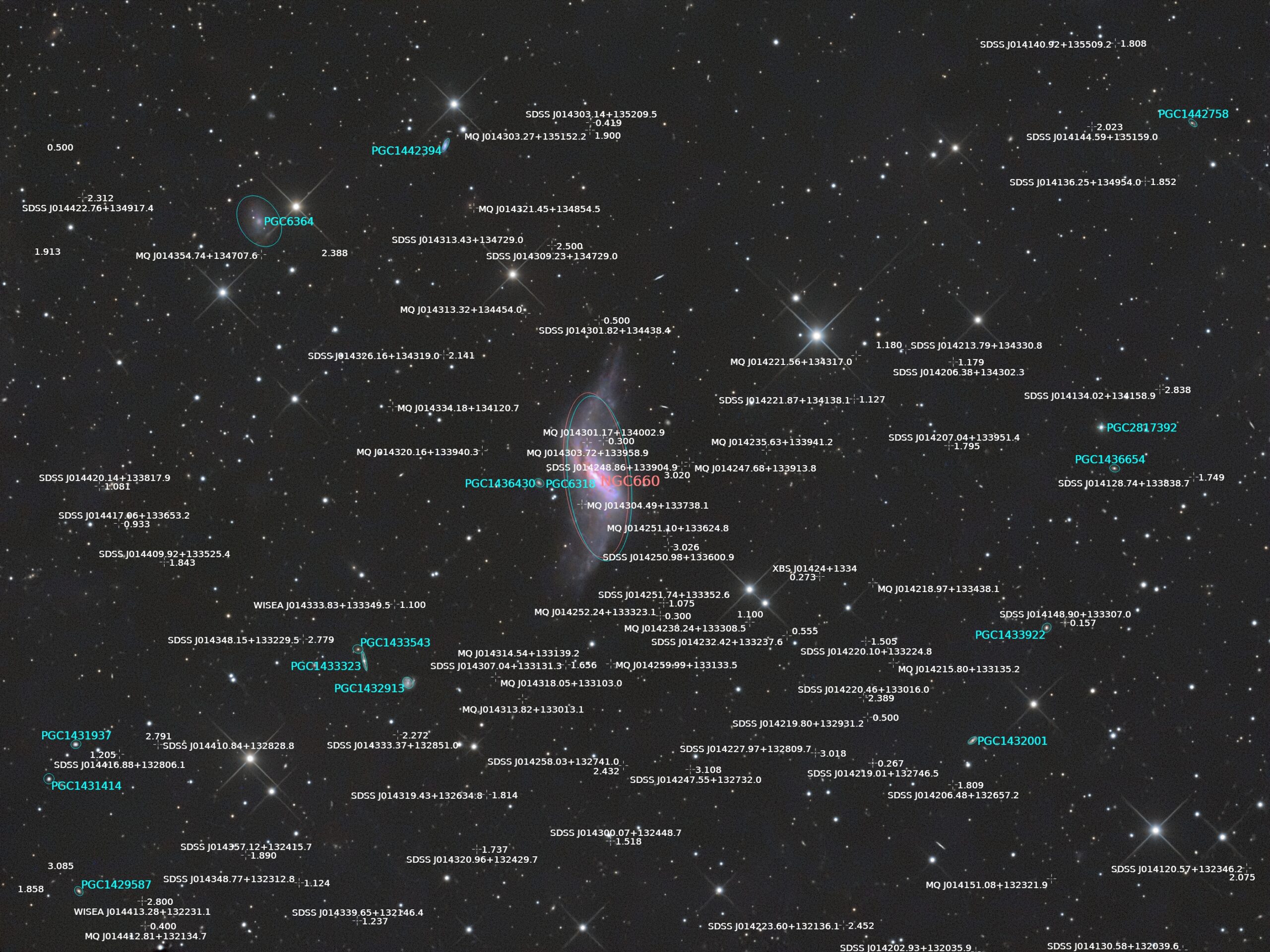
In the image, numerous background quasars are visible, highlighting the impressive depth of the dataset. The most distant among them is SDSS J014426.09+132333.3, with a measured redshift of z = 3.085.
At this redshift, we observe the quasar as it appeared more than 11 billion years ago, when the universe was less than 2 billion years old. Its enormous luminosity is powered by a supermassive black hole accreting matter at the center of a young galaxy. Despite its extreme distance, the quasar remains detectable because such active galactic nuclei can outshine their entire host galaxies.
The presence of these very distant quasars in the same field as the comparatively nearby galaxy NGC 660 creates a striking sense of cosmic depth—foreground structure at tens of millions of light-years contrasted with background objects from the early universe.
The images were taken with the following equipment:
- Date: 2013
- Location: Astrofarm Tivoli, Namibia
- Telescope: 12″ ASA Astrograph
- Focal length [mm]: 1076
- Focal ratio: 3.6
- Mount: ASA DDM 85
- Camera: FLI Microline ML8300
- Filter: L:R:G:B
- Exposure time [min]: 65:30:30:30
- Resolution: 1.04″/px

Leave a reply