

NGC 1501 from my own backyard
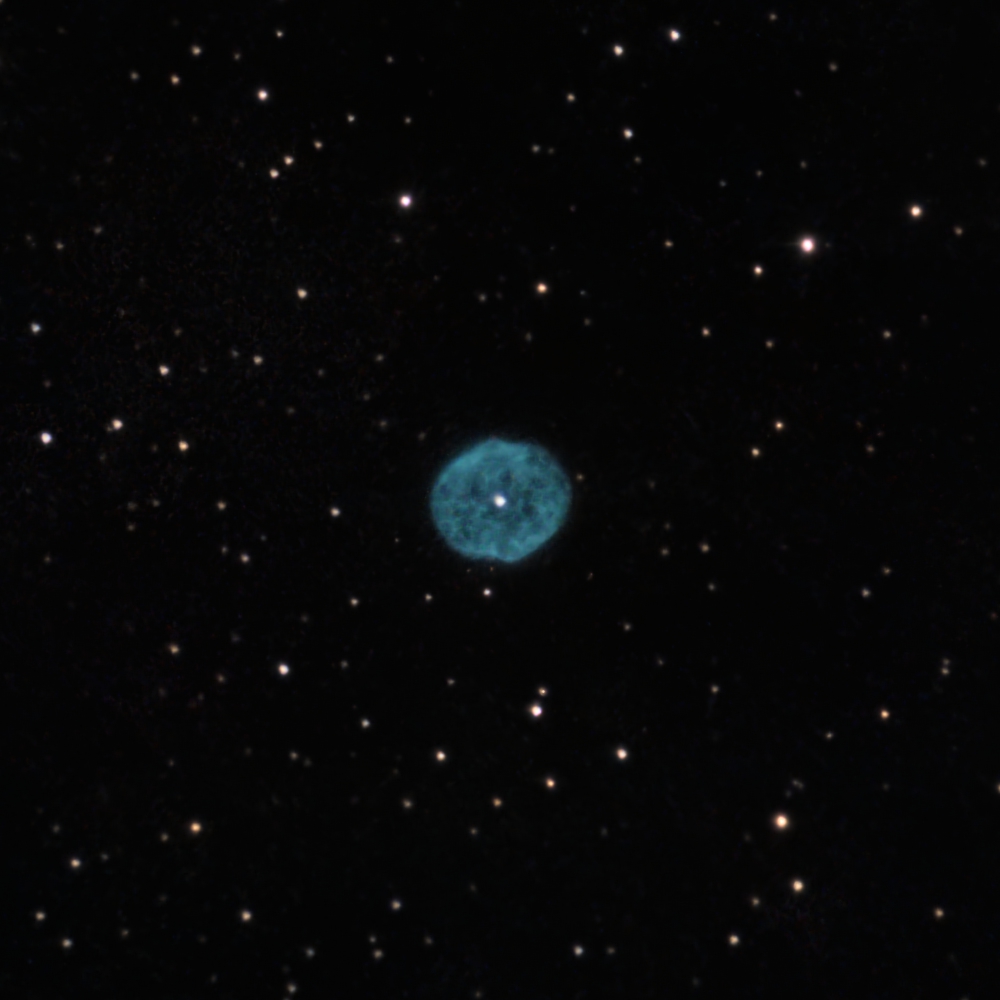
In 2011, I imaged the planetary nebula NGC 1501 from my backyard using my DSLR equipment. Despite the limitations of suburban skies, long exposures allowed me to capture the delicate structure of this fascinating deep-sky object.
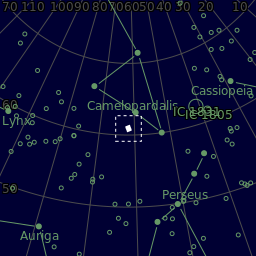
NGC 1501 is located in the constellation Camelopardalis at a distance of roughly 4,000–5,000 light-years. It is a relatively young planetary nebula, created when a Sun-like star reached the end of its life and expelled its outer layers into space. The remaining stellar core has evolved into a hot white dwarf, whose intense ultraviolet radiation ionizes the surrounding gas, causing it to glow.
Often nicknamed the “Oyster Nebula,” NGC 1501 displays a complex, slightly irregular shell structure with numerous knots and filaments. High-resolution images reveal a turbulent morphology shaped by stellar winds from the central star interacting with previously ejected material. The central star itself is a rare Wolf–Rayet-type central star (WC4), characterized by extremely strong stellar winds and high surface temperatures.
Even with DSLR equipment, the nebula’s faint circular glow and subtle internal texture can be recorded with sufficient exposure time, making it an interesting target for deep-sky imaging from smaller observatories.
The data calibration and registration was done with DeepSkyStacker, the final image processing, were performed entirely in PixInsight. The result was as follows:
The images were taken with the following equipment:
- Date: 2011 – 2012
- Location: Krefeld, Germany
- Telescope: 10″ TS Newton
- Focal length [mm]: 1140
- Focal ratio: 4.5
- Mount: Skywatcher NEQ6
- Camera: Canon 500Da – Meade DSI 2 Pro
- Filter: OSC – no
- Exposure time [min]: 210 – 80
- Resolution: 0.58″/px

Leave a reply