

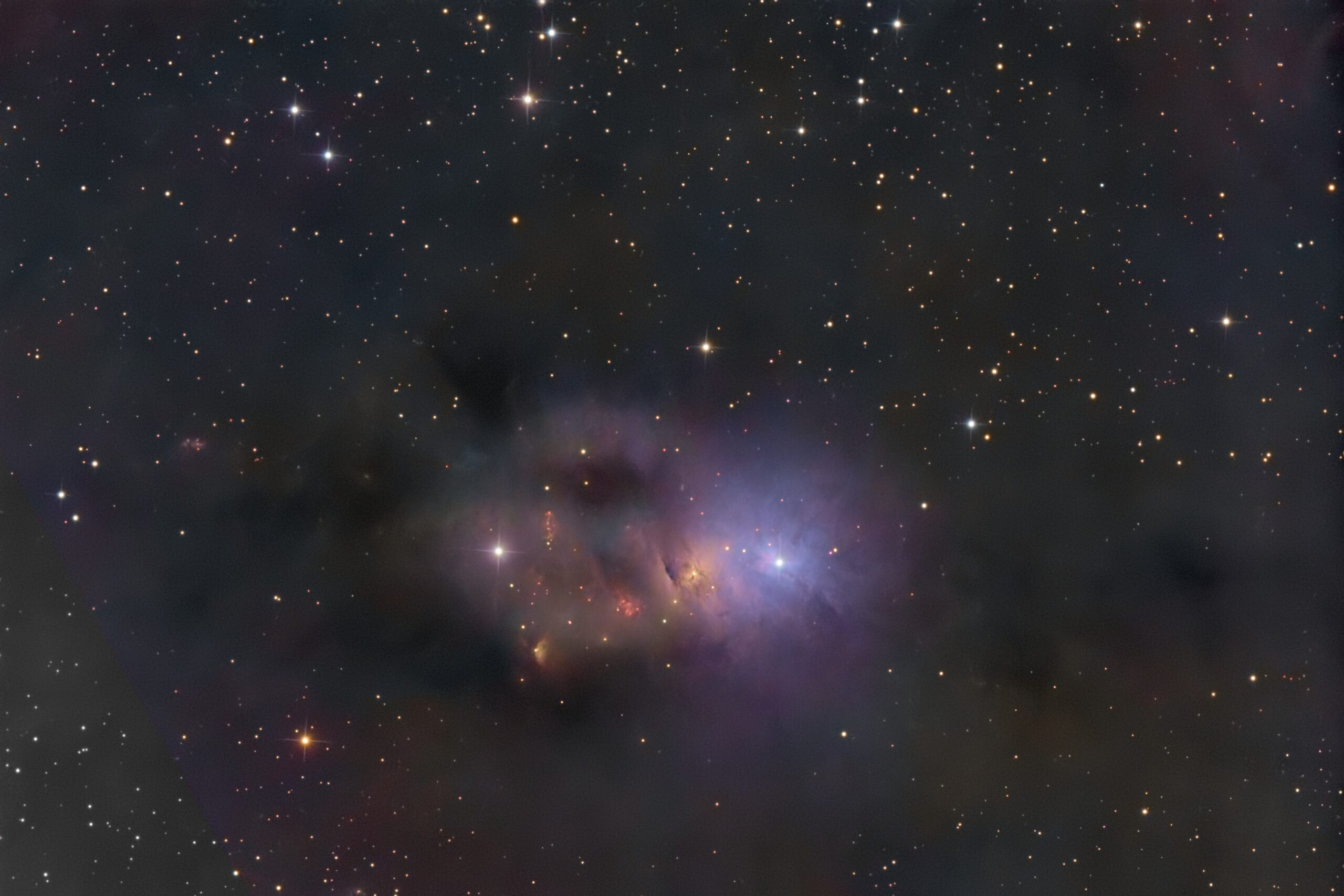
NGC 1333 from my own „Sterntaucher“ observatory
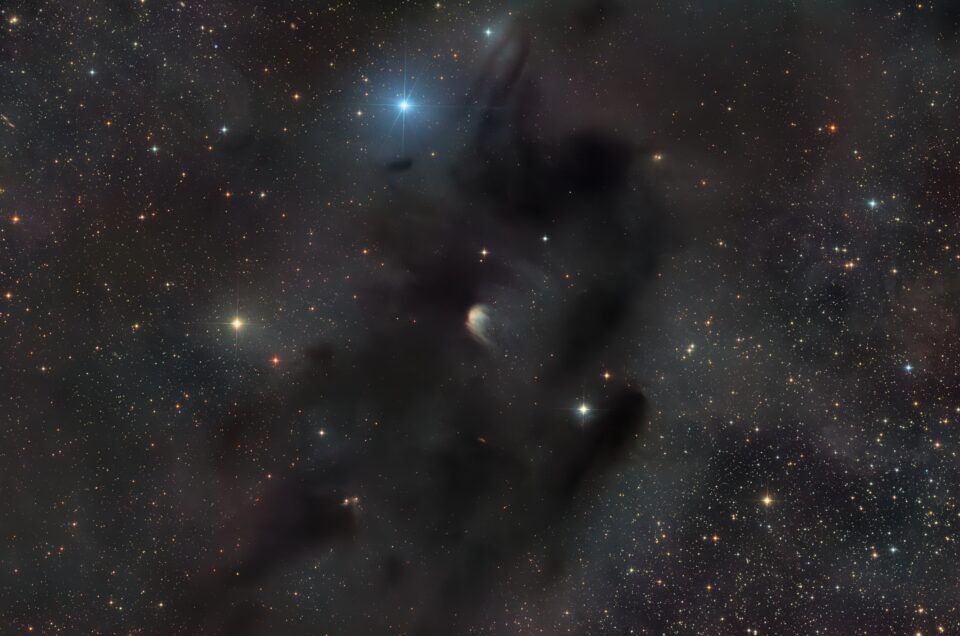
During 2017 and 2018, I imaged the reflection nebula NGC 1333 from my observatory in Krefeld using a dual-rig setup with CCD cameras. This configuration allowed me to optimize the data acquisition for both resolution and color fidelity.
For the luminance (L) data, I used my 10″ Newtonian telescope to capture fine structural detail. In parallel, a short apochromatic refractor recorded the RGB data, providing wide-field color information with excellent star shapes. To achieve a seamless integration, I upscaled the RGB data to match the higher-resolution luminance frames before combining everything into a final LRGB image.
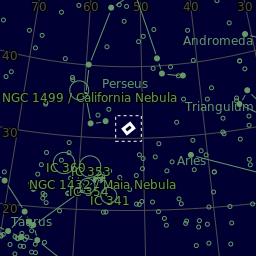
NGC 1333 lies in the constellation Perseus at a distance of roughly 1,000 light-years. It is a very young and active star-forming region embedded within the Perseus molecular cloud complex. The nebula shines primarily by reflected starlight from hot, young stars forming within the cloud, giving it its characteristic bluish appearance.
Deep imaging reveals not only the bright reflection nebulosity but also numerous dark dust lanes and faint background structures. The region is rich in Herbig–Haro objects and protostellar outflows, making it an astrophysically dynamic environment. The combination of high-resolution luminance and carefully matched RGB data allowed the delicate interplay between blue reflection light and dark interstellar dust to stand out with striking clarity.
Data calibration, registration, and final image processing were all performed using PixInsight.
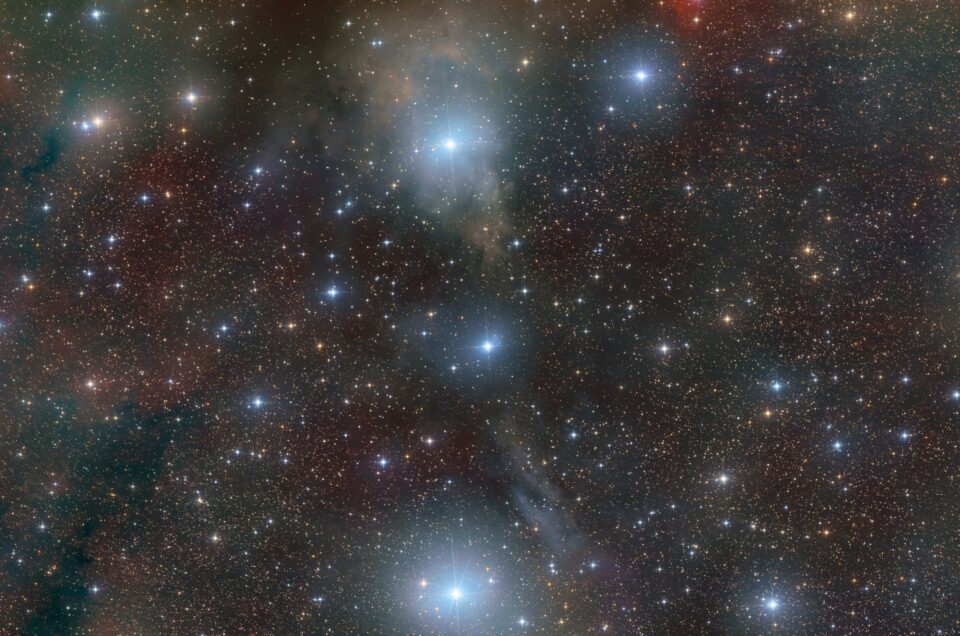
The result was as follows:
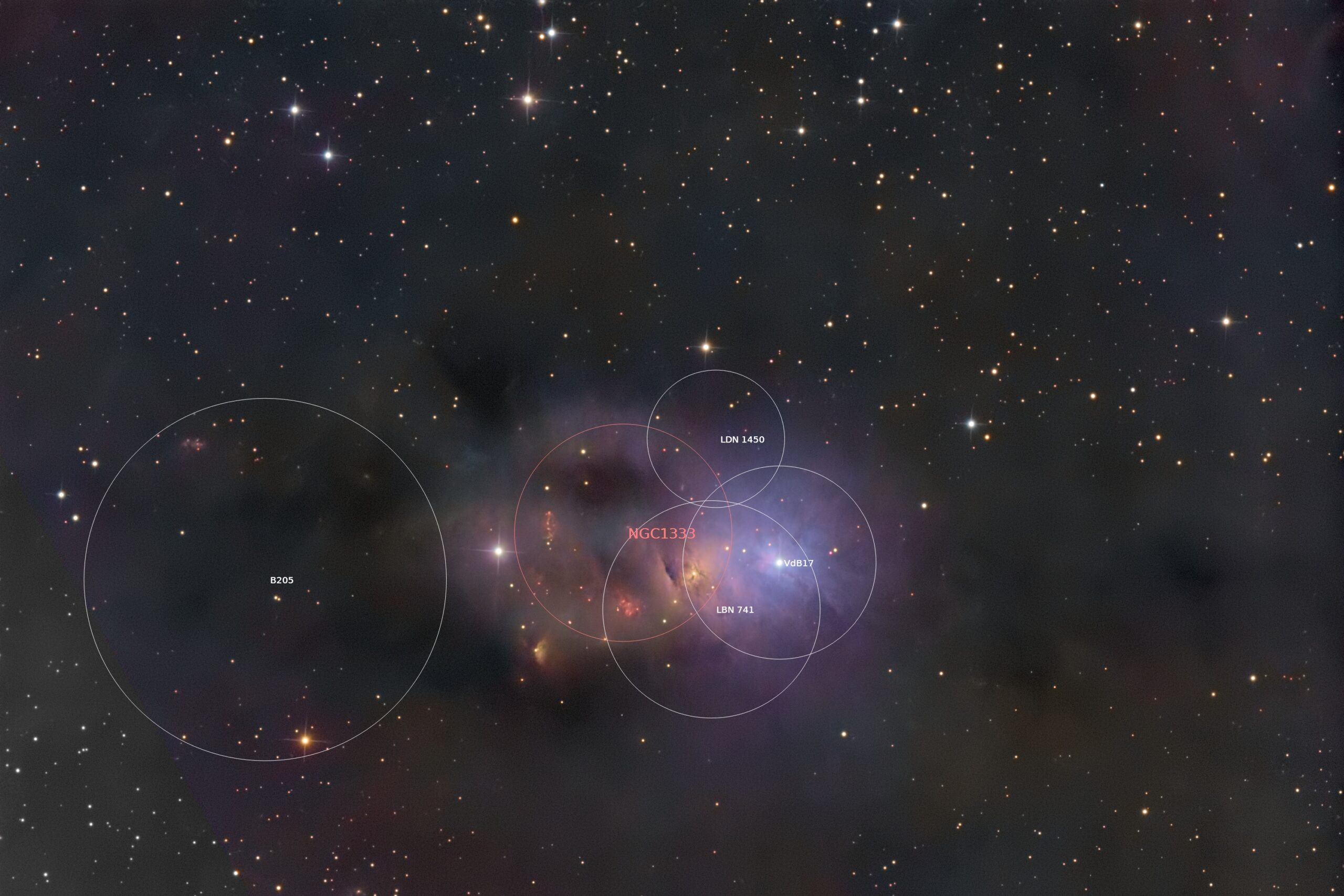
The images were taken with the following equipment:
- Location: Krefeld, Germany
- Telescope: 10″ Newton ohne Namen – TSQ-65ED Apo
- Focal length [mm]: 1000 – 420
- Focal ratio: 3.9 – 6.5
- Mount: Skywatcher EQ8
- Camera: Moravian G2 8300 FW – Moravian G3 16200 FW
- Filter: L – R:G:B
- Exposure time [min]: 185 – 180:250:170
- Resolution: 1.11″/px – 2.95″/px

Leave a reply