

Messier 47 with Messier 46
In 2025, I acquired two new datasets of the neighboring open clusters Messier 46 (M46) and Messier 47 (M47), expanding my long-term study of these visually contrasting stellar groups. The first dataset was obtained from the VdS Remote Observatory in Hakos, Namibia, where, as a VdS member, I carried out the imaging and data calibration myself. The site’s high altitude and exceptionally stable atmospheric conditions provided excellent seeing and transparency, resulting in data of outstanding depth and resolution. This dataset offered a valuable opportunity to refine my calibration workflow, from dark and flat-field correction to star registration and photometric color balance.
The second dataset was sourced from Telescope Live, one of my preferred remote data providers, operating telescopes in Spain, Australia, and Chile. Their automated acquisition system delivered consistently high-quality, well-calibrated subframes across multiple filters. The global network’s geographic diversity allows for flexible scheduling and optimal sky coverage, making it particularly suitable for targets like M46 and M47, which are well-placed for both northern and southern hemisphere observations.
Combining and comparing these two datasets enabled a detailed evaluation of instrumental and atmospheric influences on image quality. Furthermore, the side-by-side presentation of M46 and M47—one enriched with an embedded planetary nebula and the other a bright, loosely bound cluster—offered an excellent visual and photometric contrast between two stellar populations of differing ages and compositions. Together, these observations represent a continued progression toward high-precision, multi-source astrophotography and collaborative remote imaging practices.
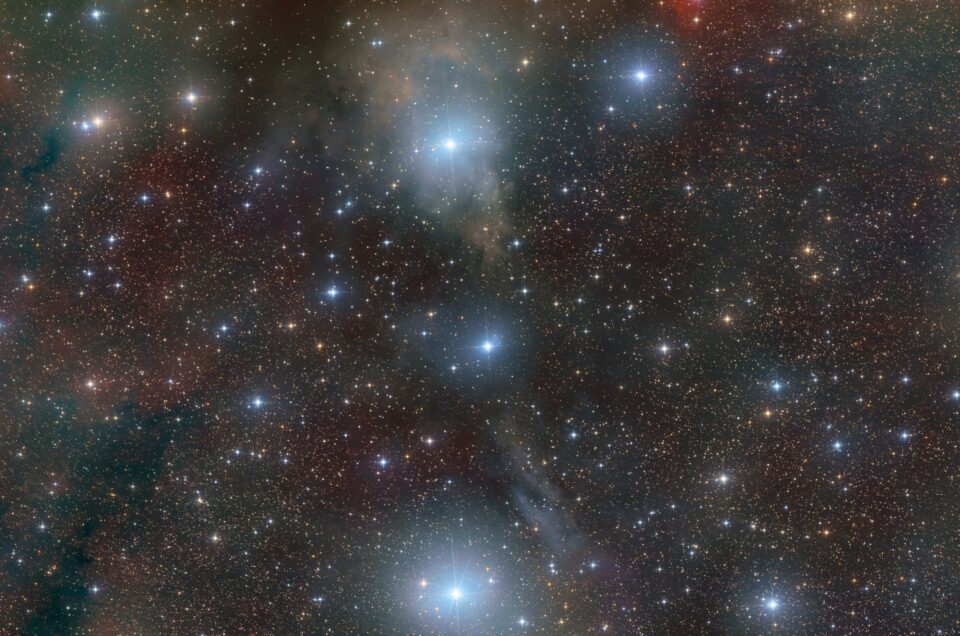
The data calibration and registration and the final processing was done with PixInsight. The result from Hakos was as follows:

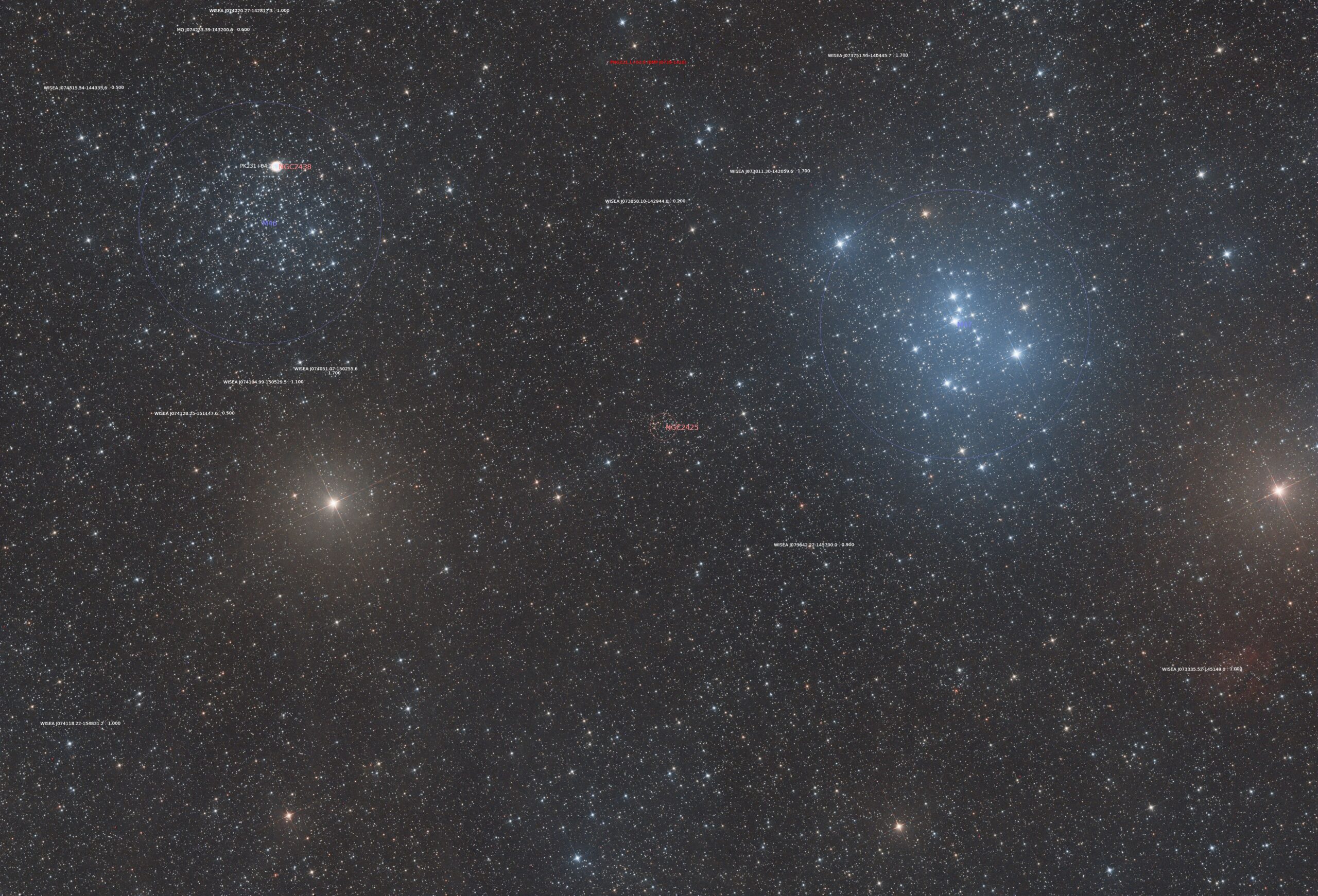
In the image you can find a lot of quasars.
Here is an overview of the used equipment and the exposure times:
- Date: 2025
- Location: Hakos, Namibia
- Telescope/Lense: Takahashi Epsilon 160D
- Focal length [mm]: 500
- Focal ratio: 3.3
- Mount: 10Micron GM3000
- Camera: Lacerta 2600C
- Autoguiding: yes
- Filter: OSC (Triband)
- Exposure time [min]: 108
- Resolution: 1.45″/px
The data calibration and registration and the final processing was done with PixInsight. The result from Telescope Live was as follows:

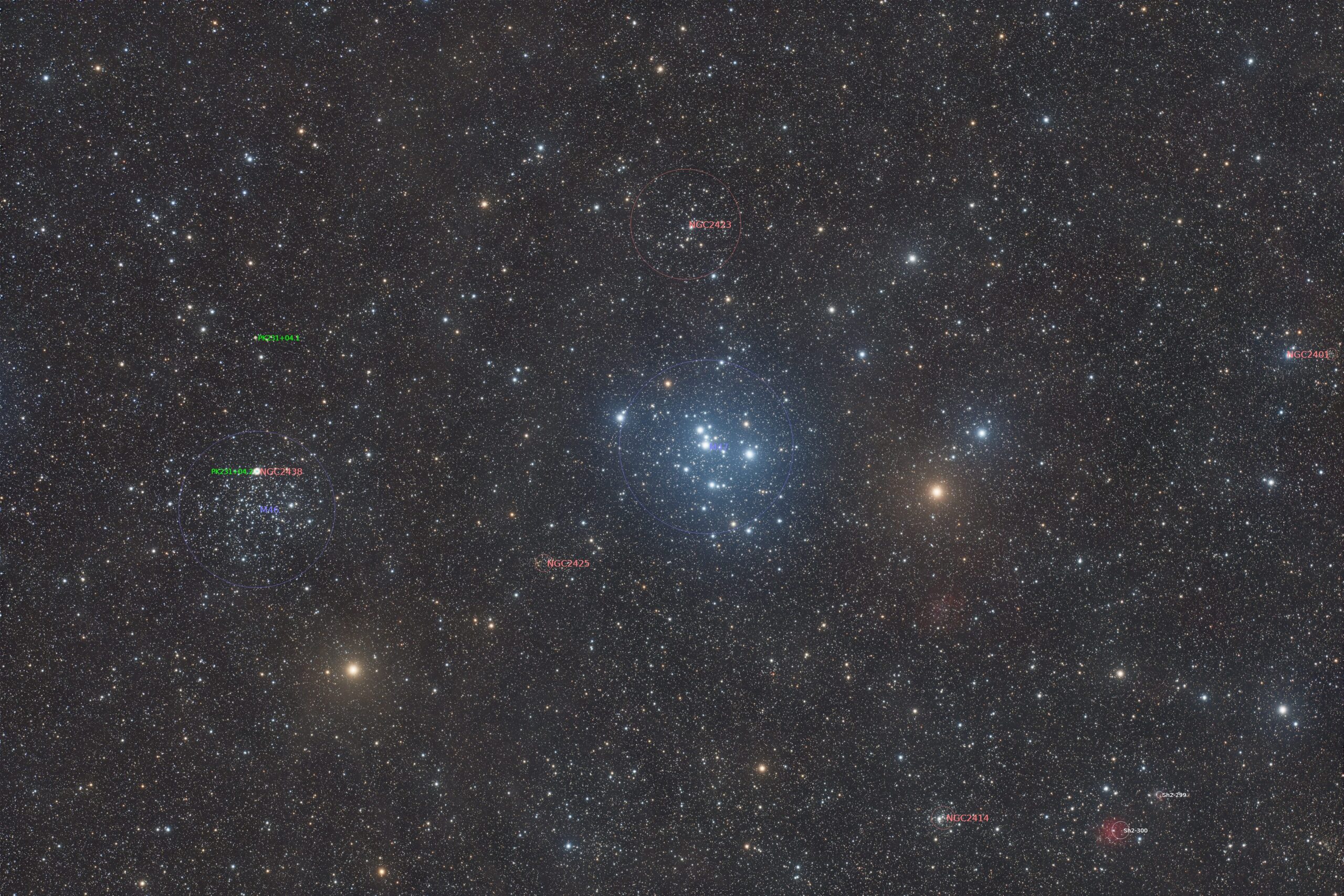
Here is an overview of the used equipment and the exposure times:
- Date: 2025
- Location: Australia
- Telescope/Lense: FSQ 106
- Focal length [mm]: 530
- Focal ratio: 3.6
- Mount: Paramoubt MX+
- Camera: QHY 600M Pro
- Autoguiding: yes
- Filter: L:R:G:B
- Exposure time [min]: 120:120:120:120
- Resolution: 1.46″/px


Leave a reply