

Messier 46 with NGC 2438
Over the years, I have acquired several images of Messier 46 (M46) and its associated planetary nebula NGC 2438, documenting both the evolution of my equipment and the improvements in imaging techniques. The earliest datasets, captured in 2007 and 2008 using a DSLR camera, provided a valuable introduction to deep-sky imaging, despite the inherent limitations in dynamic range, sensitivity, and thermal noise typical of consumer-grade sensors. Nevertheless, these initial observations successfully revealed the open cluster’s dense stellar population and the faint, ghostly outline of the superimposed nebula.
In 2014, I revisited M46 using my first CCD camera, marking a significant step forward in image quality and data depth. The CCD’s enhanced quantum efficiency and superior cooling system allowed for longer, more stable exposures and improved signal-to-noise ratios. The resulting frames displayed finer detail within the cluster and better separation between the nebular emission and the surrounding star field.
The most recent imaging session took place at Astrofarm Tivoli in Namibia, utilizing professional-grade equipment under exceptionally dark and stable skies in the southern hemisphere. These conditions enabled deep integrations across multiple filters, capturing both the intricate internal structures of NGC 2438 and the diverse stellar population of M46 with unprecedented clarity.
This progressive series of observations not only illustrates the technological advancements in amateur and semi-professional astrophotography but also demonstrates how consistent targets can serve as benchmarks for tracking improvements in optical, sensor, and processing performance over time.
Data calibration, image registration, integration, and advanced post-processing of the 2022 image were performed in PixInsight.

Here is an overview of the used equipment and the exposure times:
- Date: September 2022
- Location: Astrofarm Tivoli, Namibia
- Telescope/Lense: 16″ ASA
- Focal length [mm]: 1440
- Focal ratio: 3.6
- Mount: ASA DDM 85
- Camera: Moravian G4 16000
- Autoguiding: yes
- Filter: R:G:B:Hα:[OIII]
- Exposure time [min]: 30:30:30:60:90
- Resolution: 1.29/px
In 2014, I conducted a follow-up imaging session focused exclusively on the Hα (hydrogen-alpha) emission of NGC 2438. Using my first CCD camera, I obtained narrowband data with significantly higher quantum efficiency and improved thermal stability compared to the earlier DSLR system. The resulting Hα frames revealed the nebula’s ionized gas structures in far greater detail, particularly the inner shell morphology and subtle emission gradients.
Subsequently, I combined the monochromatic Hα data from 2014 with the broadband color information from the 2008 dataset. This hybrid processing approach enhanced both the visual depth and scientific accuracy of the composite image—preserving the true color distribution of the stellar field while integrating the high-resolution emission data to emphasize the nebular structure.
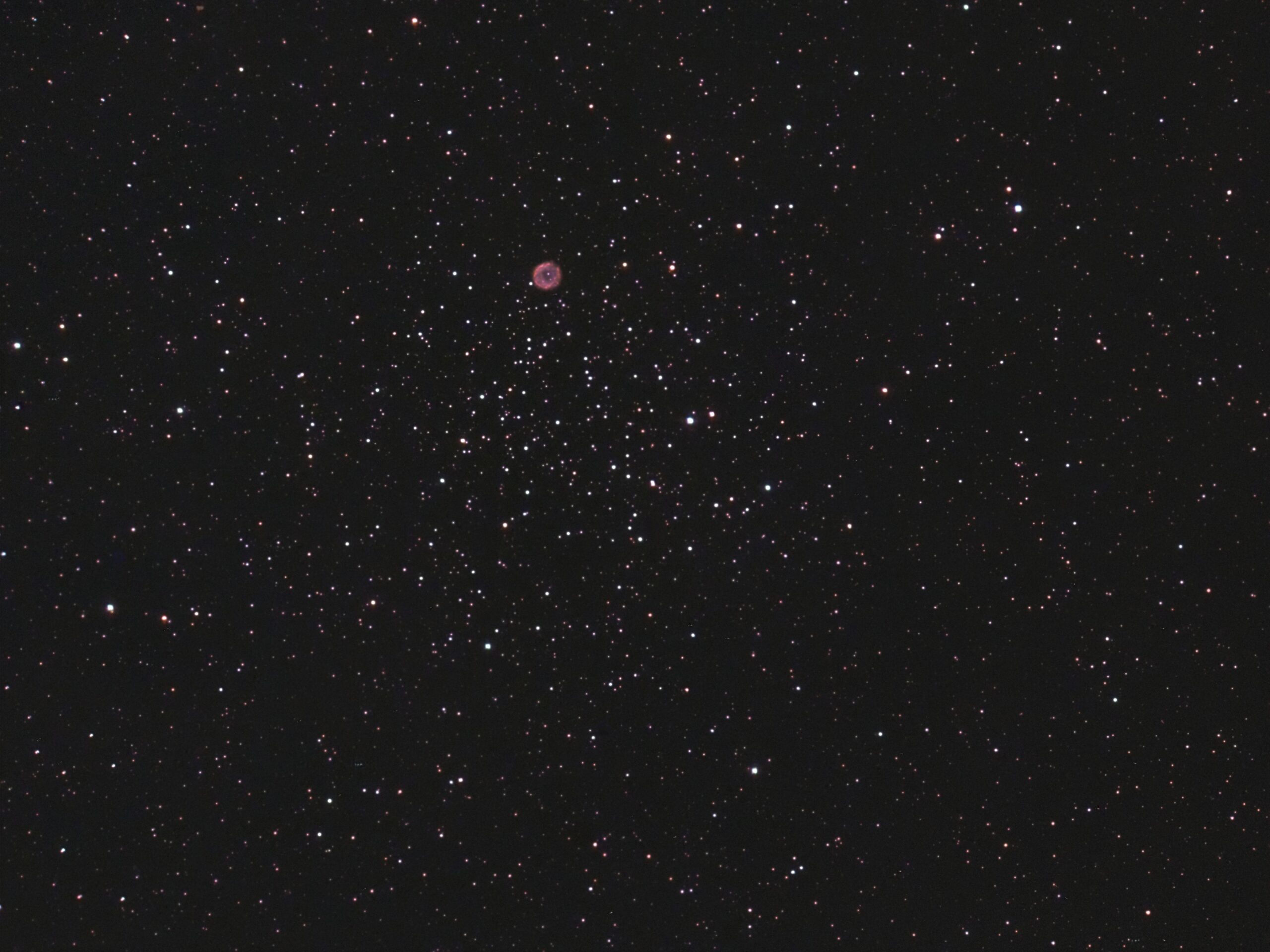
Here is an overview of the used equipment and the exposure times:
- Date: 2014
- Location: Krefeld
- Telescope/Lense: 10″ Newton ohne Namen
- Focal length [mm]: 1000
- Focal ratio: 3.9
- Mount: Losmandy G11
- Camera: Moravian 8300FW
- Autoguiding: yes
- Filter: Hα
- Exposure time [min]: 80
- Resolution: 1.11/px
And now the image from 2008:
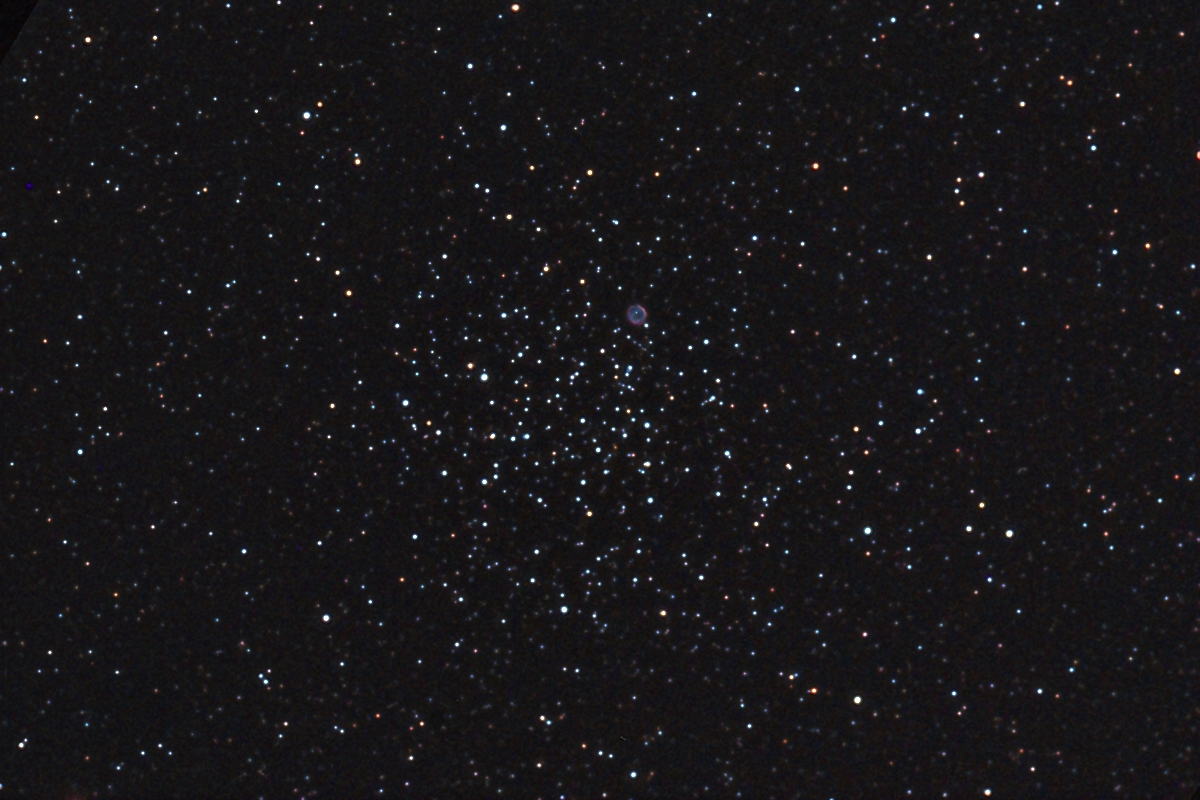
Here is an overview of the used equipment and the exposure times:
- Date: September 2008
- Location: Krefeld
- Telescope/Lense: Pentax 75
- Focal length [mm]: 500
- Focal ratio: 6.7
- Mount: Vixen GP-DX
- Camera: Canon 300Da
- Autoguiding: no
- Filter: OSC
- Exposure time [min]: 15
- Resolution: 3.04/px
And now the image from 2007:
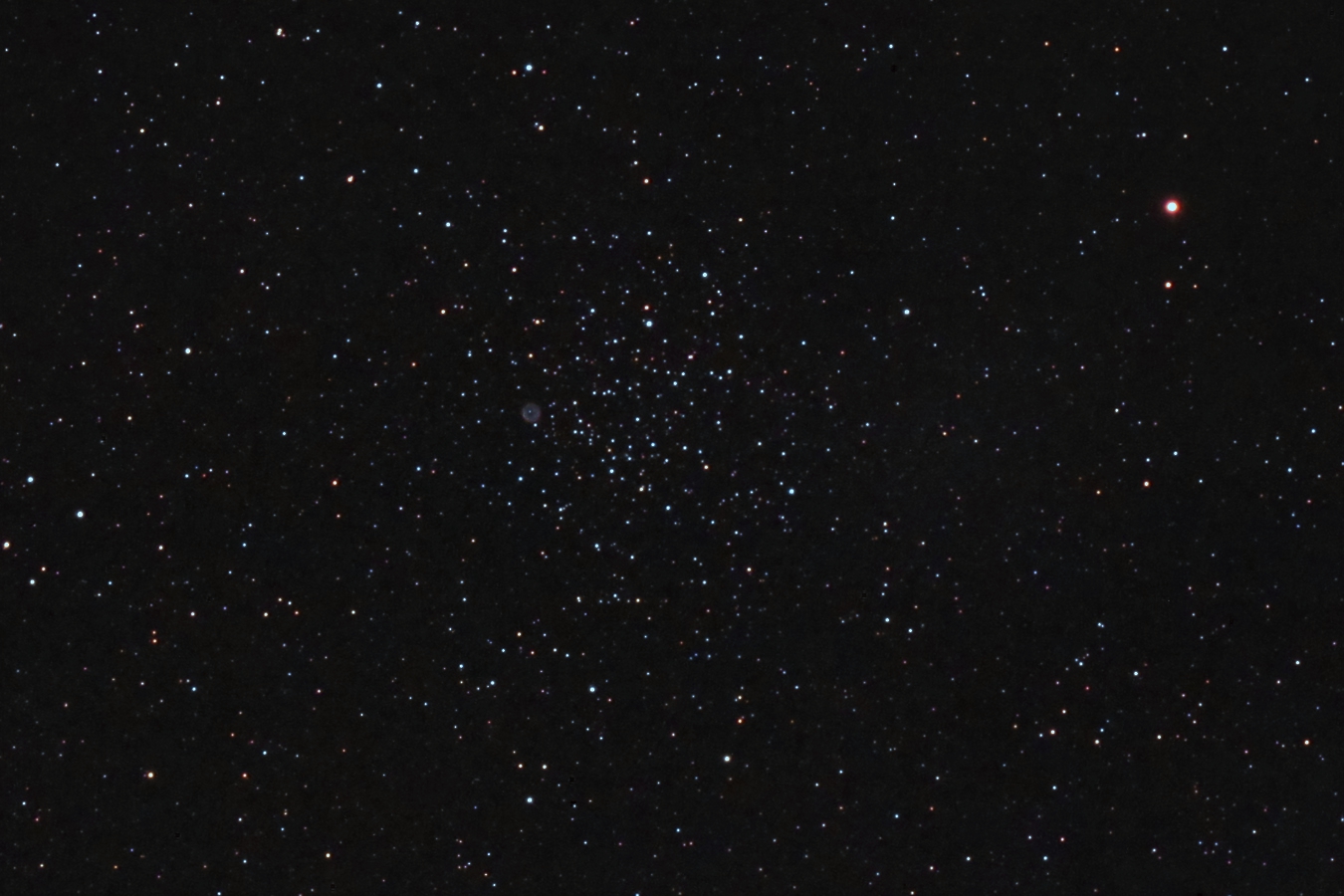
Here is an overview of the used equipment and the exposure times:
- Date: 2007
- Location: Krefeld
- Telescope/Lense: Pentax 75
- Focal length [mm]: 500
- Focal ratio: 6.7
- Mount: Skywatcher Vixen GP-DX
- Camera: Canon 300Da
- Autoguiding: no
- Filter: OSC
- Exposure time [min]: 15
- Resolution: 3.04″/px


Leave a reply