

IC 1848 (Soul Nebula)
I have imaged IC 1848, better known as the Soul Nebula, several times over the years. On two occasions, I concentrated specifically on the Soul Nebula itself, while on two further occasions I photographed it together with its spectacular neighbour, IC 1805, the Heart Nebula, creating a much wider view of this rich region of the constellation Cassiopeia.
In 2026, I returned once again to IC 1848, the Soul Nebula, this time using my Smart Telescope. Seven years earlier, in 2019, I had received a high-quality dataset of the same object from the Deep Sky West (DSW) Observatory in New Mexico.
In 2014 and again in 2019, I photographed both IC 1805, the Heart Nebula, and IC 1848, the Soul Nebula, using my mobile astrophotography equipment during holidays in the Haute-Provence region of southern France.
IC 1848 is the Soul Nebula, a huge emission nebula and star-forming region in Cassiopeia, about 6,500–7,500 light-years from Earth. It is often imaged together with its close neighbor, the Heart Nebula (IC 1805), and the pair is popularly called “Heart and Soul”.
IC 1848 is an H II region: a vast cloud of ionized hydrogen glowing red because of the intense ultraviolet radiation from young, massive stars embedded in it. The nebula is also known as Sharpless 2-199, LBN 667, and Westerhout 5 (W5). Strictly speaking, the IC 1848 designation refers to the central open cluster, but in practice the name is used for the entire nebula.
The Soul spans roughly 100–300 light-years across, depending on how its faint outer edges are defined, and covers about 2 degrees on the sky—roughly four times the apparent diameter of the full Moon. It lies in the Perseus Arm of the Milky Way and is part of the larger Cas OB6 association, a sprawling complex of gas, dust, and massive O and B stars.
The Soul Nebula is a very active stellar nursery. The central cluster, IC 1848, formed only about 1 million years ago from the nebula’s own gas and dust. It contains dozens of young stellar objects and several small open clusters, including Collinder 34, 632, and 634, which are embedded in the bright “head” and “body” of the nebula.
The most massive stars in the region are O-type giants, including the multiple system HD 17505, which consists of several O6–O8 stars. Their fierce radiation and powerful stellar winds are carving huge cavities and bubbles in the surrounding cloud, creating the Soul’s characteristic evacuated regions and bright rims.
Within the nebula are towering pillars of gas and dust, each about 10 light-years tall, with new stars forming at their tips. Infrared studies show a gradient of young stellar objects increasing from the outer rim toward the center of the molecular cloud, consistent with triggered star formation driven by the expanding bubbles.
IC 1848 lies only about 2.5 degrees from IC 1805, the Heart Nebula, and the two are physically connected by bridges of gas and dust. Both belong to the same giant star-forming complex in Cas OB6 and are illuminated by stars that are only about a million years old. That makes the Heart and Soul a single, enormous region of recent and ongoing star formation, even though they are cataloged separately.
Visually, the Soul Nebula is challenging because its light is spread over a large area, giving it a low surface brightness despite an integrated magnitude around 6.5. Under dark skies it can be glimpsed with binoculars as a faint haze, but it is primarily an imaging target. Narrowband filters that isolate hydrogen-alpha and oxygen emission bring out the intricate filaments, bright rims, and dark lanes that define its shape.
In images, the Soul often appears as a ghostly, heart-shaped or embryo-like glow dotted with bright clusters and dark pillars. Its proximity to the Heart Nebula makes it a favorite for wide-field mosaics that capture both objects in a single frame.
For the 2026 data the calibration and registration and the final processing was done with PixInsight. The result was as follows:
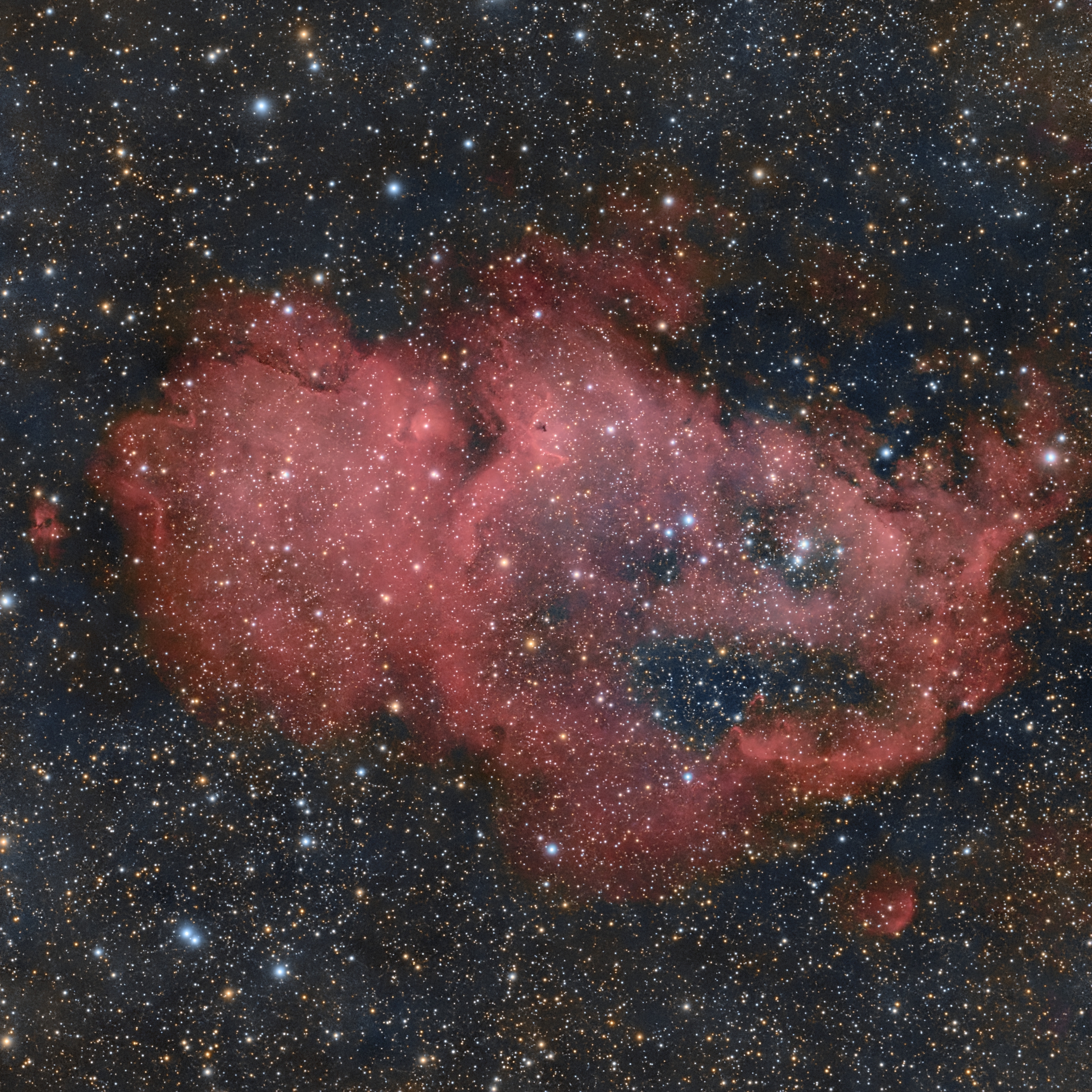
The images were taken with the following equipment:
- Date: 2026
- Location: Varel, Germany
- Telescope: Seestar S30 Pro
- Focal length [mm]: 160
- Focal ratio: 5.3
- Mount: EQ Mode
- Camera: Seestar Tele
- Filter: OSC (LP)
- Exposure time [min]: 191
- Resolution: 3.67″/px
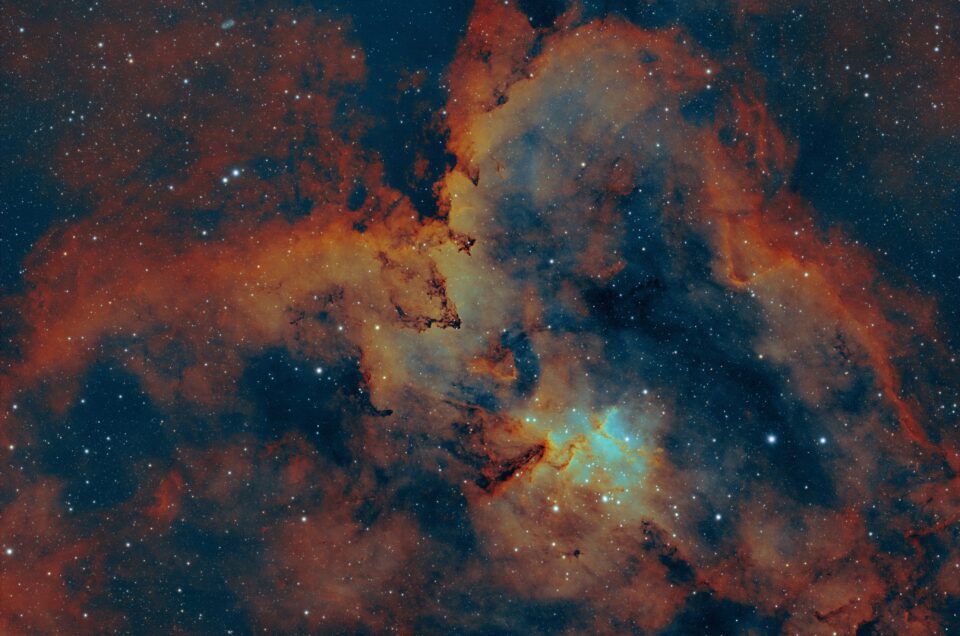
For theDSW data the calibration and registration and the final processing was done with PixInsight. First I created an image in the Hubble palette:
The [SII] data was assigned to the red channel, the Hα data to the green channel and the [OIII] data to the blue channel.
The result was as follows:

Then I created also a bicolor image:
For the nebula I assigned the Hα data to the red channel and the [OIII] data to the green and blue channel. For the stars I assigned the Hα data to the red channel, 50% of Hα and 50% of [OIII] to the green channel and [OIII] to the blue channel.
The result was as follows:

The images were taken with the following equipment:
- Date: 2019
- Location: Rowe, New Mexico
- Telescope: Takahashi FSQ-106
- Focal length [mm]: 530
- Focal ratio: 5
- Mount: Paramount MyT
- Camera: QSI 683-WSG-8
- Filter: Hα:[OIII]:[SII]
- Exposure time [min]: 900:540:960
- Resolution: 2.08″/px
I also imaged these two nebulae in 2019 during my holiday in Banon, France with my mobile equipment.
Data calibration and registration and the final processing was done with PixInsight. The result was as follows:
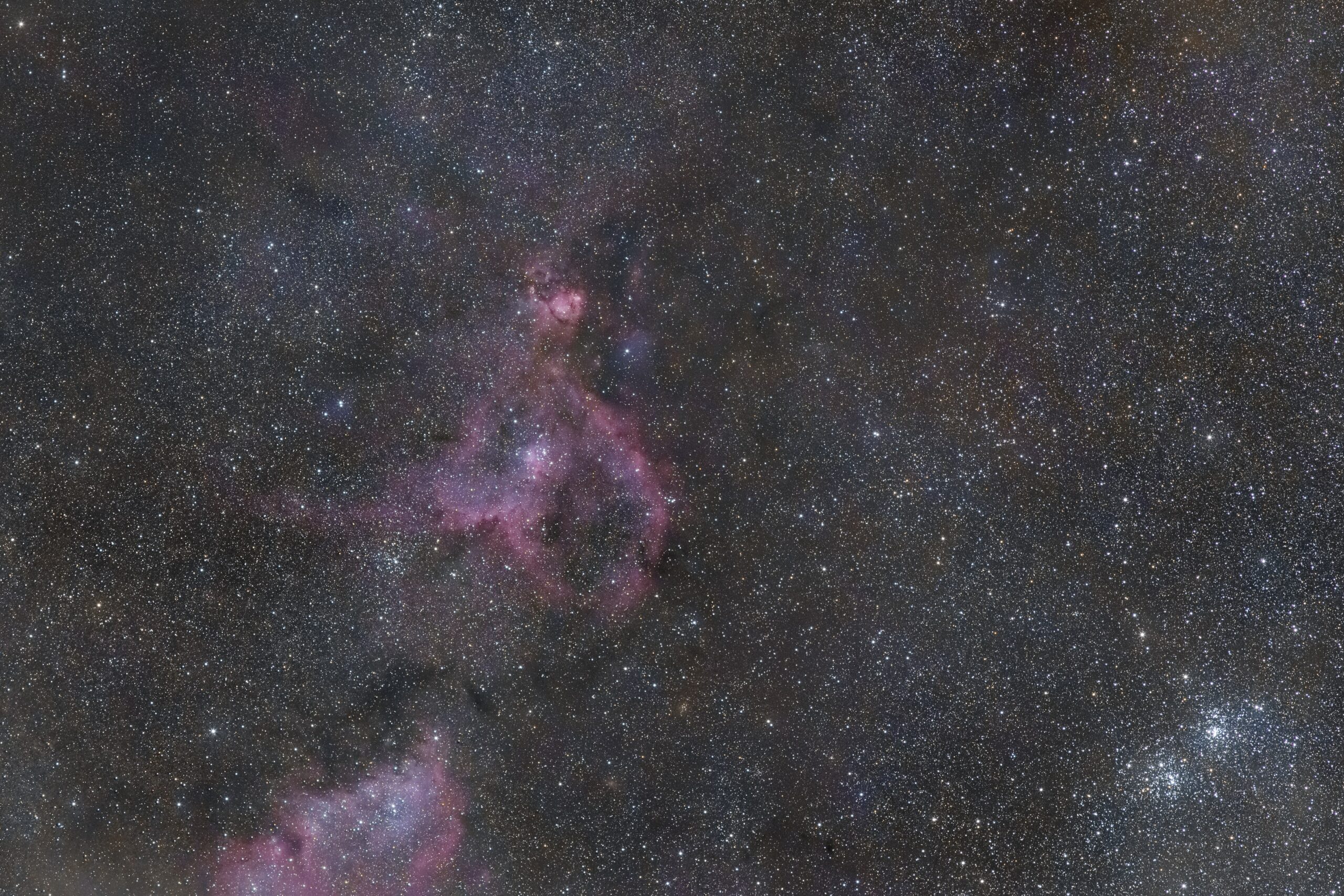
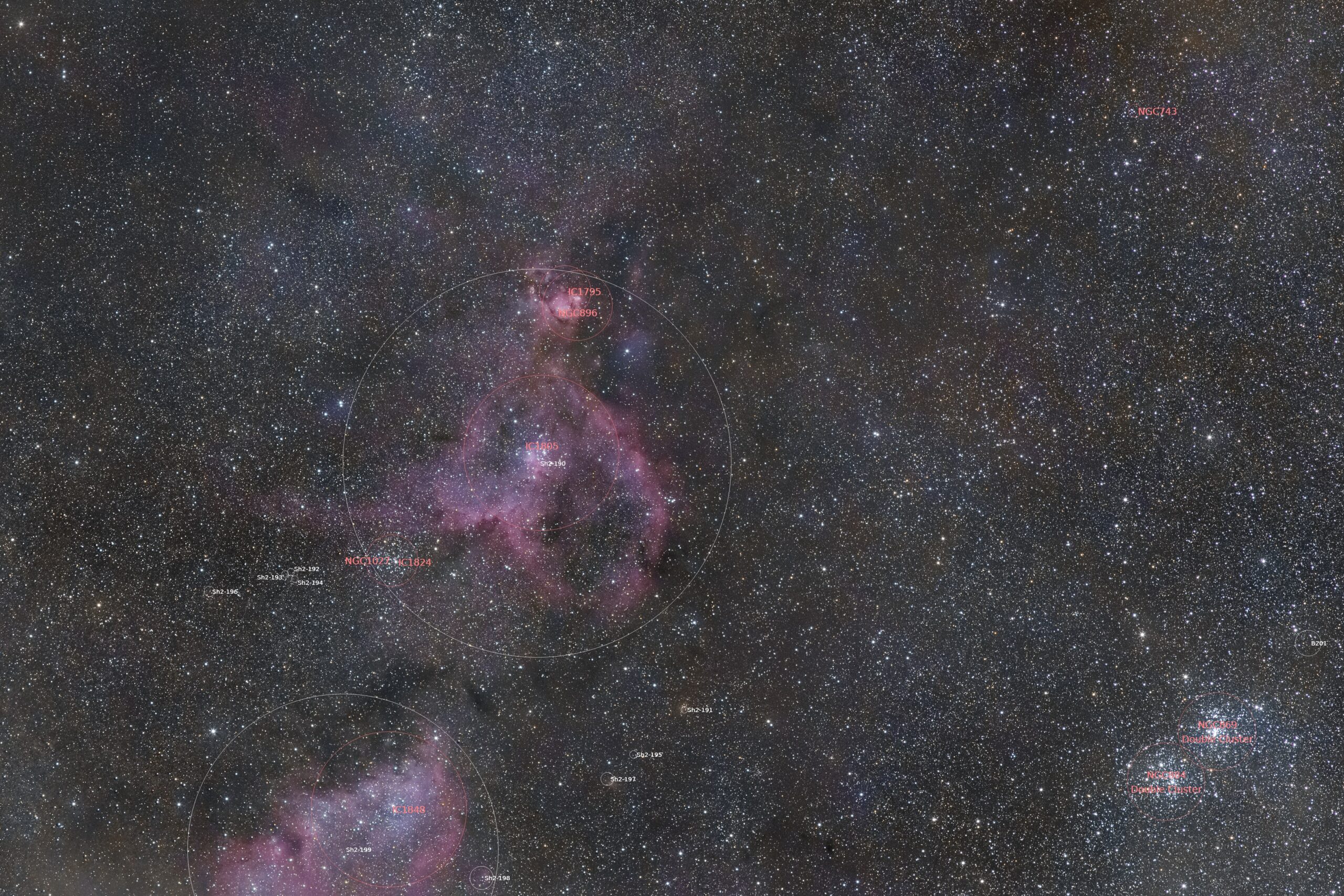
The images were taken with the following equipment:
- Date: 2019
- Location: Banon, France
- Telescope: Canon 200mm lens
- Focal length [mm]: 195
- Focal ratio: 4
- Mount: Skywatcher NEQ6
- Camera: Canon 6D
- Filter: OSC
- Exposure time [min]: 177
- Resolution: 6.92″/px
Five years ago, in 2014, I also imaged these two nebulae during my holiday in Banon, France with my mobile equipment.
Data calibration and registration and the final processing was done with PixInsight. The result was as follows:
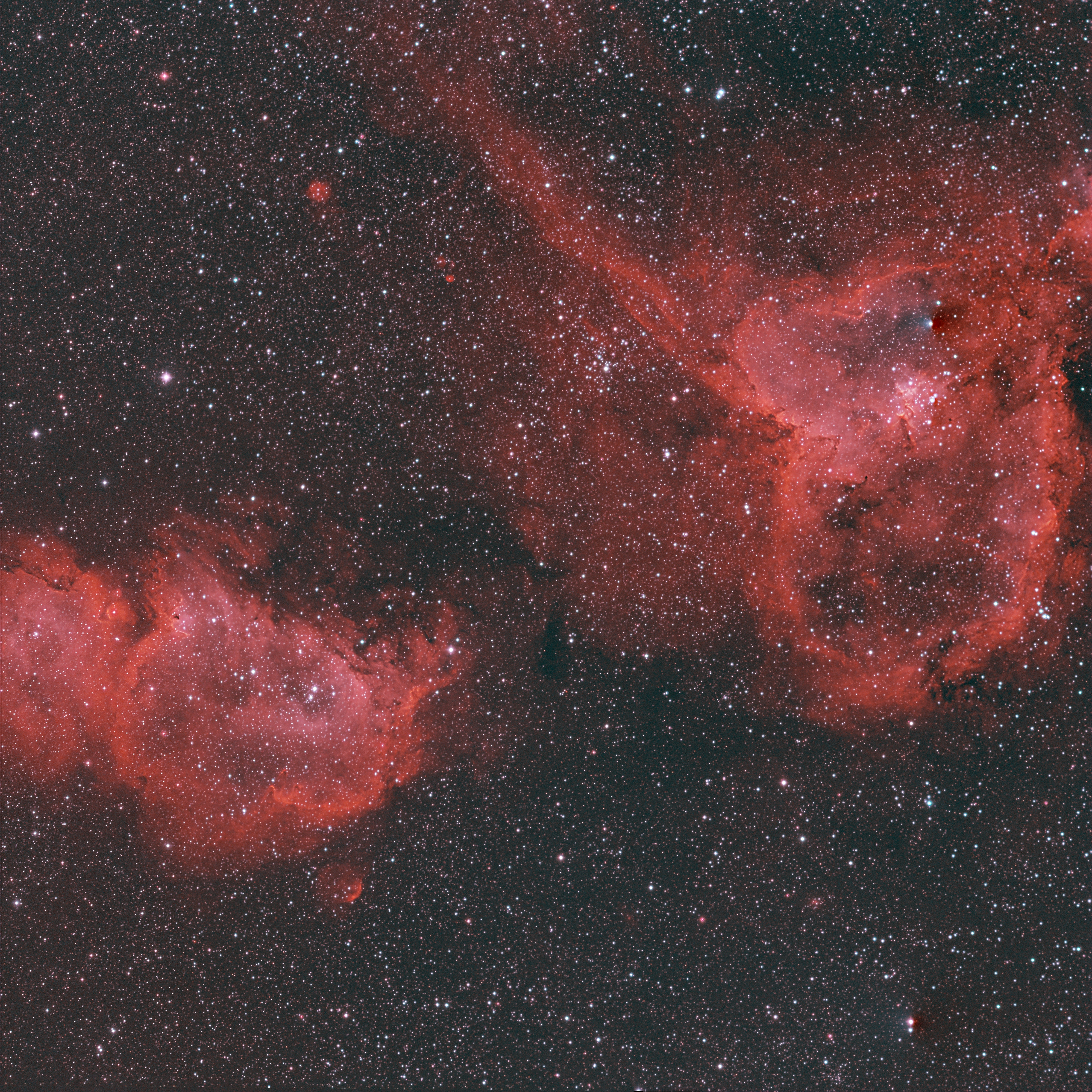
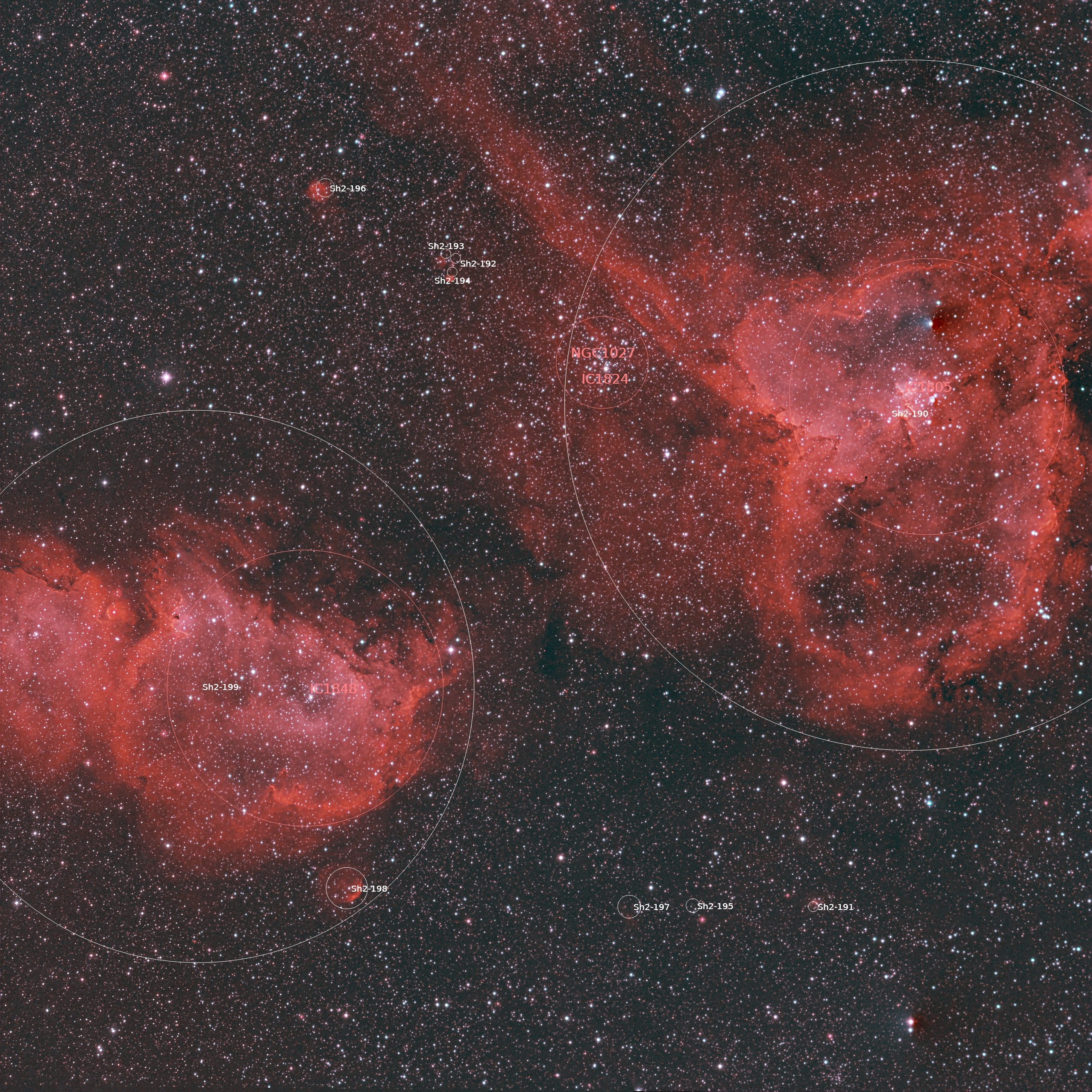
The images were taken with the following equipment:
- Date: 2014
- Location: Banon, France
- Telescope: Canon 200mm lens
- Focal length [mm]: 200
- Focal ratio: 4
- Mount: Skywatcher NEQ6
- Camera: Moravian FW8300 and Canon 500Da
- Filter: OSC:Hα:[OIII]
- Exposure time [min]: 234:200:200
- Resolution: 5.57″/px



Leave a reply