

The Hyades from Hohenwoos
During our holiday in Hohenwoos, Germany, in 2019, I brought along my portable astrophotography equipment to take advantage of the comparatively dark rural skies. Although much simpler than my permanent observatory setup, the mobile equipment was ideally suited for wide-field imaging of the rich winter Milky Way. One of the images I captured was a wide-field view centered on the Hyades, including the remarkable reflection nebula NGC 1555 as well as the open clusters NGC 1647 and NGC 1746, all located in the constellation Taurus.
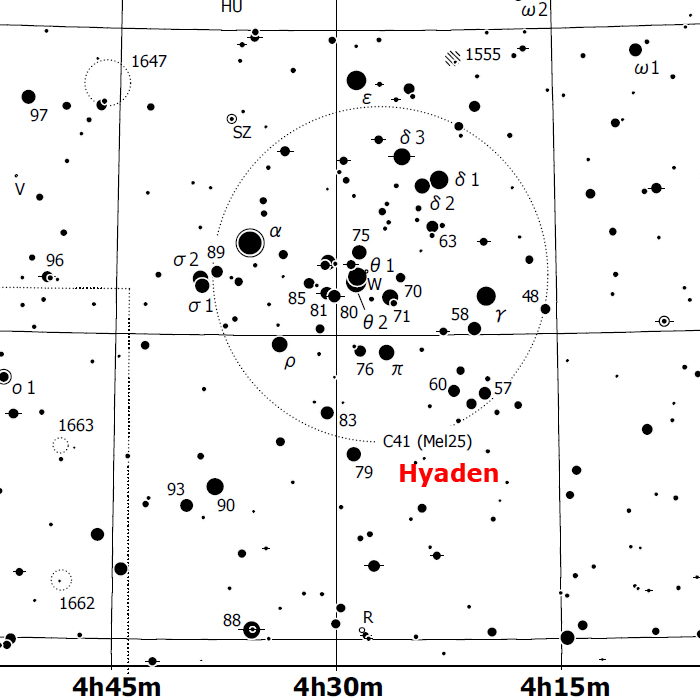
The Hyades are the nearest open star cluster to Earth, lying at a distance of approximately 153 light-years. With an age of about 625 million years, they represent one of the best-studied stellar clusters in the sky and serve as an important benchmark for stellar evolution. Because of their proximity, the cluster spans more than five degrees, making it an ideal target for wide-field photography. The familiar V-shaped pattern forms the head of Taurus, although the bright orange giant Aldebaran, which appears to belong to the cluster, is actually a foreground star located less than half the distance away.
One of the most fascinating objects in the field is Hind’s Variable Nebula (NGC 1555), a rare reflection nebula illuminated by the young variable star T Tauri. The nebula was discovered in 1852 by the English astronomer John Russell Hind and is famous for its changing appearance. Variations in brightness are thought to result from changing clouds of dust close to T Tauri, which alternately illuminate or obscure different parts of the surrounding nebula. As the prototype of the T Tauri stars, this young stellar object represents one of the earliest stages of solar-type stellar evolution and is still actively accreting material from its surrounding disk.
The image also includes NGC 1647, a beautiful open cluster located approximately 1,800 light-years from Earth. It contains around one hundred stars and is estimated to be about 150 million years old. The cluster stands out against the rich background of the Milky Way and provides an attractive contrast to the much nearer Hyades. Its relatively loose stellar distribution makes it an excellent object for wide-field imaging.
Another interesting object in the field is NGC 1746. Modern observations suggest that this object is probably not a true open cluster, but rather an asterism—a chance alignment of unrelated stars along our line of sight. Nevertheless, it remains listed in the New General Catalogue and continues to be an interesting historical object for observers and astrophotographers alike.
The entire field beautifully illustrates the diversity of the winter sky. Within a single image, it is possible to observe nearby stars of the Hyades, a young stellar object still embedded in its natal dust cloud, a genuine distant open cluster, and a historical asterism. Together they demonstrate the enormous range of distances and evolutionary stages represented in a seemingly small area of the night sky.
This image remains one of my favorite wide-field photographs from our holiday in Hohenwoos. It demonstrates that even a portable astrophotography setup can produce scientifically interesting and aesthetically pleasing results, capturing not only the beauty of the Hyades but also several lesser-known deep-sky objects that enrich this remarkable region of Taurus.
The Raw data conversion was done with Adobe Lightroom, the registration and the final processing was done with PixInsight. The result was as follows:
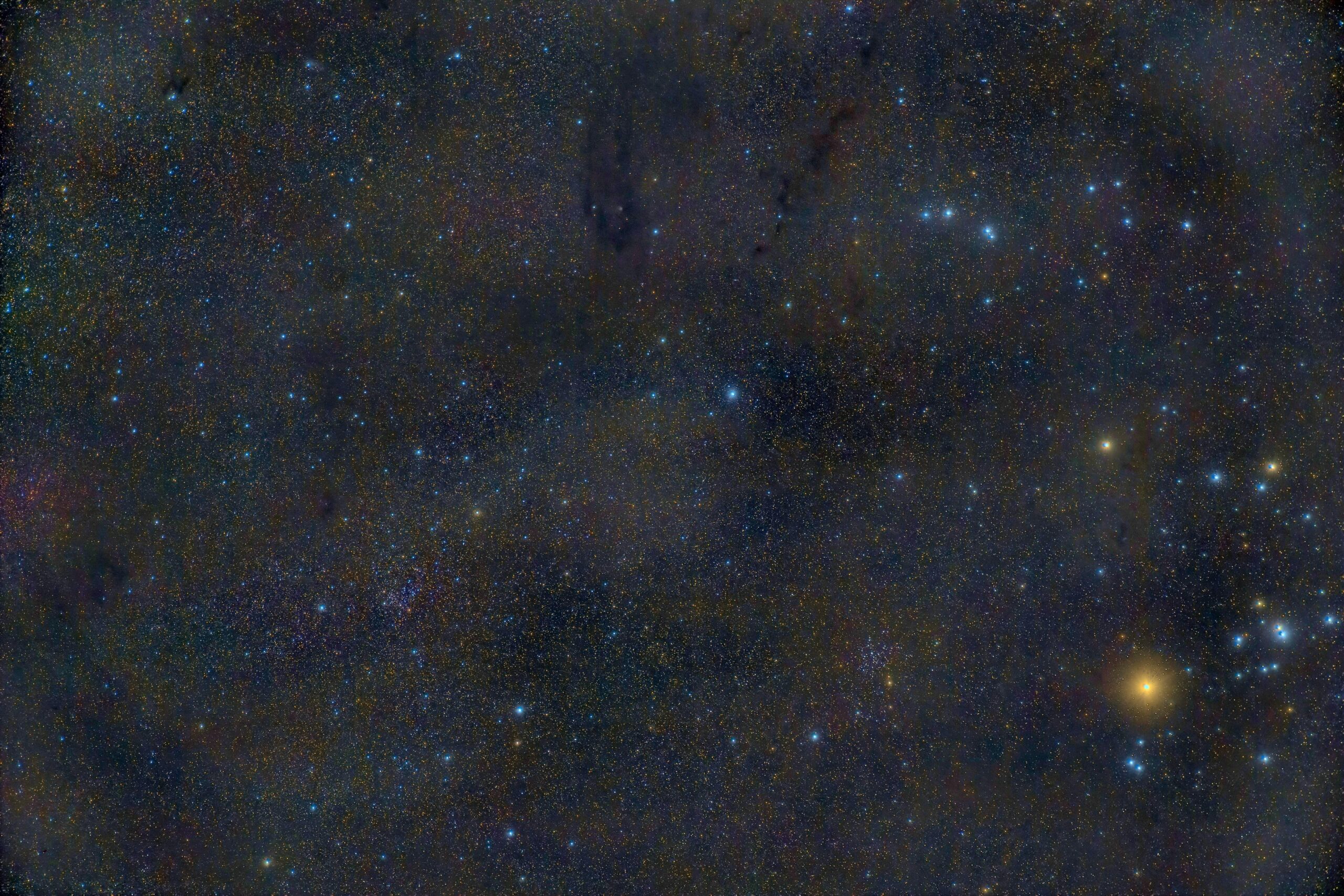

Here is an overview of the used equipment and the exposure time:
- Date: 23.09.2019
- Location: Hohenwoos, Germany
- Telescope/Lense: Canon 24-105
- Focal length [mm]: 105
- Focal ratio: 4
- Mount: Skywatcher Star Adventurer
- Camera: Canon 6D
- Filter: OSC
- Exposure time [min]: 168 at 1600 ISO
- Resolution: 12.77″/px


Leave a reply