• Home
  • Blog
  • Astrophotography
    • Deep Sky
      • Galaxies (Galaxien)
      • Nebulae (Nebel)
      • Planetary Nebulae (Planetarische Nebel)
      • Globular Clusters (Kugelsternhaufen)
      • Open Clusters (Offene Sternhaufen)
      • Miscellaneous (Verschiedenes)
    • Solar System (Sonnensystem)
      • Comets (Kometen)
      • Sun (Sonne)
      • Moon (Mond)
      • Mars
      • Jupiter
      • Saturn
      • Other Planets ( Andere Planeten)
  • Archiv

    • Juli 2026
    • Juni 2026
    • Mai 2026
    • April 2026
    • Februar 2026
    • Januar 2026
    • Dezember 2025
    • November 2025
    • Oktober 2025
    • September 2025
    • August 2025
    • Juli 2025
    • Juni 2025
    • Mai 2025
    • April 2025
    • März 2025
    • Januar 2025
    • Dezember 2024
    • November 2024
    • Oktober 2024
    • September 2024
    • August 2024
    • Juli 2024
    • Juni 2024
    • Mai 2024
    • April 2024
    • März 2024
    • Februar 2024
    • Januar 2024
    • November 2023
    • Oktober 2023
    • September 2023
    • August 2023
    • Juli 2023
    • Juni 2023
    • Mai 2023
    • April 2023
    • März 2023
    • Februar 2023
    • Januar 2023
    • Dezember 2022
    • November 2022
    • Oktober 2022
    • September 2022
    • August 2022
    • Juli 2022
    • Juni 2022
    • Mai 2022
    • April 2022
    • März 2022
    • Februar 2022
    • Januar 2022
    • Dezember 2021
    • November 2021
    • September 2021
    • August 2021
    • Juli 2021
    • März 2021
    • Februar 2021
    • November 2020
    • September 2020
    • August 2020
    • April 2020
    • März 2020
    • Februar 2020
    • Januar 2020
    • Dezember 2019
    • November 2019
    • Oktober 2019
    • September 2019
    • August 2019
    • Mai 2019
    • April 2019
    • März 2019
    • Dezember 2018
    • November 2018
    • Oktober 2018
    • September 2018
    • Juni 2018
    • Mai 2018
    • April 2018
    • März 2018
    • Februar 2018
    • Januar 2018
    • Oktober 2017
    • Juli 2017
    • Juni 2017
    • März 2017
    • Januar 2017
    • Dezember 2016
    • September 2016
    • Mai 2016
    • März 2016
    • November 2015
    • Oktober 2015
    • Juli 2015
    • Mai 2015
    • März 2015
    • Februar 2015
    • September 2014
    • August 2014
    • März 2014
    • Februar 2014
    • Oktober 2013
    • September 2013
    • August 2013
    • April 2013
    • März 2013
    • November 2012
    • August 2012
    • Juli 2012
    • Mai 2012
    • März 2012
    • Januar 2012
    • November 2011
    • Oktober 2011
    • September 2011
    • August 2011
    • April 2011
    • März 2011
    • Oktober 2010
    • September 2010
    • August 2010
    • Juli 2010
    • April 2010
    • Juli 2009
    • Juli 2008
    • Januar 2008
    • Oktober 2007
    • Juli 2007
    • März 2007
    • Februar 2007
    • Juni 2006
    • Oktober 2005
    • September 2005
    • August 2005
    • Januar 2005
  • Kategorien

    • Asterism
    • Astrophotography
    • Barnard
    • Comet
    • Galaxies
    • Globular Cluster
    • IC
    • Messier
    • Moon
    • Nebula
    • NGC
    • Open cluster
    • Photography
    • Planetary Nebula
    • Travel
  • Meta

    • Anmelden
    • Eintrags-Feed
    • Kommentar-Feed
    • WordPress.org
  • Privacy Policy
  • Impressum
  • Haftungsausschluss
  • Cookie-Richtlinie
  • Datenschutzerklärung

wonderfuluniverse.de
  • Home
  • Blog
  • Astrophotography
    • Deep Sky
      • Galaxies (Galaxien)
      • Nebulae (Nebel)
      • Planetary Nebulae (Planetarische Nebel)
      • Globular Clusters (Kugelsternhaufen)
      • Open Clusters (Offene Sternhaufen)
      • Miscellaneous (Verschiedenes)
    • Solar System (Sonnensystem)
      • Comets (Kometen)
      • Sun (Sonne)
      • Moon (Mond)
      • Mars
      • Jupiter
      • Saturn
      • Other Planets ( Andere Planeten)

NGC 3675 from remote


In 2017, I received a high-quality dataset of the spiral galaxy NGC 3675 from Telescope Live, acquired with a telescope in the USA. The excellent observing conditions provided very clean and deep data, ideal for capturing the fine details of this remarkable object.

NGC 3675 is a spiral galaxy in the constellation Ursa Major, about 35–55 million light-years from Earth, and a member of the Ursa Major Cluster within the Virgo Supercluster. It was discovered by William Herschel on 14 January 1788 and is one of the brighter, more structured spirals in that part of the sky.

NGC 3675 is classified as type Sb or SA(s)b, meaning it is a spiral with a fairly prominent bulge and moderately wound arms, and no strong bar. Its apparent size is roughly 6 × 3 arcminutes for the main disk, with fainter outer regions extending to about 8–9 arcminutes. At a distance of around 35–55 million light-years, that translates into a physical diameter of roughly 90,000–100,000 light-years, so it is comparable in size to the Milky Way.

Visually, the galaxy is described as “very bright, considerably large, very much extended” with a “very suddenly much brighter middle and nucleus”. In images, it shows a bright central bulge surrounded by a fainter elliptical disk and patchy, filamentary spiral arms. Some sources call it a flocculent spiral, meaning its arms are not grand, continuous arcs but rather broken, woolly segments.

One of the most interesting features of NGC 3675 is its nucleus. It hosts a low-ionization nuclear emission-line region (LINER), a type of weak active galactic nucleus powered by a supermassive black hole. Hubble-based measurements of the central velocity dispersion imply a black hole mass of roughly 10–39 million solar masses. That is not a quasar-level monster, but it is enough to produce detectable emission lines and influence the innermost gas.

The galaxy is also classified as an H II/LINER type, meaning it has both star-formation-related emission and a low-level AGN signature. That combination makes it scientifically useful for studying how star formation and nuclear activity coexist in spiral galaxies.

NGC 3675 has a fairly complex structure. About 20% of its total mass is in the nuclear bulge, and the disk is inclined by roughly 67° to our line of sight. The galaxy features two ring structures, with diameters of about 1.62 and 2.42 arcminutes, and tightly wound spiral arms that form an inner pseudoring before continuing for roughly one revolution outside that ring. The outer arms are described as very patchy and filamentary, consistent with its flocculent classification.

Infrared images once suggested a strong bar, but later observations have not confirmed a clear bar structure, so it is usually treated as an unbarred or very weakly barred spiral.

One supernova has been observed in NGC 3675: SN 1984R, discovered by Kaoru Ikeya on 2 December 1984. Its type is listed as unknown in most summaries, with a peak magnitude around 13. The presence of a supernova confirms that the galaxy is still forming massive stars, even though its overall appearance is dominated by an older stellar population in the bulge and inner disk.

For amateur astronomers, NGC 3675 is a rewarding but somewhat under-imaged target. With a visual magnitude around 10.0–10.2, it is accessible to moderate telescopes under dark skies. Observers describe it as large and quite bright, with a bright center and a fainter elongated disk, and sometimes note two moderately bright stars near the southern end of the disk. Its flocculent arms are subtle, so larger apertures and good contrast help reveal the spiral structure.

Data calibration, regitration and the final processing were all performed with PixInsight. The result was as follows:
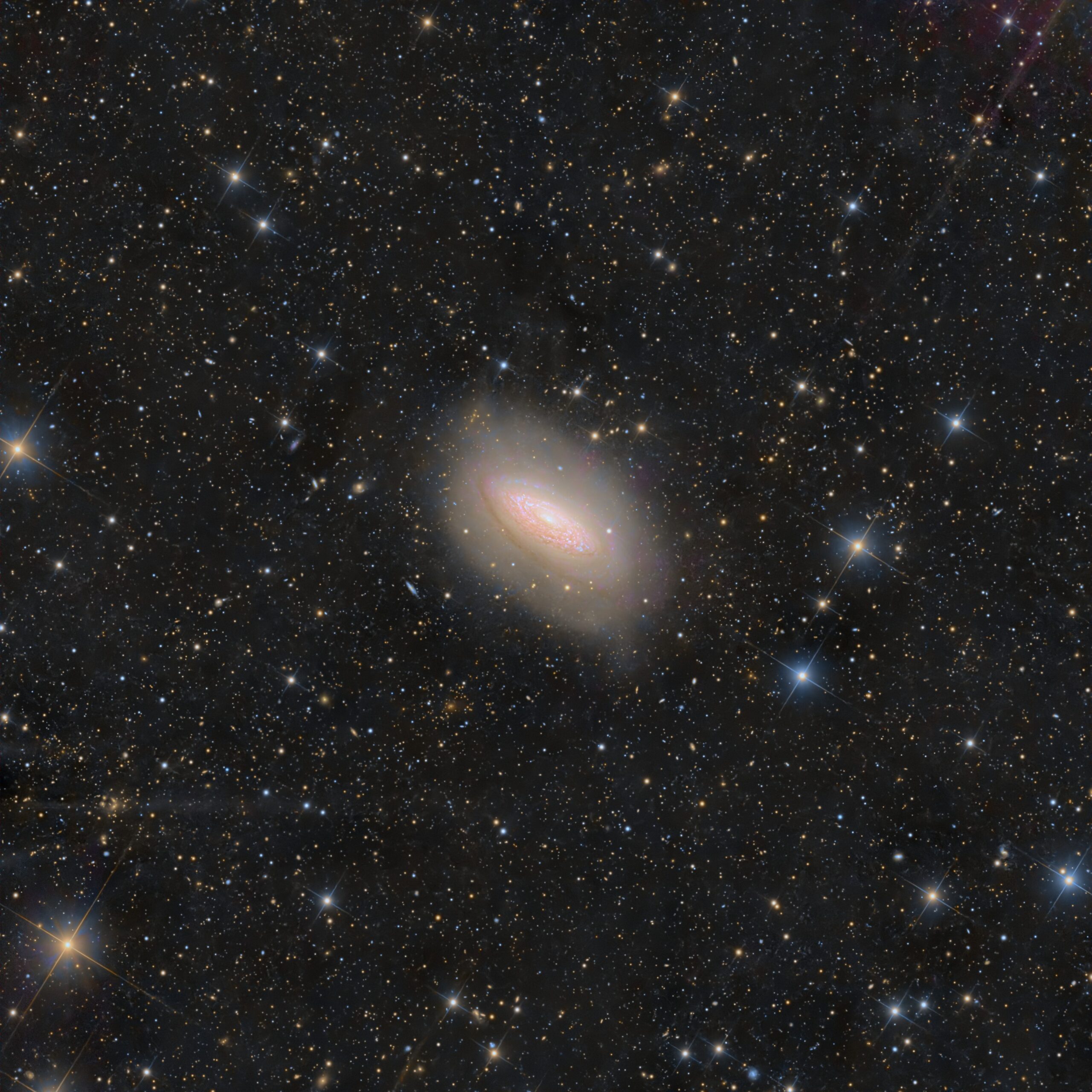
NGC 3675, Telescope Live, USA, 2017
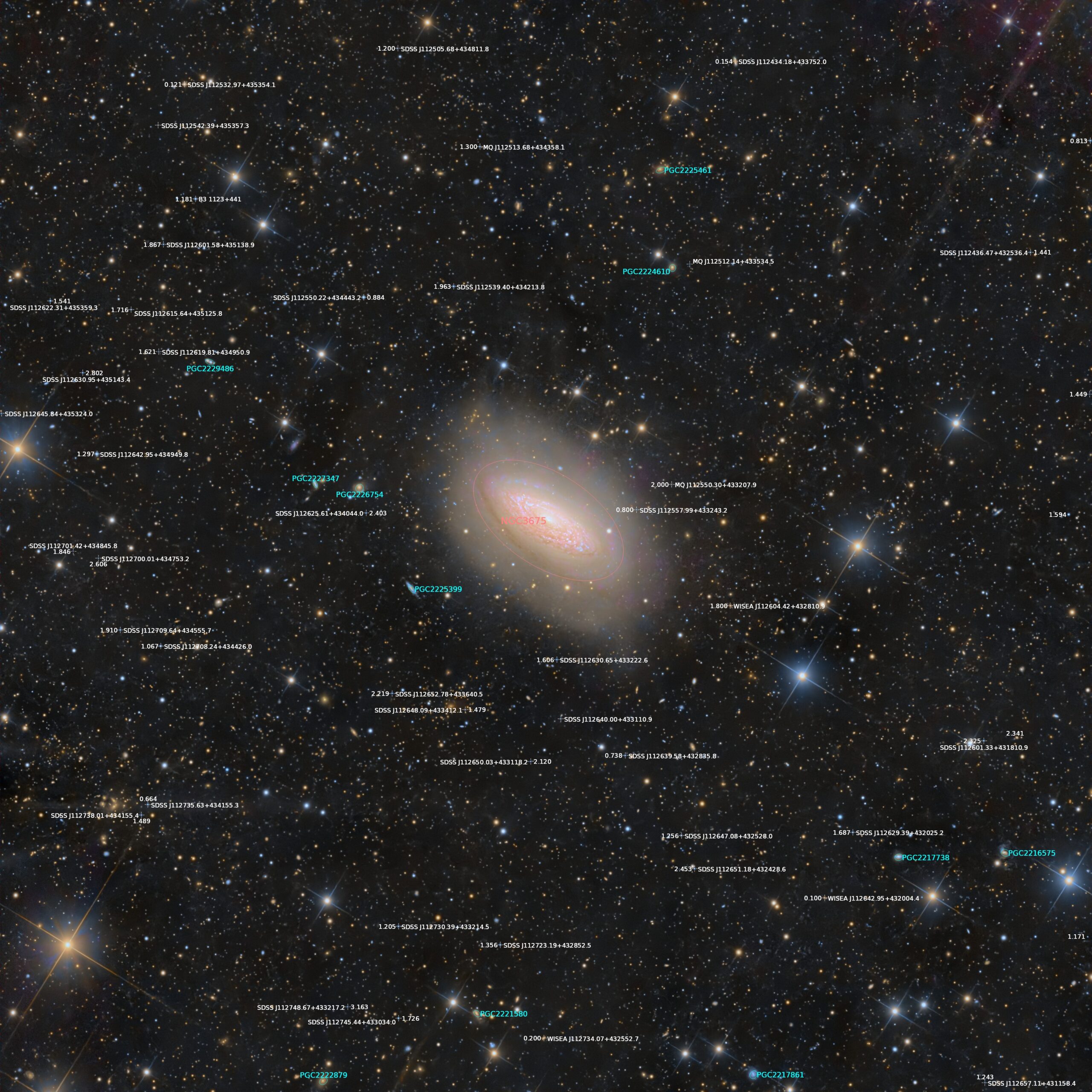
NGC 3675 annotated
NGC 3675 annotated

The image also reveals a remarkable number of distant quasars scattered throughout the background field. The most distant identified object is SDSS J112748.67+433217.2, with a measured redshift of z = 3.163. Its light has travelled for more than 11.5 billion years before reaching Earth, allowing us to observe this quasar as it appeared when the Universe was only around 2.1 billion years old.


The images were taken with the following equipment:

  • Date: 2017
  • Location: USA
  • Telescope/Lens: Planwave CDK17
  • Focal length [mm]: 2924
  • Focal ratio: 6.8
  • Mount: Paramount ME
  • Camera: FLI Proline 16803
  • Filter: L:R:G:B
  • Exposure time [min]: 580:180:180:165
  • Resolution: 0.64″/px


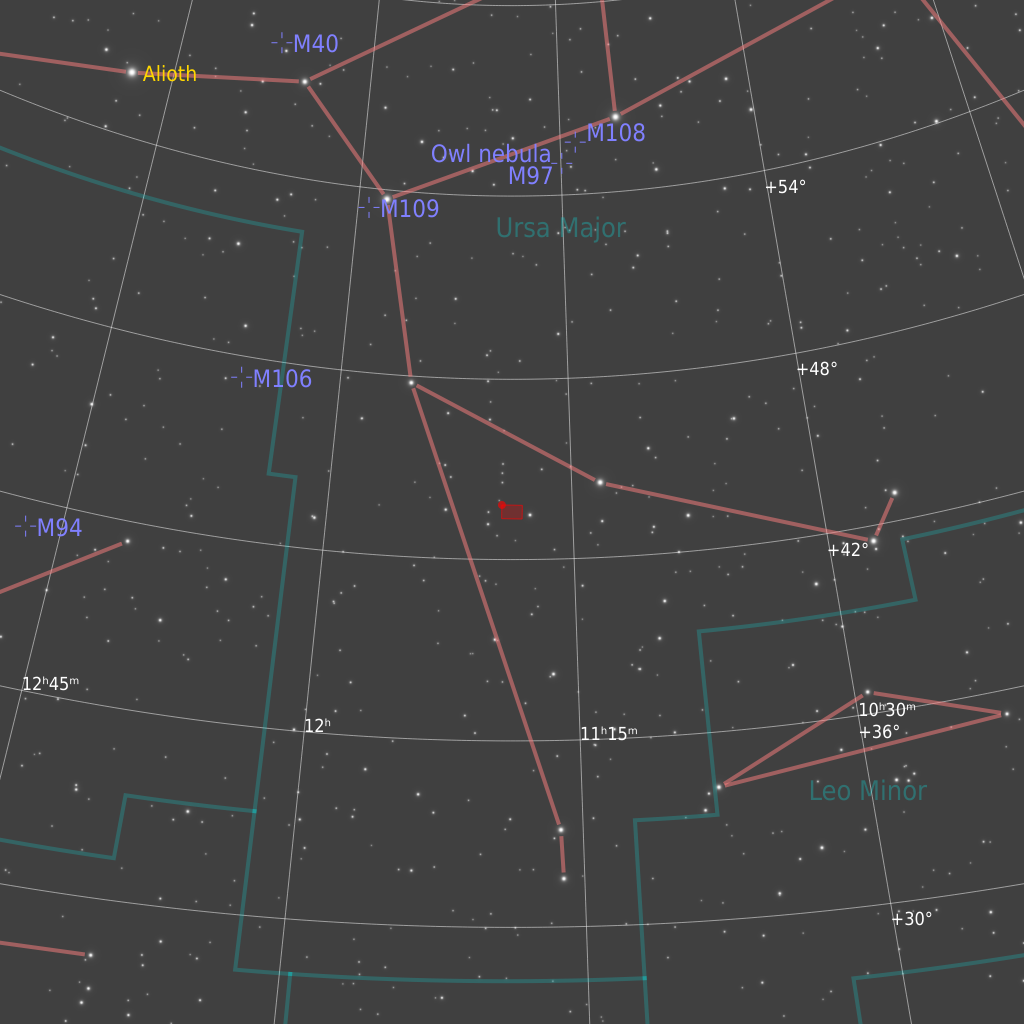
NGC 3675 Finder Chart


Stephan Küppers


You might also like
IC 1318
15. Juli 2026
NGC 7000 with IC 5070
24. Juni 2026
Sh2-129, Outters 4
29. Mai 2026

Leave a reply

Schreibe einen Kommentar Antwort abbrechen

Deine E-Mail-Adresse wird nicht veröffentlicht. Erforderliche Felder sind mit * markiert


© Stephan Küppers 2020-2026

Cookie-Zustimmung verwalten
Wir verwenden Cookies, um unsere Website und unseren Service zu optimieren.
Funktional Immer aktiv
Die technische Speicherung oder der Zugang ist unbedingt erforderlich für den rechtmäßigen Zweck, die Nutzung eines bestimmten Dienstes zu ermöglichen, der vom Teilnehmer oder Nutzer ausdrücklich gewünscht wird, oder für den alleinigen Zweck, die Übertragung einer Nachricht über ein elektronisches Kommunikationsnetz durchzuführen.
Vorlieben
Die technische Speicherung oder der Zugriff ist für den rechtmäßigen Zweck der Speicherung von Präferenzen erforderlich, die nicht vom Abonnenten oder Benutzer angefordert wurden.
Statistiken
Die technische Speicherung oder der Zugriff, der ausschließlich zu statistischen Zwecken erfolgt. Die technische Speicherung oder der Zugriff, der ausschließlich zu anonymen statistischen Zwecken verwendet wird. Ohne eine Vorladung, die freiwillige Zustimmung deines Internetdienstanbieters oder zusätzliche Aufzeichnungen von Dritten können die zu diesem Zweck gespeicherten oder abgerufenen Informationen allein in der Regel nicht dazu verwendet werden, dich zu identifizieren.
Marketing
Die technische Speicherung oder der Zugriff ist erforderlich, um Nutzerprofile zu erstellen, um Werbung zu versenden oder um den Nutzer auf einer Website oder über mehrere Websites hinweg zu ähnlichen Marketingzwecken zu verfolgen.
  • Optionen verwalten
  • Dienste verwalten
  • Verwalten von {vendor_count}-Lieferanten
  • Lese mehr über diese Zwecke
Einstellungen anzeigen
  • {title}
  • {title}
  • {title}