

Abell 426 (Perseus Cluster) from remote
In 2025, I received a high-quality OSC dataset of Abell 426 (Perseus Cluster) from Astrophotomarket, acquired in USA.
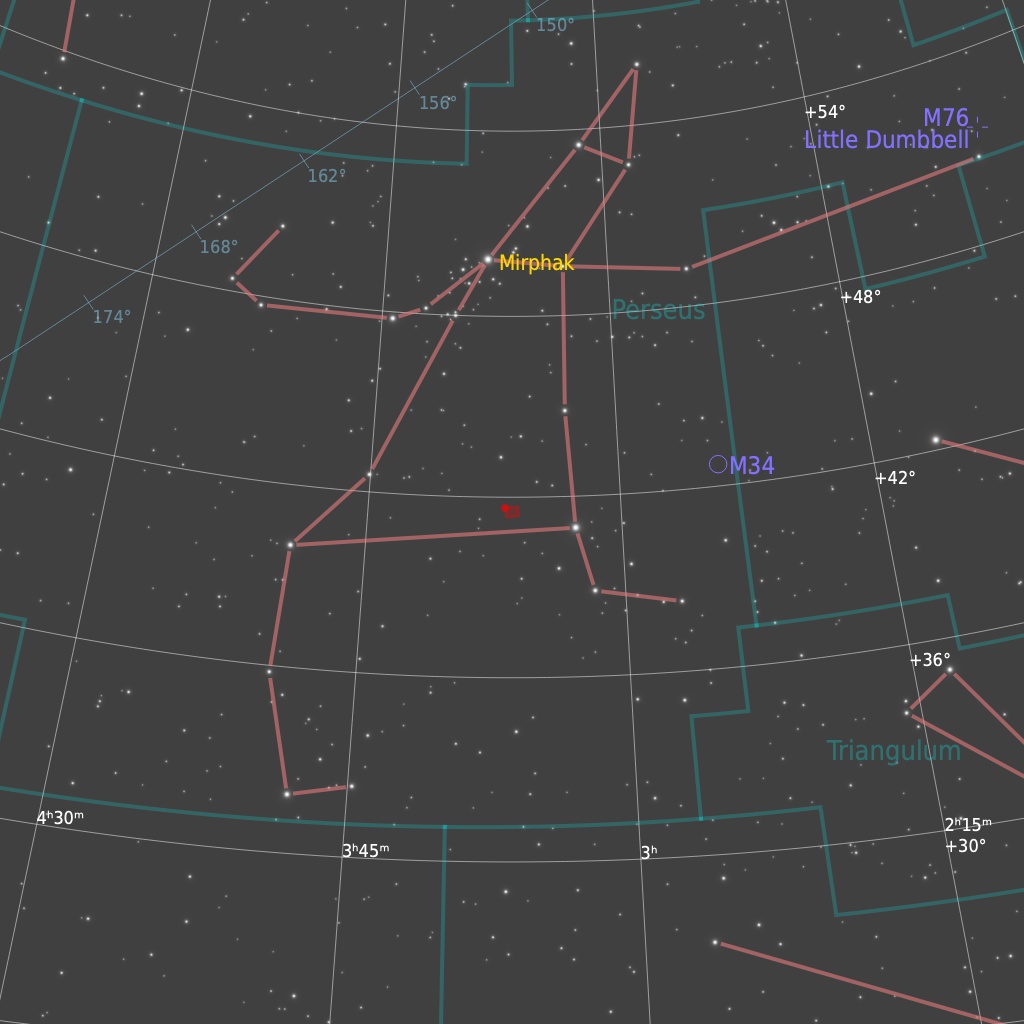
Abell 426, better known as the Perseus Cluster, is one of the nearest rich clusters of galaxies and one of the most massive structures in the nearby Universe. It lies in the constellation Perseus, roughly 72 Mpc away, or about 235–240 million light-years, depending on the distance scale used. Because it is so close on cosmic scales and so massive, it has become a benchmark object for studying galaxy clusters, hot gas, dark matter, and active galactic nuclei.science.
The Perseus Cluster contains thousands of galaxies immersed in a vast cloud of extremely hot, X-ray-emitting intracluster gas. Many of the visible members are elliptical and lenticular galaxies, though spirals are present too. The cluster is very large on the sky, with an apparent diameter of hundreds of arcminutes, and in physical terms it spans many millions of light-years. It is part of the larger Perseus-Pisces supercluster, a major filamentary structure in the local Universe.science.
At the center sits NGC 1275, also called Perseus A, the dominant galaxy in the cluster. NGC 1275 is a powerful active galaxy whose supermassive black hole drives jets and outflows that strongly influence the surrounding cluster gas. Those jets inflate bubbles in the intracluster medium and help create the dramatic filaments seen in optical and X-ray images. In the X-ray sky, the Perseus Cluster is the brightest galaxy cluster, largely because of the intense emission from the hot gas around its center.
Like all rich clusters, Perseus contains far more mass than is visible in starlight alone. Much of its total mass is in the form of dark matter, which holds the cluster together gravitationally, while the hot intracluster gas accounts for much of the remaining visible mass. The gas reaches temperatures of millions of degrees, so it emits strongly in X-rays rather than visible light. Studies using X-ray telescopes have shown that the cluster contains an enormous amount of energy and matter, with total masses of order 6 × 10¹⁴ solar masses or more.
The Perseus Cluster is famous for more than just its size. Astronomers have detected pressure ripples in the X-ray gas that behave like sound waves, generated by the activity of the central black hole in NGC 1275. This is one of the best-known examples of feedback between a galaxy’s active nucleus and the surrounding cluster environment. The idea that a black hole can stir a cluster-sized atmosphere is one of the most dramatic results from modern X-ray astronomy.
The cluster is also valuable because it is close enough for detailed study but rich enough to represent the extreme end of cluster environments in the local Universe. That makes it a key test case for models of galaxy evolution, intracluster gas cooling, and the growth of large-scale structure.
In visible light, the cluster looks like a crowded field of faint galaxies, with NGC 1275 dominating the center. In X-rays, however, it becomes one of the most spectacular objects in the sky. Amateur astrophotographers sometimes tackle Perseus as a deep-sky challenge because it shows the richness of a galaxy cluster in a single wide frame.
For the Astrophotomarket data the calibration, registration, and final image processing were carried out in PixInsight.
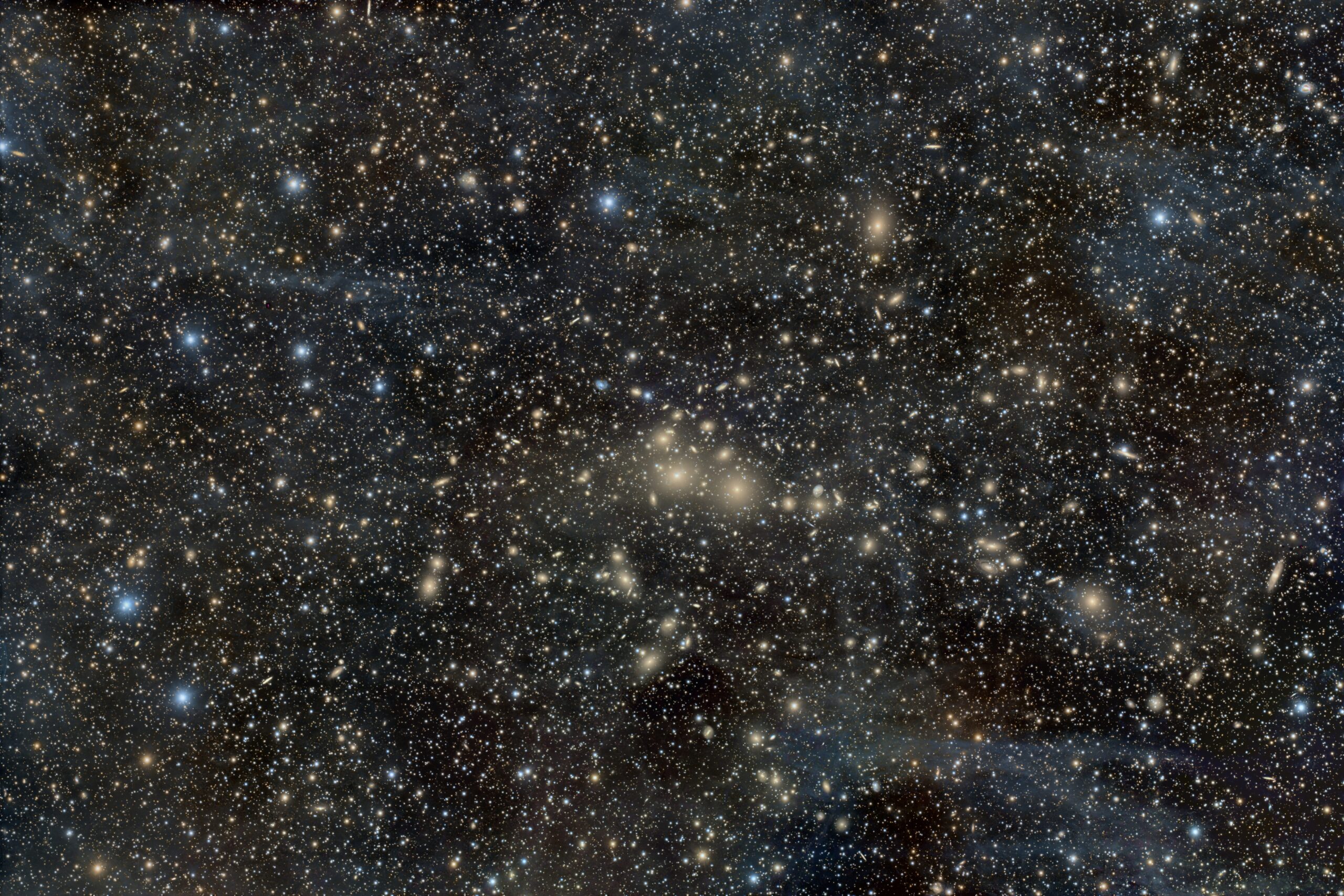

The images were taken with the following equipment:
- Date: 2025
- Location: USA
- Telescope/Lense: C14 Hyperstar
- Focal length [mm]: 715
- Focal ratio: 1.9
- Mount: Celestron CGE
- Camera: ZWO ASI 2600MC Pro
- Filter: OSC
- Exposure time [min]: 444
- Resolution: 1.13″/px



Leave a reply