• Home
  • Blog
  • Astrophotography
    • Deep Sky
      • Galaxies (Galaxien)
      • Nebulae (Nebel)
      • Planetary Nebulae (Planetarische Nebel)
      • Globular Clusters (Kugelsternhaufen)
      • Open Clusters (Offene Sternhaufen)
      • Miscellaneous (Verschiedenes)
    • Solar System (Sonnensystem)
      • Comets (Kometen)
      • Moon (Mond)
      • Planets (Planeten)
      • Sun (Sonne)
  • Archiv

    • Juli 2026
    • Juni 2026
    • Mai 2026
    • April 2026
    • Februar 2026
    • Januar 2026
    • Dezember 2025
    • November 2025
    • Oktober 2025
    • September 2025
    • August 2025
    • Juli 2025
    • Juni 2025
    • Mai 2025
    • April 2025
    • März 2025
    • Januar 2025
    • Dezember 2024
    • November 2024
    • Oktober 2024
    • September 2024
    • August 2024
    • Juli 2024
    • Juni 2024
    • Mai 2024
    • April 2024
    • März 2024
    • Februar 2024
    • Januar 2024
    • November 2023
    • Oktober 2023
    • September 2023
    • August 2023
    • Juli 2023
    • Juni 2023
    • Mai 2023
    • April 2023
    • März 2023
    • Februar 2023
    • Januar 2023
    • Dezember 2022
    • November 2022
    • Oktober 2022
    • September 2022
    • August 2022
    • Juli 2022
    • Juni 2022
    • Mai 2022
    • April 2022
    • März 2022
    • Februar 2022
    • Januar 2022
    • Dezember 2021
    • November 2021
    • September 2021
    • August 2021
    • Juli 2021
    • März 2021
    • Februar 2021
    • November 2020
    • September 2020
    • August 2020
    • April 2020
    • März 2020
    • Februar 2020
    • Januar 2020
    • Dezember 2019
    • November 2019
    • Oktober 2019
    • September 2019
    • August 2019
    • Mai 2019
    • April 2019
    • März 2019
    • Dezember 2018
    • November 2018
    • Oktober 2018
    • September 2018
    • Juni 2018
    • Mai 2018
    • April 2018
    • März 2018
    • Februar 2018
    • Januar 2018
    • Oktober 2017
    • Juli 2017
    • Juni 2017
    • Januar 2017
    • Dezember 2016
    • September 2016
    • Mai 2016
    • März 2016
    • November 2015
    • Oktober 2015
    • Juli 2015
    • Mai 2015
    • März 2015
    • Februar 2015
    • September 2014
    • August 2014
    • März 2014
    • Februar 2014
    • Oktober 2013
    • September 2013
    • August 2013
    • April 2013
    • März 2013
    • November 2012
    • August 2012
    • Juli 2012
    • Mai 2012
    • März 2012
    • Januar 2012
    • November 2011
    • Oktober 2011
    • September 2011
    • August 2011
    • April 2011
    • März 2011
    • Oktober 2010
    • September 2010
    • August 2010
    • Juli 2010
    • April 2010
    • Juli 2009
    • Juli 2008
    • Januar 2008
    • Oktober 2007
    • Juli 2007
    • März 2007
    • Februar 2007
    • Juni 2006
    • Oktober 2005
    • September 2005
    • August 2005
    • Januar 2005
  • Kategorien

    • Asterism
    • Astrophotography
    • Barnard
    • Comet
    • Galaxies
    • Globular Cluster
    • IC
    • Messier
    • Moon
    • Nebula
    • NGC
    • Open cluster
    • Photography
    • Planetary Nebula
    • Travel
  • Meta

    • Anmelden
    • Eintrags-Feed
    • Kommentar-Feed
    • WordPress.org
  • Privacy Policy
  • Impressum
  • Haftungsausschluss
  • Cookie-Richtlinie
  • Datenschutzerklärung

wonderfuluniverse.de
  • Home
  • Blog
  • Astrophotography
    • Deep Sky
      • Galaxies (Galaxien)
      • Nebulae (Nebel)
      • Planetary Nebulae (Planetarische Nebel)
      • Globular Clusters (Kugelsternhaufen)
      • Open Clusters (Offene Sternhaufen)
      • Miscellaneous (Verschiedenes)
    • Solar System (Sonnensystem)
      • Comets (Kometen)
      • Moon (Mond)
      • Planets (Planeten)
      • Sun (Sonne)

Messier 61 from remote


In 2022, I received a high-quality LRGB dataset of Messier 61 from Telescope Live, acquired under the pristine skies of Chile.

Messier 61, or M61, is a large barred spiral galaxy in the Virgo Cluster, about 50–55 million light-years from Earth. It is one of the brighter Virgo galaxies and also one of the more active, with a strong history of star formation and several recorded supernovae.

M61 is also cataloged as NGC 4303 and is classified as an intermediate barred spiral, usually written SAB(rs)bc or similar. It lies in the constellation Virgo and was discovered on May 5, 1779 by the Italian astronomer Barnaba Oriani. With an apparent magnitude around 10.2, it is visible in a modest telescope, though it needs a reasonably dark sky to show its full structure.

The galaxy is roughly 100,000 light-years across, so it is similar in size to the Milky Way. Images show a bright central bulge, a barred nucleus, and loosely wound spiral arms dotted with star-forming regions. It is not especially edge-on, so its spiral pattern can be seen more clearly than in some other Virgo Cluster members.

M61 is often described as a starburst galaxy or at least a galaxy with a high star-formation rate. That means large amounts of gas are being converted into new stars, especially in the spiral arms and central regions. This active behavior is part of what makes M61 stand out among Virgo Cluster spirals.

The nucleus of M61 is an active galactic nucleus in some classifications, and the galaxy is sometimes listed as a Seyfert 2 galaxy. That suggests a supermassive black hole is feeding on surrounding gas and dust at the center. The central black hole is not directly visible, of course, but its activity influences the surrounding gas and can contribute to the galaxy’s energetic core.

One of the most interesting facts about M61 is that it has produced multiple observed supernovae. Sources note six supernovae between 1926 and 2008. That is unusually rich for a single nearby galaxy and is a sign of its vigorous star formation, because core-collapse supernovae come from massive stars that live only a short time. Supernova activity also makes M61 valuable for calibrating galaxy evolution and stellar end-of-life studies.

M61 is a member of the Virgo Cluster of galaxies, the nearest major galaxy cluster to the Local Group. Distances in the literature vary, but modern estimates commonly fall near 16 Mpc, or about 52 million light-years. As a cluster galaxy, it lives in a crowded environment where gravitational interactions, gas stripping, and tidal effects can all shape its evolution.

That environment helps explain some of its disturbed gas properties. Radio observations of neutral hydrogen show asymmetries and extended gas distributions, implying that past interactions may have affected its outer disk. In a cluster setting, galaxies rarely evolve in isolation.

For amateur astronomers, M61 is appealing because it is bright enough to see with moderate equipment and detailed enough to reward long exposures. Under good conditions, you can trace its bright core, disk, and hints of spiral structure. Because it sits in Virgo, it is also in the middle of one of the richest galaxy fields in the sky.

Data calibration and registration and the final processing was done with PixInsight. The result was as follows:

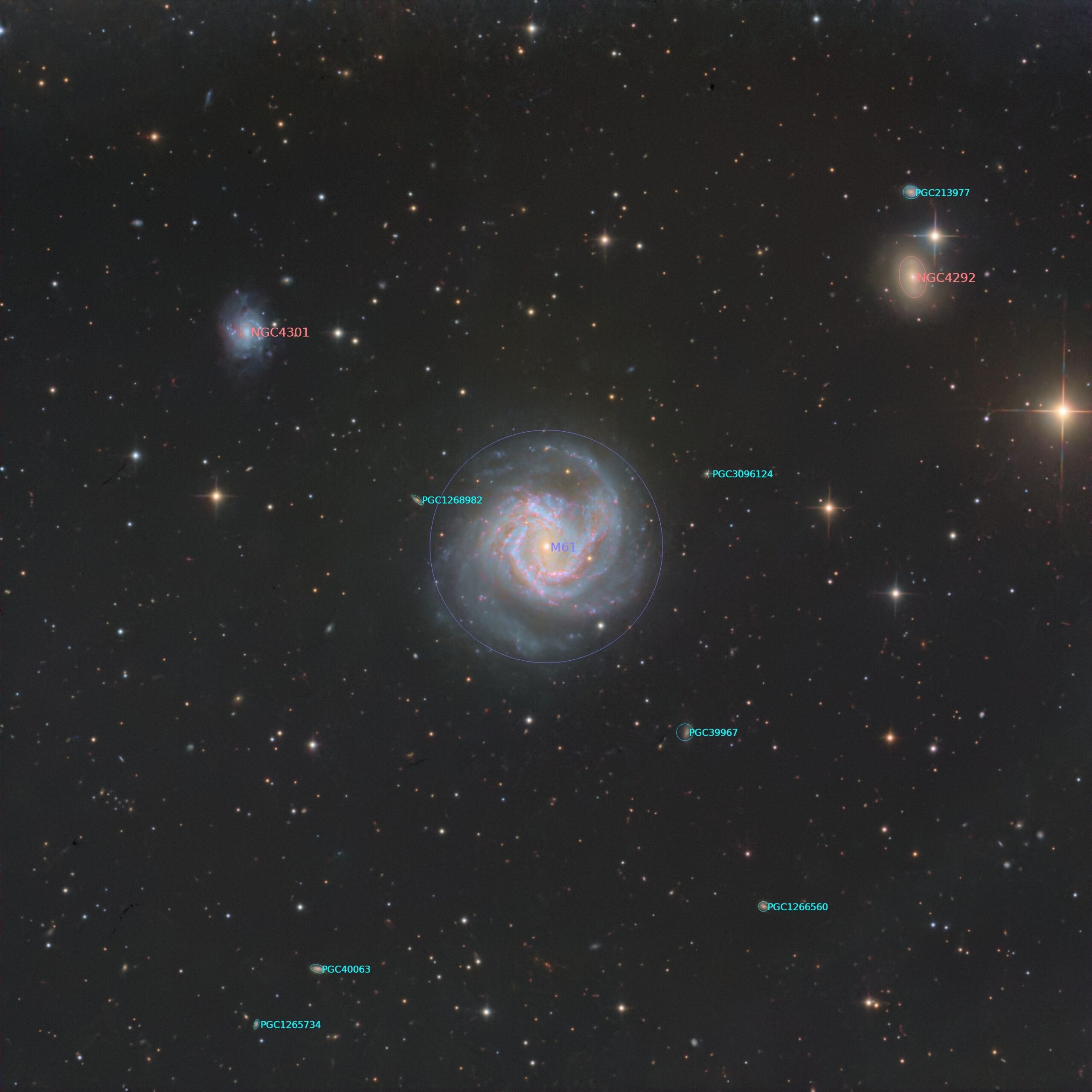
Messier 61, Telescope Live, Chile, 2022
Messier 61 annotated


The images were taken with the following equipment (Telescope Live CHI-1):

  • Date: 2022
  • Telescope/Lens: Planwave CDK24
  • Focal length [mm]: 3900
  • Focal ratio: 6.5
  • Mount: Mathis MI-1000/1250
  • Camera: FLI Proline 9000
  • Filter: RGB
  • Exposure time [min]: 80:80:80
  • Resolution: 0.62″/px


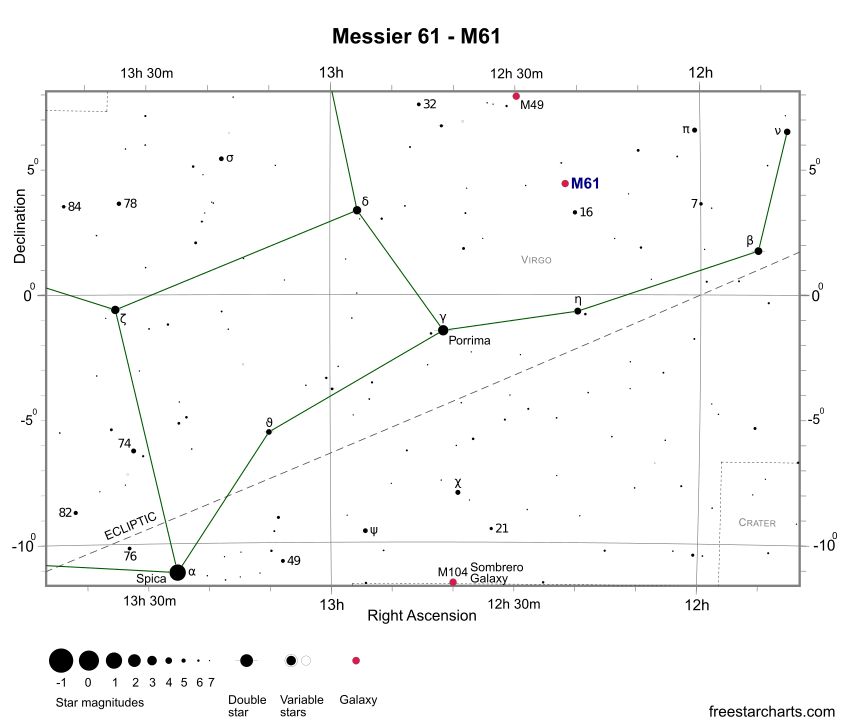
Messier 61 Finder Chart

Stephan Küppers


You might also like
IC 1318
15. Juli 2026
NGC 7000 with IC 5070
24. Juni 2026
Sh2-129, Outters 4
29. Mai 2026

Leave a reply

Schreibe einen Kommentar Antwort abbrechen

Deine E-Mail-Adresse wird nicht veröffentlicht. Erforderliche Felder sind mit * markiert


© Stephan Küppers 2020-2022

Cookie-Zustimmung verwalten
Wir verwenden Cookies, um unsere Website und unseren Service zu optimieren.
Funktional Immer aktiv
Die technische Speicherung oder der Zugang ist unbedingt erforderlich für den rechtmäßigen Zweck, die Nutzung eines bestimmten Dienstes zu ermöglichen, der vom Teilnehmer oder Nutzer ausdrücklich gewünscht wird, oder für den alleinigen Zweck, die Übertragung einer Nachricht über ein elektronisches Kommunikationsnetz durchzuführen.
Vorlieben
Die technische Speicherung oder der Zugriff ist für den rechtmäßigen Zweck der Speicherung von Präferenzen erforderlich, die nicht vom Abonnenten oder Benutzer angefordert wurden.
Statistiken
Die technische Speicherung oder der Zugriff, der ausschließlich zu statistischen Zwecken erfolgt. Die technische Speicherung oder der Zugriff, der ausschließlich zu anonymen statistischen Zwecken verwendet wird. Ohne eine Vorladung, die freiwillige Zustimmung deines Internetdienstanbieters oder zusätzliche Aufzeichnungen von Dritten können die zu diesem Zweck gespeicherten oder abgerufenen Informationen allein in der Regel nicht dazu verwendet werden, dich zu identifizieren.
Marketing
Die technische Speicherung oder der Zugriff ist erforderlich, um Nutzerprofile zu erstellen, um Werbung zu versenden oder um den Nutzer auf einer Website oder über mehrere Websites hinweg zu ähnlichen Marketingzwecken zu verfolgen.
  • Optionen verwalten
  • Dienste verwalten
  • Verwalten von {vendor_count}-Lieferanten
  • Lese mehr über diese Zwecke
Einstellungen anzeigen
  • {title}
  • {title}
  • {title}