

LDN 1773 (Pipe Nebula) widefield
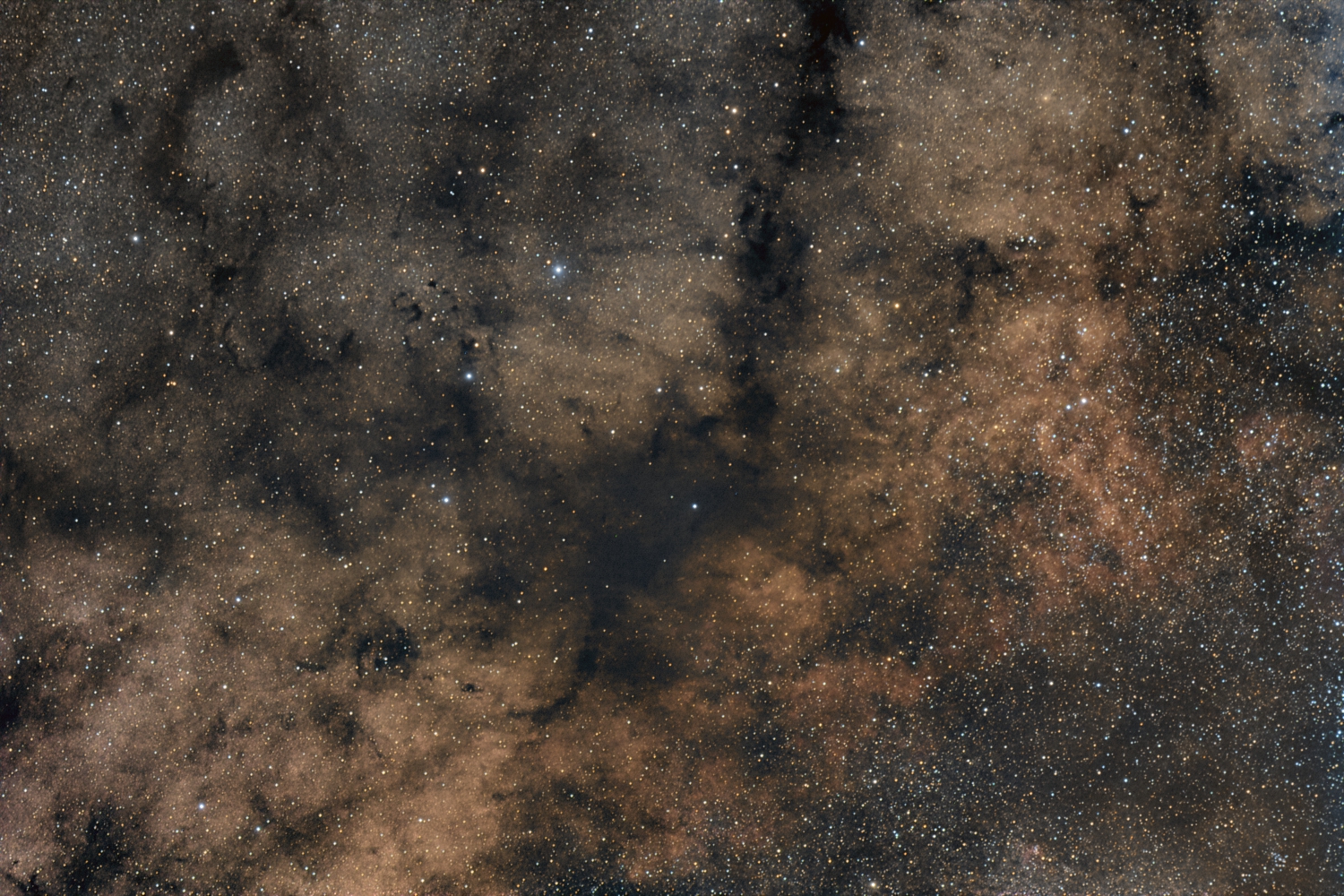
In 2006 I took some images of LDN 1773 (Pipe Nebula) during a stay at the astrofarm Tivoli in Namibia.
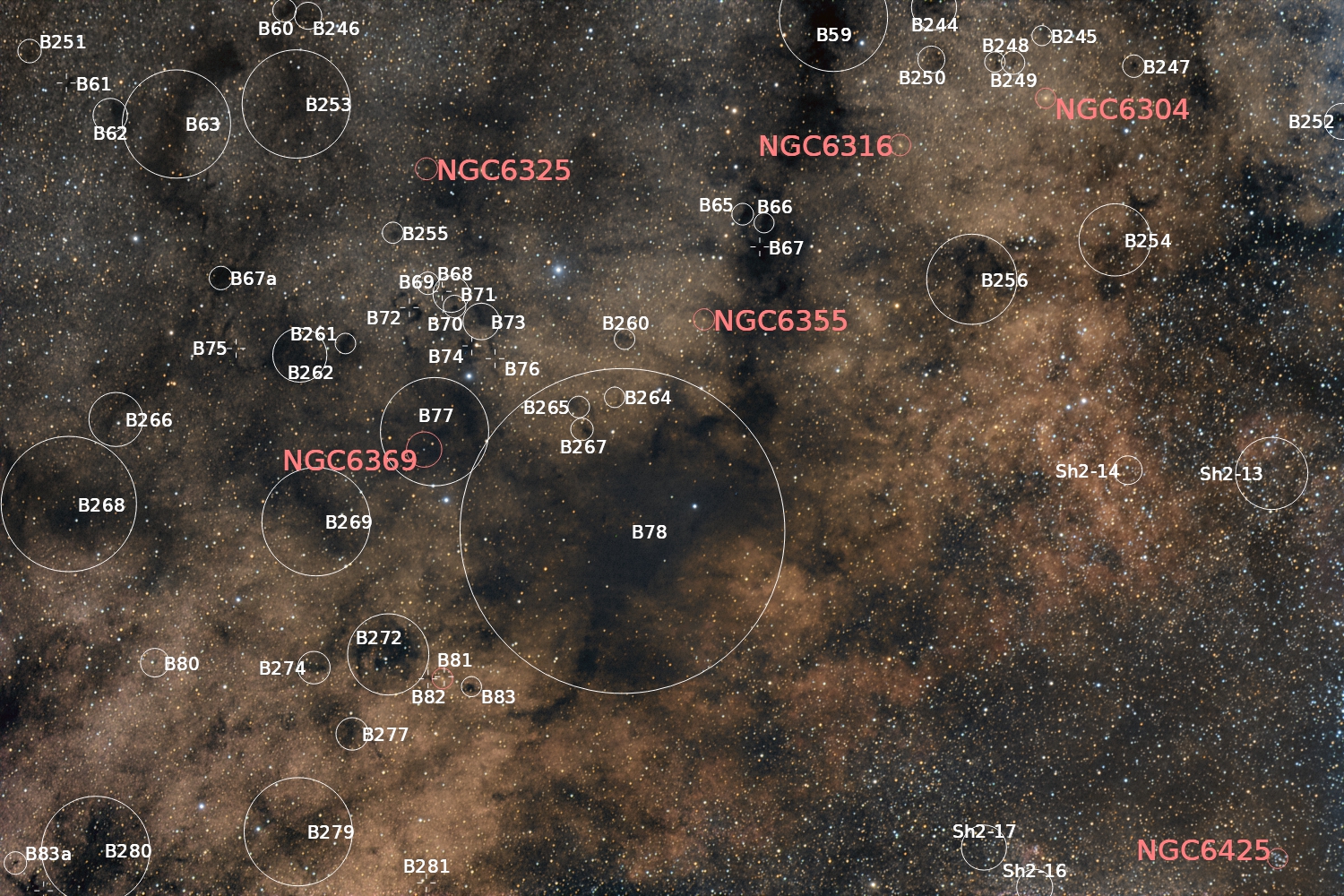
The Pipe Nebula is among the most famous dark nebulae in the southern sky, visible as a stark, pipe-shaped silhouette against the bright star clouds of the Milky Way in Ophiuchus. Barnard 78 forms the “bowl” of the pipe, while the “stem” is made by a chain of other dark clouds, primarily Barnard 59, 65, 66, and 67.
The Pipe Nebula is a dark nebula: a dense cloud of interstellar dust and gas that blocks the light of stars behind it rather than emitting or reflecting its own light. It is part of the larger Ophiuchus dark cloud complex and also forms the hindquarters and rump of the even larger Dark Horse Nebula, a huge pattern of dark clouds that resembles a horse lying across the Milky Way.
The Pipe itself is composed of several cataloged Barnard objects:
- Barnard 59, 65, 66, and 67 form the long, narrow “stem” of the pipe (also called the “pipe tongue” or “lengüeta”).wikipedia+1
- Barnard 78 makes up the broader, more rounded “bowl” or “head” of the pipe (the “cuerpo de la pipa”)
Together, these clouds span about 6.5° × 4.5° on the sky—roughly 13 times the apparent width of the full Moon.
The Pipe Nebula lies at a distance of roughly 450–500 light-years (about 140–160 parsecs) from Earth. That makes it one of the closest large dark nebulae to us, and it sits almost directly in front of the rich star fields toward the Galactic center. Because it is relatively nearby and very opaque, it is easily visible to the naked eye under dark skies as a striking “hole” in the Milky Way shaped like a smoking pipe.
Barnard 78, the bowl, appears as a broad, roughly rectangular or kidney-shaped dark patch with an opacity class of about 5 (on a scale where 6 is nearly completely opaque). The stem, composed of Barnard 59, 65, 66, and 67, is narrower and darker, with an opacity around 6, giving the impression of a thick column of smoke rising from the bowl.
Dark nebulae like the Pipe are not just empty space; they are dense molecular clouds where new stars are forming. The dust in these clouds is cold, typically only 10–20 K, and the gas is mostly molecular hydrogen, which is hard to observe directly at visible wavelengths. Astronomers study them using infrared and radio observations to see through the dust and detect the young stellar objects embedded within.
The Ophiuchus complex, which includes the Pipe, is one of the nearest and best-studied regions of low-mass star formation. Because the clouds are so close and projected against bright background stars, they are excellent targets for measuring extinction, dust properties, and the three-dimensional structure of the interstellar medium.
For observers, the Pipe Nebula is one of the most rewarding dark-sky targets in summer (for the northern hemisphere) or winter (for the southern hemisphere). It is best seen from locations with minimal light pollution, where the Milky Way is clearly visible. Binoculars (7× or 10×) are ideal for tracing its outline, as they widen the field of view and enhance the contrast between the dark cloud and the starry background.
To find it, locate the bright star θ (theta) Ophiuchi; the Pipe lies just below this star, with Barnard 78 forming the upper part and the stem extending westward. Under good conditions, the shape is unmistakable: a dark, smoking pipe floating in the Milky Way.
Data calibration and registration was done with DeepSkystacker, the final processing was done with PixInsight. The result was as follows:
The images were taken with the following equipment:
- Date 2006
- Location: Tivoli, Namibia
- Telescope: Tamron 28-300mm lens
- Focal length [mm]: 50
- Focal ratio: 4.5
- Mount: Vixen Atlux
- Camera: Canon 300 Da
- Filter: OSC
- Exposure time [min]: 36
- Resolution: 29.8″/px



Leave a reply