• Home
  • Blog
  • Astrophotography
    • Deep Sky
      • Galaxies (Galaxien)
      • Nebulae (Nebel)
      • Planetary Nebulae (Planetarische Nebel)
      • Globular Clusters (Kugelsternhaufen)
      • Open Clusters (Offene Sternhaufen)
      • Miscellaneous (Verschiedenes)
    • Solar System (Sonnensystem)
      • Comets (Kometen)
      • Moon (Mond)
      • Planets (Planeten)
      • Sun (Sonne)
  • Archiv

    • Juli 2026
    • Juni 2026
    • Mai 2026
    • April 2026
    • Februar 2026
    • Januar 2026
    • Dezember 2025
    • November 2025
    • Oktober 2025
    • September 2025
    • August 2025
    • Juli 2025
    • Juni 2025
    • Mai 2025
    • April 2025
    • März 2025
    • Januar 2025
    • Dezember 2024
    • November 2024
    • Oktober 2024
    • September 2024
    • August 2024
    • Juli 2024
    • Juni 2024
    • Mai 2024
    • April 2024
    • März 2024
    • Februar 2024
    • Januar 2024
    • November 2023
    • Oktober 2023
    • September 2023
    • August 2023
    • Juli 2023
    • Juni 2023
    • Mai 2023
    • April 2023
    • März 2023
    • Februar 2023
    • Januar 2023
    • Dezember 2022
    • November 2022
    • Oktober 2022
    • September 2022
    • August 2022
    • Juli 2022
    • Juni 2022
    • Mai 2022
    • April 2022
    • März 2022
    • Februar 2022
    • Januar 2022
    • Dezember 2021
    • November 2021
    • September 2021
    • August 2021
    • Juli 2021
    • März 2021
    • Februar 2021
    • November 2020
    • September 2020
    • August 2020
    • April 2020
    • März 2020
    • Februar 2020
    • Januar 2020
    • Dezember 2019
    • November 2019
    • Oktober 2019
    • September 2019
    • August 2019
    • Mai 2019
    • April 2019
    • März 2019
    • Dezember 2018
    • November 2018
    • Oktober 2018
    • September 2018
    • Juni 2018
    • Mai 2018
    • April 2018
    • März 2018
    • Februar 2018
    • Januar 2018
    • Oktober 2017
    • Juli 2017
    • Juni 2017
    • Januar 2017
    • Dezember 2016
    • September 2016
    • Mai 2016
    • März 2016
    • November 2015
    • Oktober 2015
    • Juli 2015
    • Mai 2015
    • März 2015
    • Februar 2015
    • September 2014
    • August 2014
    • März 2014
    • Februar 2014
    • Oktober 2013
    • September 2013
    • August 2013
    • April 2013
    • März 2013
    • November 2012
    • August 2012
    • Juli 2012
    • Mai 2012
    • März 2012
    • Januar 2012
    • November 2011
    • Oktober 2011
    • September 2011
    • August 2011
    • April 2011
    • März 2011
    • Oktober 2010
    • September 2010
    • August 2010
    • Juli 2010
    • April 2010
    • Juli 2009
    • Juli 2008
    • Januar 2008
    • Oktober 2007
    • Juli 2007
    • März 2007
    • Februar 2007
    • Juni 2006
    • Oktober 2005
    • September 2005
    • August 2005
    • Januar 2005
  • Kategorien

    • Asterism
    • Astrophotography
    • Barnard
    • Comet
    • Galaxies
    • Globular Cluster
    • IC
    • Messier
    • Moon
    • Nebula
    • NGC
    • Open cluster
    • Photography
    • Planetary Nebula
    • Travel
  • Meta

    • Anmelden
    • Eintrags-Feed
    • Kommentar-Feed
    • WordPress.org
  • Privacy Policy
  • Impressum
  • Haftungsausschluss
  • Cookie-Richtlinie
  • Datenschutzerklärung

wonderfuluniverse.de
  • Home
  • Blog
  • Astrophotography
    • Deep Sky
      • Galaxies (Galaxien)
      • Nebulae (Nebel)
      • Planetary Nebulae (Planetarische Nebel)
      • Globular Clusters (Kugelsternhaufen)
      • Open Clusters (Offene Sternhaufen)
      • Miscellaneous (Verschiedenes)
    • Solar System (Sonnensystem)
      • Comets (Kometen)
      • Moon (Mond)
      • Planets (Planeten)
      • Sun (Sonne)

Cometary Globule CG 30 from remote


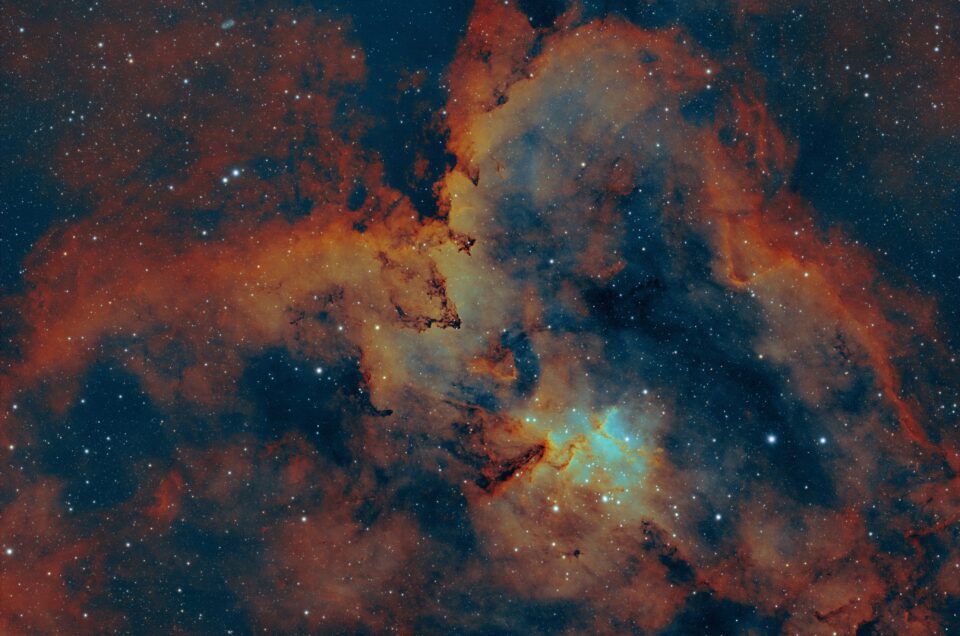
From time to time, I obtain data sets from remote observatories around the world. One of my favorite providers is Telescope Live, offering access to high-quality instruments located in Chile, Australia, and Spain. Among the data I received was a particularly fascinating set featuring the cometary globule CG 30, situated in the southern constellation Puppis.

CG 30 and CG 31 are two of the most famous cometary globules in the southern sky, located in the constellations Puppis and Vela on the outskirts of the large Gum Nebula. These striking, comet-shaped clouds are isolated clumps of dense gas and dust that are being sculpted and illuminated by nearby massive stars and the energetic environment of the Gum Nebula.

Cometary globules (CGs) are compact interstellar clouds that resemble comets in shape: a dense, dark, rounded “head” and a faint, diffuse “tail” stretching away from a source of intense radiation. They were first systematically identified in 1976 and are typically 0.1–0.8 parsecs across, with densities of 10⁴–10⁵ particles per cubic centimeter and temperatures around 10 K. Their masses range from about 10 to 100 solar masses.

The tails always point away from the ionizing source because the radiation and stellar winds erode the far side of the cloud more quickly than the shielded head. For CG 30 and CG 31, the main shaping influence is thought to be the hot stars in the Gum Nebula and possibly the nearby Vela supernova remnant, whose blast wave may have compressed and swept material into these forms.

CG 30 and CG 31 are part of a small complex that also includes CG 38, all lying within about 360 parsecs (roughly 1,160–1,300 light-years) of Earth. The three globules are often treated as a single association because they share similar distances, kinematics, and ages. CG 30 is the most prominent and well-studied, with a bright rim on the side facing the ionizing stars and a long, faint tail streaming away.

CG 30 is especially famous because it is actively forming stars. Inside its head, a small reddish glow betrays the presence of a young protostar, and observations have detected powerful jets and outflows known as Herbig–Haro objects, including HH 120 and a large bipolar jet, HH 950. These jets are the signatures of a star in the earliest stages of its life, still accreting material and ejecting gas along its poles.

CG 30 and CG 31 are rich laboratories for studying low-mass star formation under strong external radiation. Spectroscopic studies of young stars near CG 30 show that many of them are classical T Tauri stars, with ages less than 1 million years and active accretion disks. About 14 of these young stars appear kinematically associated with the CG 30/31/38 complex, all at a distance of roughly 358 parsecs (about 1,170 light-years).

The presence of so many young, low-mass stars supports the idea that the globules are being compressed by radiation and possibly by the Vela supernova remnant, triggering gravitational collapse in their dense cores. Over time, these stars will disperse the remaining gas and destroy the globules entirely.

CG 30 and CG 31 are important because they show star formation in a relatively nearby, moderately irradiated environment. They help astronomers understand how external radiation affects the formation and evolution of low-mass stars and protoplanetary disks. The complex also provides a clear visual example of how massive stars and supernovae can shape the interstellar medium and potentially trigger new generations of stars.

For this project, data calibration, registration, and final processing were carried out entirely in PixInsight.

CG 30, Telescope Live, Chile, 2022


The images were taken with the following equipment (CHI1-CCD):

  • Date: 2022
  • Location: El Sauce Observatory, Chile
  • Telescope: PLanwave CDK24
  • Focal length [mm]: 3962
  • Focal ratio: 6.5
  • Mount: Mathis MI-1000/1250
  • Camera: FLI Proline 9000
  • Filter: L:R:G:B:H
  • Exposure time [min]: 225:150:75:75:490
  • Resolution: 0.62″/px


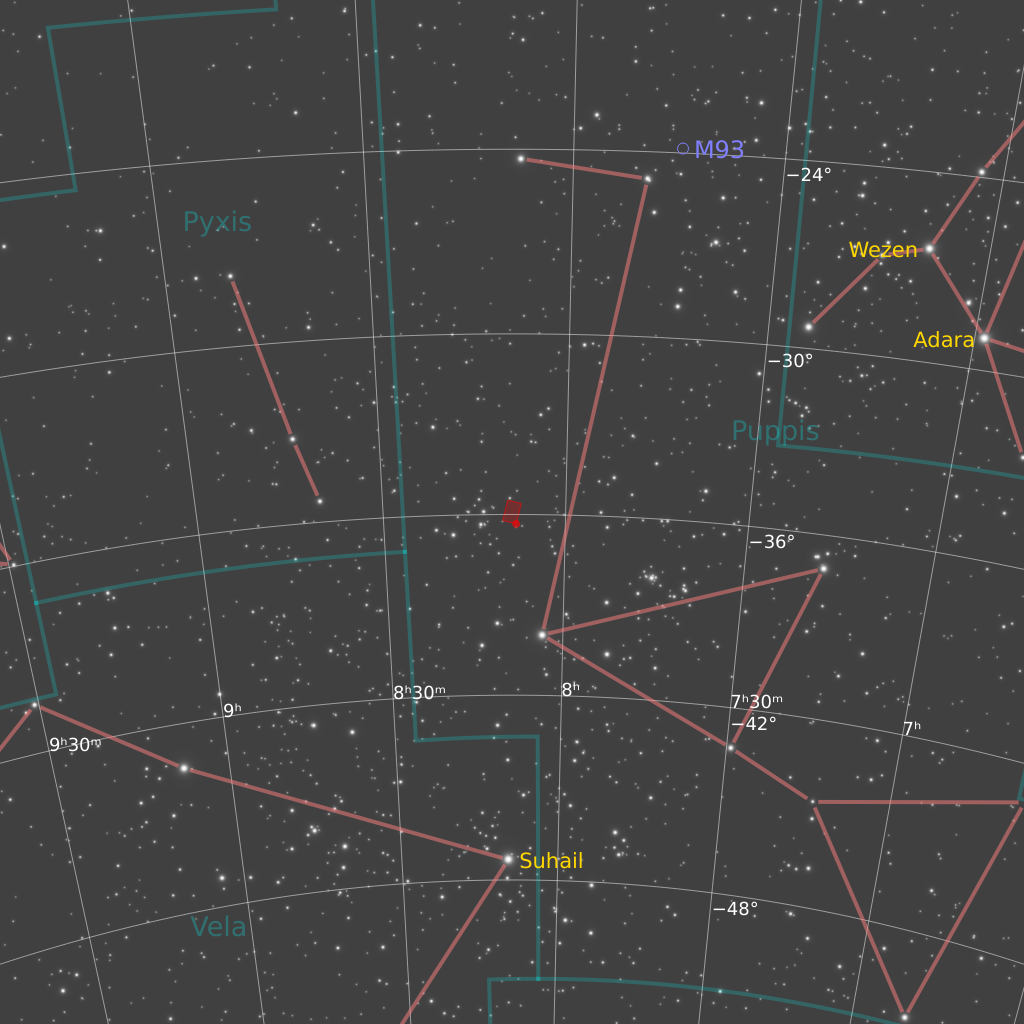
CG30 Finder Chart
CG30 Finder Chart

Stephan Küppers


You might also like
IC 1318
15. Juli 2026
NGC 7000 with IC 5070
24. Juni 2026
Sh2-129, Outters 4
29. Mai 2026

Leave a reply

Schreibe einen Kommentar Antwort abbrechen

Deine E-Mail-Adresse wird nicht veröffentlicht. Erforderliche Felder sind mit * markiert


© Stephan Küppers 2020-2022

Cookie-Zustimmung verwalten
Wir verwenden Cookies, um unsere Website und unseren Service zu optimieren.
Funktional Immer aktiv
Die technische Speicherung oder der Zugang ist unbedingt erforderlich für den rechtmäßigen Zweck, die Nutzung eines bestimmten Dienstes zu ermöglichen, der vom Teilnehmer oder Nutzer ausdrücklich gewünscht wird, oder für den alleinigen Zweck, die Übertragung einer Nachricht über ein elektronisches Kommunikationsnetz durchzuführen.
Vorlieben
Die technische Speicherung oder der Zugriff ist für den rechtmäßigen Zweck der Speicherung von Präferenzen erforderlich, die nicht vom Abonnenten oder Benutzer angefordert wurden.
Statistiken
Die technische Speicherung oder der Zugriff, der ausschließlich zu statistischen Zwecken erfolgt. Die technische Speicherung oder der Zugriff, der ausschließlich zu anonymen statistischen Zwecken verwendet wird. Ohne eine Vorladung, die freiwillige Zustimmung deines Internetdienstanbieters oder zusätzliche Aufzeichnungen von Dritten können die zu diesem Zweck gespeicherten oder abgerufenen Informationen allein in der Regel nicht dazu verwendet werden, dich zu identifizieren.
Marketing
Die technische Speicherung oder der Zugriff ist erforderlich, um Nutzerprofile zu erstellen, um Werbung zu versenden oder um den Nutzer auf einer Website oder über mehrere Websites hinweg zu ähnlichen Marketingzwecken zu verfolgen.
  • Optionen verwalten
  • Dienste verwalten
  • Verwalten von {vendor_count}-Lieferanten
  • Lese mehr über diese Zwecke
Einstellungen anzeigen
  • {title}
  • {title}
  • {title}