

Sh2-114 and Kronberger 26 from remote
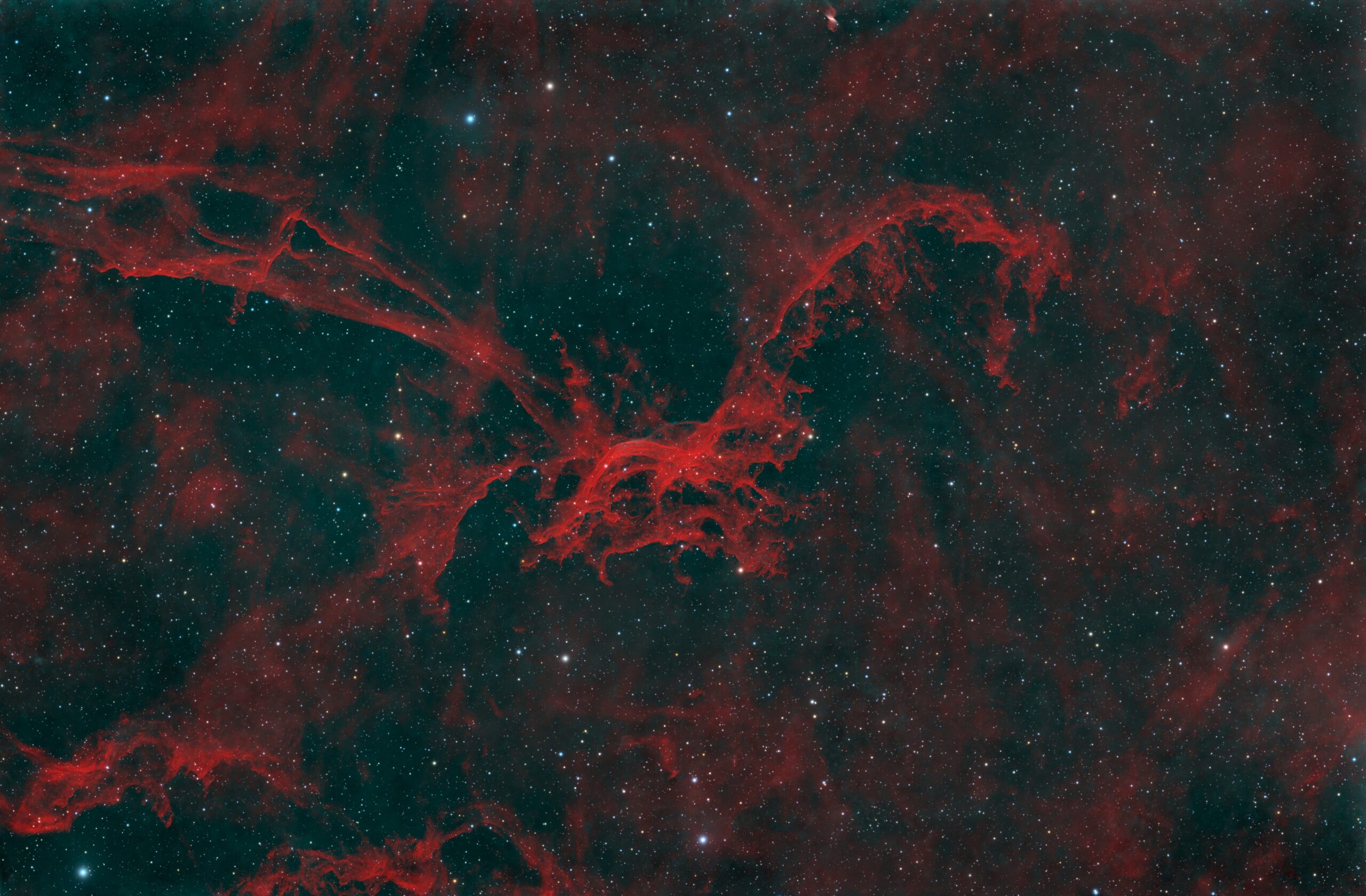
In 2025, I received a deep SHO narrowband dataset of Sh2-114 together with the faint planetary nebula Kn 26 from Astrophotomarket in Canada. The dataset combines the emission lines of sulfur (S II), hydrogen (Hα), and oxygen (O III), making it possible to distinguish the different physical structures within this fascinating field. While the expansive hydrogen clouds of Sh2-114 dominate the image, the tiny planetary nebula Kn 26 provides an intriguing contrast, representing the final evolutionary stage of a Sun-like star amid an active region of ongoing star formation.
Sh2-114 is an extremely faint, filamentary emission nebula in Cygnus nicknamed the “Flying Dragon Nebula,” and Kn 26 (Kronberger 26) is a small, quadrupolar planetary nebula projected near its northeastern edge but not physically related.
Sh2-114 is a complex H II emission nebula in the northern part of Cygnus, forming part of the Sharpless catalog of ionized hydrogen regions. It is very faint and little‑studied, with no firmly established distance, though one reference suggests roughly 3,500–4,200 light‑years; most authors still treat the distance as uncertain.
Sh2-114 has a wispy, filamentary structure made of overlapping arched strands that give it a roughly semicircular, wing‑like appearance with the concavity toward the south. Together with nearby Sh2-113 it seems to form a bubble‑like structure that superficially resembles a supernova remnant, but no supernova or remnant has been identified in this region.
Its intricate form is thought to arise from the interaction of strong stellar winds from hot, massive stars with magnetic fields in the interstellar medium, rather than from a single explosive event. The catalog designation Sh2‑114 technically refers to a bright central patch about 12′×6′ in size, but faint filaments extend over more than 1.5° of sky.
Sh2-114 lies in Cygnus, a few degrees from stars such as τ Cygni or σ Cygni, in a very rich Milky Way field near the Cygnus star‑forming complexes. The best evening visibility is from roughly July to December for observers in the northern hemisphere, including Germany.
For imagers, Sh2-114 is a “challenge object”: its surface brightness is extremely low, so long total integration times and narrowband filters (especially H‑alpha and S II) are typically needed to reveal the dragon‑like filaments. Many deep images frame Sh2‑113 in the same field, showing the apparent bubble formed by both nebulae.
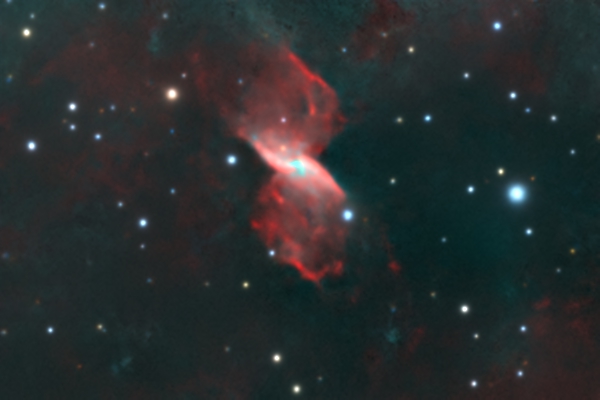
Kn 26, also cataloged as Lan 384, is a small planetary nebula in Cygnus located at the northeastern edge of the Sh2‑114 field. It was discovered in 2006 by Austrian amateur astronomer Matthias Kronberger and confirmed spectroscopically as a planetary nebula around 2011.
Morphologically, Kn 26 is a bipolar planetary nebula with a “butterfly” or hourglass shape and strong H₂ emission, and detailed studies show evidence for two distinct pairs of bipolar lobes, making it a member of the rare class of quadrupolar planetary nebulae. Its angular size is about 110 arcseconds, so it appears very small in wide‑field images of Sh2‑114 and needs higher resolution or longer focal length to show structure.
Spectroscopic analysis reveals an unusual chemical composition: a relatively low nitrogen‑to‑oxygen ratio (typical of Type II planetary nebulae) combined with high helium abundance (more like Type I PNe), a combination that is otherwise seen more often in symbiotic systems. Despite its proximity in the sky to Sh2‑114, Kn 26 is regarded as unrelated physically; it is simply seen in projection against the larger nebula.
The surrounding star field is densely populated with Milky Way stars, while dark molecular clouds weave through the glowing emission, adding depth and contrast to the scene. Deep observations also reveal faint background galaxies shining through gaps in the Galactic dust, despite the heavy foreground extinction.
The SHO dataset from Astrophotomarket beautifully captures the complexity of this remarkable region. The vivid narrowband colors highlight the differing chemical compositions and excitation levels of the ionized gas, while simultaneously revealing the delicate structure of the small planetary nebula. Together, Sh2-114 and Kn 26 provide a compelling illustration of the continuous cycle of stellar evolution, from the formation of massive young stars to the quiet demise of Sun-like stars billions of years later.
Data calibration and registration and the final processing was done with PixInsight. The result was as follows:
The images were taken with the following equipment:
- Date: 2025
- Location: Canada
- Telescope/Lense: Askar 151PHQ
- Focal length [mm]: 1057
- Focal ratio: 7
- Mount: iOptron HAE69
- Camera: ZWO ASI 2600MM Pro
- Filter: SHO
- Exposure time [min]: 990:650:460
- Resolution: 0.74″/px




Leave a reply