

NGC 6744
In 2015, during a stay at the astrofarm Tivoli in Namibia, I imaged the magnificent spiral galaxy NGC 6744 using the equipment of a rented observatory. The pristine Namibian skies, exceptional transparency, and excellent seeing conditions provided ideal circumstances for capturing one of the finest Milky Way analogues in the southern sky. The long exposures revealed the galaxy’s extensive spiral arms, intricate dust lanes, and numerous star-forming regions embedded throughout its disk.
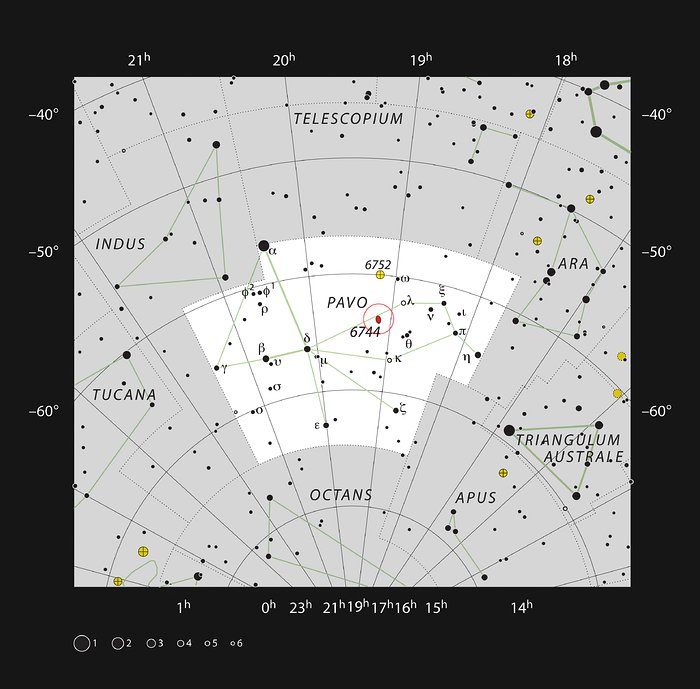
NGC 6744 is located in the constellation Pavo at a distance of approximately 30 million light-years. It is widely regarded as one of the closest and best examples of a galaxy resembling our own Milky Way. With a diameter of nearly 175,000 light-years, it is considerably larger than our Galaxy and is one of the largest spiral galaxies in the nearby universe.
Viewed at a moderate inclination, NGC 6744 displays a striking system of loosely wound spiral arms extending from a bright central bulge. These arms are threaded with prominent dust lanes and dotted with numerous H II regions, where massive young stars ionize surrounding hydrogen gas and create brilliant emission nebulae. The combination of dark dust structures and bright star-forming complexes gives the galaxy a rich and highly detailed appearance that makes it a favorite target for deep-sky astrophotographers.
One particularly interesting feature is the small irregular companion galaxy NGC 6744A, located near one of the outer spiral arms. This dwarf galaxy is thought to interact gravitationally with NGC 6744 and may contribute to the subtle asymmetries observed within the spiral structure. Such interactions are believed to play an important role in shaping the evolution of large spiral galaxies over cosmic timescales.
From a scientific perspective, NGC 6744 is of great interest because it provides astronomers with an external view of a galaxy that closely resembles our own. Since we observe the Milky Way from within, its overall structure is difficult to determine directly. NGC 6744 therefore serves as an important reference object for studying spiral arm morphology, star formation, galactic dynamics, and the distribution of interstellar dust in a Milky Way-like system.
Deep images also reveal numerous faint background galaxies scattered across the field, adding depth and emphasizing the enormous scale of the universe beyond this nearby spiral galaxy. The rich star field of the southern sky further enhances the visual appeal of the image.
The image obtained in 2015 showcases one of the finest grand-design spiral galaxies visible from the southern hemisphere. Thanks to the superb observing conditions at Tivoli and the capabilities of the rented observatory, the final result captures the delicate dust lanes, luminous star-forming regions, and graceful spiral structure that make NGC 6744 one of the most beautiful and scientifically significant galaxies in the nearby universe.
The data calibration and registration, as well as the final image processing, were all done with PixInsight.
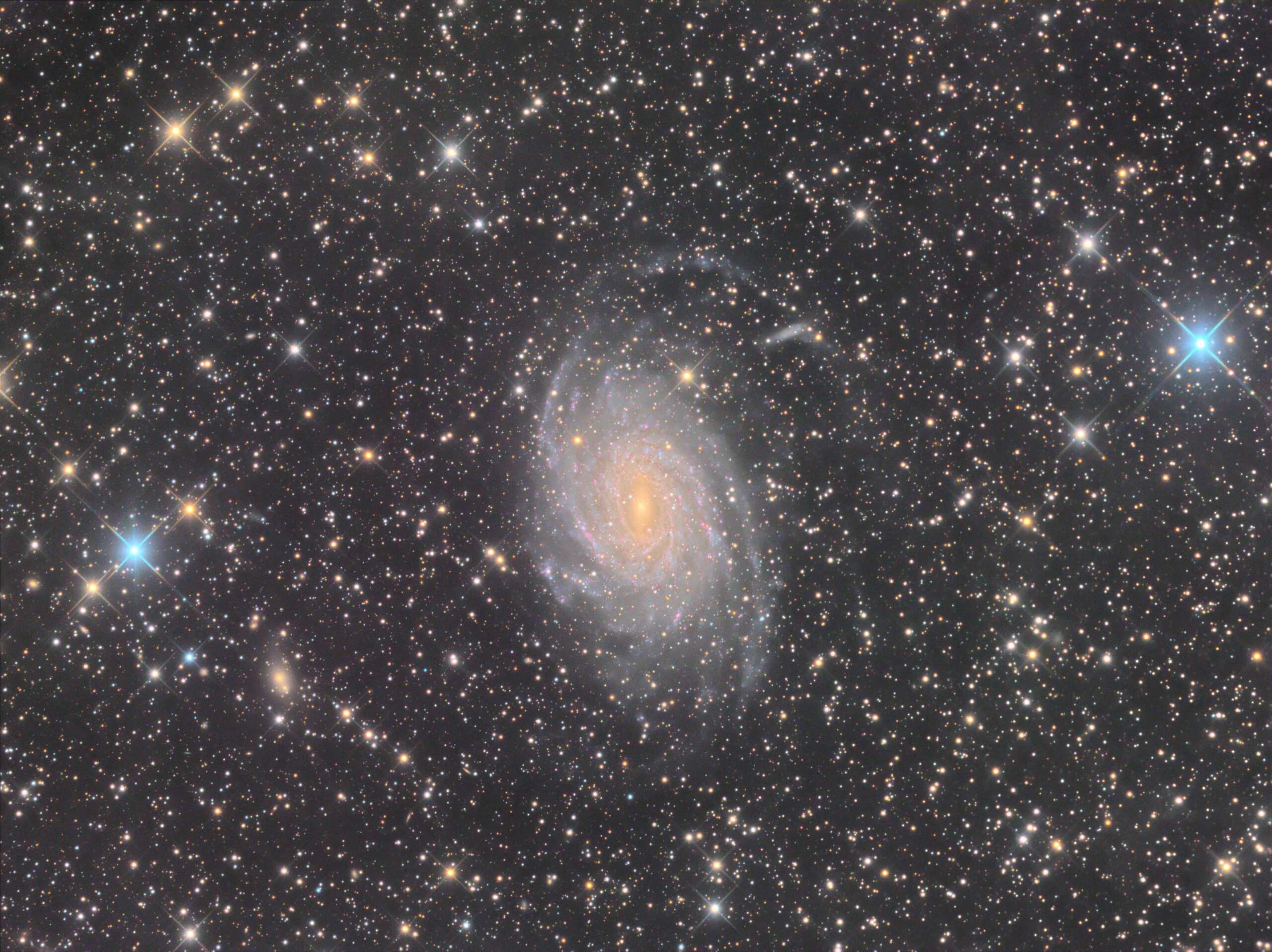
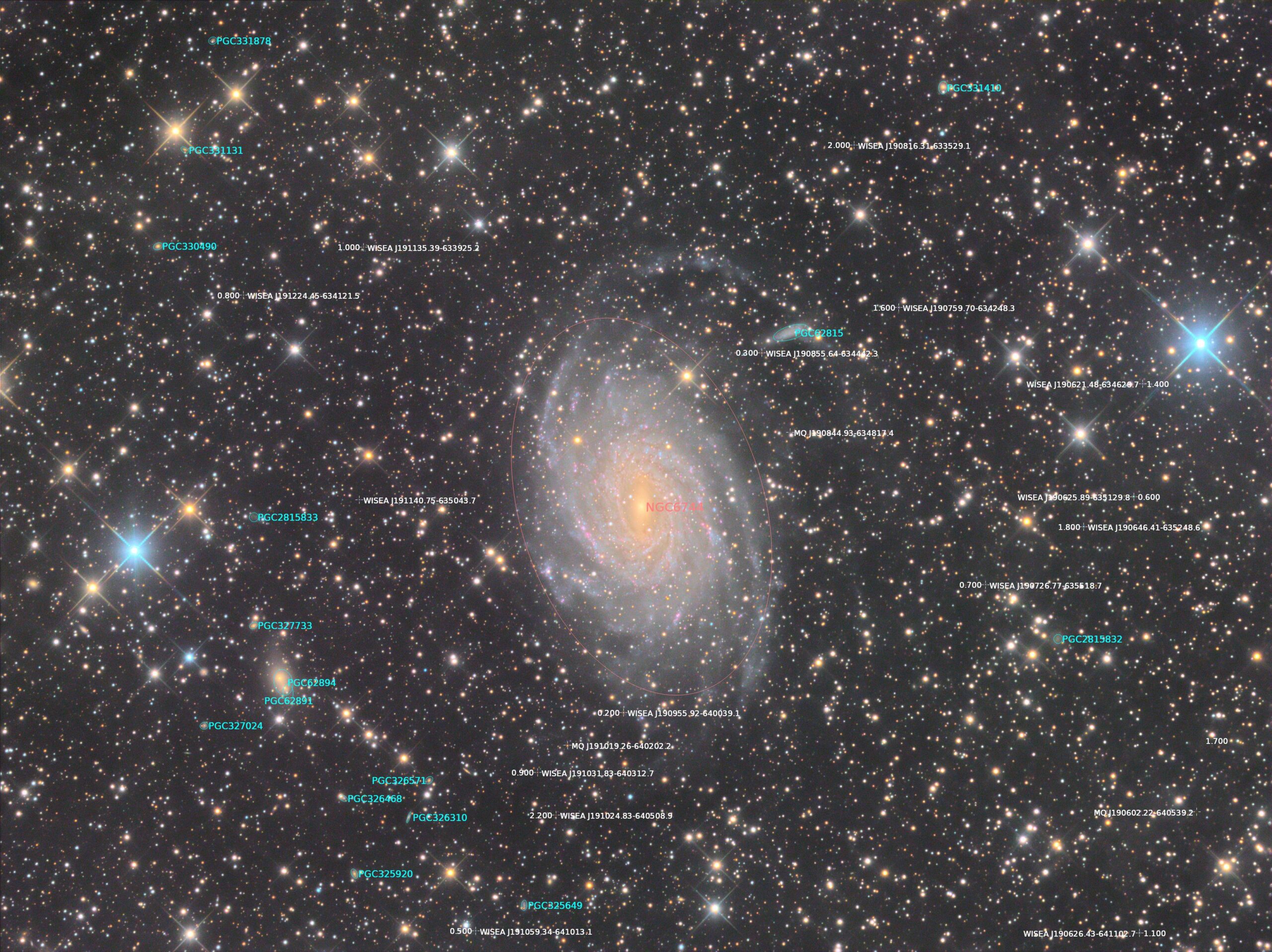
The field is also rich in distant background objects. Careful annotation revealed numerous background galaxies as well as several quasars.
The images were taken with the following equipment:
- Date: 2015
- Location: Tivoli, Namibia
- Telescope/Lens: 12″ ASA Astrograph
- Focal length [mm]: 1076
- Focal ratio: 3.6
- Mount: ASA DDM85
- Camera: FLI Microline ML8300
- Filter: L:R:G:B:Hα
- Exposure time [min]: 300:60:60:60:60
- Resolution: 1.04″/px



Leave a reply