

NGC 6397 from remote
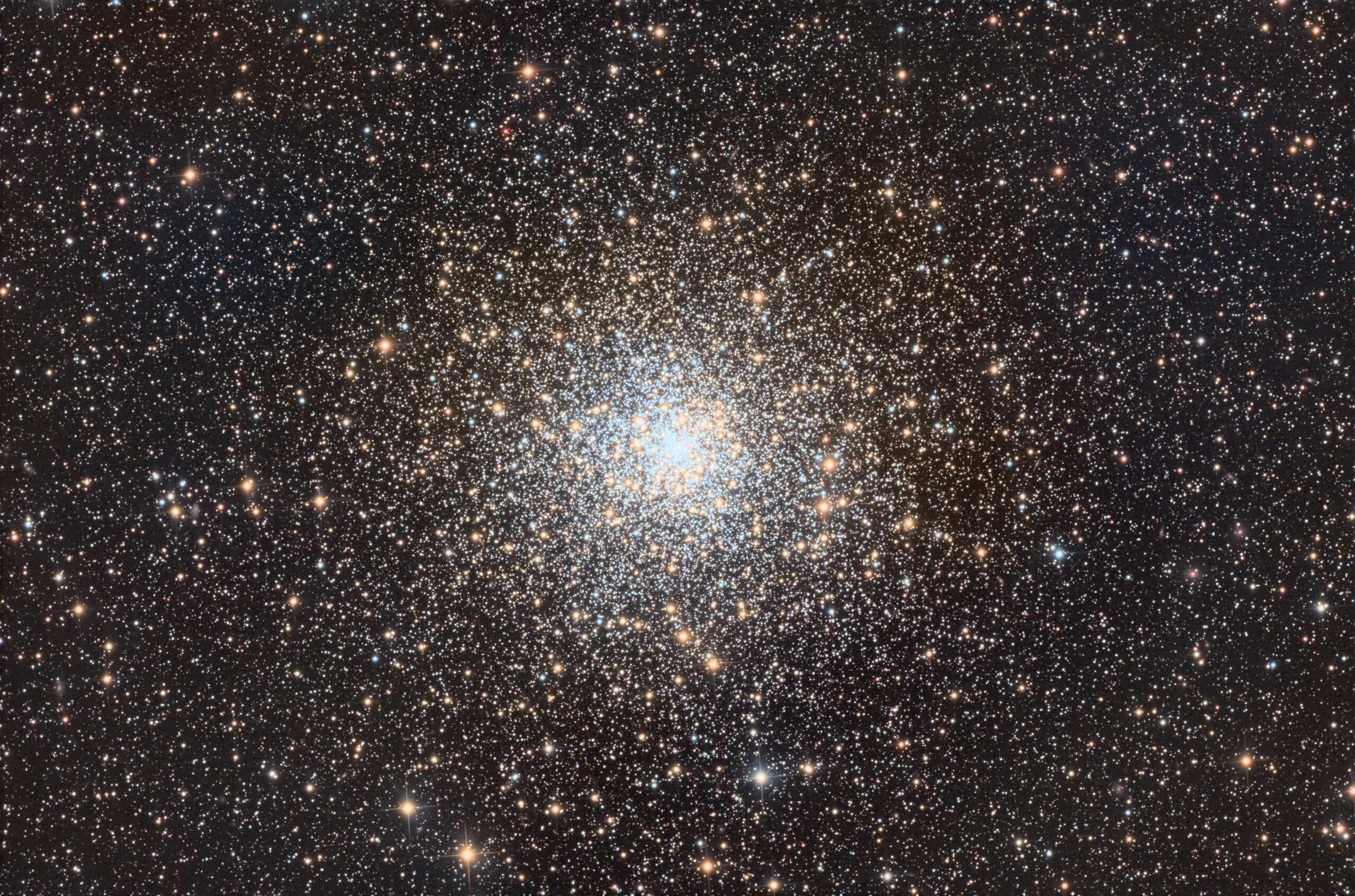
From time to time, I obtain datasets from remote observatories around the world. One of my favorite providers is Telescope Live, which operates telescopes in locations such as Chile, Australia, and Spain. One of the datasets I received in 2024 featured the magnificent globular cluster NGC 6397, acquired with a telescope in Chile.
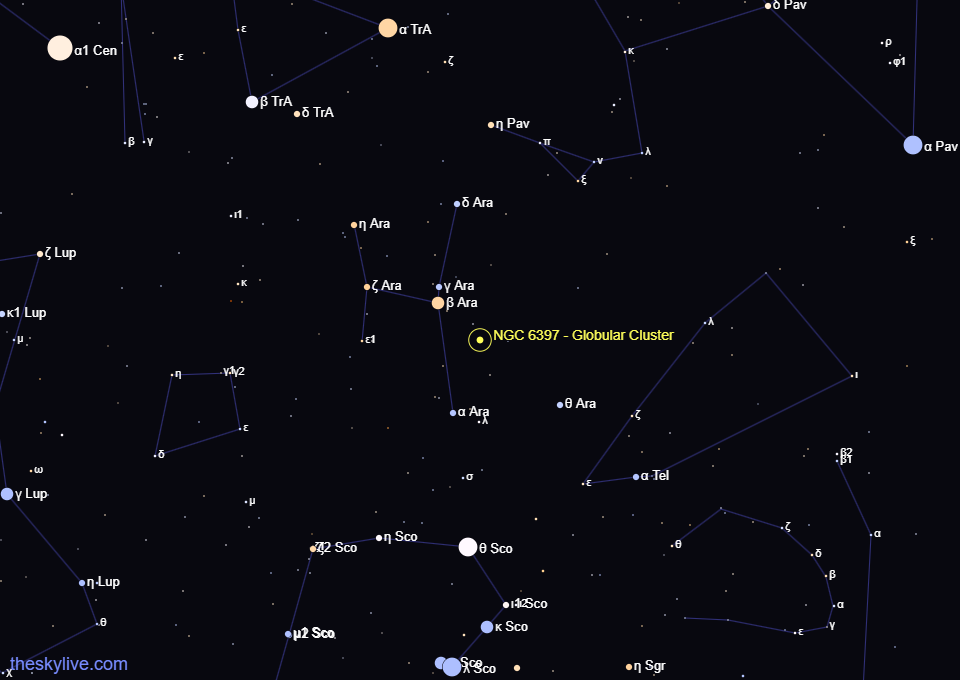
NGC 6397 is located in the constellation Ara at a distance of approximately 7,800 light-years, making it one of the closest globular clusters to Earth. It is also one of the oldest known globular clusters in the Milky Way, with an estimated age of about 13.4 billion years. Formed only a few hundred million years after the Big Bang, it represents a fossil remnant of the earliest stages of our Galaxy’s formation.
Containing several hundred thousand stars packed into a region only a few dozen light-years across, NGC 6397 is classified as a core-collapsed globular cluster. Over billions of years, gravitational interactions between its stars have caused the central region to become extremely dense. As a result, the cluster’s core contains one of the highest stellar densities known, making it an ideal laboratory for studying stellar dynamics and close gravitational encounters.
Deep observations have revealed a remarkable population of white dwarfs, blue straggler stars, variable stars, and compact binary systems. Because all member stars formed at nearly the same time but possess different masses, NGC 6397 provides astronomers with an exceptional opportunity to test models of stellar evolution. In particular, observations of its white dwarf population have been used to determine the cluster’s age with remarkable precision, providing important constraints on the age of the Milky Way itself.
The cluster has also been extensively observed by the Hubble Space Telescope, whose ultra-deep images resolved thousands of individual stars even within the crowded central regions. These observations have helped astronomers investigate stellar motions, mass segregation, and the possible presence of stellar-mass black holes within the cluster.
The high-quality Telescope Live dataset beautifully resolves the dense stellar core while simultaneously revealing the more sparsely populated outer halo of the cluster. The image captures an extraordinary range of stellar colors, from cool reddish giants to hot blue stars, illustrating the diversity of stellar evolutionary stages present within this ancient stellar system.
NGC 6397 is one of the finest globular clusters in the southern sky and remains a favorite target for both professional astronomers and astrophotographers. The 2024 Telescope Live dataset from Chile provides a superb portrait of this remarkable object, showcasing one of the oldest surviving stellar populations in our Galaxy with exceptional clarity and detail.
The data calibration and registration and the final processing was done with PixInsight. The result was as follows:
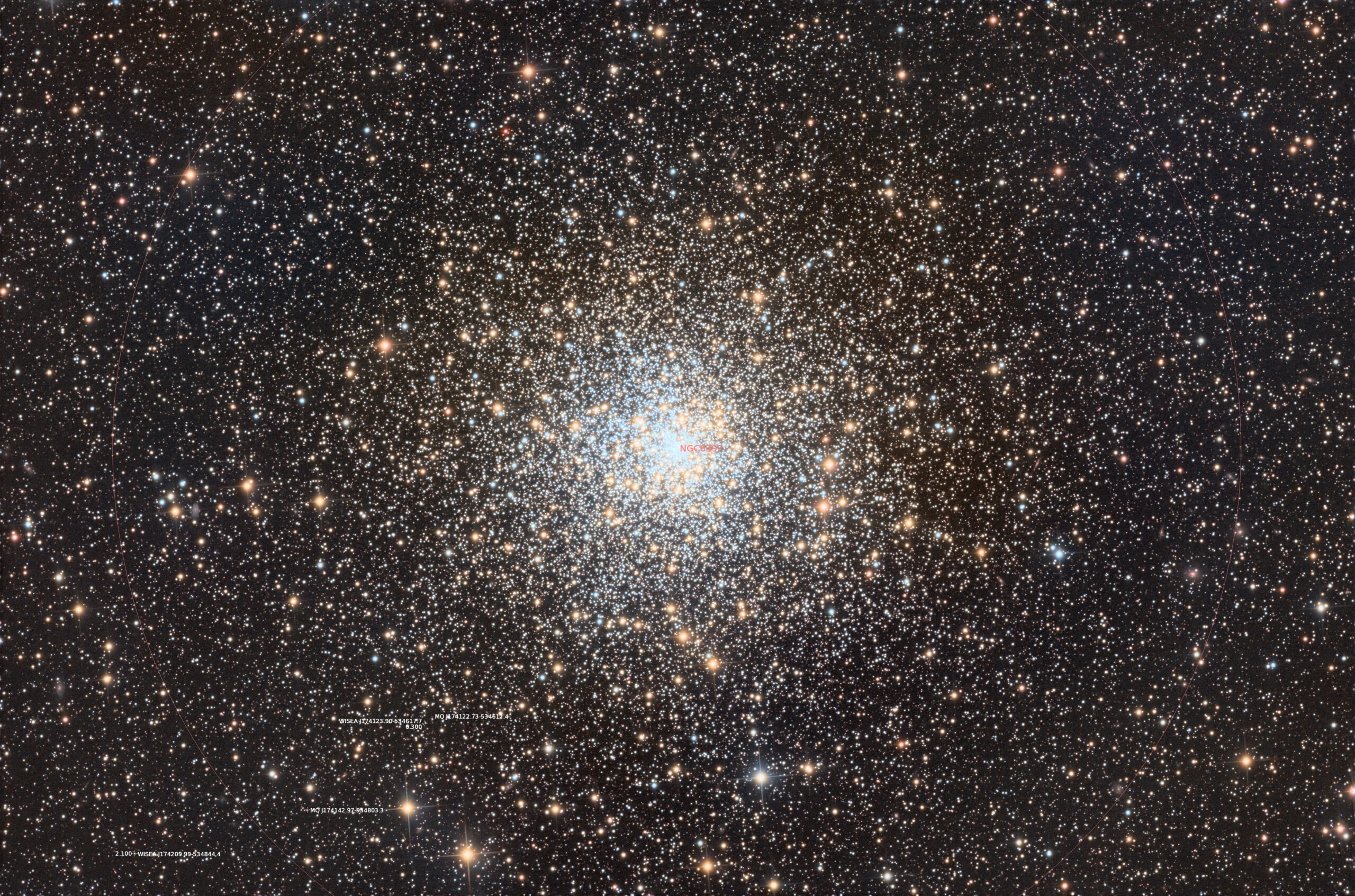
The field also contains several distant quasars, which are visible as faint, star-like points of light far beyond the globular cluster. During the annotation process, I identified and labeled a selection of these remarkable objects.
The images were taken with the following eqipment:
- Date: 2024
- Location: El Sauce Observatory, Chile
- Telescope: Planwave CDK24
- Focal length [mm]: 3962
- Focal ratio: 6.5
- Mount: Mathis MI-1000/1250
- Camera: QHY 600M Pro
- Filter: L:R:G:B
- Exposure time [min]: 105:100:100:115
- Resolution: 0.39″/px (2×2 binning)



Leave a reply