

NGC 4755 (Jewel Box)
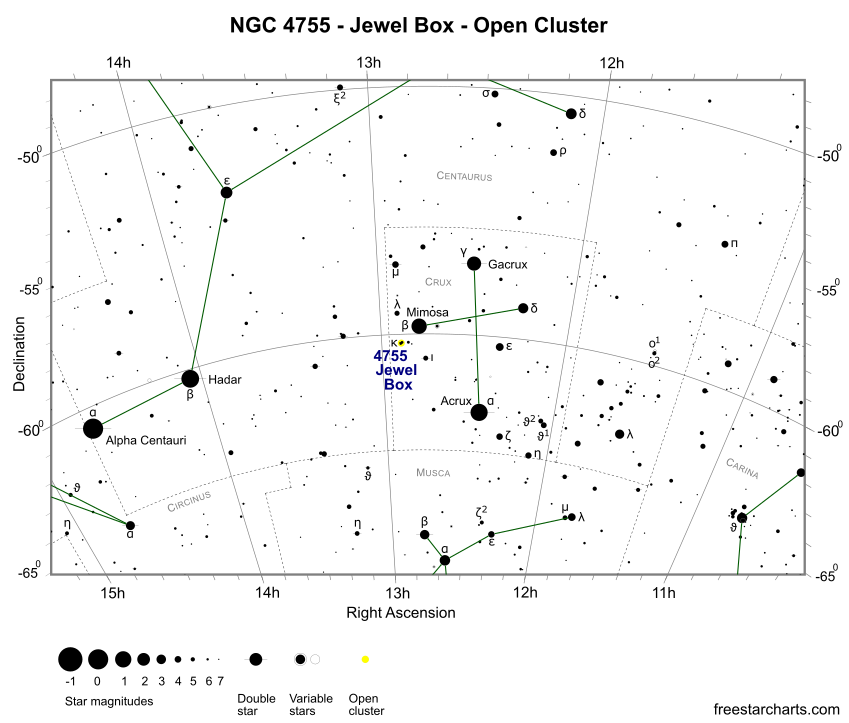
In June 2006, I spent some unforgettable nights at the Tivoli Astrofarm in Namibia, under some of the clearest and darkest skies on Earth. During that stay, I captured several images of the southern sky, one of them featuring the beautiful open cluster NGC 4755, located in the constellation Crux. Using my DSLR equipment, I was able to record the cluster’s rich stellar population and its striking range of stellar colors, which have made it one of the most celebrated open clusters in the southern hemisphere.
NGC 4755 is commonly known as the Jewel Box Cluster, a name that perfectly describes its appearance in the eyepiece. The cluster contains a remarkable mixture of brilliant blue stars interspersed with a handful of orange and red supergiants, creating the impression of precious gemstones scattered across a dark velvet background. This vivid color contrast makes it one of the most visually impressive star clusters in the entire sky.
Located approximately 6,500 light-years from Earth, NGC 4755 is a relatively young open cluster with an estimated age of around 10–15 million years. It contains more than a hundred known member stars, many of which are hot, massive blue stars that formed from the same giant molecular cloud. Because these stars are so young, they have not yet dispersed into the Milky Way’s general stellar population and still remain gravitationally associated as a cluster.
One of the cluster’s most famous members is the red supergiant star often designated DU Crucis, whose deep reddish color contrasts beautifully with the surrounding blue stars. This color difference is not only visually striking but also scientifically significant, illustrating how stellar mass influences stellar evolution. While the most massive stars evolve rapidly and can already become red supergiants after only a few million years, less massive stars remain on the main sequence for much longer periods.
The Jewel Box was one of the first deep-sky objects observed and described by Nicolas-Louis de Lacaille during his survey of the southern skies in the eighteenth century. Later, John Herschel famously compared its appearance to a casket filled with precious gems, inspiring the popular name that is still used today.
From a scientific perspective, NGC 4755 is an important laboratory for studying the early evolution of massive stars. Since the cluster’s stars formed at approximately the same time and distance, differences in their properties are primarily related to stellar mass. This makes the cluster valuable for testing theoretical models of stellar evolution and determining the ages of young stellar populations.
The exceptionally dark skies of Namibia provided ideal conditions for imaging this remarkable object. The resulting image captures not only the dense concentration of stars within the cluster but also the rich Milky Way background of the Southern Cross region. More than any other open cluster, the Jewel Box truly lives up to its name, combining scientific significance with extraordinary visual beauty.
The data calibration and registration were done using DeepSkyStacker, while the final image processing was performed in PixInsight.
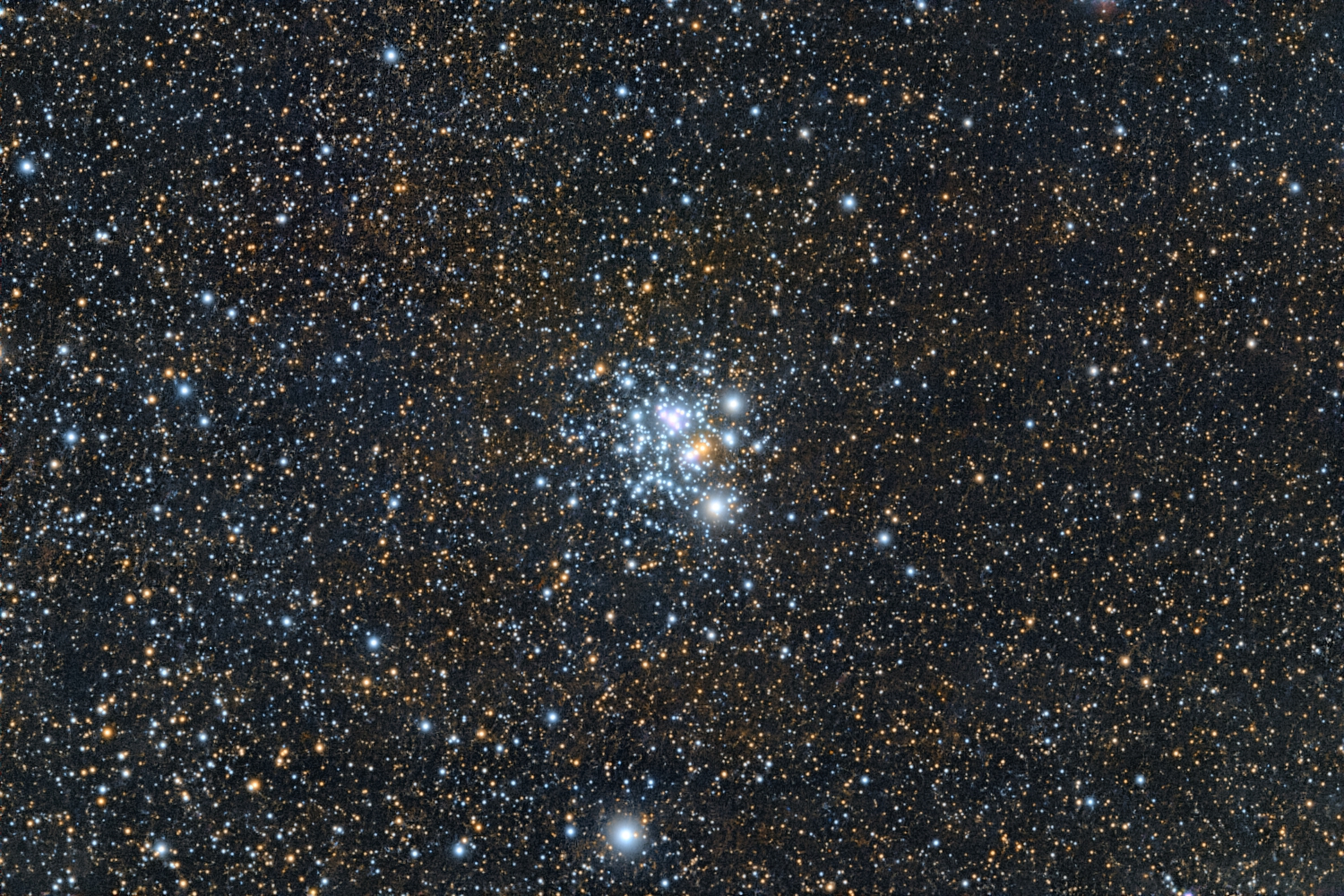
The images were taken with the following equipment:
- Location: Tivoli, Namibia
- Telescope: Rubinar lens
- Focal length [mm]: 500
- Focal ratio: 5.6
- Mount: Vixen Atlux
- Camera: Canon 300 Da
- Filter: OSC
- Exposure time [min]: 16
- Resolution: 2.42″/px



Leave a reply