

NGC 4038, NGC 4039
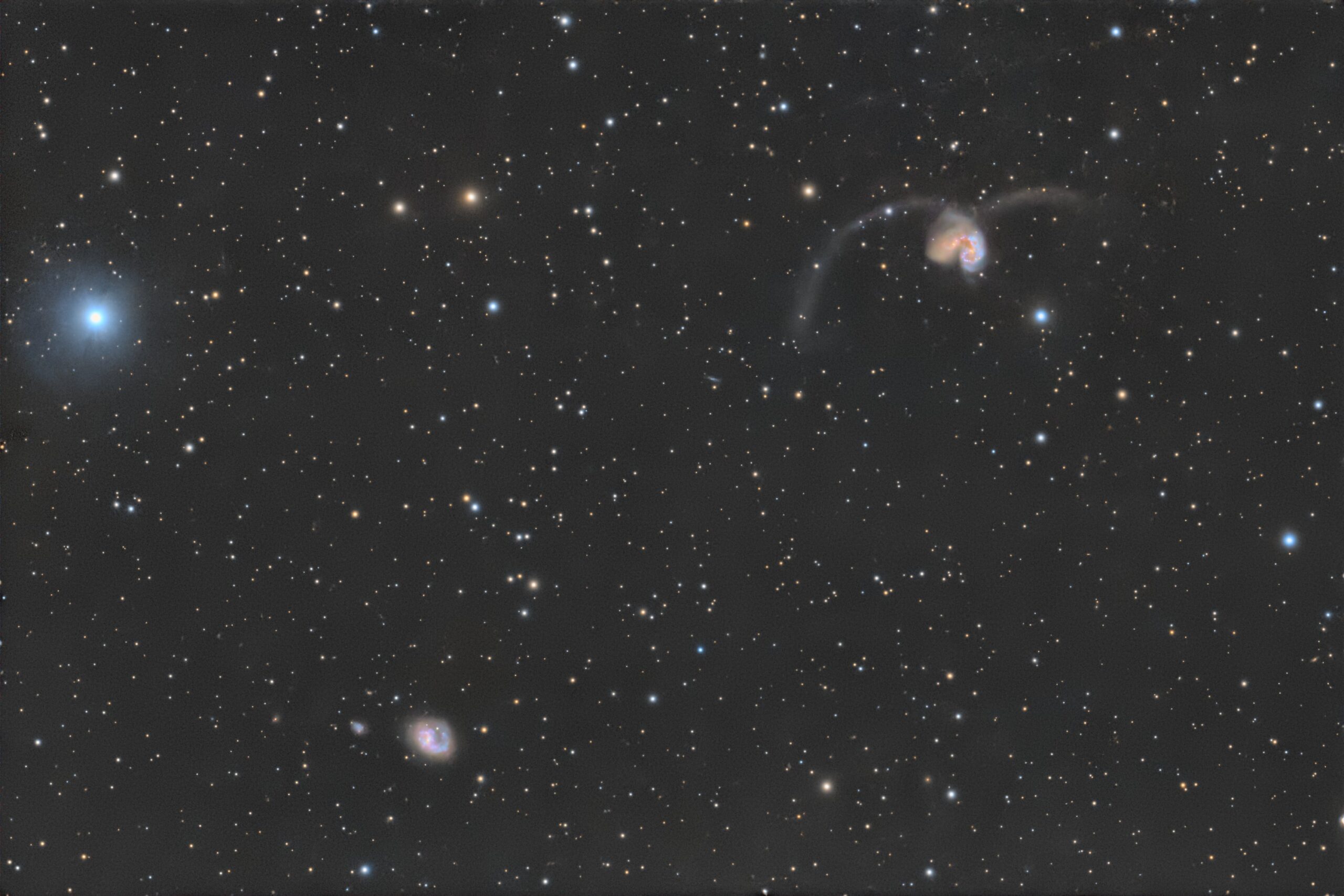
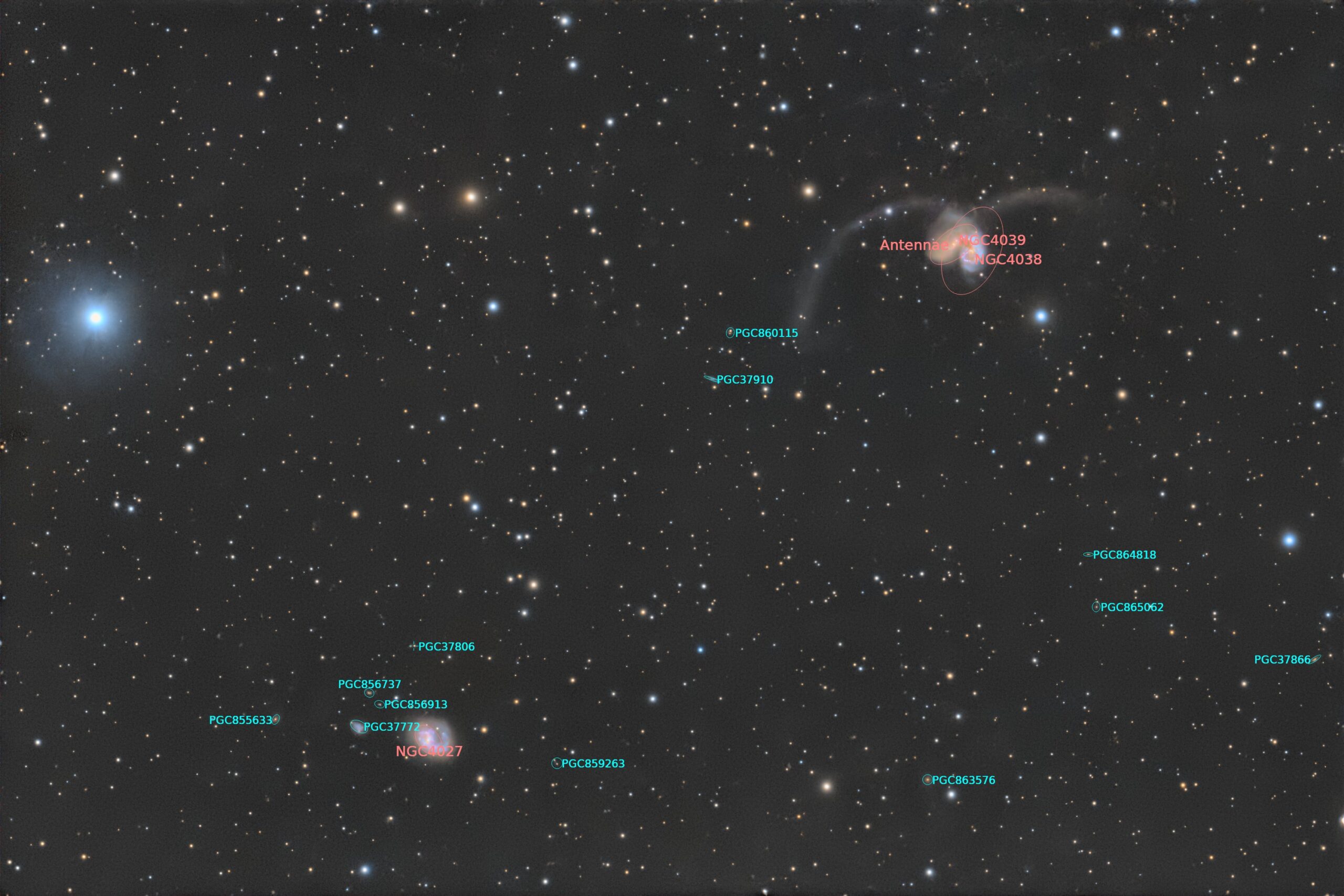
In 2008, during a stay at the astrofarm Tivoli in Namibia, I imaged the famous interacting galaxy pair NGC 4038 and NGC 4039 using my DSLR equipment. The exceptionally dark Namibian skies provided ideal conditions for capturing this remarkable deep-sky object, whose faint tidal structures are difficult to record from more light-polluted locations. Even with DSLR technology available at the time, the interaction between the two galaxies and their characteristic shape could be clearly recorded.
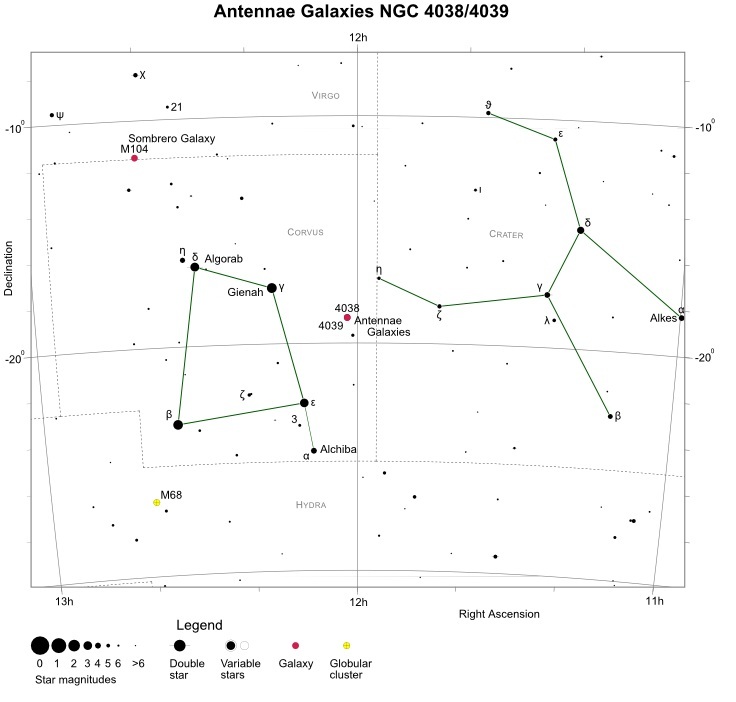
Together, NGC 4038 and NGC 4039 are better known as the Antennae Galaxies, one of the nearest and most spectacular examples of a major galaxy collision. Located in the constellation Corvus at a distance of approximately 45–60 million light-years, the system represents two spiral galaxies in the process of merging into a single larger galaxy.
The name „Antennae“ originates from the enormous tidal tails extending outward from the galaxies. These long streams of stars, gas, and dust were created by gravitational forces during repeated close encounters between the two galaxies. Stretching for hundreds of thousands of light-years, the tidal tails provide dramatic evidence of the powerful interactions taking place within the system.
The collision has triggered an intense burst of star formation throughout both galaxies. Deep images reveal numerous bright blue star clusters and vast emission regions where massive young stars are being born. Many of these clusters are only a few million years old and contain some of the most massive stars known. The interaction compresses giant molecular clouds, dramatically increasing the rate at which new stars form.
From a scientific perspective, the Antennae Galaxies provide astronomers with a unique opportunity to study the processes involved in galaxy mergers. Computer simulations suggest that the two galaxies began interacting several hundred million years ago and will eventually merge completely, forming a large elliptical galaxy. Such mergers were much more common in the early universe and played a major role in the growth and evolution of galaxies.
Deep observations across the electromagnetic spectrum reveal enormous quantities of gas, dust, star-forming regions, and supernova remnants distributed throughout the system. The central regions are particularly chaotic, with dust lanes, young stellar clusters, and turbulent gas clouds all interacting on a grand scale.
The image captured from Tivoli in 2008 recorded one of the most iconic interacting galaxy systems in the sky. The combination of dark southern skies and the dramatic structure of the Antennae Galaxies resulted in a fascinating image that showcases the beauty and violence of galactic evolution in action.
Data calibration and registration and the final image processing was performed in PixInsight. The result was as follows:
The images were taken with the following equipment:
- Date: 2008
- Location: Tivoli, Namibia
- Telescope: Pentax 75
- Focal length [mm]: 500
- Focal ratio: 6.7
- Mount: Vixen Atlux
- Camera: Canon 300 Da
- Filter: OSC
- Exposure time [min]: 72
- Resolution: 3.04″/px



Leave a reply