• Home
  • Blog
  • Astrophotography
    • Deep Sky
      • Galaxies (Galaxien)
      • Nebulae (Nebel)
      • Planetary Nebulae (Planetarische Nebel)
      • Globular Clusters (Kugelsternhaufen)
      • Open Clusters (Offene Sternhaufen)
      • Miscellaneous (Verschiedenes)
    • Solar System (Sonnensystem)
      • Comets (Kometen)
      • Moon (Mond)
      • Planets (Planeten)
      • Sun (Sonne)
  • Archiv

    • Juli 2026
    • Juni 2026
    • Mai 2026
    • April 2026
    • Dezember 2025
    • November 2025
    • Oktober 2025
    • September 2025
    • August 2025
    • Juli 2025
    • Juni 2025
    • Mai 2025
    • April 2025
    • März 2025
    • Januar 2025
    • Dezember 2024
    • November 2024
    • Oktober 2024
    • September 2024
    • Juli 2024
    • Juni 2024
    • Mai 2024
    • April 2024
    • März 2024
    • Februar 2024
    • Januar 2024
    • November 2023
    • Oktober 2023
    • September 2023
    • August 2023
    • Juli 2023
    • Juni 2023
    • Mai 2023
    • April 2023
    • März 2023
    • Februar 2023
    • Januar 2023
    • Dezember 2022
    • November 2022
    • Oktober 2022
    • September 2022
    • August 2022
    • Juni 2022
    • Mai 2022
    • April 2022
    • März 2022
    • Februar 2022
    • Januar 2022
    • Dezember 2021
    • November 2021
    • September 2021
    • August 2021
    • Juli 2021
    • März 2021
    • Februar 2021
    • November 2020
    • September 2020
    • August 2020
    • April 2020
    • März 2020
    • Februar 2020
    • Januar 2020
    • Dezember 2019
    • November 2019
    • Oktober 2019
    • September 2019
    • August 2019
    • Mai 2019
    • April 2019
    • März 2019
    • Dezember 2018
    • November 2018
    • September 2018
    • Juni 2018
    • Mai 2018
    • April 2018
    • März 2018
    • Februar 2018
    • Januar 2018
    • Oktober 2017
    • Juli 2017
    • Juni 2017
    • Januar 2017
    • September 2016
    • Mai 2016
    • März 2016
    • November 2015
    • Oktober 2015
    • September 2015
    • Mai 2015
    • März 2015
    • Februar 2015
    • September 2014
    • August 2014
    • März 2014
    • Februar 2014
    • Oktober 2013
    • September 2013
    • August 2013
    • April 2013
    • März 2013
    • November 2012
    • August 2012
    • Juli 2012
    • Mai 2012
    • März 2012
    • Januar 2012
    • November 2011
    • Oktober 2011
    • September 2011
    • August 2011
    • April 2011
    • März 2011
    • Oktober 2010
    • September 2010
    • August 2010
    • Juli 2010
    • April 2010
    • Juli 2009
    • Juli 2008
    • Januar 2008
    • Oktober 2007
    • Juli 2007
    • Februar 2007
    • Juni 2006
    • Oktober 2005
    • September 2005
    • August 2005
    • Januar 2005
  • Kategorien

    • Asterism
    • Astrophotography
    • Barnard
    • Comet
    • Galaxies
    • Globular Cluster
    • IC
    • Messier
    • Moon
    • Nebula
    • NGC
    • Open cluster
    • Photography
    • Planetary Nebula
    • Travel
  • Meta

    • Anmelden
    • Eintrags-Feed
    • Kommentar-Feed
    • WordPress.org
  • Privacy Policy
  • Impressum
  • Haftungsausschluss
  • Cookie-Richtlinie
  • Datenschutzerklärung

wonderfuluniverse.de
  • Home
  • Blog
  • Astrophotography
    • Deep Sky
      • Galaxies (Galaxien)
      • Nebulae (Nebel)
      • Planetary Nebulae (Planetarische Nebel)
      • Globular Clusters (Kugelsternhaufen)
      • Open Clusters (Offene Sternhaufen)
      • Miscellaneous (Verschiedenes)
    • Solar System (Sonnensystem)
      • Comets (Kometen)
      • Moon (Mond)
      • Planets (Planeten)
      • Sun (Sonne)

Comet C/2023 A3 (Tsuchinshan–ATLAS)


In 2024, during a stay in Lembruch, I captured images of C/2023 A3 (Tsuchinshan-ATLAS) using my mobile astrophotography setup under clear autumn skies. Equipped with a portable tracking mount and camera system, I was able to photograph one of the most anticipated comets of recent years. Favorable weather and a dark observing location allowed the comet’s impressive dust tail to be recorded against the twilight sky, making it one of the highlights of my 2024 observing season.

Comet C/2023 A3 was independently discovered in January 2023 by astronomers working with the Purple Mountain Observatory (also known as Tsuchinshan Observatory) and the ATLAS survey in South Africa. It is a long-period comet originating from the distant Oort Cloud, a vast reservoir of icy bodies that surrounds the Solar System at distances of thousands to tens of thousands of astronomical units. After spending millions of years in deep space, gravitational perturbations sent the comet on its long journey toward the inner Solar System.

The comet reached perihelion in late September 2024, passing within approximately 0.39 astronomical units of the Sun. As solar radiation heated its icy nucleus, large amounts of gas and dust were released, forming the spectacular coma and the long dust and ion tails that made the comet such an attractive target for observers around the world. During October 2024, C/2023 A3 became visible in the evening sky after sunset and developed an impressive dust tail extending many degrees across the sky in photographs.

The bright, curved dust tail consists of microscopic particles pushed away from the nucleus by the pressure of sunlight, while the much fainter ion tail is composed of electrically charged gas carried directly away from the Sun by the solar wind. Depending on observing conditions and photographic technique, both tails can often be distinguished in deep images, providing a striking illustration of the different physical processes acting on cometary material.

Like all comets, C/2023 A3 is considered a time capsule from the early Solar System. Its nucleus, only a few kilometers across, consists of primordial ice, dust, and rocky material that has remained largely unchanged since the formation of the planets approximately 4.6 billion years ago. Studying comets like C/2023 A3 helps astronomers better understand the composition of the early Solar System and the processes that may have delivered water and complex organic molecules to the young Earth.

Photographing a bright comet is always a special experience because every apparition is unique. The brightness, tail length, and overall appearance can change noticeably from night to night as the comet approaches and recedes from the Sun. Capturing C/2023 A3 from Lembruch under clear autumn skies therefore provided a memorable opportunity to document one of the finest naked-eye comets of the decade.

The resulting images beautifully preserve the comet’s delicate tail against the evening sky and stand as a lasting reminder of this rare celestial visitor. They also demonstrate how a portable astrophotography setup, combined with careful planning and favorable observing conditions, can successfully capture one of the Solar System’s most dynamic and spectacular phenomena.

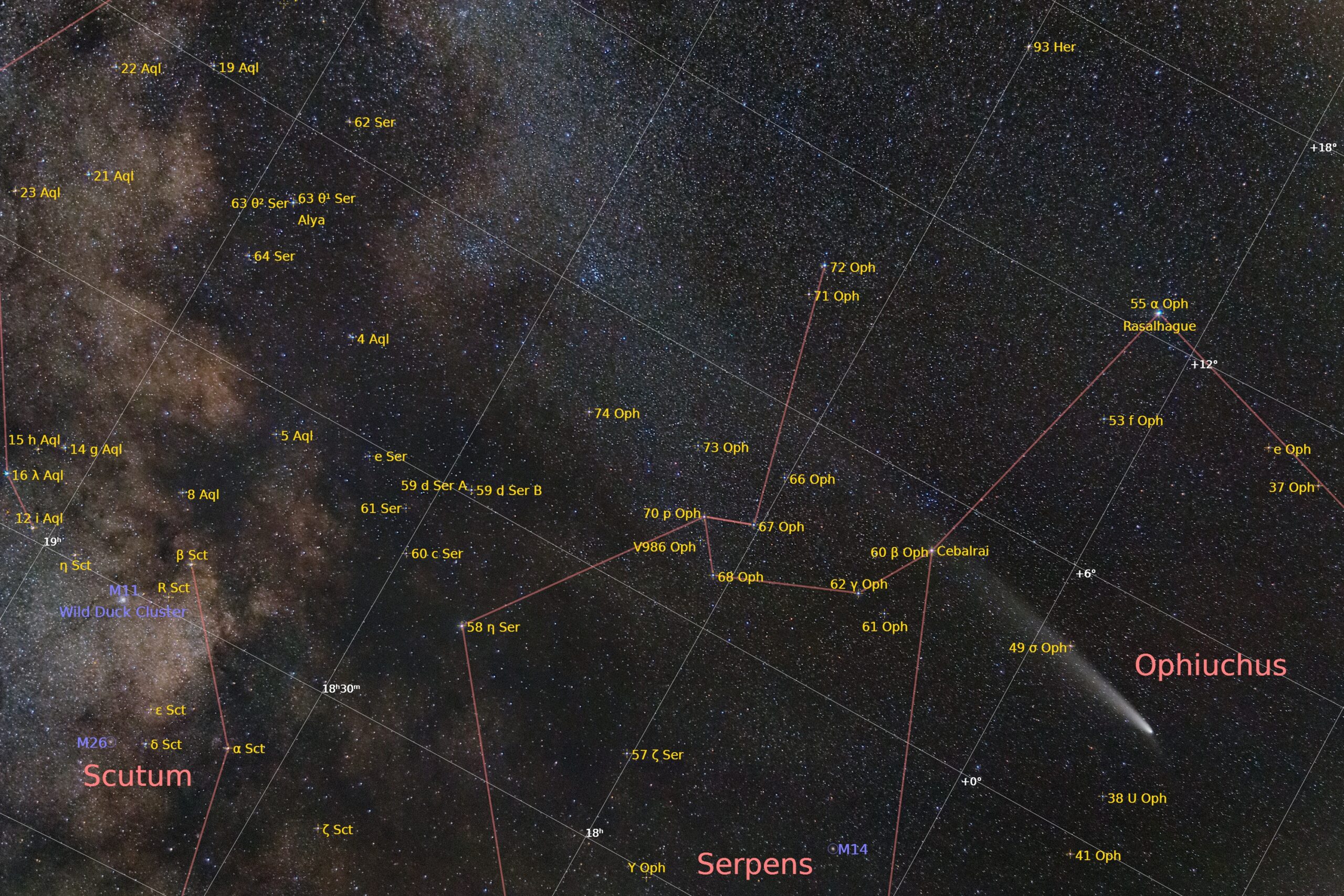
The final image reveals Comet C/2023 A3 (Tsuchinshan–ATLAS) along the milky-way.
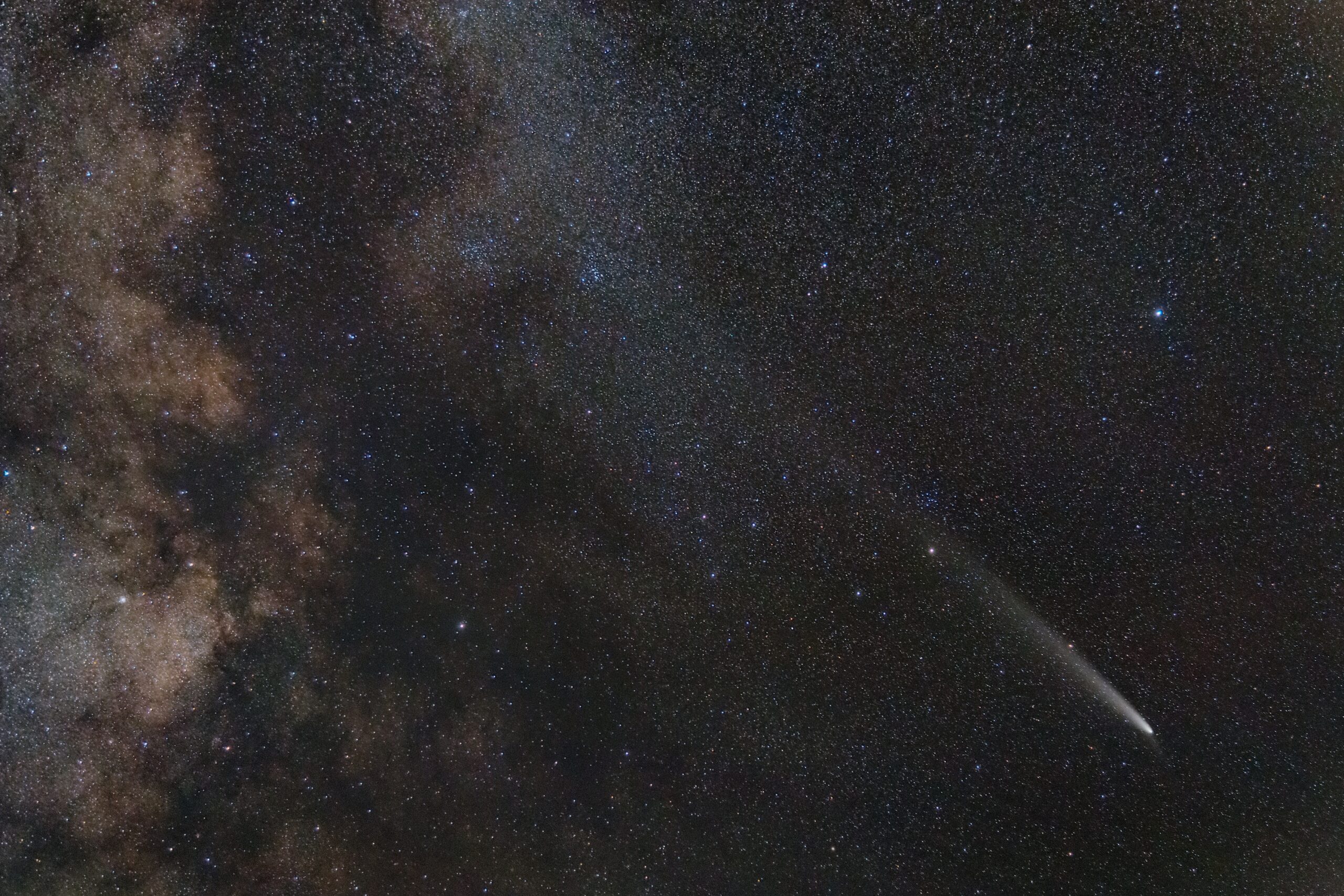
Comet C/2023 A3 (Tsuchinshan-ATLAS)
Komet C/2023 A3 (Tsuchinshan–ATLAS), Lembruch, 2024
Komet C/2023 A3 (Tsuchinshan–ATLAS) annotated


The images were taken with the following equipment:

  • Date: 2024
  • Location: Lembruch, Germany
  • Telescope: Canon 28-105 mm lens
  • Focal length [mm]: 47
  • Focal ratio: 4
  • Mount: Skywatcher Star Adventurer
  • Camera: Canon 6D
  • Filter: OSC
  • Exposure time [min]: 15
  • Resolution: 39.8″/px


Stephan Küppers


You might also like
IC 1318
15. Juli 2026
NGC 7000 with IC 5070
24. Juni 2026
NGC 7023 (Iris Nebula) and LBN 468
25. Mai 2026

Leave a reply

Schreibe einen Kommentar Antwort abbrechen

Deine E-Mail-Adresse wird nicht veröffentlicht. Erforderliche Felder sind mit * markiert


© Stephan Küppers 2020-2022

Cookie-Zustimmung verwalten
Wir verwenden Cookies, um unsere Website und unseren Service zu optimieren.
Funktional Immer aktiv
Die technische Speicherung oder der Zugang ist unbedingt erforderlich für den rechtmäßigen Zweck, die Nutzung eines bestimmten Dienstes zu ermöglichen, der vom Teilnehmer oder Nutzer ausdrücklich gewünscht wird, oder für den alleinigen Zweck, die Übertragung einer Nachricht über ein elektronisches Kommunikationsnetz durchzuführen.
Vorlieben
Die technische Speicherung oder der Zugriff ist für den rechtmäßigen Zweck der Speicherung von Präferenzen erforderlich, die nicht vom Abonnenten oder Benutzer angefordert wurden.
Statistiken
Die technische Speicherung oder der Zugriff, der ausschließlich zu statistischen Zwecken erfolgt. Die technische Speicherung oder der Zugriff, der ausschließlich zu anonymen statistischen Zwecken verwendet wird. Ohne eine Vorladung, die freiwillige Zustimmung deines Internetdienstanbieters oder zusätzliche Aufzeichnungen von Dritten können die zu diesem Zweck gespeicherten oder abgerufenen Informationen allein in der Regel nicht dazu verwendet werden, dich zu identifizieren.
Marketing
Die technische Speicherung oder der Zugriff ist erforderlich, um Nutzerprofile zu erstellen, um Werbung zu versenden oder um den Nutzer auf einer Website oder über mehrere Websites hinweg zu ähnlichen Marketingzwecken zu verfolgen.
  • Optionen verwalten
  • Dienste verwalten
  • Verwalten von {vendor_count}-Lieferanten
  • Lese mehr über diese Zwecke
Einstellungen anzeigen
  • {title}
  • {title}
  • {title}